
Understanding and accurately calculating your savings is a cornerstone of robust personal finance. It’s more than just knowing your bank balance; it’s about evaluating your financial health, progress toward your goals, and capacity for future security. This crucial exercise provides the clarity needed to make informed financial decisions, adjust spending habits, and build a resilient financial future. Without a clear method for tracking savings, even the most diligent savers can lose sight of their true progress and potential.
The Foundational Importance of Savings Calculation
Calculating savings is not merely an accounting exercise; it’s a powerful feedback mechanism that reflects your financial discipline and effectiveness. It translates abstract financial aspirations into concrete, measurable progress.

Why Tracking Savings Matters
At its core, tracking savings provides undeniable proof of financial momentum. It answers fundamental questions: Are you living within your means? Are you allocating enough towards your future goals? Is your money working as hard as you are? Without this quantifiable insight, personal finance can feel like an endless guessing game, leading to anxiety and uncertainty. Regular calculation allows you to identify trends, celebrate milestones, and quickly address any deviations from your financial plan. It fosters accountability and empowers you to take control rather than merely reacting to your financial circumstances.
Beyond Simple Balances: Understanding Your Financial Progress
Many individuals mistakenly equate their savings with the current balance in their savings account. While that balance is a component, it doesn’t paint the full picture. True savings calculation encompasses various aspects, including contributions to retirement accounts, investments, debt reduction, and even the equity built in assets like real estate. It’s about understanding the net increase in your financial assets and overall net worth, signaling genuine progress towards financial independence rather than just a temporary cash reserve. A holistic view ensures you’re not overlooking hidden savings or mistakenly counting funds that are actually allocated for imminent expenses.
Core Methods for Calculating Personal Savings
There are several effective methods for calculating personal savings, each offering a slightly different perspective on your financial picture. The most effective approach often involves using a combination of these methods to gain comprehensive insight.
The Basic Approach: Income Minus Expenses
This is the most fundamental and intuitive method for determining how much you are saving. It provides a direct measure of the surplus cash flow generated within a specific period.
Formula explanation (Income – Expenses = Savings)
The principle is straightforward: take all the money you earned in a given period (e.g., a month, a quarter) and subtract all the money you spent in that same period. The remaining figure is your savings.
-
Income: This includes your net pay from employment, any side hustle income, rental income, dividends, interest earned, and any other money flowing into your accounts. Be sure to use net income (after taxes and deductions) for consistency with net expenses.
-
Expenses: This category covers everything you spend money on. It’s crucial to be thorough and honest here.
Identifying all income sources
Beyond your primary paycheck, consider:
-
Freelance or consulting payments
-
Bonuses or commissions
-
Tax refunds
-
Gifts of money
-
Sale of personal items
-
Interest from savings accounts
-
Dividends from investments
Categorizing and tracking expenses (fixed vs. variable)
To make this method truly insightful, break down your expenses:
-
Fixed Expenses: These are costs that generally stay the same each month. Examples include rent/mortgage payments, loan repayments (car, student), insurance premiums, and subscription services.
-
Variable Expenses: These fluctuate month to month based on your consumption and choices. Examples include groceries, dining out, entertainment, utilities (which can vary), transportation costs (gas, public transit), and clothing.
-
Irregular Expenses: These are less frequent but significant expenses that should be budgeted for, such as annual insurance premiums, car maintenance, or holiday spending.
By tracking both fixed and variable expenses meticulously, you can identify areas where spending can be reduced to increase your savings. Tools like budgeting apps, spreadsheets, or even a simple notebook can aid in this tracking.
The Savings Rate Method
While “Income – Expenses = Savings” tells you how much you saved in absolute terms, the savings rate provides a powerful percentage metric that allows for easier comparison over time and against financial benchmarks.
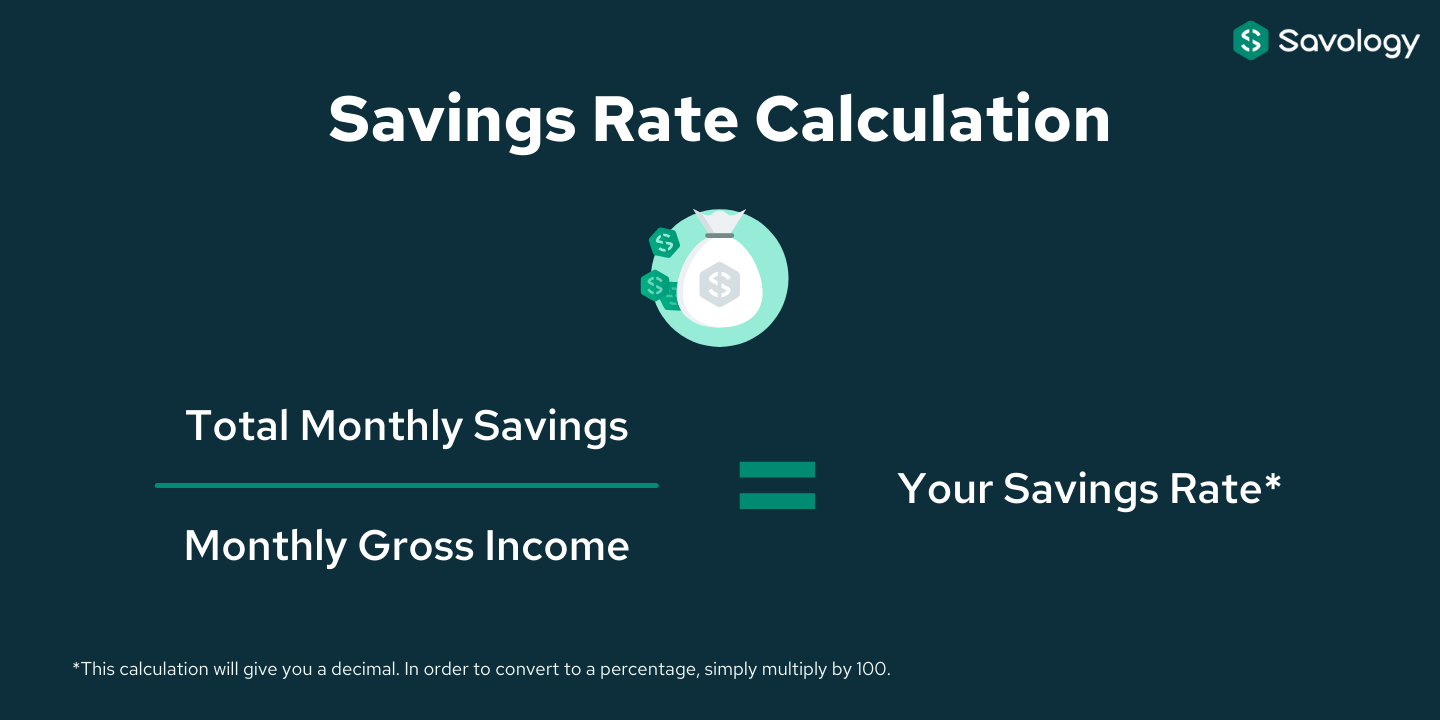
Formula explanation (Savings / Gross Income * 100)
Your savings rate is calculated by dividing your total savings for a period by your gross income for that same period, then multiplying by 100 to get a percentage. Note that some financial experts prefer using net income for this calculation for consistency with expense tracking, so be consistent in your approach. Using gross income often provides a more universal benchmark.
-
Savings: The total amount of money you set aside or invested in a given period.
-
Gross Income: Your total earnings before taxes and deductions.
For example, if you earn $5,000 (gross) in a month and save $1,000, your savings rate is ($1,000 / $5,000) * 100 = 20%.
Setting savings rate goals (e.g., 10%, 15%, 20%)
Many financial advisors recommend aiming for a savings rate of at least 10-15% of your gross income. For those striving for early retirement or significant wealth accumulation, a rate of 20% or even higher is often pursued. Setting a specific percentage goal provides a tangible target and motivates consistent effort.
Impact of savings rate on financial independence
A higher savings rate directly correlates with a shorter time frame to achieve financial independence. The more you save and invest relative to your income, the faster your invested capital can grow to cover your living expenses, ultimately freeing you from the necessity of working. This metric is a powerful indicator of how quickly you are building your “freedom fund.”
Net Worth Tracking for a Holistic View
Net worth provides the most comprehensive snapshot of your overall financial health and how your savings contribute to your wealth accumulation over time.
Definition of Net Worth (Assets – Liabilities)
Your net worth is the total value of everything you own (assets) minus everything you owe (liabilities).
-
Assets: This includes cash in savings accounts, checking accounts, investment portfolios (stocks, bonds, mutual funds), retirement accounts (401k, IRA), real estate equity (market value minus mortgage owed), vehicles (market value), and other valuable possessions.
-
Liabilities: This includes mortgages, car loans, student loans, credit card debt, personal loans, and any other outstanding debts.
How increasing savings directly impacts net worth
Every dollar you save, whether it goes into a high-yield savings account or an investment portfolio, increases your assets without increasing your liabilities (assuming you’re not taking on new debt). Therefore, increased savings directly contribute to a higher net worth. Conversely, paying down debt reduces liabilities, also boosting your net worth.
Tracking net worth over time as a savings metric
By regularly calculating your net worth (e.g., monthly or quarterly), you gain a powerful long-term perspective on your financial progress. An increasing net worth signifies that you are effectively accumulating wealth and that your savings efforts are yielding tangible results beyond just cash balances. It’s a key indicator of genuine financial growth.
Advanced Considerations and Financial Tools
While the core methods provide a solid foundation, several advanced considerations and modern tools can refine your savings calculations and offer deeper insights.
Incorporating Investment Growth and Returns

Simply calculating how much you put into savings isn’t enough; you must also account for how that money grows.
Distinguishing between saved cash and invested assets
It’s vital to differentiate between cash held in a savings account (which typically offers minimal returns) and money invested in assets like stocks, bonds, or real estate (which have the potential for significant growth). While both are “saved,” their growth trajectory differs dramatically. Investment growth should be factored into your overall savings calculation, particularly when evaluating your progress towards long-term goals.
The power of compound interest in savings calculations
Compound interest is often called the “eighth wonder of the world.” It’s the process where your earnings themselves earn returns. When calculating your savings over extended periods, especially for retirement or large future purchases, understanding how compound interest accelerates your wealth accumulation is critical. You’re not just saving your principal; you’re also saving the returns on that principal and the returns on those returns.
Calculating future value of savings with investments
Financial calculators or spreadsheet functions can project the future value of your savings, taking into account your regular contributions, initial principal, and an assumed rate of return. This allows you to see the potential impact of your current savings habits and make adjustments to meet future financial targets more effectively.
Accounting for Irregular Income and Expenses
Many individuals face financial situations that don’t fit a perfectly steady monthly income and expense pattern.
Strategies for fluctuating income streams (e.g., side hustles, commissions)
If your income varies significantly, calculating monthly savings can be challenging. Strategies include:
-
Averaging Income: Calculate your average monthly income over several months to set a baseline.
-
“Pay Yourself First” with a Percentage: As soon as you receive income, allocate a fixed percentage to savings, regardless of the amount.
-
Creating a Buffer: Build a larger emergency fund to smooth over lean months.
-
Annualizing: Calculate savings on an annual basis rather than monthly for a more stable perspective.
Handling large, infrequent expenses (e.g., home repairs, medical bills)
These “surprise” expenses can derail monthly savings targets. The best approach is to anticipate them. Create sinking funds for known irregular expenses (e.g., car maintenance, holiday gifts, annual insurance premiums) by setting aside a small amount each month. For truly unexpected large expenses, a robust emergency fund is paramount. When these expenses occur, they reduce your cash assets but don’t necessarily negate your overall savings progress if they were accounted for within a broader financial plan.
Leveraging Financial Tools and Apps
Modern technology offers powerful solutions for simplifying and enhancing savings calculations.
Budgeting software and apps (e.g., Mint, YNAB)
These tools automatically categorize transactions from linked bank accounts and credit cards, providing real-time insights into your income and expenses. They can automatically track your savings rate, project your net worth, and highlight areas for improvement, dramatically reducing the manual effort involved in calculation.
Spreadsheets (Excel, Google Sheets) for custom tracking
For those who prefer a hands-on approach or have unique financial situations, a custom spreadsheet offers unparalleled flexibility. You can design it to track exactly what matters to you, incorporate complex formulas, and visualize your progress with charts and graphs. Many free templates are available online to get started.
Robo-advisors and investment platforms that track progress
Many investment platforms and robo-advisors now offer integrated dashboards that not only manage your investments but also track your contributions, returns, and overall portfolio growth. These can be valuable for seeing how your invested savings are performing and how they contribute to your long-term financial goals.
Strategic Uses of Savings Calculation Data
The act of calculating savings is just the first step. The real value comes from how you use that data to refine your financial strategy and accelerate your progress.
Identifying Opportunities for Increased Savings
Once you have a clear picture of your income, expenses, and current savings rate, you can pinpoint areas for improvement.
Analyzing spending patterns to cut costs
Detailed expense tracking reveals where your money is actually going. Are you spending excessively on dining out, subscription services you don’t use, or impulse purchases? This data empowers you to make conscious decisions about reducing discretionary spending and redirecting those funds to savings or debt repayment.
Optimizing debt repayment to free up cash
High-interest debt (like credit card debt) can significantly hinder your ability to save. By paying down these liabilities, you free up cash flow that was previously allocated to interest payments. This freed-up cash can then be directly channeled into your savings, effectively increasing your savings rate without necessarily cutting other expenses. Tools that show the long-term cost of debt can be highly motivating.
Setting Realistic Financial Goals
Savings calculations provide the empirical data needed to set achievable and impactful financial goals.
Short-term goals (emergency fund, vacation)
Knowing your current savings rate helps you determine how quickly you can accumulate funds for immediate needs like an emergency fund (typically 3-6 months of living expenses) or a planned vacation. This allows for realistic timelines and motivates consistent saving.
Mid-term goals (down payment, education)
For goals like a down payment on a house or funding a child’s education, your savings calculation helps you assess how much you need to set aside regularly to reach the target amount within a desired timeframe. It makes these larger goals feel less daunting by breaking them down into manageable monthly contributions.
Long-term goals (retirement, financial independence)
Retirement planning relies heavily on consistent savings and investment growth. By calculating your current savings rate and projecting its future value with compound interest, you can determine if you’re on track for your desired retirement lifestyle or if adjustments are needed. This forward-looking analysis is crucial for ensuring long-term financial security.
Adapting Your Savings Strategy Over Time
Life is dynamic, and so too should be your financial plan. Regular savings calculations enable essential adjustments.
Adjusting for life changes (marriage, children, career shifts)
Major life events inevitably impact your income and expenses. Marriage might merge two financial lives, requiring a new joint savings calculation. Children introduce new costs, necessitating budget reallocations. A career change, whether a promotion or a temporary reduction in income, demands a reassessment of your savings capacity and goals. Regularly calculating your savings allows you to proactively adapt your strategy to these new realities.
Reviewing and refining your budget regularly
Your budget is not a static document; it’s a living guide. Reviewing your savings calculations monthly or quarterly provides the feedback loop needed to refine your budget. Are you consistently underspending in one category and overspending in another? Is your savings rate still aligned with your goals? Regular review ensures your financial plan remains relevant, effective, and responsive to your evolving circumstances, maximizing your savings potential over the long run.
aViewFromTheCave is a participant in the Amazon Services LLC Associates Program, an affiliate advertising program designed to provide a means for sites to earn advertising fees by advertising and linking to Amazon.com. Amazon, the Amazon logo, AmazonSupply, and the AmazonSupply logo are trademarks of Amazon.com, Inc. or its affiliates. As an Amazon Associate we earn affiliate commissions from qualifying purchases.