
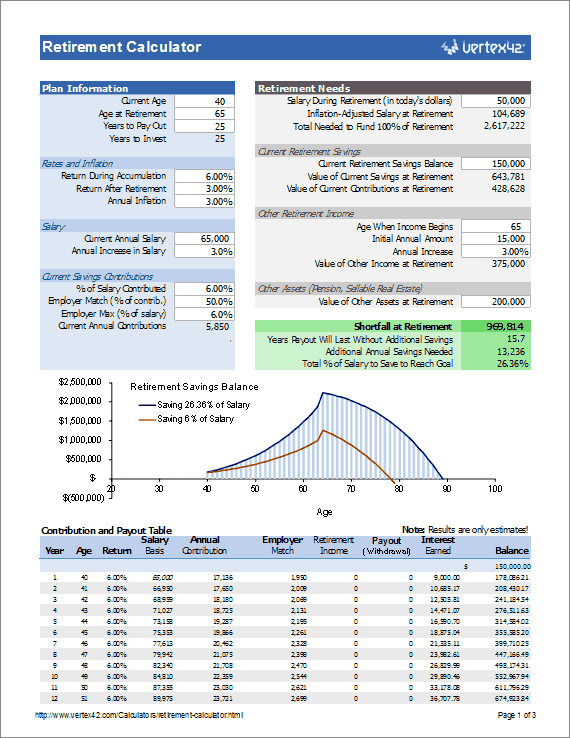
Transitioning from a career of earning to a lifetime of living off your assets is one of the most significant psychological and financial shifts an individual will ever experience. For decades, the focus is on accumulation—the steady growth of a nest egg. However, as retirement nears, the fundamental question shifts from “How much can I save?” to “How much can I spend?”
Calculating retirement income is not a one-time event but a dynamic process that involves assessing multiple revenue streams, estimating future costs, and accounting for the variables of the market and longevity. This guide provides a strategic framework to help you navigate these calculations with precision and confidence.

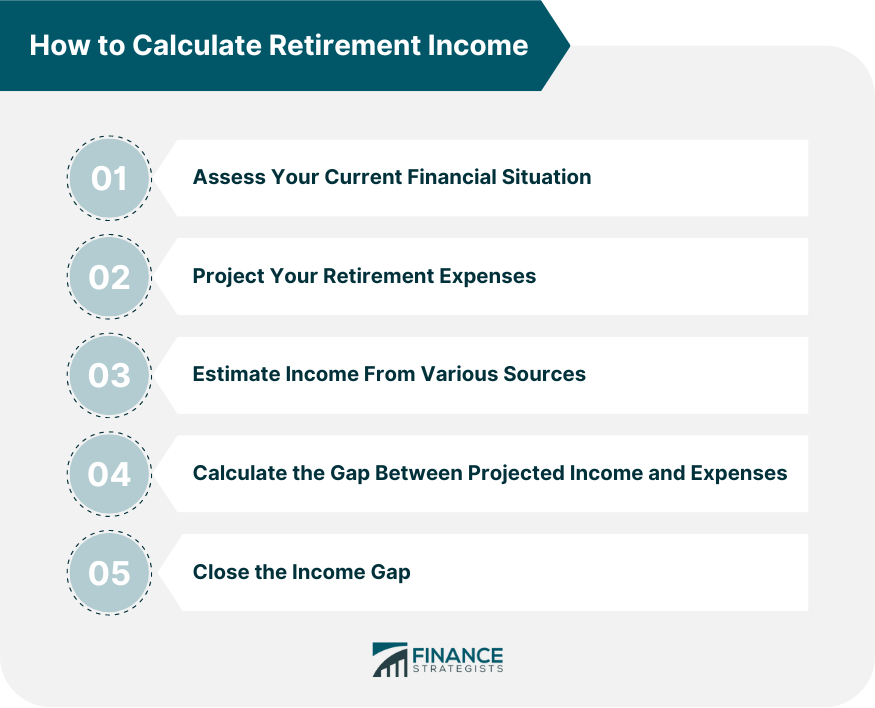
1. Inventorying Your Retirement Income Streams
Before you can determine if you have enough, you must identify where the money will come from. Most successful retirees rely on a “multi-layered” approach to income, often referred to as the modern three-legged stool.
Social Security and Government Benefits
For the majority of Americans, Social Security forms the bedrock of retirement income. However, calculating this amount is not as simple as checking a statement. The age at which you choose to claim benefits significantly impacts your monthly check. Claiming at 62 results in a permanent reduction, while waiting until age 70 provides a 132% increase over the base amount at full retirement age. When calculating your total income, you must weigh the benefit of immediate liquidity against the long-term “insurance” of a higher inflation-adjusted payment.
Employer-Sponsored Retirement Plans
The 401(k), 403(b), and traditional pension plans are primary engines of retirement wealth. If you have a defined-benefit pension, your calculation is straightforward—it is a fixed monthly amount. For defined-contribution plans (like a 401(k)), the calculation is more complex. You must project the total balance at retirement and apply a sustainable withdrawal rate. It is also vital to distinguish between Traditional (pre-tax) and Roth (after-tax) accounts, as the “net” income from a Traditional 401(k) will be lower after the IRS takes its share.
Personal Savings and Brokerage Accounts
Beyond work-sponsored plans, many retirees hold assets in Individual Retirement Accounts (IRAs) or taxable brokerage accounts. These accounts offer the most flexibility but require careful management. When calculating income from these sources, you must account for capital gains taxes and dividend yields. Dividend-growth investing is a popular strategy here, as it provides a “natural” income stream that doesn’t necessarily require selling off the underlying principal.
2. Estimating Your Retirement Expenses
You cannot accurately calculate the income you need without first understanding the “burn rate” of your desired lifestyle. Retirement spending is rarely a flat line; it often follows a “smile” pattern—higher spending in the early active years, a dip in the middle, and an increase late in life due to healthcare costs.
The 80% Rule of Thumb and Its Limitations
A common starting point in financial planning is the “80% Rule,” which suggests you will need approximately 80% of your pre-retirement income to maintain your standard of living. This assumes that you will no longer be saving for retirement, your commuting costs will disappear, and your mortgage might be paid off. However, this is a blunt instrument. High-earners with modest lifestyles may need only 50%, while those planning to travel extensively might need 110% of their former income.
Accounting for Healthcare and Long-Term Care
Healthcare is the greatest “wildcard” in retirement income planning. Even with Medicare, out-of-pocket costs for premiums, deductibles, and services not covered (like dental and vision) can be substantial. According to recent estimates, a healthy 65-year-old couple may need over $300,000 just to cover healthcare costs throughout retirement. When calculating your income needs, it is prudent to dedicate a specific portion of your portfolio to a Health Savings Account (HSA) or a dedicated healthcare fund.
Factoring in Inflation and Purchasing Power
Inflation is the silent thief of retirement security. A $5,000 monthly income might feel comfortable today, but at a 3% average inflation rate, that same $5,000 will have the purchasing power of roughly $2,700 in 20 years. Your income calculation must include a cost-of-living adjustment (COLA). While Social Security has an inherent COLA, your private investments and fixed annuities do not. Your withdrawal strategy must be designed to grow over time to keep pace with rising prices.
3. Proven Withdrawal Strategies and Methodology
Once you know your sources and your expenses, the next step is determining the “Safe Withdrawal Rate” (SWR). This is the percentage of your portfolio you can take out annually without a high risk of running out of money.
The 4% Rule: A Benchmark for Sustainability
Originating from the “Bengen Study,” the 4% Rule suggests that if you withdraw 4% of your portfolio in the first year of retirement and adjust that amount for inflation every year thereafter, your money should last at least 30 years. For example, on a $1 million portfolio, you would take $40,000 in year one. While the 4% rule is a helpful starting point, it is not a law. In low-yield environments or during periods of high market volatility, some experts suggest a more conservative 3.3% or 3.5% starting rate.
The Bucket Strategy for Risk Management
To mitigate the fear of market crashes, many retirees use the “Bucket Strategy.”
- Bucket 1 (Cash): 1–3 years of living expenses held in high-yield savings or CDs. This is your “safe” money for immediate use.
- Bucket 2 (Income): 4–10 years of expenses held in bonds and preferred stocks. This provides a steady yield to replenish the cash bucket.
- Bucket 3 (Growth): The remainder of the portfolio held in equities. This is designed for long-term growth to combat inflation.
This structure allows you to avoid selling stocks during a market downturn, as you have several years of cash and bonds to live on while waiting for a recovery.
Guardrails and Dynamic Spending
Static withdrawal rules can be inefficient. “Dynamic spending” involves adjusting your income based on market performance. If the market is up, you might take a small “bonus” for a vacation. If the market is down, you tighten your belt and skip the inflation adjustment for that year. By implementing “guardrails”—predefined rules for when to increase or decrease spending—you significantly increase the probability of your portfolio outlasting you.
4. Navigating Longevity Risk and Market Volatility
The two greatest threats to a retirement income plan are living “too long” (longevity risk) and experiencing a market crash early in retirement (sequence of returns risk).
Sequence of Returns Risk
The order in which you earn your investment returns matters immensely once you start taking withdrawals. If the market drops 20% in your first year of retirement and you still withdraw 4%, you are “cannibalizing” your principal at a rate that is very difficult to recover from. To calculate a safe income, you must stress-test your plan against a “bear market” scenario in the early years. This often leads retirees to keep a larger cash cushion as they approach the “retirement red zone”—the five years before and after their last day of work.
The Role of Guaranteed Income and Annuities
To combat longevity risk, some retirees convert a portion of their assets into an annuity. An annuity is essentially a contract with an insurance company that provides a guaranteed paycheck for life, regardless of how long you live or how the market performs. While annuities often have high fees and lack liquidity, they can act as a “personal pension,” providing a floor of guaranteed income that covers your essential expenses, leaving your remaining portfolio free for discretionary spending and growth.
5. Integrating Tools and Professional Oversight
The math of retirement is complex, and the stakes are high. While DIY calculations are a great start, the most robust plans leverage sophisticated tools and expert eyes.
Retirement Calculators and Monte Carlo Simulations
Basic calculators provide a linear projection, but the real world is non-linear. Professional-grade software uses “Monte Carlo Simulations,” which run your financial data through 1,000+ different market scenarios (including high inflation, market crashes, and prolonged bull markets). If your plan has a “90% probability of success,” you can feel relatively secure. If it is below 70%, you may need to work longer, save more, or lower your spending expectations.
The Value of a Fiduciary Financial Planner
Retirement income planning involves tax optimization, estate planning, and complex investment management. A fiduciary financial advisor—someone legally obligated to act in your best interest—can help you calculate the most tax-efficient way to draw down your accounts (e.g., drawing from taxable accounts first to allow Roth accounts to grow longer). They provide the emotional discipline needed to stick to the plan when markets get volatile, ensuring that your calculations remain grounded in reality rather than fear or greed.
Calculating retirement income is not about finding a single “magic number.” It is about creating a flexible, resilient system that accounts for your unique needs, the realities of the economy, and the unpredictability of life. By understanding your sources, controlling your expenses, and applying disciplined withdrawal strategies, you can turn your accumulated wealth into a lasting legacy of financial freedom.
aViewFromTheCave is a participant in the Amazon Services LLC Associates Program, an affiliate advertising program designed to provide a means for sites to earn advertising fees by advertising and linking to Amazon.com. Amazon, the Amazon logo, AmazonSupply, and the AmazonSupply logo are trademarks of Amazon.com, Inc. or its affiliates. As an Amazon Associate we earn affiliate commissions from qualifying purchases.