
Mastering your personal finances begins with a clear understanding of your debt obligations. Whether you are eyeing a new home, purchasing a vehicle, or consolidating high-interest credit card debt, the ability to accurately calculate a monthly loan payment is a fundamental skill. It transforms a vague “monthly cost” into a precise figure, allowing for better budgeting, smarter comparisons between lenders, and long-term financial stability.
In this guide, we will dissect the mechanics of loan payments, explore the mathematical formulas behind amortization, and provide the tools necessary to navigate the complexities of interest rates and principal balances.
Understanding the Core Components of a Loan Payment
Before diving into the mathematics, it is essential to understand the variables that dictate how much you owe each month. A monthly payment is not a random number; it is a calculated figure based on three primary pillars: the principal, the interest rate, and the loan term.
The Principal Amount
The principal is the total amount of money you are borrowing from a lender. If you take out a $30,000 auto loan, your initial principal is $30,000. As you make monthly payments, a portion goes toward reducing this balance. However, the proportion of your payment that goes toward the principal changes over time—a process known as amortization.
Interest Rates and APR
The interest rate is the cost of borrowing the principal, expressed as a percentage. However, savvy borrowers look beyond the base interest rate to the Annual Percentage Rate (APR). The APR includes the interest rate plus any additional fees or costs associated with the loan, such as origination fees or points. When calculating your monthly payment, the interest rate is the figure used in the formula, but the APR provides a truer picture of the loan’s total cost.
The Loan Term and Frequency
The term refers to the length of time you have to repay the loan, typically measured in months or years. Common terms include 36 to 72 months for auto loans and 15 or 30 years for mortgages. While a longer term results in a lower monthly payment, it significantly increases the total interest paid over the life of the loan. Conversely, a shorter term requires higher monthly outlays but saves thousands in interest.
The Mathematical Formula for Amortized Loans
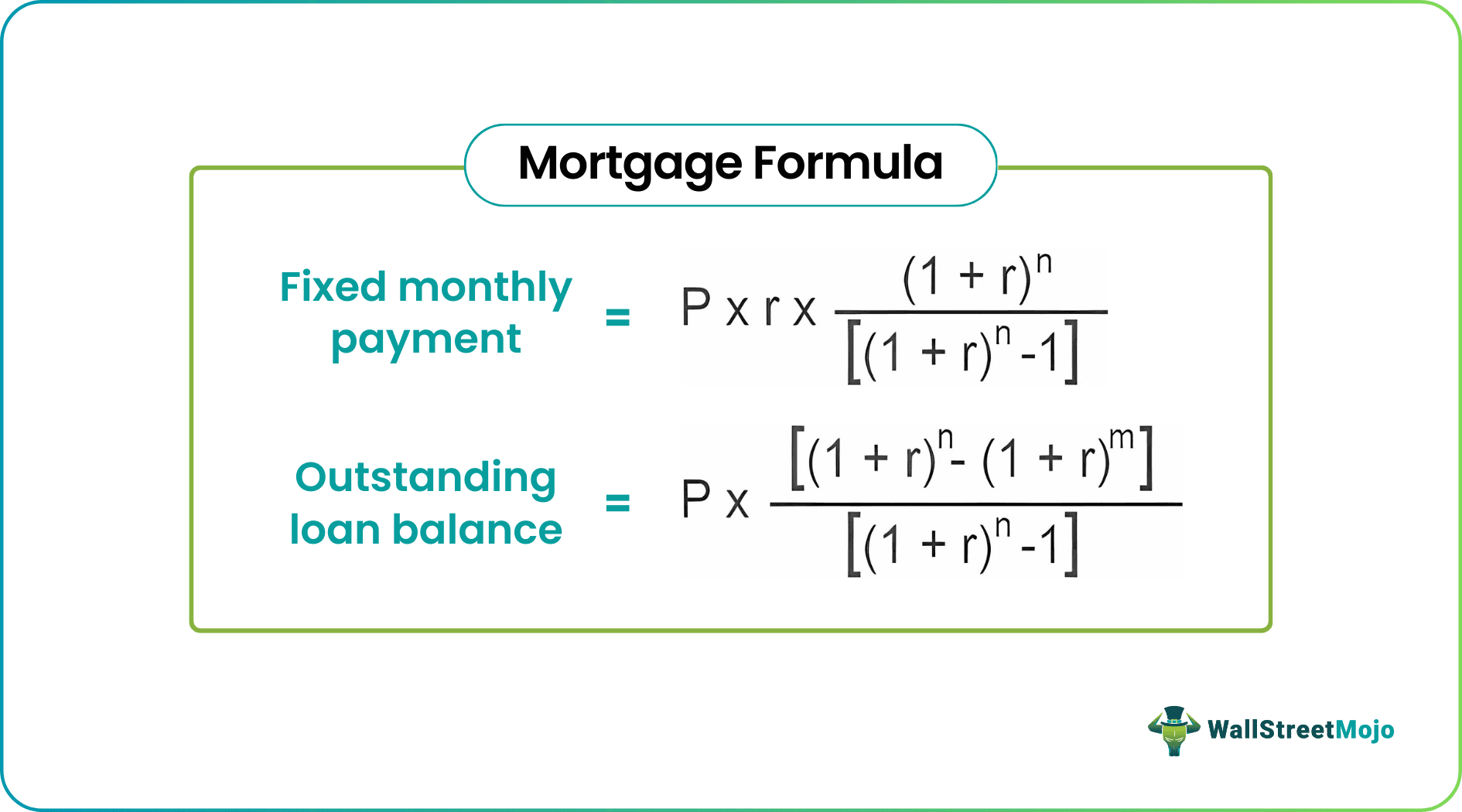
For most consumer loans—including mortgages, personal loans, and auto loans—the payments are “amortized.” This means the monthly payment remains fixed, but the ratio of interest to principal shifts every month. To calculate this manually, you must use the standard amortization formula.
The Standard Amortization Formula
The formula to calculate a monthly payment ($M$) is:
M = P [ i(1 + i)^n ] / [ (1 + i)^n – 1 ]
- P = Principal loan amount
- i = Monthly interest rate (Annual rate divided by 12 months)
- n = Number of months (Term of the loan)
For example, if you borrow $10,000 at a 6% annual interest rate for 4 years (48 months):
- P = 10,000
- i = 0.06 / 12 = 0.005
- n = 48
Plugging these into the formula allows you to find the exact monthly commitment required to zero out the balance by the end of the term.
Fixed-Rate vs. Variable-Rate Calculations
The formula above works perfectly for fixed-rate loans where the interest rate never changes. However, variable-rate loans (like certain Adjustable-Rate Mortgages or private student loans) feature interest rates that fluctuate based on market indices. For these loans, your monthly payment must be recalculated every time the interest rate adjusts. This makes budgeting more difficult, as your “P” (remaining principal) and “i” (new interest rate) change throughout the life of the loan.
Creating an Amortization Schedule
Beyond the monthly payment, an amortization schedule is a table that shows exactly how much of each payment goes toward interest versus principal. In the early stages of a loan, the interest portion is at its highest because the balance is large. As the principal drops, the interest (calculated as a percentage of the remaining balance) also drops, allowing more of your payment to “chip away” at the debt. Understanding this schedule is vital for those considering early repayment or refinancing.
Tools and Methods for Modern Borrowers
While the manual formula is excellent for understanding the theory, modern financial planning usually involves more efficient tools. Utilizing software or online resources can reduce the margin for error and allow for “what-if” scenarios.
Using Financial Calculators
Dedicated financial calculators (like the TI-BA II Plus) have built-in functions for Time Value of Money (TVM). By inputting the Present Value (PV), Interest Rate (I/Y), and Number of Periods (N), the calculator can solve for the Payment (PMT) instantly. This is a staple for finance professionals and students, as it allows for rapid comparison between different loan offers.
Mastering the PMT Function in Excel and Google Sheets
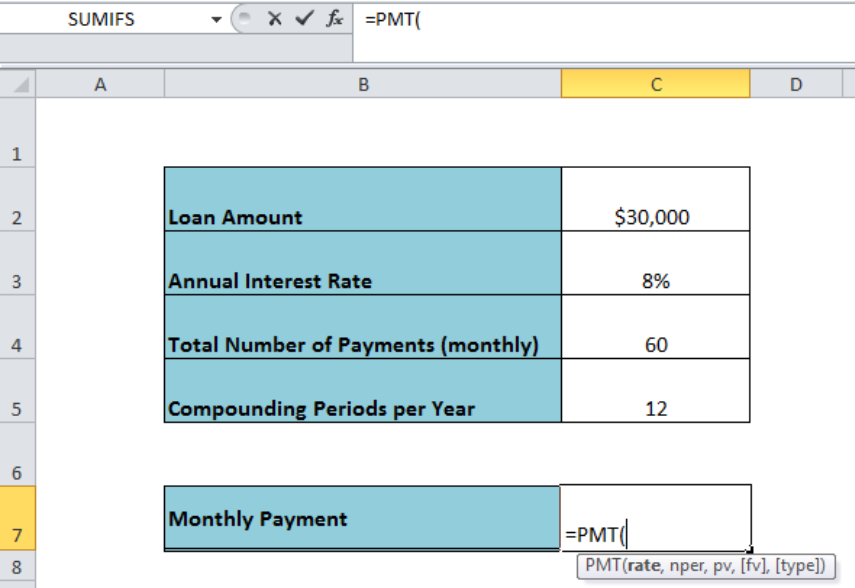
For most individuals, a spreadsheet is the most powerful tool available. Both Microsoft Excel and Google Sheets feature the =PMT function. The syntax is:
=PMT(rate, nper, pv)
- Rate: The interest rate for the period (e.g., 5%/12).
- Nper: Total number of payment periods.
- Pv: The present value or total principal.
By setting up a spreadsheet, you can easily change the interest rate or the loan amount to see how it affects your monthly budget in real-time. This is particularly useful when comparing two different mortgage products or car deals while sitting in the showroom.
Online Loan Simulators
Most reputable financial websites offer loan calculators. However, it is important to ensure these calculators account for all variables. A basic calculator might only show principal and interest, whereas a comprehensive mortgage calculator will include property taxes, homeowners insurance, and Private Mortgage Insurance (PMI). Always ensure you are using a tool that aligns with the specific type of debt you are acquiring.
Factors That Influence Your Monthly Obligation
The math of a loan is straightforward, but the inputs (the interest rate and fees) are highly subjective and based on your financial profile. Several external factors can drastically alter your monthly payment.
The Impact of Credit Scores on Interest
Your credit score is the single most significant factor in determining the “i” in your loan formula. Lenders use your FICO or VantageScore to assess risk. A borrower with a 780 score might qualify for a 4% interest rate, while a borrower with a 620 score might be offered 10% for the same loan. Over a 30-year mortgage, that difference in the “i” variable can result in hundreds of dollars added to the monthly payment and hundreds of thousands added to the total cost of the home.
Escrow, Insurance, and Hidden Costs
For many loans, the “Monthly Payment” includes more than just the repayment of the debt. In real estate, your monthly check often goes into an escrow account to cover property taxes and homeowners insurance. If your down payment is less than 20%, you may also be required to pay PMI. When calculating how much house or car you can afford, you must account for these “hidden” costs, which are often bundled into the monthly billing statement.
Loan-to-Value (LTV) Ratios and Down Payments
The amount of money you put down upfront reduces the principal ($P$). A higher down payment lowers the LTV ratio, which often leads to a lower interest rate from the lender. By reducing the principal from the start, you not only lower the monthly payment through the math of the formula but also potentially eliminate the need for additional insurance costs like PMI or GAP insurance.
Strategies to Manage and Reduce Monthly Payments
Once you understand how to calculate your payment, you can begin to manipulate the variables to your advantage. Financial literacy provides the leverage needed to save money over the long term.
The Power of Prepayments
Making extra payments toward your principal is one of the most effective ways to save money. Because interest is calculated based on the remaining balance, every extra dollar you pay today reduces the interest charged in every subsequent month. Even a single extra payment per year can shave years off a mortgage and save significant amounts in total interest, even though it doesn’t technically change the “required” monthly payment for the current month.
Refinancing for Lower Rates
If market interest rates drop or your credit score improves significantly, you may be able to refinance your loan. Refinancing involves taking out a new loan with a lower interest rate to pay off the old one. This effectively resets the “i” variable in your formula. When calculating whether refinancing is worth it, you must weigh the monthly savings against the closing costs of the new loan.
Bi-Weekly Payment Strategies
Instead of making one payment per month, some borrowers choose to pay half of their monthly obligation every two weeks. Because there are 52 weeks in a year, this results in 26 half-payments, or 13 full monthly payments per year. This simple adjustment to the frequency of payments reduces the principal faster and can significantly shorten the life of a loan without requiring a massive change in lifestyle.
Conclusion: Empowerment Through Financial Literacy
Calculating a monthly loan payment is more than just a mathematical exercise; it is an act of due diligence. By understanding how principal, interest, and time interact, you move from being a passive borrower to an active manager of your wealth.
Whether you use the manual formula, a spreadsheet, or an online tool, the goal remains the same: to ensure that every dollar you borrow is a calculated step toward your financial goals, rather than a burden on your future self. In the world of personal finance, knowledge is the best hedge against debt, and precision is the key to long-term prosperity.
aViewFromTheCave is a participant in the Amazon Services LLC Associates Program, an affiliate advertising program designed to provide a means for sites to earn advertising fees by advertising and linking to Amazon.com. Amazon, the Amazon logo, AmazonSupply, and the AmazonSupply logo are trademarks of Amazon.com, Inc. or its affiliates. As an Amazon Associate we earn affiliate commissions from qualifying purchases.