
Understanding how to calculate your monthly loan payments is a foundational skill in personal finance and business management. Whether you’re considering a mortgage, an auto loan, a personal loan, or financing for your business, the ability to accurately project your financial commitments empowers you to make informed decisions, budget effectively, and secure your financial future. This comprehensive guide will demystify the process, breaking down the complex calculations into understandable steps and exploring the various factors that influence your monthly obligations.
For many, the prospect of taking on a loan can feel daunting, primarily due to the long-term financial commitment it entails. However, by grasping the underlying mechanics of loan payments, you transform from a passive borrower to an active participant in your financial journey. This knowledge not only helps you plan your budget but also enables you to compare different loan offers, identify potential savings, and strategize for quicker debt repayment.

Understanding the Fundamentals of Loan Payments
Before diving into the mathematical formulas, it’s crucial to grasp the basic components that constitute any loan and how they interact to determine your monthly payment. A clear understanding of these elements is the first step towards financial literacy in the realm of borrowing.
Key Components of a Loan
Every loan, regardless of its purpose, is built upon a few core components:
- Principal (P): This is the initial amount of money borrowed. It’s the face value of the loan before any interest or fees are added. For example, if you borrow $200,000 for a home, $200,000 is your principal.
- Interest Rate (i): This is the cost of borrowing money, expressed as a percentage of the principal. It’s the fee charged by the lender for the use of their funds. Interest rates can be fixed (staying the same throughout the loan term) or variable (fluctuating with market rates). For monthly payment calculations, the annual interest rate must be converted to a monthly rate.
- Loan Term (n): This refers to the duration over which the loan is to be repaid, typically expressed in years or months. A 30-year mortgage has a term of 360 months, while a 5-year auto loan has a term of 60 months. The longer the loan term, the lower the individual monthly payments, but generally, the greater the total interest paid over the life of the loan.
The Concept of Amortization
Amortization is the process of paying off debt over time through regular, equal payments. Each payment consists of both principal and interest. Early in the loan’s life, a larger portion of your monthly payment goes towards interest, with a smaller portion reducing the principal. As the loan matures, the proportion gradually shifts, with more of your payment going towards the principal and less towards interest.
This structured repayment ensures that by the end of the loan term, the entire principal balance, along with all accrued interest, has been paid off. An amortization schedule is a table detailing each payment, showing how much goes towards interest, how much goes towards principal, and the remaining loan balance after each payment. Understanding this schedule can be incredibly insightful for managing your debt.
Why Calculation Matters
Knowing how to calculate your monthly payments offers several significant advantages:
- Budgeting: It allows you to accurately incorporate loan payments into your monthly budget, ensuring you have enough income to cover your obligations without straining your finances.
- Comparison Shopping: You can compare different loan offers from various lenders, understanding how different interest rates and terms impact your payment and the total cost of the loan.
- Financial Planning: It helps in long-term financial planning, allowing you to project your debt burden and strategize for future financial goals, such as saving for retirement or making investments.
- Empowerment: It demystifies the lending process, giving you confidence and control over your financial decisions, rather than relying solely on a lender’s quoted figures.
The Core Formula: Demystifying the Math
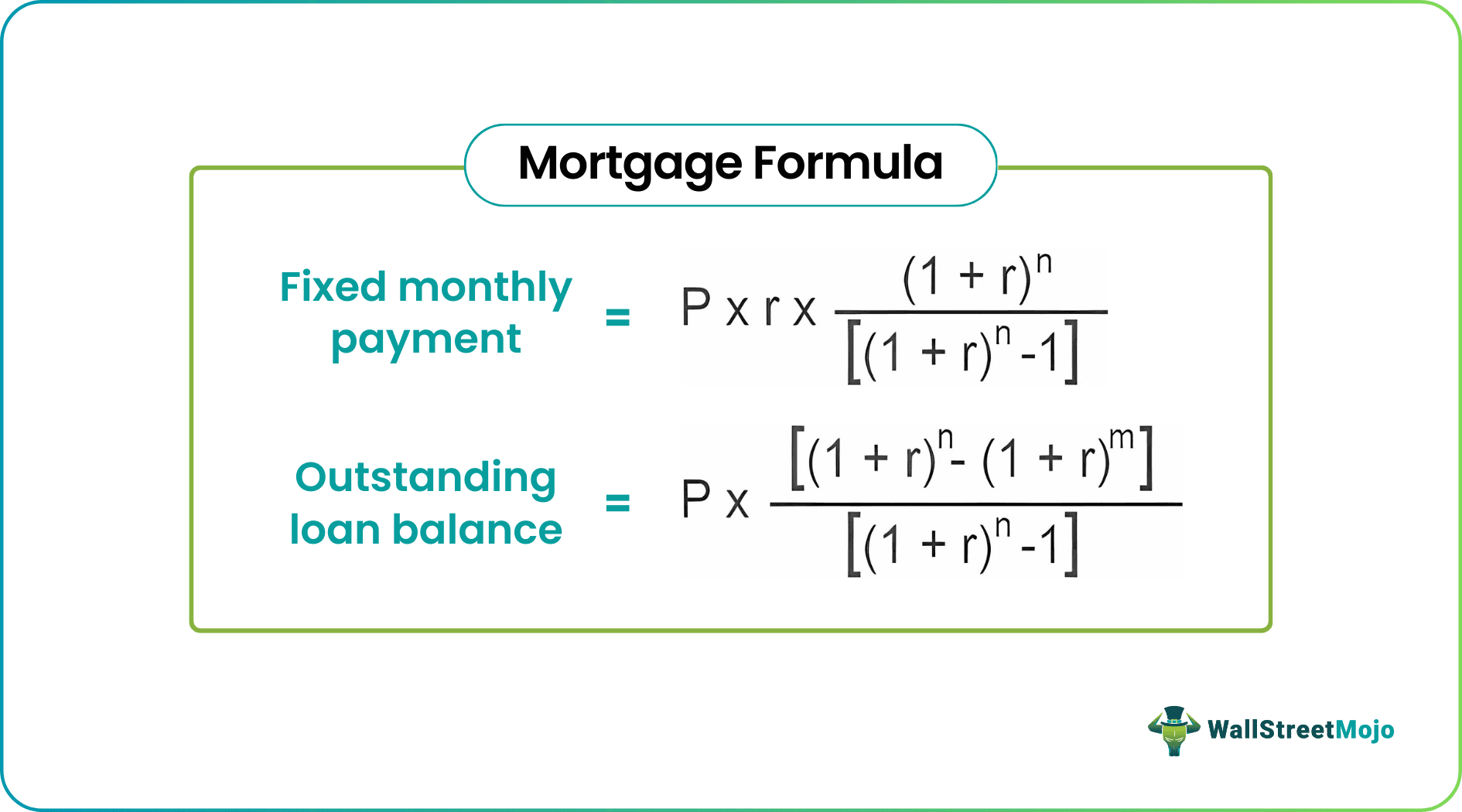
At the heart of every loan payment calculation lies a universal formula that, once understood, unlocks the ability to calculate payments for virtually any amortizing loan. While it may appear complex at first glance, breaking it down into its components makes it manageable.
The standard formula for calculating monthly loan payments is:
$M = P [ i(1 + i)^n ] / [ (1 + i)^n – 1]$
Where:
- M = Your monthly loan payment
- P = The principal loan amount (the initial amount borrowed)
- i = Your monthly interest rate (your annual interest rate divided by 12)
- n = Your total number of payments (your loan term in years multiplied by 12)
Explaining Each Variable
Let’s break down each variable to ensure clarity:
- P (Principal Loan Amount): This is straightforward – it’s the exact amount you are borrowing. If you’re buying a house for $250,000 and putting down $50,000, your principal (P) would be $200,000.
- i (Monthly Interest Rate): This is where many make a common mistake. Lenders typically quote an annual interest rate (APR). For the purpose of monthly calculations, you must convert this to a monthly rate. If your annual interest rate is 6%, your monthly interest rate (i) would be 0.06 / 12 = 0.005. Always convert the percentage to a decimal before dividing.
- n (Total Number of Payments): This represents the total number of payments you will make over the entire life of the loan. If you have a 30-year loan, you will make 30 * 12 = 360 payments. For a 5-year loan, it would be 5 * 12 = 60 payments.
Step-by-Step Calculation Guide
To simplify the formula, let’s break down the order of operations:
- Calculate (1 + i): Add 1 to your monthly interest rate.
- Calculate (1 + i)^n: Raise the result from step 1 to the power of ‘n’ (total number of payments). This value will appear twice in the formula.
- Calculate the Numerator: Multiply P by the monthly interest rate (i), and then multiply that result by the value from step 2. So,
P * i * (1 + i)^n. - Calculate the Denominator: Take the value from step 2 and subtract 1 from it. So,
(1 + i)^n – 1. - Calculate M: Divide the numerator (from step 3) by the denominator (from step 4).
Practical Example: A Home Mortgage Scenario
Let’s assume you want to borrow $200,000 for a mortgage.
- P = $200,000
- Annual Interest Rate = 5%
- Loan Term = 30 years
First, convert the annual interest rate to a monthly decimal and the loan term to total months:
- i = 0.05 / 12 = 0.0041666667
- n = 30 years * 12 months/year = 360 months
Now, plug these values into the formula:
$M = 200,000 [ 0.0041666667(1 + 0.0041666667)^{360} ] / [ (1 + 0.0041666667)^{360} – 1]$
$M = 200,000 [ 0.0041666667(1.0041666667)^{360} ] / [ (1.0041666667)^{360} – 1]$
Calculate $(1.0041666667)^{360} approx 4.470129$
Now substitute this back:
$M = 200,000 [ 0.0041666667 * 4.470129 ] / [ 4.470129 – 1]$
$M = 200,000 [ 0.0186255376 ] / [ 3.470129 ]$
$M = 3725.10752 / 3.470129$
$M approx 1073.64$
So, your estimated monthly payment would be approximately $1,073.64. This figure represents only the principal and interest. It does not include property taxes, homeowner’s insurance, or private mortgage insurance (PMI), which are often bundled into your actual mortgage payment (known as PITI).
Beyond the Formula: Factors Influencing Your Payments
While the core formula provides the principal and interest component of your loan, several other factors can significantly influence your actual monthly outgoings and the total cost of your loan. Understanding these nuances is vital for holistic financial planning.
Interest Rate Variations (Fixed vs. Variable)
The type of interest rate chosen plays a critical role in the predictability and total cost of your loan:
- Fixed-Rate Loans: The interest rate remains constant for the entire duration of the loan. This offers stability and predictability, as your principal and interest payment will not change. It’s excellent for budgeting and offers protection against rising interest rates. Mortgages are often fixed for 15 or 30 years.
- Variable-Rate Loans: Also known as adjustable-rate mortgages (ARMs) or loans with floating rates, these loans have an interest rate that can change periodically based on a benchmark index (e.g., prime rate, LIBOR, SOFR). While they might start with a lower introductory rate, your monthly payments can increase or decrease over time, introducing an element of risk and uncertainty.
Loan Term Length (Short vs. Long)
The length of your repayment period profoundly impacts both your monthly payment amount and the total interest paid:
- Shorter Loan Term: Results in higher monthly payments because you’re repaying the principal over fewer periods. However, you pay significantly less interest over the life of the loan, saving you money in the long run. Example: a 15-year mortgage.
- Longer Loan Term: Leads to lower monthly payments, making the loan more affordable on a month-to-month basis. The downside is that you pay substantially more interest over the extended period, increasing the overall cost of borrowing. Example: a 30-year mortgage.

Choosing the right loan term requires balancing affordability with the desire to minimize total interest paid.
Down Payments and Their Impact
A down payment is an upfront payment made on a large purchase, such as a home or a car. It directly reduces the principal amount you need to borrow.
- Larger Down Payment: Directly reduces ‘P’ in our formula. A smaller principal leads to lower monthly payments and significantly less interest paid over the life of the loan. It can also help you avoid certain fees (like Private Mortgage Insurance, or PMI, for mortgages if you put down 20% or more).
- Smaller Down Payment: Requires you to borrow a larger principal, resulting in higher monthly payments and greater total interest.
Strategically saving for a substantial down payment can be one of the most effective ways to lower your loan payments and overall borrowing costs.
Fees and Additional Costs
Beyond principal and interest, loans often come with various fees and additional costs that contribute to the true cost of borrowing and can affect your effective monthly outlay, even if not directly part of the loan payment calculation:
- Origination Fees: Charged by the lender for processing the loan.
- Closing Costs: For mortgages, these include title insurance, appraisal fees, legal fees, etc., which can be thousands of dollars.
- Private Mortgage Insurance (PMI): Required for conventional mortgages if your down payment is less than 20% of the home’s purchase price. This is an additional monthly expense.
- Property Taxes and Homeowner’s Insurance: For mortgages, these are often collected by the lender and held in an escrow account, then paid on your behalf, effectively increasing your monthly mortgage payment (PITI – Principal, Interest, Taxes, Insurance).
- Late Payment Fees: Penalties for missing payment due dates.
Always inquire about all associated fees and costs when comparing loan offers to get a complete picture of your financial commitment.
Leveraging Tools for Accurate Calculations
While understanding the manual calculation is empowering, in practice, most people use tools to calculate loan payments due to their speed and accuracy. These tools eliminate human error and can instantly show the impact of changing variables.
Online Loan Calculators
The internet is replete with free online loan calculators designed for various types of loans—mortgage, auto, personal, student, and business.
- Convenience: They are easy to find and use, requiring only a few inputs (principal, interest rate, term) to generate instant results.
- Scenario Planning: Most calculators allow you to adjust inputs to see how different interest rates, loan terms, or down payments affect your monthly payment, making them excellent for scenario planning and comparison.
- Amortization Schedules: Many advanced online calculators will also generate a full amortization schedule, breaking down each payment into principal and interest components over the loan’s life.
When using online calculators, ensure they are from reputable sources (e.g., well-known financial institutions, trusted financial education websites) to ensure accuracy.
Spreadsheet Software (Excel/Google Sheets)
For those who prefer a hands-on approach or need to integrate loan calculations into a broader financial model, spreadsheet software like Microsoft Excel or Google Sheets offers powerful functions.
The PMT (Payment) function is specifically designed for this purpose. Its syntax is typically:
=PMT(rate, nper, pv, [fv], [type])
Where:
rate: The interest rate per period (your monthly interest rate, e.g., 0.05/12).nper: The total number of payments for the loan (your total months, e.g., 30*12).pv: The present value, or the total amount that a series of future payments is worth now (the principal loan amount). This is usually entered as a negative number.fv: [Optional] The future value, or a cash balance you want to attain after the last payment is made. If omitted, it’s assumed to be 0 (meaning the loan is fully paid off).type: [Optional] The number 0 or 1, indicates when payments are due. 0 for end of the period (most common), 1 for beginning of the period. If omitted, it’s assumed to be 0.
Using this function, you can quickly calculate payments, build custom amortization schedules, and even model the impact of extra payments.
Financial Advisor Software
For complex financial situations, business loans, or integrated wealth management, financial advisors often use specialized software. These tools can:
- Holistic Planning: Factor in multiple loans, investments, taxes, and other financial goals.
- Advanced Scenario Modeling: Model sophisticated “what-if” scenarios, such as the impact of market fluctuations on variable-rate loans or the benefits of early repayment strategies.
- Compliance: Ensure calculations adhere to regulatory standards and accounting principles.
While not for everyday personal use, it’s good to know that professionals have advanced tools for more intricate financial planning involving loan management.
Strategic Approaches to Managing Loan Payments
Calculating your loan payment is just the beginning. Effective loan management involves strategic planning to minimize costs, accelerate repayment, and maintain financial stability.
Making Extra Payments
One of the most powerful strategies to reduce the total cost and term of your loan is to make extra payments whenever possible.
- Principal Reduction: Any amount paid above your regular monthly payment typically goes directly towards reducing the principal balance (check your loan terms to confirm this).
- Interest Savings: By reducing the principal faster, you reduce the amount of interest that accrues on the remaining balance over time. Even small, consistent extra payments can shave years off a loan term and save thousands in interest.
- Examples: Paying an extra $50 or $100 per month, making bi-weekly payments (which results in one extra full payment per year), or applying windfalls (tax refunds, bonuses) directly to the principal.
Refinancing Opportunities
Refinancing involves taking out a new loan to pay off an existing one, often with more favorable terms.
- Lower Interest Rates: If market interest rates have dropped since you took out your original loan, refinancing can secure you a lower rate, significantly reducing your monthly payment and total interest.
- Change Loan Term: You might refinance to shorten the loan term (to save interest) or extend it (to lower monthly payments, though at a higher total interest cost).
- Consolidate Debt: Refinancing can also be used to consolidate multiple debts into a single, lower-interest payment.
Always weigh the benefits of refinancing against the costs (e.g., closing costs for a new mortgage) to ensure it’s a financially sound decision.
Debt Consolidation
For individuals or businesses with multiple outstanding debts (credit cards, personal loans), debt consolidation can simplify repayment and potentially reduce interest costs.
- Single Payment: Instead of juggling several payments with different due dates and interest rates, you consolidate them into one manageable loan.
- Lower Interest Rate: If you have high-interest debts (like credit cards), a consolidation loan might offer a lower overall interest rate, saving you money.
- Be Cautious: While beneficial, ensure the consolidation loan truly offers better terms and doesn’t just extend the repayment period, potentially increasing the total interest paid in the long run. Also, avoid racking up new debt on the old accounts.
Budgeting for Loan Payments
Integrating your loan payments into a robust personal or business budget is fundamental for financial health.
- Know Your Cash Flow: Understand your income and expenses to identify how much you can comfortably allocate to loan payments without jeopardizing other essential expenditures or savings goals.
- Prioritize Debt: Prioritize high-interest debts in your budget to accelerate their repayment and minimize long-term costs.
- Emergency Fund: Always maintain an emergency fund to cover unexpected expenses. This prevents you from missing loan payments or incurring new debt if an unforeseen event occurs.
- Review Regularly: Your financial situation can change, so review your budget and loan repayment strategy periodically to make adjustments as needed.
Conclusion
The ability to calculate monthly loan payments is more than just a mathematical exercise; it’s a critical component of financial empowerment. By understanding the core formula, the various factors that influence your payments, and the tools available for accurate calculation, you equip yourself to make smarter borrowing decisions. Furthermore, by adopting strategic approaches to managing your loans—from making extra payments to judiciously considering refinancing or consolidation—you can significantly impact your financial well-being. Proactive management of your debt is a cornerstone of a healthy and secure financial future, allowing you to not only meet your obligations but also to build wealth and achieve your long-term goals.
aViewFromTheCave is a participant in the Amazon Services LLC Associates Program, an affiliate advertising program designed to provide a means for sites to earn advertising fees by advertising and linking to Amazon.com. Amazon, the Amazon logo, AmazonSupply, and the AmazonSupply logo are trademarks of Amazon.com, Inc. or its affiliates. As an Amazon Associate we earn affiliate commissions from qualifying purchases.