
Understanding how to calculate monthly interest rates is a cornerstone of sound financial literacy. Whether you’re a borrower contemplating a loan, a saver evaluating an investment, or a business owner managing cash flow, the monthly interest rate is a critical figure that directly impacts your financial health. This guide will demystify the process, breaking down complex concepts into actionable steps, and illustrating their relevance across various financial scenarios. By mastering this calculation, you gain greater control over your money, allowing for more informed decisions and strategic financial planning.
Understanding the Fundamentals of Interest Rates
Before diving into calculations, it’s essential to grasp the core concepts that define interest rates. An interest rate is, at its heart, the cost of borrowing money or the return on lending money. It’s a percentage of the principal amount that is charged by the lender to the borrower, or paid by the financial institution to the saver.
What is an Interest Rate?
An interest rate is expressed as a percentage of the principal amount and is typically quoted on an annual basis. For borrowers, it represents the price paid for the privilege of using someone else’s money. For lenders and investors, it’s the compensation received for foregoing current consumption or taking on the risk of lending. This seemingly simple percentage has profound implications for how much you pay for a car, how quickly your mortgage grows, or how much your savings accumulate over time. The higher the interest rate, the more expensive the loan, or the more lucrative the investment.
Annual Percentage Rate (APR) vs. Nominal Interest Rate
One of the most common points of confusion in interest rate discussions is the distinction between the Annual Percentage Rate (APR) and the nominal interest rate. The nominal interest rate is the stated interest rate on a loan or investment, often before accounting for compounding or fees. It’s the straightforward percentage applied to the principal.
The Annual Percentage Rate (APR), on the other hand, provides a more comprehensive measure of the true cost of borrowing. It includes not only the nominal interest rate but also any additional fees or charges associated with the loan, such as origination fees, processing fees, or closing costs. When comparing loans, APR is generally a more accurate metric than the nominal rate alone because it reflects the total annual cost to the borrower. For credit cards, APR often includes the effect of monthly compounding. Understanding APR helps consumers make apples-to-apples comparisons between different credit products, revealing the actual cost over a year.
The Importance of Monthly Interest Rates
While most financial products quote interest rates annually (like APR), payments and accruals often occur monthly. This is why the monthly interest rate becomes crucial. A monthly interest rate is simply the portion of the annual interest rate that applies each month. For borrowers, calculating the monthly interest rate helps determine the exact interest portion of their monthly payment, informing budgeting and debt management strategies. For investors, understanding the monthly compounding effect, derived from the monthly rate, can significantly impact the growth of their returns. Ignoring the monthly rate can lead to miscalculations regarding payment burdens or investment yields, leading to financial surprises.
Step-by-Step Guide to Calculating Monthly Interest
Calculating the monthly interest rate is a fundamental skill that applies across various financial instruments. The method varies slightly depending on whether you’re converting an annual rate or calculating interest on a principal amount.
From APR to Monthly Rate: The Basic Conversion
The most common scenario involves converting an Annual Percentage Rate (APR) into a monthly interest rate. This is usually straightforward, assuming the APR is a simple annual rate without complex compounding implications already baked in.
The formula is:
Monthly Interest Rate = APR / 12
For example, if a credit card has an APR of 18%, the monthly interest rate would be:
18% / 12 = 1.5% per month.
It’s crucial to convert the percentage to a decimal for calculations:
0.18 / 12 = 0.015.
This means for every dollar you owe, you will be charged 1.5 cents in interest each month. This conversion is vital for understanding the true per-month cost of your debt or the per-month yield of your investment before considering compounding.
The Simple Interest Method
Simple interest is calculated only on the principal amount, without taking into account any accumulated interest from previous periods. It is typically used for short-term loans or simple investment scenarios.
The formula for simple interest for a single month is:
Monthly Simple Interest = (Principal Amount × Annual Interest Rate) / 12
Or, using the converted monthly rate:
Monthly Simple Interest = Principal Amount × Monthly Interest Rate (as a decimal)
Let’s say you take out a personal loan of $10,000 at a 6% annual simple interest rate.
The monthly interest rate is 0.06 / 12 = 0.005.
So, the monthly simple interest would be: $10,000 × 0.005 = $50.
This means you would pay $50 in interest each month, in addition to any principal repayment, until the loan is paid off. This calculation is relatively easy, but it’s less common for long-term financial products where compounding interest dominates.
The Compound Interest Method (and its implications)
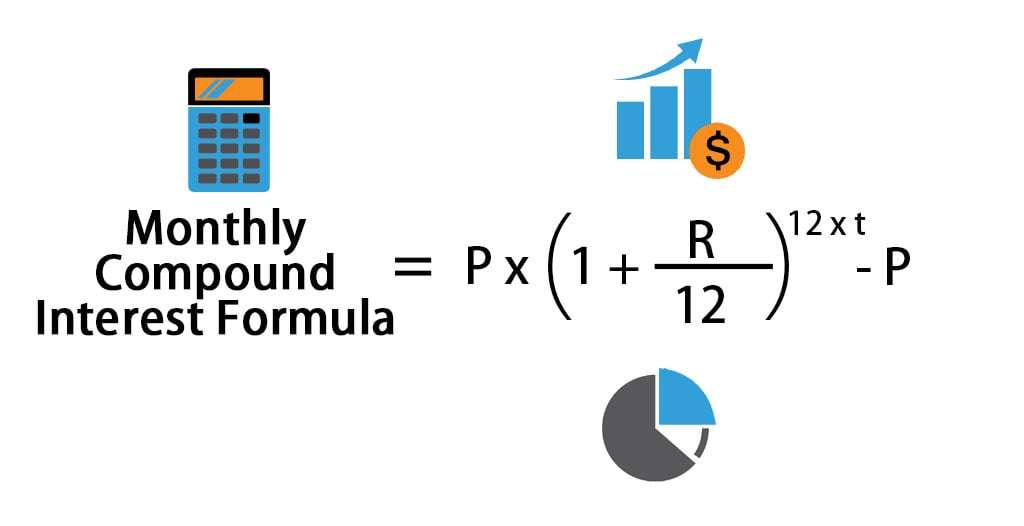
Compound interest is often referred to as the “eighth wonder of the world” by Albert Einstein, and for good reason. Unlike simple interest, compound interest is calculated on the initial principal and also on all the accumulated interest from previous periods. This means your money grows (or your debt increases) at an accelerating rate. Most loans (mortgages, credit cards) and investments (savings accounts, retirement funds) use compound interest.
The general formula for calculating the future value (FV) with compound interest is:
FV = P (1 + r/n)^(nt)
Where:
-
P = Principal amount
-
r = Annual nominal interest rate (as a decimal)
-
n = Number of times that interest is compounded per year
-
t = Number of years
To calculate the interest for a specific month, you would need to determine the outstanding balance at the beginning of that month and then apply the monthly interest rate.
Let’s take a credit card with an 18% APR, compounded monthly, and an initial balance of $1,000.
The monthly interest rate is 0.18 / 12 = 0.015.
-
Month 1 Interest: $1,000 (Principal) × 0.015 = $15.00
- New Balance after interest: $1,000 + $15.00 = $1,015.00
-
Month 2 Interest: $1,015.00 (New Principal) × 0.015 = $15.23
- New Balance after interest: $1,015.00 + $15.23 = $1,030.23
As you can see, the interest charged in Month 2 is slightly higher because it’s calculated on the increased balance from Month 1’s accrued interest. This compounding effect means that your debt grows faster if you only make minimum payments, and your investments grow significantly larger over time. Understanding this mechanism is crucial for both managing debt and maximizing savings.
Using Online Calculators and Financial Tools

While manual calculations are excellent for understanding the mechanics, for accuracy and convenience, especially with complex amortization schedules or large numbers, online calculators and financial tools are invaluable.
-
Online Interest Calculators: Many financial websites offer free calculators that can determine monthly payments, total interest paid, or future values based on various inputs (principal, interest rate, term).
-
Spreadsheets (e.g., Excel, Google Sheets): Programs like Excel have built-in functions (e.g.,
PMTfor loan payments,FVfor future value,IPMTfor interest portion of a payment) that can handle complex financial calculations, including amortization tables. This is particularly useful for business finance or detailed personal financial planning. -
Banking Apps and Investment Platforms: Most modern banking and investment apps provide insights into how much interest you’re earning or paying, often breaking it down by month or statement period. They simplify tracking and give a real-time view of your financial standing.
These tools reduce the risk of human error and allow for quick scenario analysis, helping you compare different loan options or project investment growth with greater efficiency.
Practical Applications Across Different Financial Products
The ability to calculate monthly interest rates is not just an academic exercise; it has tangible applications across virtually every financial product you encounter.
Credit Cards and Revolving Debt
For credit cards, understanding monthly interest is paramount. Credit card APRs are typically high, and interest is almost always compounded daily or monthly. If you carry a balance, the monthly interest charge can quickly inflate your debt. By knowing the monthly rate, you can estimate how much interest you’ll pay each month on your outstanding balance, motivating you to pay more than the minimum to reduce the principal and, consequently, future interest charges. It reveals the true cost of carrying a balance and highlights the benefits of paying off high-interest debt quickly.
Loans (Personal, Mortgage, Auto)
Monthly interest calculations are fundamental to loans. Mortgage, auto, and personal loans are typically repaid in fixed monthly installments over several years. Each payment consists of both principal and interest. In the early stages of an amortizing loan (like a mortgage), a larger portion of your monthly payment goes towards interest. As the principal reduces over time, a greater share of subsequent payments goes towards paying down the principal. Understanding the monthly interest allows you to analyze amortization schedules, see how extra payments reduce the principal faster, and determine the overall cost of the loan. This insight can help you decide whether to make bi-weekly payments or refinance.
Savings Accounts and Investments
On the flip side, monthly interest calculations are crucial for evaluating savings accounts, certificates of deposit (CDs), and certain investment products. While annual percentage yield (APY) is often quoted for savings, understanding the monthly compounding effect helps you project how quickly your money will grow. Even a small monthly interest rate, compounded consistently over many years, can lead to substantial growth through the power of compounding, illustrating the importance of starting to save and invest early.
Business Finance and Working Capital
For businesses, calculating monthly interest is vital for managing lines of credit, short-term loans, and working capital. Businesses need to accurately forecast their interest expenses to maintain healthy cash flow and profitability. Understanding the monthly cost of borrowing allows a business to make informed decisions about financing inventory, covering operational gaps, or investing in growth, ensuring that the cost of capital doesn’t erode margins.
Factors Influencing Monthly Interest Rates
Monthly interest rates are not static; they are dynamic figures influenced by a myriad of economic, personal, and product-specific factors.
Economic Conditions and Central Bank Policies
Broader economic conditions play a significant role. Inflation, economic growth, and unemployment rates can all sway interest rates. Central banks, like the U.S. Federal Reserve, use monetary policy tools, such as adjusting the federal funds rate, to influence lending rates across the economy. When the central bank raises its benchmark rate, commercial banks often follow suit, leading to higher monthly interest rates for consumers and businesses. Conversely, rate cuts can lower borrowing costs.
Creditworthiness and Risk Assessment
Your creditworthiness is a primary determinant of the interest rate you’ll receive. Lenders assess your credit score, payment history, debt-to-income ratio, and other financial indicators to gauge your risk of defaulting on a loan. A higher credit score signals lower risk, typically resulting in a lower annual and, consequently, lower monthly interest rate. Conversely, a poor credit history will likely lead to higher interest rates as lenders seek to compensate for the increased risk.
Loan Term and Type
The length of the loan (its term) also affects the interest rate. Generally, longer loan terms (e.g., a 30-year mortgage compared to a 15-year mortgage) tend to have higher interest rates because the lender is exposed to risk for a longer period. The type of loan also matters; secured loans (like mortgages or auto loans, backed by collateral) typically have lower interest rates than unsecured loans (like personal loans or credit cards) because the collateral reduces the lender’s risk.
Fees and Hidden Charges
While not directly part of the monthly interest rate calculation itself, various fees can significantly impact the overall cost of borrowing, which the APR aims to capture. Loan origination fees, annual fees, late payment fees, and prepayment penalties can add to the total expense, even if the nominal monthly interest rate seems low. It’s crucial to look at the total cost of borrowing, not just the quoted interest rate, to get a complete financial picture.
Strategies for Managing and Optimizing Interest Payments
Beyond just knowing how to calculate, the real power comes from using this knowledge to manage and optimize your interest payments, ultimately saving money and building wealth.
Understanding Your Debt Structure
Begin by thoroughly understanding all your outstanding debts. List them out with their principal amounts, interest rates (especially the APR for credit cards), and monthly payment due dates. Identify which debts have the highest interest rates. This clarity allows you to prioritize effectively. Are you paying simple interest or compound interest? How often is interest compounded? Knowing these details helps you target the most financially draining debts first.
Making Extra Payments
One of the most effective strategies to reduce total interest paid, particularly on compound interest loans, is to make extra payments whenever possible. Even small additional payments directed towards the principal can significantly shorten the loan term and reduce the overall interest cost. For example, on a mortgage, making one extra principal payment a year or rounding up your monthly payment can shave years off the loan. For credit cards, paying more than the minimum dramatically reduces the balance on which future interest is calculated.
Refinancing and Balance Transfers
If you have high-interest debt, consider options like refinancing or balance transfers.
-
Refinancing involves taking out a new loan to pay off an existing one, often at a lower interest rate or with different terms. This can be beneficial for mortgages, auto loans, or personal loans if your credit score has improved or market rates have dropped.
-
Balance transfers allow you to move high-interest credit card debt to a new card, often with a promotional 0% APR for a limited period. This provides a crucial window to pay down a significant portion of the principal without accruing interest, though it’s important to be aware of balance transfer fees and the standard APR after the promotional period ends.

Negotiating Better Terms
Don’t be afraid to negotiate. For credit card debt, if you have a good payment history, you might be able to call your credit card company and request a lower APR. Similarly, when taking out a new loan, you can often negotiate the interest rate or terms, especially if you have an excellent credit score and have shopped around for competitive offers. Sometimes, simply asking can lead to substantial savings over the life of the loan.
In conclusion, the ability to calculate monthly interest rates is more than just a mathematical exercise; it’s a vital financial skill that empowers you to make smarter decisions, manage debt effectively, and accelerate your savings. By understanding the underlying principles, utilizing appropriate tools, and implementing strategic management techniques, you can transform your financial outlook and work towards achieving your monetary goals.
aViewFromTheCave is a participant in the Amazon Services LLC Associates Program, an affiliate advertising program designed to provide a means for sites to earn advertising fees by advertising and linking to Amazon.com. Amazon, the Amazon logo, AmazonSupply, and the AmazonSupply logo are trademarks of Amazon.com, Inc. or its affiliates. As an Amazon Associate we earn affiliate commissions from qualifying purchases.