
Understanding how to calculate a loan amount is a fundamental skill for anyone navigating the landscape of personal finance, business growth, or major life purchases. Whether you’re considering a mortgage, a car loan, a personal loan, or financing for your business, knowing the mechanics behind loan calculations empowers you to make informed decisions, negotiate better terms, and manage your debt effectively. This article will demystify the process, breaking down the components of a loan, explaining common calculation methods, and providing practical tools to help you understand the true cost of borrowing.
Understanding the Fundamentals of Loan Calculation
Before diving into complex formulas, it’s crucial to grasp the core elements that constitute any loan. These components interact to determine your monthly payments and the total amount you will repay over the loan’s lifetime.

Key Loan Components
-
Principal: This is the initial amount of money you borrow. If you take out a $200,000 mortgage, the principal is $200,000. It’s the starting point from which all interest calculations begin.
-
Interest Rate: The interest rate is the cost of borrowing money, expressed as a percentage of the principal. It can be fixed (remaining the same throughout the loan term) or variable (fluctuating with market rates). When comparing loans, distinguish between the nominal interest rate and the Annual Percentage Rate (APR). The APR often includes additional fees and charges, providing a more comprehensive measure of the total cost of borrowing than the nominal rate alone.
-
Loan Term: The loan term refers to the duration over which you agree to repay the loan, typically expressed in months or years. A longer loan term usually results in lower monthly payments but increases the total interest paid over the life of the loan. Conversely, a shorter term means higher monthly payments but less interest paid overall.
-
Payment Frequency: This dictates how often you are required to make payments. Most loans, especially mortgages and personal loans, require monthly payments. However, some loans might offer bi-weekly or even weekly payment options, which can sometimes reduce the total interest paid.
Types of Loans and Their Calculation Nuances
Different types of loans employ distinct calculation methodologies, primarily based on how interest is applied and how payments are structured.
-
Amortized Loans: These are the most common type for significant purchases like mortgages, auto loans, and many personal loans. An amortized loan involves a repayment schedule where each payment includes both principal and interest. Early payments consist primarily of interest, with a smaller portion going towards the principal. As the loan matures, more of each payment goes towards reducing the principal. This systematic reduction of the loan balance over time is known as amortization.
-
Simple Interest Loans: Some loans, particularly certain personal loans, lines of credit, and credit cards, use simple interest. With simple interest, the interest is calculated only on the outstanding principal balance. This means if you pay down your principal faster, you reduce the base on which interest is charged, potentially saving money. Credit card interest, for example, is typically calculated daily on your average daily balance.
-
Lines of Credit: Unlike traditional loans that disburse a lump sum, a line of credit allows you to borrow up to a certain limit as needed, repaying and re-borrowing as funds become available. Interest is only charged on the amount you’ve actually drawn, not the full credit limit. Calculation here involves tracking your outstanding balance and applying the interest rate to it.
The Amortization Schedule: Your Roadmap to Repayment
For most significant loans, understanding the amortization schedule is key. It’s a detailed breakdown of every payment you’ll make, showing how much goes towards interest and how much reduces your principal.
The Amortization Formula Explained
The cornerstone of calculating payments for an amortized loan is the loan payment formula. It helps determine your fixed periodic payment (P) based on the loan’s principal, interest rate, and term.
The standard formula for calculating the fixed monthly payment (P) for an amortized loan is:
P = r * PV / [1 – (1 + r)^-n]
Let’s break down each variable:
-
P: Your fixed monthly loan payment.
-
PV: The Present Value, which is the principal loan amount (the initial sum borrowed).
-
r: The monthly interest rate. This is derived by dividing the annual interest rate by 12 (if payments are monthly). For example, if the annual rate is 6%, the monthly rate is 0.06 / 12 = 0.005.
-
n: The total number of payments over the loan’s term. This is calculated by multiplying the loan term in years by 12 (for monthly payments). For a 30-year mortgage, n would be 30 * 12 = 360 payments.
This formula essentially calculates the constant payment required to fully pay off the loan (principal plus interest) over the specified term.
Constructing an Amortization Table
While the formula gives you the monthly payment, an amortization table provides a granular view of how that payment is distributed over time. You can create one manually or using spreadsheet software.
An amortization table typically includes these columns:
-
Payment Number: A sequential count of each payment made.
-
Starting Balance: The outstanding principal balance at the beginning of the payment period.
-
Interest Paid: The portion of your payment that goes towards interest. This is calculated by multiplying the starting balance by the monthly interest rate (Starting Balance * r).
-
Principal Paid: The portion of your payment that goes towards reducing the principal. This is simply the fixed monthly payment minus the interest paid for that period (P – Interest Paid).
-
Ending Balance: The new outstanding principal balance after the payment. This is the starting balance minus the principal paid (Starting Balance – Principal Paid).
Here’s how the process works for each payment:
-
Payment 1:
-
Starting Balance = Original Principal
-
Interest Paid = Original Principal * r
-
Principal Paid = P – Interest Paid
-
Ending Balance = Original Principal – Principal Paid
-
-
Payment 2:
-
Starting Balance = Ending Balance from Payment 1
-
Interest Paid = (Ending Balance from Payment 1) * r
-
Principal Paid = P – Interest Paid
-
Ending Balance = (Ending Balance from Payment 1) – Principal Paid
-
This sequence continues until the ending balance reaches zero at the end of the loan term. Observing an amortization table clearly illustrates how early payments are heavily weighted towards interest, while later payments contribute significantly more to principal reduction.
Practical Tools and Methods for Loan Calculation
While understanding the underlying formulas is valuable, most people rely on accessible tools to perform loan calculations quickly and accurately.
Online Loan Calculators
The internet is replete with free online loan calculators provided by banks, financial institutions, and independent financial websites. These tools are incredibly user-friendly and require you to input just a few pieces of information:
-
Loan amount (principal)
-
Interest rate (annual percentage)
-
Loan term (in years or months)
Once you enter these details, the calculator instantly provides your estimated monthly payment and often shows the total interest paid over the life of the loan. Many advanced calculators also allow you to input additional payments, showing the potential savings. They are excellent for quick estimates and comparing different loan scenarios without needing to manually apply formulas.
Spreadsheet Software (Excel/Google Sheets)
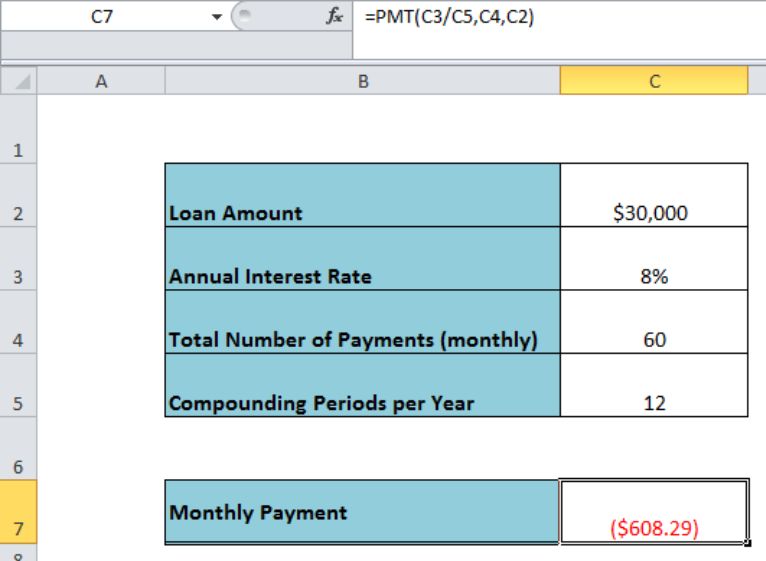
For those who want more control, customization, and the ability to run detailed scenarios, spreadsheet software like Microsoft Excel or Google Sheets is an invaluable tool. These programs offer powerful built-in financial functions specifically designed for loan calculations:
-
PMT Function: This function calculates the payment for a loan based on constant payments and a constant interest rate.
-
Syntax:
=PMT(rate, nper, pv, [fv], [type]) -
rate: The interest rate per period (e.g., annual rate/12). -
nper: The total number of payments (e.g., loan term in years * 12). -
pv: The present value or the principal loan amount. -
fv: [Optional] The future value, or a cash balance you want to attain after the last payment (defaults to 0). -
type: [Optional] Indicates when payments are due (0 for end of period, 1 for beginning of period; defaults to 0).
-
-
IPMT Function: Calculates the interest portion of a loan payment for a specific period.
-
PPMT Function: Calculates the principal portion of a loan payment for a specific period.
By using these functions, you can easily build your own comprehensive amortization schedule in a spreadsheet, allowing you to tweak variables and instantly see the impact on your payments and overall loan cost. This is particularly useful for sensitivity analysis – seeing how a slight change in interest rate or loan term affects your financial burden.
Financial Advisors and Software
For complex financial situations, large loans, or when integrating loan payments into a broader financial plan, consulting a financial advisor or utilizing specialized financial planning software can be beneficial. These professionals and tools can help you:
-
Analyze multiple loan options in the context of your overall financial health.
-
Project long-term financial impacts of different loan choices.
-
Develop strategies for debt consolidation or accelerated repayment.
While the fundamental calculations remain the same, their expertise provides a holistic perspective, ensuring your borrowing decisions align with your broader financial goals.
Beyond the Monthly Payment: Strategic Considerations
Calculating the monthly payment is just the first step. True financial literacy involves understanding the broader implications of your loan choices and strategizing for optimal repayment.
Impact of Interest Rates and Loan Terms
The interest rate and loan term are the two most significant variables influencing the total cost of your loan.
-
Interest Rate: Even a seemingly small difference in the annual interest rate can translate into thousands, or even tens of thousands, of dollars in extra interest paid over the life of a large loan like a mortgage. A lower interest rate directly reduces the “cost” of borrowing, saving you money.
-
Loan Term: While a longer loan term (e.g., 30 years vs. 15 years for a mortgage) offers the benefit of lower monthly payments, it comes at a significant cost: substantially more total interest paid. This is because interest accrues over a longer period on the outstanding principal. Conversely, a shorter loan term means higher monthly payments but a much lower total interest expense. It’s a critical trade-off between monthly affordability and overall cost-efficiency.
Always compare loans with similar terms and rates, and carefully consider the balance between a manageable monthly payment and the total cost of borrowing.
The True Cost of Borrowing (Total Interest Paid)
Focusing solely on the monthly payment can be misleading. The “true cost” of a loan is not just the principal you borrowed, but the principal plus all the interest you will pay over the loan’s term.
To calculate the total interest paid:
Total Interest Paid = (Monthly Payment * Total Number of Payments) – Principal Loan Amount
For example, a $200,000, 30-year mortgage at 5% interest might have a monthly payment of around $1,073.64.
Total payments = $1,073.64 * 360 (30 years * 12 months) = $386,510.40
Total interest paid = $386,510.40 – $200,000 = $186,510.40
This stark figure highlights why understanding the total interest is critical for evaluating the long-term impact of your debt.
Prepayment Strategies and Their Benefits
Once you’ve calculated your loan and understand its structure, you can employ strategies to save money and accelerate repayment. Most amortized loans allow for prepayments without penalty, which can significantly reduce the total interest paid.
-
Making Extra Principal Payments: Even small, consistent extra payments directly applied to the principal can shave years off your loan term and save you substantial interest. Since interest is calculated on the outstanding principal, reducing that principal earlier means less interest accrues going forward.
-
Bi-Weekly Payments: Instead of 12 monthly payments, you make 26 half-payments throughout the year. This effectively results in one extra full monthly payment per year (26 half-payments = 13 full payments). This strategy significantly reduces the loan term and total interest paid over time without feeling like a massive financial burden.
-
Refinancing: If interest rates drop significantly, or your credit score improves, refinancing your loan to a lower interest rate can be a powerful way to reduce your monthly payment or shorten your loan term, thereby saving on total interest. However, be mindful of refinancing costs.
By proactively managing your loan and understanding how prepayments impact the amortization schedule, you can take control of your debt and reach financial freedom sooner.

Conclusion
Calculating a loan amount might seem intimidating at first, but by breaking it down into its fundamental components and understanding the tools available, you transform a complex financial concept into an actionable skill. From grasping the roles of principal and interest to utilizing amortization formulas and online calculators, each step contributes to a clearer picture of your financial obligations.
Armed with this knowledge, you are better equipped to compare loan offers, negotiate favorable terms, and strategically manage your debt. Don’t just accept the monthly payment presented to you; understand how it’s derived, what contributes to the total cost, and how you can actively work towards reducing that cost. Empowering yourself with loan calculation skills is a critical step towards sound financial planning and achieving your long-term financial goals.
aViewFromTheCave is a participant in the Amazon Services LLC Associates Program, an affiliate advertising program designed to provide a means for sites to earn advertising fees by advertising and linking to Amazon.com. Amazon, the Amazon logo, AmazonSupply, and the AmazonSupply logo are trademarks of Amazon.com, Inc. or its affiliates. As an Amazon Associate we earn affiliate commissions from qualifying purchases.