
Understanding how to calculate interest on your savings is more than just a mathematical exercise; it is a fundamental pillar of financial literacy. Whether you are tucking away a small emergency fund in a standard savings account or managing a high-yield portfolio, knowing exactly how your money grows allows you to make informed decisions about where to park your capital. In a world of fluctuating economic conditions and varying bank offers, the ability to dissect interest rates ensures that you are never leaving money on the table.

To master your personal finances, you must look beyond the surface-level percentages advertised by financial institutions. Calculating interest involves understanding the nuances of compounding, the difference between various rate types, and the impact of external forces like inflation and taxes. This guide provides a deep dive into the mechanics of interest calculation, offering the tools you need to project your future wealth with precision.
The Mechanics of Interest: Why It Matters for Your Financial Health
Interest is essentially the price a bank pays you for the privilege of using your money. When you deposit funds into a savings account, the bank lends those funds to other borrowers. In exchange, you receive a portion of the profit in the form of interest. However, not all interest is calculated the same way, and the terminology used by banks can often be confusing for the average consumer.
Simple Interest vs. Compound Interest: The Power of Growth
The most basic distinction in the world of savings is the difference between simple and compound interest. Simple interest is calculated solely on the principal amount—the initial sum of money you deposited. While easy to calculate, simple interest is rarely used in modern consumer savings accounts because it does not account for the growth of the interest itself.
Compound interest, on the other hand, is the engine of long-term wealth. It is calculated on the initial principal as well as the accumulated interest from previous periods. In essence, you are earning “interest on interest.” Over short periods, the difference may seem negligible, but over decades, compounding creates an exponential growth curve that can turn modest savings into a significant nest egg. Understanding this distinction is the first step in recognizing why even a slightly higher interest rate or more frequent compounding can lead to vastly different financial outcomes over time.
The Difference Between Nominal Rate and APY
When shopping for a savings account, you will likely encounter two different figures: the interest rate (nominal rate) and the Annual Percentage Yield (APY). The nominal interest rate is the stated rate without taking compounding into account. The APY, however, reflects the actual amount of interest you will earn in one year, inclusive of the effects of compounding.
Because most savings accounts compound interest more than once a year (often daily or monthly), the APY will almost always be higher than the nominal interest rate. For example, a 4.00% nominal rate compounded monthly results in an APY of 4.07%. When comparing different financial products, the APY is the “gold standard” metric because it provides an apples-to-apples comparison of your potential earnings across different institutions.
The Mathematical Formulas for Interest Calculation
To move from conceptual understanding to practical application, you must be comfortable with the underlying formulas. While online calculators are convenient, knowing how to perform these calculations manually—or within a spreadsheet—gives you a much deeper grasp of your financial trajectory.
Calculating Simple Interest
Although less common in savings accounts, the simple interest formula is the foundation for all interest math. The formula is:
I = P × r × t
Where:
-
I is the interest earned.
-
P is the principal amount (the initial deposit).
-
r is the annual interest rate (expressed as a decimal).
-
t is the time the money is invested (expressed in years).
For instance, if you deposit $10,000 at a 3% simple interest rate for five years, the calculation would be $10,000 × 0.03 × 5, resulting in $1,500 of interest.
The Compound Interest Formula and Variable Breakdown
To calculate the future value of a savings account with compound interest, the formula becomes more complex. The standard formula for compound interest is:
A = P(1 + r/n)^(nt)
Where:
-
A is the final amount in the account.
-
P is the principal balance.
-
r is the annual interest rate (decimal).
-
n is the number of times interest is compounded per year.
-
t is the number of years the money is left to grow.
This formula demonstrates the three levers you can pull to increase your savings: you can increase the principal (P), seek a higher interest rate (r), or allow the money to sit for a longer period (t). The variable n (compounding frequency) is often overlooked but plays a vital role in the final result.
Adjusting for Compounding Periods
The frequency of compounding—the n in our formula—can vary. Most high-yield savings accounts compound interest daily but credit it to your account monthly. Certificates of Deposit (CDs) might compound monthly or quarterly.
-
Daily compounding: n = 365
-
Monthly compounding: n = 12
-
Quarterly compounding: n = 4
-
Semi-annual compounding: n = 2
As n increases, the final amount A increases. This is why a bank offering daily compounding is technically superior to a bank offering the same nominal rate with monthly compounding.
Practical Applications and Real-World Scenarios
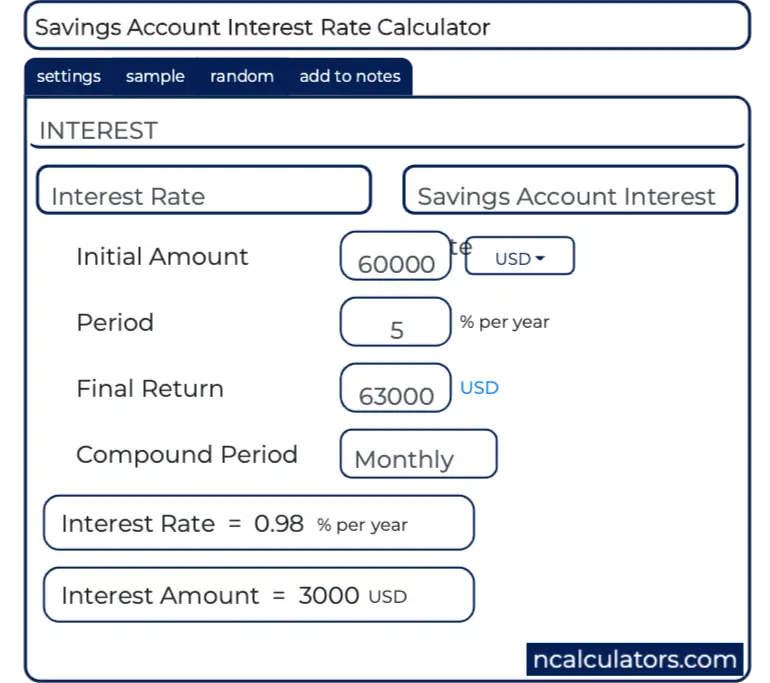
Calculations on paper are useful, but real-world saving often involves moving targets. Most people do not just deposit a lump sum and leave it; they make monthly contributions or occasionally withdraw funds.
The Impact of Daily vs. Monthly Compounding
Consider two accounts with a $10,000 balance and a 5% interest rate. Account A compounds annually (n=1), while Account B compounds daily (n=365). After one year:
-
Account A: $10,000(1 + 0.05/1)^1 = $10,500.00
-
Account B: $10,000(1 + 0.05/365)^365 = $10,512.67
While a $12.67 difference might seem minor on a $10,000 balance, the gap widens significantly as the balance grows and the time horizon extends. Over 20 years, that small difference in compounding frequency can result in hundreds or even thousands of dollars in “free” money.
Calculating Interest on Periodic Contributions
For most savers, the “Future Value of an Ordinary Annuity” formula is more applicable. This is used when you make regular deposits (e.g., $500 every month) into an interest-bearing account. The formula is:
FV = PMT × [((1 + r/n)^(nt) – 1) / (r/n)]
Where PMT is the amount of your periodic payment. This formula is the key to understanding how “paying yourself first” through automated savings leads to wealth. If you contribute $500 a month to an account with a 4% APY for 30 years, you will end up with approximately $347,000, despite only having contributed $180,000 of your own money. The remaining $167,000 is pure compound interest.
External Factors That Dilute Your Savings Performance
Calculating the interest rate on your bank statement is only half the battle. To understand the true growth of your purchasing power, you must account for “leakage”—the factors that reduce the effective value of your savings.
The Erosion of Value: Accounting for Inflation
Inflation is the rate at which the general level of prices for goods and services rises. If your savings account is earning 4% interest, but inflation is running at 3%, your “real” interest rate is only 1%. This means that while your balance is increasing numerically, your actual purchasing power is only growing by 1%.
When calculating the long-term viability of a savings strategy, it is essential to subtract the projected inflation rate from your nominal interest rate. This “Real Rate of Return” provides a more honest assessment of whether you are actually building wealth or simply treading water.
The Tax Implications of Earned Interest
In many jurisdictions, interest earned on savings is treated as taxable income. At the end of the year, your bank will issue a form (such as a 1099-INT in the United States) documenting your earnings. Depending on your tax bracket, you may owe a significant portion of that interest to the government.
To calculate your after-tax yield, use the following formula:
After-Tax Yield = APY × (1 – Tax Rate)
If you are in a 24% tax bracket and have an account with a 5% APY, your after-tax yield is actually 3.8%. Understanding this helps in comparing taxable savings accounts with tax-advantaged vehicles like Roth IRAs or municipal bonds.
Strategic Tools for Maximizing Interest Returns
Armed with the math, you can now move into the strategic phase of personal finance. Calculating interest is not just about observing growth; it’s about optimizing it.
The Rule of 72 for Fast Projections
If you want a quick mental shortcut to see how long it will take for your money to double at a given interest rate, use the Rule of 72. Simply divide 72 by your interest rate.
-
At a 4% interest rate, your money will double in 18 years (72 / 4).
-
At an 8% interest rate, your money will double in 9 years (72 / 8).
While not perfectly accurate (it’s an approximation based on logarithmic growth), it is an invaluable tool for comparing the long-term impact of different interest rates during a quick evaluation.
Leveraging Technology: Excel and Financial Calculators
For complex scenarios involving variable interest rates or irregular deposits, software like Microsoft Excel or Google Sheets is indispensable. The most critical function to learn is =FV(rate, nper, pmt, [pv], [type]).
-
Rate: The interest rate per period (e.g., 0.05/12 for monthly).
-
Nper: Total number of payment periods.
-
Pmt: The payment made each period.
-
Pv: The present value or lump sum starting balance.
By mastering these digital tools, you can run “what-if” scenarios. What if interest rates drop by 1%? What if I increase my monthly contribution by $100? Having these answers at your fingertips transforms savings from a passive activity into a proactive strategy.

Final Thoughts on Interest Management
Calculating the interest rate on your savings is the bridge between hoping for financial security and planning for it. By understanding the formulas, accounting for compounding frequencies, and recognizing the impact of inflation and taxes, you gain total clarity over your financial future. In a landscape where every basis point counts, the disciplined saver who knows the math will always outperform the one who relies on the bank’s marketing materials alone. Precision in calculation leads to confidence in strategy, which ultimately leads to the accumulation of lasting wealth.
aViewFromTheCave is a participant in the Amazon Services LLC Associates Program, an affiliate advertising program designed to provide a means for sites to earn advertising fees by advertising and linking to Amazon.com. Amazon, the Amazon logo, AmazonSupply, and the AmazonSupply logo are trademarks of Amazon.com, Inc. or its affiliates. As an Amazon Associate we earn affiliate commissions from qualifying purchases.