
Purchasing a car is a significant financial decision for many individuals, often second only to buying a home. For most, this purchase involves securing a car loan, which means committing to monthly payments over several years. Understanding how these payments are calculated, especially the role of interest, is crucial for effective budgeting, comparing loan offers, and ultimately making a financially sound choice. This guide will demystify the process, providing you with the knowledge and tools to confidently calculate your car payments with interest.
Deciphering the Anatomy of a Car Loan
Before diving into the calculations, it’s essential to understand the fundamental components that collectively determine your monthly car payment. Each element plays a distinct role in shaping the total cost of your loan.
Principal Amount
The principal is the initial amount of money you borrow from a lender to purchase the car. This is the core figure upon which interest is charged. It’s not simply the car’s sticker price; rather, it’s the agreed-upon price of the vehicle minus any down payment you make and any trade-in value you receive for an old car. A lower principal amount directly translates to lower monthly payments and less interest paid over the life of the loan.
Interest Rate (APR)
The interest rate is arguably the most critical factor influencing the overall cost of your loan. Expressed as an Annual Percentage Rate (APR), it represents the cost of borrowing money annually. Lenders determine your APR based on several factors, including your creditworthiness, the loan term, and current market rates. A higher APR means you’ll pay significantly more interest over time, even if the principal amount is the same. It’s vital to compare APRs carefully between lenders, as even a seemingly small difference can amount to hundreds or thousands of dollars over the loan’s duration.
Loan Term (or Duration)
The loan term is the period over which you agree to repay the loan, typically expressed in months (e.g., 36, 48, 60, 72, or even 84 months). The loan term has a dual impact:
-
Longer terms: Lead to lower monthly payments because the principal and interest are spread out over more installments. However, you’ll generally pay more interest over the life of the loan due to the extended period of borrowing.
-
Shorter terms: Result in higher monthly payments but mean you’ll pay less interest overall and own the car outright sooner.
Choosing the right loan term involves balancing your monthly budget with the total cost of the loan.
Down Payment and Trade-In Value
While not directly part of the loan formula itself, your down payment and any trade-in value significantly reduce the principal amount you need to borrow.
-
Down Payment: This is an upfront cash payment you make towards the purchase of the car. The more you put down, the less you borrow, leading to lower monthly payments and less interest.
-
Trade-In Value: If you have an existing car to sell, its value can be applied directly towards the purchase of your new vehicle, functioning much like a down payment by reducing the principal.
Both strategies are excellent ways to lower your financial burden and make your car loan more manageable.
The Core Formula: Calculating Your Monthly Car Payment
At the heart of car payment calculation lies a standard financial formula known as the amortization formula. While it might look intimidating at first glance, understanding its components makes it quite manageable.
Introducing the Amortization Formula
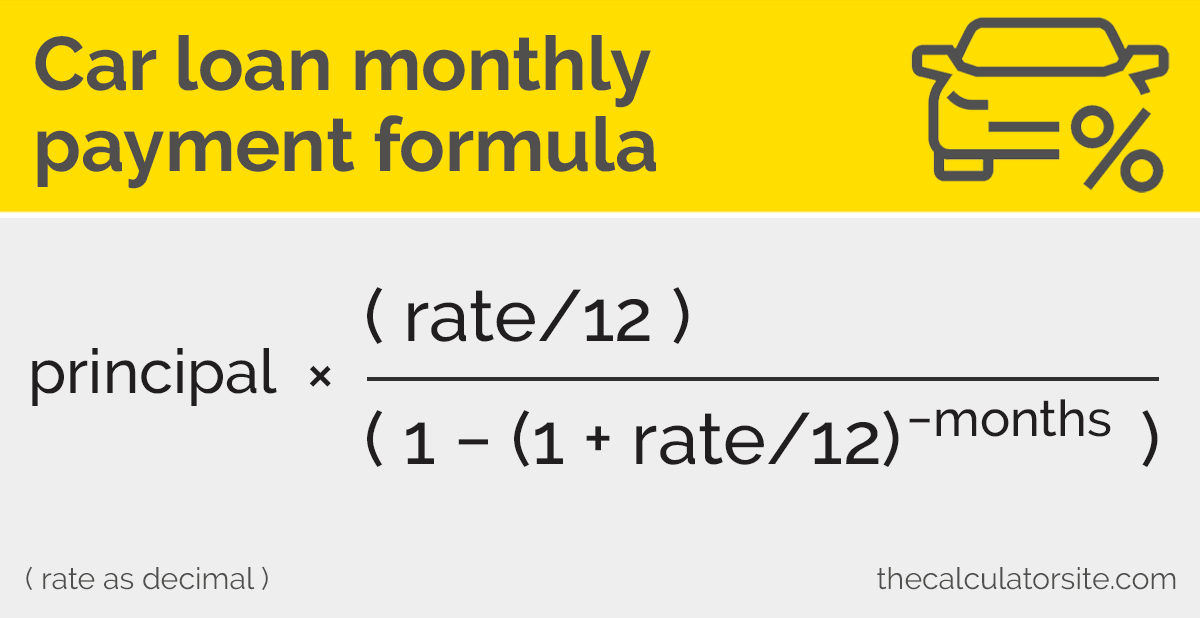
The formula used to calculate a fixed monthly payment for a loan with a fixed interest rate is:
M = P [ i(1 + i)^n ] / [ (1 + i)^n – 1]
Where:
-
M = Your monthly loan payment
-
P = The principal loan amount (the amount you’re borrowing)
-
i = Your monthly interest rate (your annual interest rate divided by 12)
-
n = The total number of payments (your loan term in years multiplied by 12)
This formula is designed to ensure that each monthly payment covers both a portion of the principal and the interest accrued on the remaining balance. Early in the loan term, a larger portion of your payment goes towards interest, gradually shifting to more principal as the loan matures.
Breaking Down Each Variable
Let’s clarify each variable with practical conversion steps:
-
P (Principal Loan Amount): As discussed, this is the final amount you need to finance after your down payment and trade-in.
- Example: If a car costs $30,000, you put $5,000 down, and trade in a car worth $3,000, your principal (P) would be $30,000 – $5,000 – $3,000 = $22,000.
-
i (Monthly Interest Rate): This is where many make a mistake. The APR provided by lenders is annual. You must convert it to a monthly rate by dividing it by 12. Crucially, you must also convert the percentage to a decimal.
- Example: If your APR is 6%, convert it to a decimal first (0.06). Then divide by 12: i = 0.06 / 12 = 0.005.
-
n (Total Number of Payments): This is your loan term in months. If your loan term is given in years, multiply it by 12.
- Example: For a 5-year loan, n = 5 years * 12 months/year = 60 payments.
Why Understanding the Formula Matters
While online calculators can do the heavy lifting, comprehending this formula empowers you. It allows you to:
-
Verify calculator results: Ensure accuracy and detect potential errors.
-
Understand sensitivities: See how changes in P, i, or n impact M.
-
Negotiate effectively: Know exactly how different loan offers translate into real monthly costs.
-
Budget more precisely: Integrate your car payment into your financial plan with confidence.
A Practical Walkthrough: Step-by-Step Calculation
Let’s walk through an example to illustrate how to use the amortization formula to calculate a car payment.
Gathering Your Loan Details
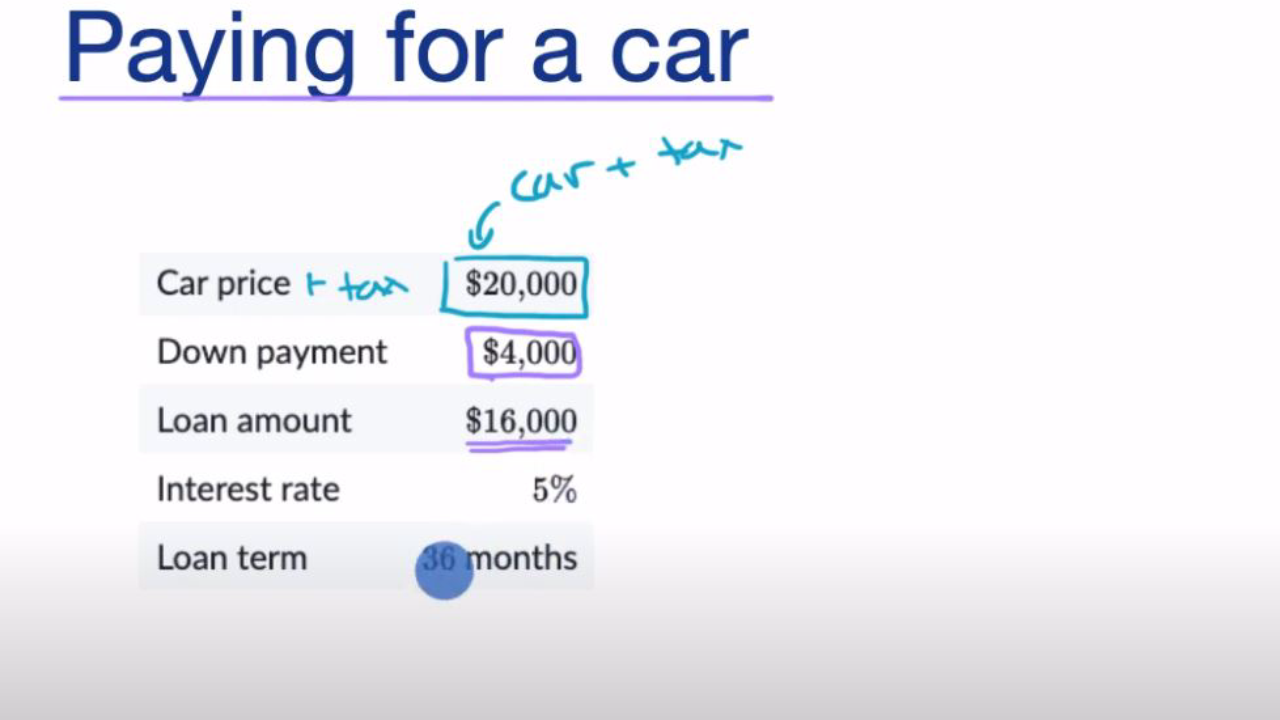
Imagine you’ve found your dream car. After negotiations, a down payment, and a trade-in, you need to finance $25,000.
-
Principal (P): $25,000
-
Annual Interest Rate (APR): 4.9%
-
Loan Term: 60 months (5 years)
Converting Annual Interest to Monthly
First, convert the annual interest rate to a monthly decimal rate:
-
Annual interest rate (decimal): 4.9% / 100 = 0.049
-
Monthly interest rate (i): 0.049 / 12 = 0.00408333
Next, determine the total number of payments:
- Total number of payments (n): 60 months
Applying the Formula with an Example
Now, plug these values into the formula:
M = P [ i(1 + i)^n ] / [ (1 + i)^n – 1]
-
Calculate (1 + i): 1 + 0.00408333 = 1.00408333
-
Calculate (1 + i)^n: (1.00408333)^60 ≈ 1.27515
-
Calculate numerator part: i(1 + i)^n: 0.00408333 * 1.27515 ≈ 0.005206
-
Calculate denominator part: (1 + i)^n – 1: 1.27515 – 1 = 0.27515
-
Divide numerator by denominator: 0.005206 / 0.27515 ≈ 0.018921
-
Multiply by Principal (P): $25,000 * 0.018921 ≈ $473.03
So, your estimated monthly car payment would be approximately $473.03.
Verifying Your Results
While manual calculation provides clarity, it’s always wise to verify your results using online car loan calculators or spreadsheet software. These tools are designed to handle complex calculations quickly and accurately, confirming your understanding and preventing calculation errors. Many financial websites offer free, user-friendly car loan calculators where you simply input P, APR, and term, and it instantly provides M.
Key Factors Influencing Your Payment Beyond the Principal
While the formula provides the numerical framework, several other real-world factors can significantly influence both your monthly payment and the total cost of your car loan.
The Impact of Your Credit Score
Your credit score is perhaps the most powerful determinant of the interest rate you’ll be offered. Lenders use it to assess your creditworthiness – your likelihood of repaying the loan.
-
Excellent Credit (720+ FICO): Qualifies you for the lowest interest rates, often leading to substantial savings over the loan term.
-
Good Credit (690-719): Still generally secures favorable rates, though perhaps not the absolute best.
-
Fair Credit (630-689): You might face higher interest rates as lenders perceive a slightly elevated risk.
-
Poor Credit (below 630): Expect significantly higher interest rates, or even difficulty securing a loan, to compensate lenders for the increased risk.
Improving your credit score before applying for a car loan can lead to thousands of dollars in savings.
Loan Term vs. Total Interest Paid
As briefly mentioned, the loan term is a double-edged sword:
-
Longer Terms (e.g., 72 or 84 months): Reduce your monthly payment, making the car seem more affordable upfront. However, you’ll accumulate more interest over the extended period, increasing the total cost of the car. For example, a $25,000 loan at 4.9% for 60 months totals about $3,380 in interest, while for 72 months, it jumps to over $4,000.
-
Shorter Terms (e.g., 36 or 48 months): Lead to higher monthly payments but significantly reduce the total interest paid and allow you to own the car free and clear much sooner.
Always consider the total cost of the loan, not just the monthly payment, when choosing a term.
Additional Costs (Taxes, Fees, Add-ons)
Beyond the vehicle’s price and interest, several other costs can be rolled into your loan, increasing the principal amount you borrow and thus your monthly payment:
-
Sales Tax: State and local sales taxes on the car’s purchase price.
-
Documentation Fees: Fees charged by the dealership for processing paperwork.
-
Registration and Licensing Fees: Required to legally operate your vehicle.
-
Extended Warranties/Service Contracts: Optional add-ons that can significantly inflate the loan amount.
-
GAP Insurance: Covers the difference between what you owe on your loan and the car’s actual cash value if it’s totaled or stolen.
Be vigilant about these “add-ons.” While some are mandatory, others are optional and can be negotiated or declined to keep your principal (and thus your payments) lower.
Leveraging Technology and Smart Strategies for Car Loan Management
Calculating your car payment is the first step; managing it effectively and smartly is the next. Various tools and strategies can assist you.
Online Car Loan Calculators
These are invaluable tools for quick, accurate calculations and comparisons. Reputable financial institutions, automotive websites, and personal finance platforms offer free online calculators. They allow you to:
-
Experiment with variables: Instantly see how changing your principal, APR, or loan term affects your monthly payment.
-
Compare offers: Input different loan scenarios from various lenders to find the most favorable terms.
-
Plan your budget: Determine what payment amount comfortably fits your monthly finances.
Spreadsheet Solutions (Excel/Google Sheets)
For those who prefer a hands-on approach or need more detailed amortization schedules, spreadsheet software like Microsoft Excel or Google Sheets is excellent. You can use their built-in financial functions, such as PMT(), to calculate monthly payments.
The PMT() function takes three main arguments:
-
rate: The monthly interest rate (APR/12). -
nper: The total number of payments (loan term in months). -
pv: The present value or principal loan amount.
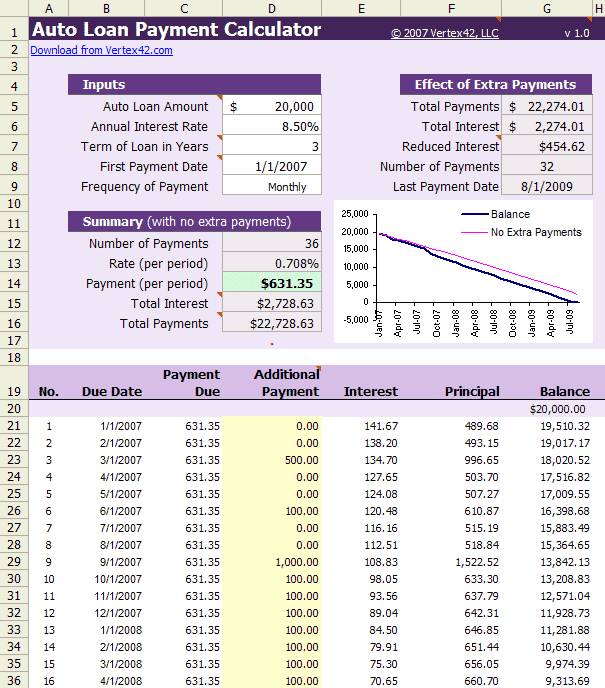
Spreadsheets also allow you to create full amortization schedules, showing how much principal and interest you pay with each installment, and how your loan balance decreases over time.
Refinancing Your Car Loan
If interest rates have dropped since you took out your original loan, or if your credit score has significantly improved, refinancing your car loan could be a smart financial move. Refinancing involves taking out a new loan to pay off your existing car loan, ideally at a lower interest rate or with more favorable terms. This can lead to:
-
Lower monthly payments: By securing a lower APR.
-
Reduced total interest: Saving you money over the life of the loan.
-
Changed loan term: Either shortening it to pay off faster or lengthening it for more financial breathing room (though lengthening increases total interest).
Always weigh the benefits against any fees associated with refinancing.
The Power of Extra Payments
Even small extra payments can have a significant impact on your car loan. When you pay more than your scheduled monthly amount, the excess typically goes directly towards reducing your principal balance. Since interest is calculated on the remaining principal, reducing this balance faster means:
-
Less interest paid overall: The total cost of your car decreases.
-
Faster loan payoff: You become debt-free sooner.
-
Increased equity: You build ownership in your vehicle more rapidly.
Before making extra payments, confirm with your lender that there are no prepayment penalties, which are rare for car loans but worth checking. Even rounding up your payment by $10 or $20 each month can make a noticeable difference over time.
Calculating your car payments with interest is more than just a mathematical exercise; it’s a fundamental step in responsible personal finance. By understanding the components of a car loan, mastering the amortization formula, and leveraging available tools and strategies, you empower yourself to make informed decisions that align with your financial goals and lead to a more secure financial future.
aViewFromTheCave is a participant in the Amazon Services LLC Associates Program, an affiliate advertising program designed to provide a means for sites to earn advertising fees by advertising and linking to Amazon.com. Amazon, the Amazon logo, AmazonSupply, and the AmazonSupply logo are trademarks of Amazon.com, Inc. or its affiliates. As an Amazon Associate we earn affiliate commissions from qualifying purchases.