
Buying a car is one of life’s significant financial milestones for many, often second only to purchasing a home. The thrill of a new vehicle, the promise of independence, or the necessity of reliable transportation can sometimes overshadow the intricate financial details involved. While the sticker price grabs initial attention, it’s the monthly auto loan payment that truly dictates the affordability and long-term financial commitment. Understanding how this payment is calculated is not just about crunching numbers; it’s about empowering yourself to make informed decisions, negotiate effectively, and ultimately, ensure your vehicle purchase aligns with your broader financial goals.
Without a clear grasp of auto loan calculations, you risk overpaying, accepting unfavorable terms, or even falling into debt traps. This comprehensive guide will demystify the process, breaking down the key components of an auto loan, explaining the underlying formula, and offering practical strategies to manage and optimize your car financing. By the end, you’ll be equipped with the knowledge to approach your next car purchase with confidence and financial acumen.
Understanding the Core Components of an Auto Loan
Before diving into the mathematical formulas, it’s crucial to understand the fundamental elements that contribute to your monthly auto loan payment. Each component plays a significant role in shaping the final figure you pay each month and the total cost of your loan over time.
Principal Amount
The principal amount is the actual sum of money you borrow to finance your car. This isn’t necessarily the car’s sticker price. Instead, it’s determined by the vehicle’s selling price, minus any down payment you make, and then often plus any additional fees and taxes that are rolled into the loan. A higher principal means a larger monthly payment and more interest paid over the life of the loan.
Interest Rate (APR)
The interest rate, typically expressed as an Annual Percentage Rate (APR), is the cost of borrowing money. It’s the fee lenders charge for letting you use their capital. A lower APR translates to lower monthly payments and significantly less interest paid over the loan term, making it one of the most critical factors to negotiate and secure favorably. Your creditworthiness is a primary determinant of the APR you’ll be offered.
Loan Term
The loan term is the duration over which you agree to repay the loan, usually expressed in months (e.g., 36, 48, 60, 72, or even 84 months). A longer loan term results in lower monthly payments because the principal is spread out over more installments. However, a longer term also means you’ll pay more interest overall, as the lender has more time to accrue interest on the outstanding balance. Conversely, a shorter term leads to higher monthly payments but less total interest paid.
Down Payment
A down payment is an upfront sum of money you pay towards the purchase of the vehicle, reducing the amount you need to borrow. A substantial down payment has several benefits: it lowers your principal amount, which reduces your monthly payments and the total interest you’ll pay. It can also help you secure a better interest rate because you’re seen as a less risky borrower. Furthermore, a larger down payment provides instant equity in the car, which is beneficial in case of an accident or if the car depreciates quickly.
Additional Costs and Fees
Beyond the car’s price and interest, several other costs can be rolled into your loan, increasing the principal. These often include sales tax, registration fees, documentation fees charged by the dealership, and sometimes optional add-ons like extended warranties, GAP insurance, or service contracts. While convenient to finance these, remember that you’ll pay interest on them for the entire loan term, increasing their actual cost. It’s generally financially prudent to pay these upfront if possible, or at least be fully aware of their impact on your loan.
The Formula Behind Your Monthly Payment
While many online calculators exist to simplify this process, understanding the underlying mathematical formula provides a deeper insight into how your payments are structured. The calculation for a fixed-rate, fully amortizing loan (where each payment includes both principal and interest, and the loan is fully paid off by the end of the term) uses a standard amortization formula.
The formula is:
$$M = P [i(1 + i)^n] / [(1 + i)^n – 1]$$
Where:
- M = Your monthly loan payment
- P = The principal loan amount (the total amount borrowed)
- i = Your monthly interest rate (your annual interest rate divided by 12)
- n = The total number of payments (your loan term in years multiplied by 12)
Let’s break down how to apply this formula with a practical example.
Step-by-Step Calculation Breakdown
-
Determine Your Principal (P): Start with the car’s selling price. Subtract your down payment. Add any taxes, registration fees, and other charges you choose to roll into the loan. This is your ‘P’.
- Example: Car Price: $30,000, Down Payment: $5,000, Taxes/Fees rolled in: $1,500.
- P = ($30,000 – $5,000) + $1,500 = $26,500
-
Calculate Your Monthly Interest Rate (i): Take your APR and divide it by 100 to convert it to a decimal, then divide by 12 (for 12 months in a year).
- Example: APR = 6%.
- i = (6 / 100) / 12 = 0.06 / 12 = 0.005
-
Determine the Total Number of Payments (n): Multiply your loan term in years by 12.
- Example: Loan Term = 5 years.
- *n = 5 * 12 = 60*
-
Plug the Values into the Formula: Now, substitute these values into the amortization formula.
Practical Example Calculation

Using the example figures:
- P = $26,500
- i = 0.005
- n = 60
$$M = 26,500 [0.005(1 + 0.005)^{60}] / [(1 + 0.005)^{60} – 1]$$
$$M = 26,500 [0.005(1.005)^{60}] / [(1.005)^{60} – 1]$$
First, calculate $(1.005)^{60}$:
$(1.005)^{60} approx 1.34885$
Now substitute back:
$$M = 26,500 [0.005 * 1.34885] / [1.34885 – 1]$$
$$M = 26,500 [0.00674425] / [0.34885]$$
$$M = 178.622625 / 0.34885$$
$$M approx 512.01$$
So, your estimated monthly payment would be approximately $512.01. This mathematical approach, while robust, highlights why most people rely on online calculators for speed and accuracy. However, understanding the variables allows you to manipulate them in your favor during negotiation.
Factors Influencing Your Auto Loan Payment
While the formula provides the exact calculation, several real-world factors significantly influence the values you input into that formula, thus affecting your final monthly payment and the total cost of the loan.
Credit Score’s Role
Your credit score is perhaps the most impactful factor determining the interest rate (APR) you’ll be offered. Lenders use your credit score to assess your creditworthiness – your likelihood of repaying the loan. A higher credit score (generally 700+) indicates a lower risk, which typically qualifies you for lower interest rates. Conversely, a lower credit score will result in a higher APR, leading to larger monthly payments and substantially more interest paid over the loan term. It’s often advisable to check and improve your credit score before applying for a significant loan like a car.
Down Payment Size
As discussed, a larger down payment reduces the principal amount borrowed. This directly translates to lower monthly payments. Beyond the immediate impact, a significant down payment can also influence the lender’s perception of your risk, potentially helping you secure a slightly better interest rate, further reducing your total cost. Aiming for at least a 10-20% down payment is often recommended, if feasible.
Loan Term Length
The choice of loan term presents a trade-off. A longer term (e.g., 72 or 84 months) will spread your principal and interest over more payments, resulting in a lower monthly payment. This can make a more expensive car seem “affordable” on a monthly basis. However, the downside is paying significantly more in total interest over the life of the loan. You also risk owing more than the car is worth (being “upside down” or “underwater”) for a longer period due to depreciation. A shorter term (e.g., 36 or 48 months) means higher monthly payments but substantially less total interest paid, saving you money in the long run.
New vs. Used Car Pricing
The decision between a new and used car directly impacts your principal amount. New cars generally have higher selling prices, leading to larger loan amounts. They also depreciate rapidly in the first few years. Used cars, while often more affordable initially, might come with higher interest rates (as they are perceived as higher risk by lenders due to age/mileage) and potentially higher maintenance costs down the line. Weighing the upfront cost versus the total cost of ownership is crucial.
Dealer vs. External Financing
Dealerships often offer financing options, sometimes with promotional low APRs. However, it’s always wise to shop around for financing before you visit the dealership. Banks, credit unions, and online lenders can often offer competitive rates. Getting pre-approved for a loan from an external lender gives you a benchmark and strengthens your negotiating position at the dealership, allowing you to compare offers and choose the best terms.
Tools and Strategies for Smarter Loan Management
Armed with the knowledge of how auto loan payments are calculated, you can employ various tools and strategies to ensure you get the best possible deal and manage your loan effectively.
Online Auto Loan Calculators
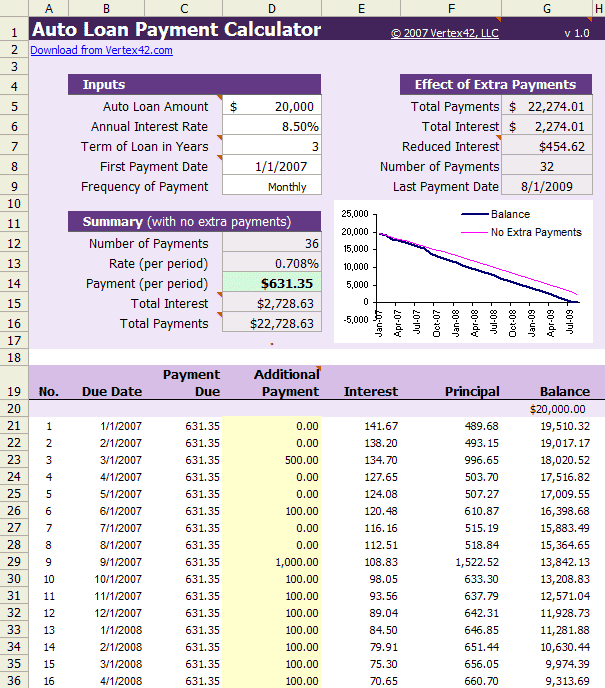
These ubiquitous tools are invaluable. By simply inputting the principal, interest rate, and loan term, they instantly calculate your monthly payment. Use multiple calculators from different sources (e.g., your bank, credit union, independent financial sites) to verify results. Many also allow you to see the total interest paid over the loan’s life and generate amortization schedules. They are excellent for scenario planning – seeing how changes to your down payment, interest rate, or term impact the monthly payment and total cost.
Amortization Schedules
An amortization schedule is a table detailing each payment made on an amortizing loan. For each payment, it shows how much goes towards interest, how much towards principal, and the remaining loan balance. Reviewing this schedule helps you understand how interest front-loads in the early payments and how your equity builds over time. It can also motivate you to make extra principal payments, as you can see the direct impact on reducing future interest.
Pre-Approval for a Loan
Getting pre-approved for an auto loan from a bank or credit union before you start car shopping is a powerful strategy. It establishes a maximum loan amount you qualify for and a specific interest rate. This allows you to:
- Set a Budget: You know precisely how much you can afford, preventing you from falling in love with a car outside your financial limits.
- Negotiate with Confidence: You walk into the dealership with your own financing in hand, effectively turning you into a cash buyer. You can then use the dealer’s financing offer as a point of comparison and leverage for a better deal.
- Focus on Car Price: With financing settled, you can concentrate solely on negotiating the vehicle’s price, rather than being distracted by monthly payment manipulation.
Refinancing Options
If interest rates drop after you’ve secured your auto loan, or if your credit score significantly improves, refinancing your car loan could save you money. Refinancing involves taking out a new loan to pay off your existing one, ideally at a lower interest rate or with a more favorable term. This can reduce your monthly payments or the total interest paid. It’s worth exploring if your current loan terms are unfavorable or if your financial situation has improved since you first financed the car.
Understanding Total Cost of Ownership
While this article focuses on loan payments, it’s crucial to consider the total cost of ownership (TCO) when buying a car. Beyond the loan payment, TCO includes fuel, insurance, maintenance, repairs, and depreciation. A car with a low monthly payment might have high insurance costs or be known for expensive repairs, ultimately costing you more over time. Use resources like Edmunds’ True Cost to Own or Kelley Blue Book to estimate these additional expenses.

Conclusion
Calculating an auto loan payment might seem complex at first glance, but by understanding the core components – principal, interest rate, and loan term – and familiarizing yourself with the underlying formula, you gain invaluable financial literacy. This knowledge is not just academic; it’s a practical tool that empowers you to take control of your car buying journey.
Armed with the ability to calculate and understand the factors influencing your monthly payment, you can confidently negotiate with dealerships, shop around for the best financing rates, make informed decisions about down payments and loan terms, and ultimately choose a vehicle that fits comfortably within your budget without compromising your long-term financial health. Remember, a car purchase is a significant financial commitment, and an informed buyer is always a powerful one. Make your next auto loan decision with clarity, confidence, and financial insight.
aViewFromTheCave is a participant in the Amazon Services LLC Associates Program, an affiliate advertising program designed to provide a means for sites to earn advertising fees by advertising and linking to Amazon.com. Amazon, the Amazon logo, AmazonSupply, and the AmazonSupply logo are trademarks of Amazon.com, Inc. or its affiliates. As an Amazon Associate we earn affiliate commissions from qualifying purchases.