
Purchasing a car is a significant financial decision for most individuals and families. While the excitement of a new vehicle can be intoxicating, the reality of its cost often hinges on one crucial element: the auto loan payment. Understanding how this monthly obligation is determined isn’t just about satisfying a lender; it’s about taking control of your personal finances, making informed decisions, and ensuring your car purchase aligns with your broader financial goals.
Many people focus solely on the monthly payment amount, often overlooking the underlying factors that contribute to it, such as the principal, interest rate, and loan term. Without a clear grasp of these components and how they interact, consumers risk overpaying, choosing an unfavorable loan structure, or even committing to a payment that strains their budget. This comprehensive guide will demystify the process of calculating an auto loan payment, empower you with the knowledge to use various tools, and help you strategize for the best possible deal.
Understanding the Core Components of an Auto Loan
Before diving into the mathematical formulas, it’s essential to grasp the fundamental elements that dictate the size of your monthly auto loan payment. Each component plays a critical role, and a slight change in any one can significantly alter your financial commitment.
The Principal Amount
The principal is the actual amount of money you are borrowing to finance your car. This isn’t necessarily the sticker price of the vehicle. Instead, it’s derived by subtracting any down payment you make, the value of any trade-in vehicle, and potentially any rebates or incentives from the vehicle’s purchase price. A larger down payment or a valuable trade-in directly reduces your principal, which in turn lowers your monthly payments and the total interest you’ll pay over the life of the loan. Conversely, if you finance almost the entire purchase price, your principal will be higher, leading to larger payments and more interest accrual. Understanding how to minimize your principal upfront is one of the most effective strategies for smart car financing.
Interest Rate (APR)
The interest rate, often expressed as an Annual Percentage Rate (APR), is essentially the cost of borrowing money. It’s the percentage charged by the lender on the principal amount over the term of the loan. A lower interest rate translates to less money paid back to the lender over time, making your loan more affordable. Your APR is influenced by several factors, including your credit score, the loan term, the car’s age, and market conditions. Lenders reserve their lowest rates for borrowers with excellent credit histories, as they are deemed less risky. It’s crucial to shop around for the best interest rates, as even a seemingly small difference of one or two percentage points can save you hundreds, if not thousands, of dollars over the life of the loan. Most auto loans feature a fixed interest rate, meaning it remains constant throughout the loan term, providing predictable payments.
Loan Term
The loan term refers to the duration over which you agree to repay the loan, typically expressed in months (e.g., 36, 48, 60, 72, or even 84 months). The loan term has a direct and significant impact on your monthly payment and the total interest paid. A shorter loan term means fewer payments, which generally results in higher individual monthly payments but less total interest paid because the principal is repaid faster. Conversely, a longer loan term will lead to lower monthly payments, making the car seem more affordable in the short term, but you will end up paying significantly more in total interest over the life of the loan. This is a critical trade-off to consider: balancing immediate affordability with the long-term cost. While lower payments might seem appealing, longer terms often mean paying more for the car than its actual value over an extended period due to depreciation and interest.
Sales Tax and Fees
Beyond the vehicle’s price, principal, interest rate, and loan term, it’s vital to account for sales tax and various fees. Sales tax, which varies by state and locality, is typically calculated on the vehicle’s purchase price and can add a substantial amount to the total cost. Other fees might include documentation fees charged by the dealership, registration fees, title fees, and license plate fees, all mandated by state motor vehicle departments. While some of these fees might be paid out-of-pocket, many buyers opt to roll them into their auto loan. When these costs are financed, they increase your principal amount, thereby impacting your monthly payment and the total interest you’ll incur. Always ask for a detailed breakdown of all fees and taxes before finalizing your loan agreement to understand the true total cost.
Manual Calculation: The Auto Loan Payment Formula
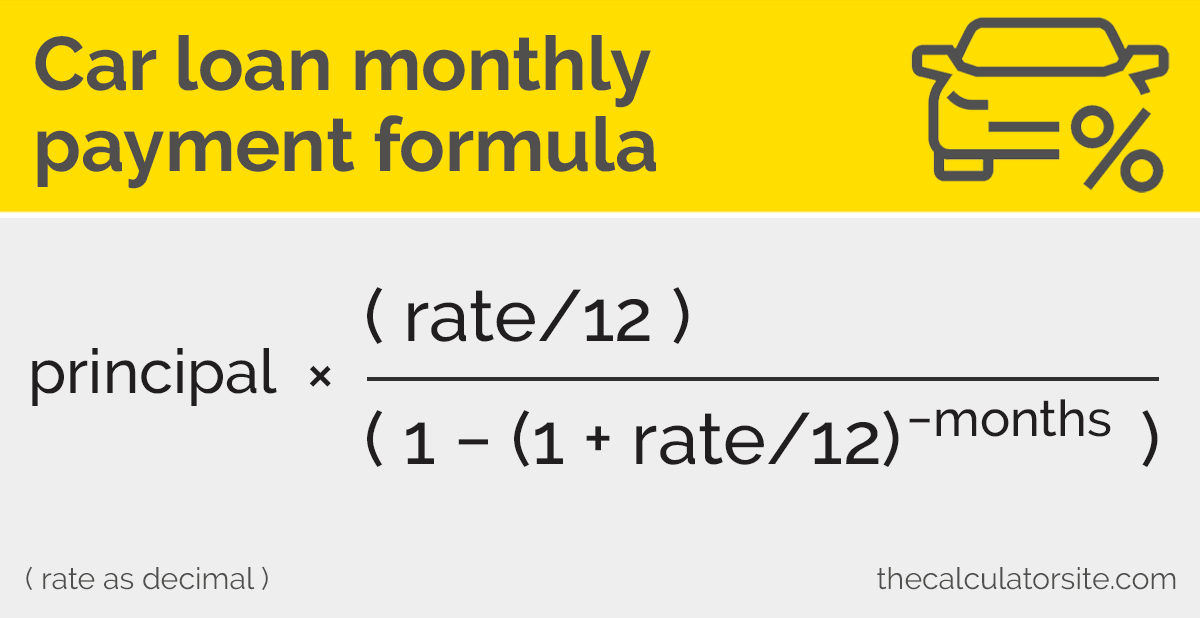
While financial calculators and online tools have made calculating loan payments incredibly convenient, understanding the underlying formula provides invaluable insight into how your payments are structured. The standard formula used to calculate a fixed-rate loan payment, which applies to most auto loans, is as follows:
M = P [ i(1 + i)^n ] / [ (1 + i)^n – 1 ]
Let’s break down each variable in this formula to understand its role.
Deconstructing the Formula
-
M = Monthly Payment: This is the figure you’re trying to find – the amount you’ll pay each month.
-
P = Principal Loan Amount: As discussed, this is the total amount of money you are borrowing after any down payment, trade-in, or rebates.
-
i = Monthly Interest Rate: This is your annual interest rate (APR) divided by 12 (for 12 months in a year). For example, if your APR is 6%, then
i = 0.06 / 12 = 0.005. It’s crucial to convert the percentage to a decimal. -
n = Total Number of Payments: This is your loan term in years multiplied by 12. For instance, a 5-year (60-month) loan term would mean
n = 5 * 12 = 60.
The formula essentially calculates the present value of an annuity (a series of equal payments) to determine the fixed payment required to amortize the loan over its term. The top part [ i(1 + i)^n ] determines the interest factor over the loan term, while the bottom part [ (1 + i)^n – 1 ] represents the total number of payments discounted by the interest rate. By understanding these components, you gain a deeper appreciation for how the interest rate compounds over time and how the term distributes that cost.
Step-by-Step Manual Calculation (Conceptual)
While performing this calculation by hand is tedious and prone to error, the conceptual steps are important for understanding the process:
-
Determine the Principal (P): Subtract your down payment and trade-in value from the vehicle’s total purchase price (including any taxes and fees you choose to finance).
-
Convert APR to Monthly Interest Rate (i): Divide your annual APR (as a decimal) by 12.
-
Calculate Total Number of Payments (n): Multiply your loan term in years by 12.
-
Plug Values into the Formula: Substitute P, i, and n into the formula.
-
Calculate Exponents First: Compute
(1 + i)^n. -
Perform Multiplication and Division: Carefully follow the order of operations to arrive at M.
This manual process highlights the intricate relationship between the principal, interest, and term. Even a slight adjustment to the interest rate or loan term can significantly alter the monthly payment, reinforcing the importance of optimizing each variable.
Leveraging Financial Tools for Auto Loan Calculation

Given the complexity of the manual formula and the potential for error, most people—including financial professionals—rely on specialized tools to calculate auto loan payments. These tools not only provide accurate results quickly but also offer additional insights that can aid in financial planning.
Online Auto Loan Calculators
Online calculators are by far the most accessible and widely used tools for determining auto loan payments. They are available on virtually every bank and credit union website, financial news portals, and even many dealership sites.
-
Benefits: These calculators are incredibly user-friendly, requiring you only to input the principal amount, interest rate, and loan term. With a click, they instantly display your estimated monthly payment.
-
Features: Beyond just the monthly payment, many advanced online calculators offer:
-
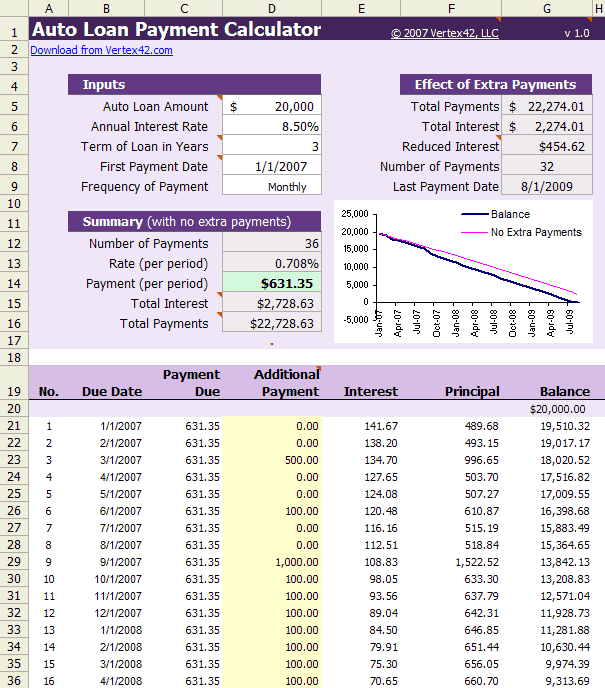
Amortization Schedules: A detailed breakdown of each payment, showing how much goes towards principal and how much towards interest over the life of the loan. This reveals how interest payments are front-loaded.
-
Total Interest Paid: This figure is crucial for understanding the true cost of your loan beyond the principal.
-
“What-If” Scenarios: The ability to quickly adjust variables (e.g., increase down payment, lower APR, extend term) allows you to see the immediate impact on your monthly payment and total cost, helping you compare different loan options effectively.
-
Using multiple online calculators from different sources can also help verify results and provide a broader perspective on potential payment ranges.
Spreadsheet Software (Excel/Google Sheets)
For those who prefer a more hands-on approach or need to integrate loan calculations into a broader personal budget, spreadsheet software like Microsoft Excel or Google Sheets offers powerful functionality. These programs include built-in financial functions that streamline loan calculations.
-
The PMT Function: The primary function for calculating loan payments is
PMT. Its syntax typically looks like this:PMT(rate, nper, pv, [fv], [type]).-
rate: The interest rate per period (i.e., monthly interest rate, APR/12). -
nper: The total number of payments for the loan (loan term in months, years*12). -
pv: The present value, or the principal amount of the loan. -
[fv]: Optional. The future value, or a cash balance you want to attain after the last payment (default is 0). -
[type]: Optional. Indicates when payments are due (0 for end of period, 1 for beginning of period; default is 0).
-
-
Benefits: Using a spreadsheet allows for:
-
Customization: You can create your own financial models, incorporating other car-related expenses (insurance, fuel, maintenance) alongside your loan payment.
-
Dynamic Scenarios: It’s easy to set up cells for principal, rate, and term and instantly see how changes affect the payment, total interest, and even your overall budget.
-
Integration: The results can be directly integrated into your personal finance tracking spreadsheets, providing a holistic view of your financial health.
-
By mastering either online calculators or spreadsheet functions, you can swiftly and accurately determine your auto loan payments and make confident financial decisions.
Beyond the Monthly Payment: Strategic Considerations
While knowing your exact monthly payment is vital, a truly insightful approach to auto financing extends beyond this single figure. Responsible financial planning requires considering the broader implications of your loan and how it fits into your overall financial picture.
Total Cost of Ownership
Focusing solely on the monthly payment can be misleading. A lower monthly payment often comes with a longer loan term and, consequently, a much higher total cost due to increased interest payments. It’s imperative to calculate the total amount you will pay for the car, including the principal plus all interest. This can be significantly higher than the vehicle’s sticker price. Furthermore, the total cost of ownership extends beyond the loan itself to include insurance premiums, fuel costs, routine maintenance, unexpected repairs, and depreciation. Understanding these ancillary expenses ensures you budget comprehensively and aren’t caught off guard by the true cost of car ownership. Always ask lenders for the “total amount repayable” to compare different loan offers accurately.
Impact of Down Payment and Trade-In
One of the most powerful levers you have in controlling your monthly payment and total loan cost is a substantial down payment. The more money you put down upfront, the less you need to borrow, directly reducing your principal. A lower principal means smaller monthly payments and, crucially, less interest accruing over the loan’s term. Similarly, strategically leveraging the value of a trade-in vehicle can serve the same purpose as a down payment. Ensure you research your trade-in’s market value independently before visiting a dealership to ensure you receive a fair offer. Maximizing your upfront contribution not only saves money but can also help you secure a better interest rate, as lenders perceive lower loan-to-value ratios as less risky.
The Power of Pre-Approval
Before you even step foot in a dealership, getting pre-approved for an auto loan is a game-changer. Pre-approval from a bank or credit union means a lender has already evaluated your creditworthiness and committed to lending you a specific amount at a particular interest rate, contingent on the final car selection.
-
Knowing Your Budget: Pre-approval clearly defines how much you can afford, preventing you from falling in love with a car outside your financial reach.
-
Negotiating Power: Armed with a pre-approval, you become a cash buyer in the dealership’s eyes. You can then negotiate the car’s price more effectively without getting bogged down in financing details, and you have a benchmark interest rate to compare against any offers from the dealership’s finance department. If the dealership can beat your pre-approved rate, fantastic; if not, you already have a strong offer in hand.
Refinancing Options
Life circumstances and financial markets change, and sometimes a loan that made sense a few years ago no longer seems optimal. Refinancing an auto loan involves taking out a new loan to pay off your existing one, often with more favorable terms. This can be a smart move if:
-
Interest Rates Have Dropped: If market rates have fallen since you took out your original loan, you might qualify for a lower APR, reducing your monthly payment or the total interest paid.
-
Your Credit Score Has Improved: A significantly improved credit score can qualify you for a much better rate than you originally received.
-
You Need to Adjust Your Payment: Refinancing can also allow you to extend the loan term to lower your monthly payments (though this typically increases total interest) or shorten the term to pay off the loan faster and save on interest.
Always calculate the potential savings and any associated fees before deciding to refinance.
Conclusion
Calculating an auto loan payment is far more than a simple mathematical exercise; it’s a fundamental aspect of sound personal financial management. By understanding the principal, interest rate, and loan term, you gain clarity on your financial commitment. Leveraging readily available tools like online calculators and spreadsheet functions makes the calculation process straightforward and accurate, empowering you to explore various scenarios and identify the most advantageous loan structure.
However, true financial insight extends beyond the monthly figure. Considering the total cost of ownership, making strategic down payments, utilizing pre-approval to your advantage, and being aware of refinancing options are all crucial steps in ensuring your car purchase is a long-term financial asset, not a burden. By taking a proactive and informed approach to auto loan calculations, you can drive away with confidence, knowing you’ve made a responsible and smart financial decision that aligns with your overall wealth-building journey.
aViewFromTheCave is a participant in the Amazon Services LLC Associates Program, an affiliate advertising program designed to provide a means for sites to earn advertising fees by advertising and linking to Amazon.com. Amazon, the Amazon logo, AmazonSupply, and the AmazonSupply logo are trademarks of Amazon.com, Inc. or its affiliates. As an Amazon Associate we earn affiliate commissions from qualifying purchases.