
Understanding how interest accumulates is a cornerstone of sound financial literacy. Whether you are saving for retirement, taking out a loan, or investing in the market, the concept of accumulated interest dictates the ultimate growth of your money or the total cost of your borrowing. Far from being a mere academic exercise, calculating accumulated interest empowers individuals and businesses to make informed decisions, manage debt effectively, and strategically plan for future wealth creation. This guide delves into the mechanisms of interest accumulation, from the basic principles of simple interest to the powerful dynamics of compounding, providing you with the tools and knowledge to confidently navigate your financial journey.
Understanding the Fundamentals of Interest
Before we delve into calculations, it’s crucial to establish a solid understanding of what interest is and the primary forms it takes. This foundational knowledge will make the subsequent calculations intuitive and the implications clear.
What is Interest?
In its simplest form, interest is the cost of borrowing money or the reward for lending money. For borrowers, it’s the fee paid for the use of someone else’s capital. For lenders or investors, it’s the income earned on their money, compensating them for the time value of money and the risk of lending. This cost or reward is typically expressed as a percentage of the principal amount over a specific period.
For example, if you deposit money into a savings account, the bank pays you interest for the use of your funds. Conversely, when you take out a loan, you pay interest to the lender for the privilege of using their money. The rate at which this interest is charged or paid is known as the interest rate.
Simple vs. Compound Interest
The two primary types of interest are simple and compound interest, and understanding their difference is paramount to grasping how money truly grows or debt escalates.
-
Simple Interest: Simple interest is calculated only on the principal amount, which is the initial sum of money borrowed or invested. It does not take into account any interest that has accumulated in previous periods. This means the interest earned or paid remains constant over the investment or loan term, assuming the principal and interest rate do not change. Simple interest is often used for short-term loans or some bonds.
-
Compound Interest: Compound interest, famously dubbed the “eighth wonder of the world” by Albert Einstein, is interest calculated on the initial principal and also on all the accumulated interest from previous periods. This “interest on interest” effect leads to exponential growth over time, making it a powerful force for long-term savings and investments, but also a significant factor in the growth of debt if not managed carefully. The more frequently interest is compounded (e.g., daily, monthly, quarterly, annually), the faster the balance grows.
Key Components of Interest Calculation (Principal, Rate, Time)
Regardless of whether you’re dealing with simple or compound interest, three core components are always involved in the calculation:
-
Principal (P): This is the initial amount of money borrowed or invested. It’s the base upon which interest is calculated.
-
Interest Rate (r): This is the percentage at which interest is charged or paid, usually expressed annually. For calculations, it must be converted from a percentage to a decimal (e.g., 5% becomes 0.05).
-
Time (t): This represents the duration for which the money is borrowed or invested, typically expressed in years. If the time is in months, it needs to be converted to years (e.g., 6 months = 0.5 years).
These three variables are the bedrock of all interest calculations.
Calculating Simple Accumulated Interest
Simple interest is the easiest form of interest to calculate and understand. While less common for long-term investments, it’s fundamental for short-term financial products and provides a clear baseline for interest accumulation.
The Simple Interest Formula Explained
The formula for calculating simple interest is straightforward:
I = P * r * t
Where:
-
I = Total Simple Interest Accumulated
-
P = Principal amount
-
r = Annual interest rate (as a decimal)
-
t = Time (in years)
To find the total amount (A) at the end of the period, you simply add the accumulated simple interest to the principal:
A = P + I
or
A = P * (1 + r * t)
Practical Examples of Simple Interest Calculation
Let’s walk through a couple of examples to solidify this concept.
Example 1: Short-term Loan
Imagine you take out a short-term loan of $5,000 at a simple annual interest rate of 4% for 6 months.
-
P = $5,000
-
r = 4% = 0.04
-
t = 6 months = 0.5 years
Using the formula I = P * r * t:
I = $5,000 * 0.04 * 0.5
I = $100
The total simple interest accumulated is $100.
The total amount to repay would be A = $5,000 + $100 = $5,100.
Example 2: Savings Deposit
You deposit $10,000 into an account that pays 2% simple annual interest for 3 years.
-
P = $10,000
-
r = 2% = 0.02
-
t = 3 years
Using the formula I = P * r * t:
I = $10,000 * 0.02 * 3
I = $600
The total simple interest accumulated is $600.
The total amount in your account after 3 years would be A = $10,000 + $600 = $10,600.
When Simple Interest Applies (e.g., short-term loans, bonds)
Simple interest is typically applied in situations where the interest is paid out or collected at the end of the term and does not get reinvested or added to the principal to earn further interest. Common applications include:
-
Short-term personal loans: Many short-duration personal loans or payday loans may use simple interest calculations.
-
Bonds: The interest payments (coupon payments) on many bonds are calculated using simple interest on the bond’s face value.
-
Some basic savings accounts: While less common for traditional savings accounts today, some very basic or specific short-term savings products might use simple interest.
It’s crucial to always check the terms and conditions of any financial product to understand whether simple or compound interest applies.
Mastering Compound Accumulated Interest
Compound interest is where the true magic (or menace, depending on your perspective) of interest accumulation lies. It’s the driving force behind long-term wealth building and also a significant contributor to the growth of long-term debt.
The Power of Compounding: A Definition
As previously mentioned, compound interest is interest earned on both the initial principal and the accumulated interest from previous periods. This means your money grows at an accelerating rate because the base upon which interest is calculated continuously increases. The longer your money is invested and the more frequently it compounds, the more dramatic the effect.
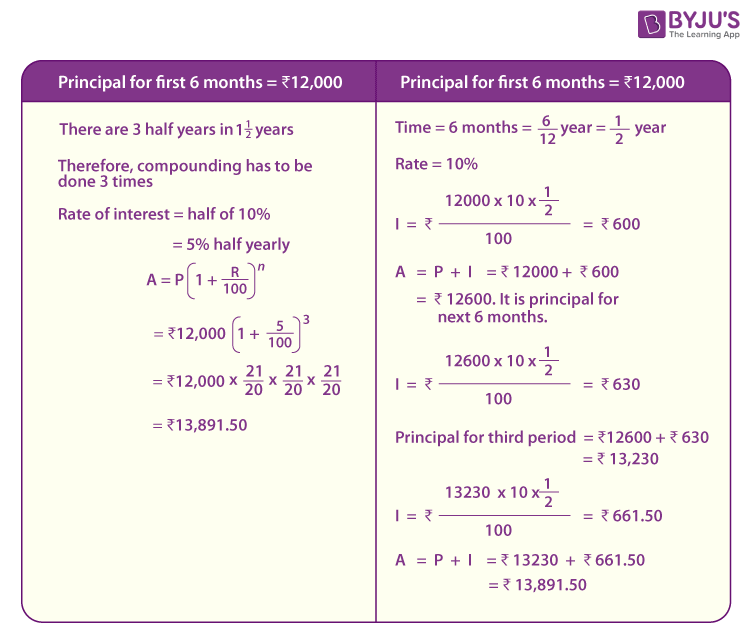
This “interest on interest” effect is why starting to save and invest early is so often emphasized in financial advice. Even small amounts can grow substantially over decades through the power of compounding.
The Compound Interest Formula Demystified
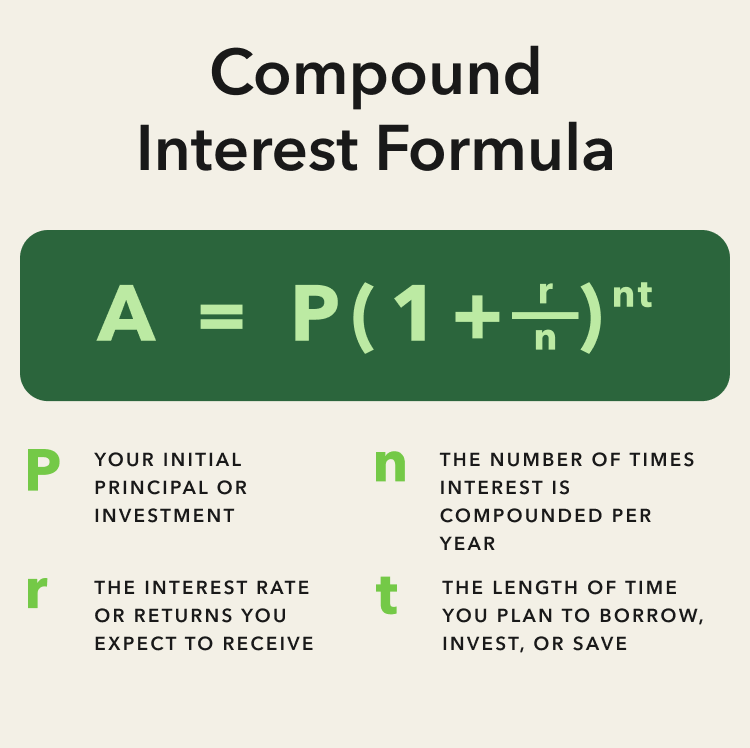
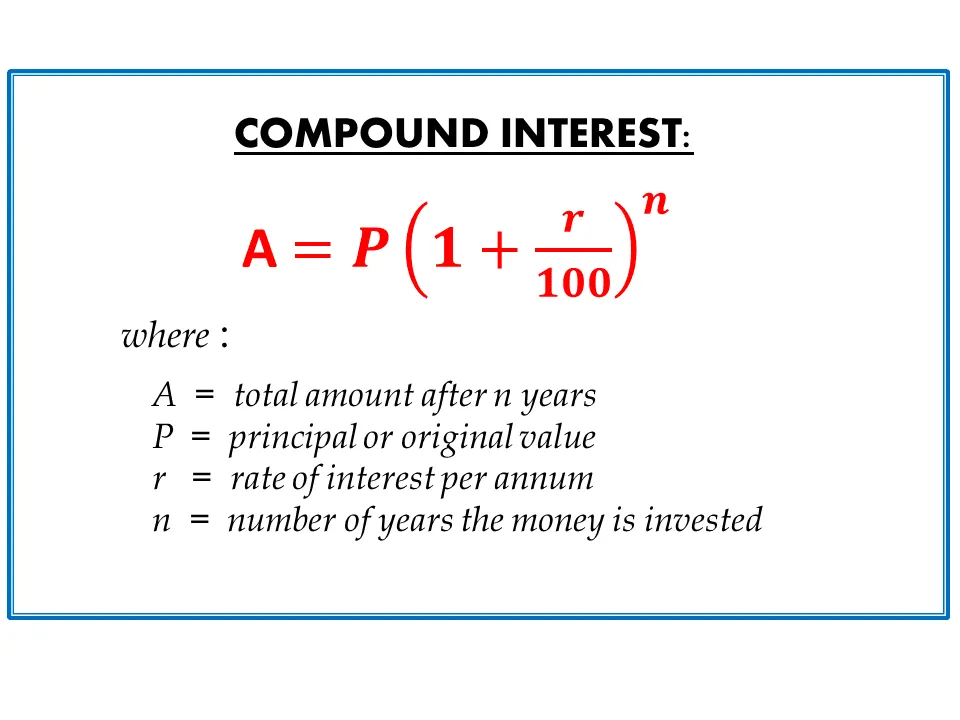
The formula for compound interest is slightly more complex than simple interest, but it’s equally crucial to understand:
A = P * (1 + r/n)^(n*t)
Where:
-
A = The future value of the investment/loan, including interest
-
P = The principal investment amount (the initial deposit or loan amount)
-
r = The annual interest rate (as a decimal)
-
n = The number of times that interest is compounded per year
-
t = The number of years the money is invested or borrowed for
To find just the accumulated compound interest (I), you subtract the principal from the future value:
I = A – P
Impact of Compounding Frequency (Annually, Semi-annually, Quarterly, Monthly, Daily)
The frequency of compounding (represented by ‘n’ in the formula) plays a significant role in how much interest accumulates. The more frequently interest is compounded, the higher the effective annual rate and the greater the accumulated amount, assuming the same nominal annual interest rate.
Let’s illustrate with an example: You invest $1,000 at an annual interest rate of 5% for 10 years.
-
Annually (n=1): A = $1,000 * (1 + 0.05/1)^(1*10) = $1,000 * (1.05)^10 = $1,628.89
-
Semi-annually (n=2): A = $1,000 * (1 + 0.05/2)^(2*10) = $1,000 * (1.025)^20 = $1,638.62
-
Quarterly (n=4): A = $1,000 * (1 + 0.05/4)^(4*10) = $1,000 * (1.0125)^40 = $1,643.62
-
Monthly (n=12): A = $1,000 * (1 + 0.05/12)^(12*10) = $1,000 * (1.00416667)^120 = $1,647.01
-
Daily (n=365): A = $1,000 * (1 + 0.05/365)^(365*10) = $1,000 * (1.000136986)^3650 = $1,648.66
As you can see, the difference grows incrementally with more frequent compounding, even if the nominal annual rate remains 5%. While the difference might seem small for a single investment of $1,000, over larger sums and longer periods, these differences can amount to thousands or even millions of dollars.
Real-World Applications and Benefits (Savings, Investments, Retirement)
Compound interest is the engine behind most long-term financial growth:
-
Savings Accounts: Most high-yield savings accounts compound interest, often monthly or daily.
-
Investments: Stocks, bonds, mutual funds, and ETFs that pay dividends or reinvest earnings benefit significantly from compounding.
-
Retirement Accounts (401k, IRA): The exponential growth from compounding is crucial for building a substantial nest egg over decades. The earlier you start contributing, the more time your money has to compound.
-
Mortgages and Loans: While beneficial for savings, compound interest can also work against you with loans, especially those with long terms like mortgages or high-interest credit card debt, where interest compounds rapidly on the outstanding balance.
Advanced Scenarios and Considerations
While the basic formulas for simple and compound interest cover most situations, real-world finance often presents more complex scenarios. Understanding these nuances can further refine your financial planning.
Interest with Regular Contributions/Payments (Annuities)
Many people don’t just invest a lump sum; they make regular contributions (e.g., monthly deposits to a savings account or retirement fund). This scenario involves what’s known as an annuity. Calculating the future value of an annuity with compound interest is more involved, requiring a specific formula:
FV = P * [((1 + r/n)^(n*t) – 1) / (r/n)]
Where:
-
FV = Future Value of the annuity
-
P = The amount of each regular payment/contribution
-
r = Annual interest rate (as a decimal)
-
n = Number of times interest is compounded per year
-
t = Number of years
This formula calculates the future value of a series of equal payments, assuming they are made at the end of each period (ordinary annuity). Many online calculators can simplify these calculations for practical use.
Dealing with Variable Interest Rates
Not all interest rates are fixed. Adjustable-rate mortgages (ARMs), certain credit cards, and some business loans feature variable interest rates that can change over time based on market conditions (e.g., tied to a benchmark like the prime rate or LIBOR/SOFR).
When dealing with variable rates, calculating accumulated interest becomes more dynamic. You typically need to calculate the interest for each period (e.g., month or quarter) using the prevailing rate for that period and then sum them up. Financial models often use forecasted interest rate scenarios to estimate future accumulated interest. For individuals, it’s crucial to understand how rate changes will impact your payments or earnings.
The Effect of Inflation on Accumulated Interest
While your money might be growing due to interest, inflation erodes its purchasing power. The “real” rate of return or accumulation is the nominal interest rate minus the inflation rate.
Real Rate of Return ≈ Nominal Interest Rate – Inflation Rate
If your accumulated interest rate is 5% annually, but inflation is 3%, your money’s real purchasing power is only growing by approximately 2%. This is a vital consideration for long-term planning, especially for retirement savings, as you need your investments to outpace inflation to genuinely increase your wealth over time.
Using Financial Calculators and Software
While understanding the formulas is essential, in practice, most people rely on financial calculators, spreadsheet software (like Excel or Google Sheets), or online tools to perform complex interest calculations.
-
Financial Calculators: Dedicated financial calculators (e.g., Texas Instruments BA II Plus) have built-in functions for time value of money (TVM) calculations, including future value, present value, payments, interest rates, and periods.
-
Spreadsheets: Excel’s
FV()(Future Value),PV()(Present Value),PMT()(Payment),RATE()(Interest Rate), andNPER()(Number of Periods) functions are incredibly powerful for various interest-related calculations, including annuities. -
Online Calculators: Numerous free online calculators exist for compound interest, mortgage payments, savings goals, and more. These are excellent for quick estimates and what-if scenarios.
These tools allow for quick and accurate calculations, helping you model different financial scenarios without having to manually plug numbers into complex formulas every time.
Why Understanding Accumulated Interest Matters
The ability to calculate and comprehend accumulated interest is more than just a mathematical skill; it’s a critical life skill that underpins sound financial decision-making.
Empowering Personal Finance Decisions
Understanding how interest accumulates allows you to:
-
Evaluate loan offers: Compare different loan products, assess their true cost over time, and identify the most favorable terms.
-
Set realistic savings goals: Project the growth of your investments and determine how much you need to save to reach specific financial milestones.
-
Manage debt: Recognize the long-term cost of carrying balances on credit cards or other high-interest loans and motivate yourself to pay them down faster.
-
Choose the right financial products: Distinguish between accounts that offer simple versus compound interest, and understand the impact of compounding frequency on your returns.
Strategic Investing and Debt Management
For investors, a deep understanding of compound interest is the key to unlocking long-term wealth. It emphasizes the importance of:
-
Starting early: Giving your money more time to compound.
-
Consistent contributions: Regularly adding to your investments.
-
Reinvesting returns: Allowing dividends and interest to compound.
-
Patience: Trusting in the long-term growth trajectory.
Conversely, for debt management, understanding how interest accumulates helps in:
-
Prioritizing high-interest debt: Recognizing which debts are costing you the most over time.
-
Accelerating payments: Seeing how even small extra payments can significantly reduce total interest paid and shorten the loan term.
-
Avoiding unnecessary debt: Being fully aware of the true cost of borrowing.
Building Long-Term Wealth
Ultimately, knowing how to calculate accumulated interest is a vital tool for building and preserving long-term wealth. It demystifies the mechanics of financial growth and decay, allowing you to take control of your financial future. Whether you’re planning for a comfortable retirement, saving for a down payment, or funding a child’s education, mastering the principles of interest accumulation is an indispensable step toward achieving your financial aspirations. It shifts you from being a passive participant in your financial life to an active, informed decision-maker, strategically leveraging the power of interest to your advantage.
aViewFromTheCave is a participant in the Amazon Services LLC Associates Program, an affiliate advertising program designed to provide a means for sites to earn advertising fees by advertising and linking to Amazon.com. Amazon, the Amazon logo, AmazonSupply, and the AmazonSupply logo are trademarks of Amazon.com, Inc. or its affiliates. As an Amazon Associate we earn affiliate commissions from qualifying purchases.