
In the realms of personal finance, corporate accounting, and institutional investing, precision is the bedrock of sound decision-making. One of the most common yet frequently misunderstood calculations is determining the percentage increase of a percentage. While it may sound redundant at first, this mathematical process is vital when tracking fluctuating interest rates, analyzing profit margin growth, or evaluating the performance of investment portfolios.
Miscalculating these figures can lead to significant errors in financial forecasting and reporting. For instance, if a company’s profit margin grows from 10% to 12%, many stakeholders might mistakenly describe this as a 2% increase. In reality, it is a 20% increase in the margin. Understanding this distinction is not just a matter of semantics; it is a fundamental requirement for anyone looking to master their money and business finances.
Understanding the Concept in a Financial Context
To calculate the percentage increase of a percentage, one must first distinguish between “percentage points” and “percentage change.” This distinction is the most frequent source of confusion in financial news and corporate boardrooms.
The Difference Between Percentage Points and Percentage Increase
A “percentage point” refers to the simple arithmetic difference between two percentages. If your high-yield savings account interest rate moves from 4% to 5%, it has increased by 1 percentage point.
However, a “percentage increase” measures the relative growth of the initial value. In the same example, moving from 4% to 5% represents a 25% increase over the original rate (1 divided by 4). In the financial world, using the term “percentage” without clarification can lead to a misinterpretation of data. If an investor is told their returns grew by “5%,” they need to know if that means the total return rate moved from 10% to 15% (a 50% relative increase) or if the final number was simply 5% higher than the previous year’s total.
Why This Calculation Matters for Investors and Business Owners
For business owners, profit margins are expressed as percentages. If you are aiming to scale your business, a 1% increase in gross margin on a multimillion-dollar revenue stream can translate to hundreds of thousands of dollars in bottom-line profit. By calculating the percentage increase of that margin, management can better assess the effectiveness of cost-cutting measures or price hikes.
For investors, the same logic applies to dividend yields and interest rates. When the Federal Reserve adjusts interest rates by 25 basis points (0.25%), the relative impact on a 1% rate is massive (a 25% increase), whereas the impact on a 5% rate is much smaller (a 5% increase). Understanding this relativity helps in assessing risk and potential reward across different asset classes.
The Step-by-Step Methodology for Accurate Calculations
Performing this calculation requires a disciplined approach to ensure that the “base” and “target” values are handled correctly. Whether you are using a calculator or a spreadsheet, the logic remains the same.
Identifying the Base Value and the Target Value
The “Base Value” is the original percentage you are starting with. The “Target Value” is the new percentage you have reached. It is important to treat these percentages as the actual numbers for the sake of the formula. Do not convert them back to decimals until the very end if you find it easier to work with whole numbers, but stay consistent.
For example, if you are looking at an increase in a tax rate from 15% to 18%:
- Base Value: 15
- Target Value: 18
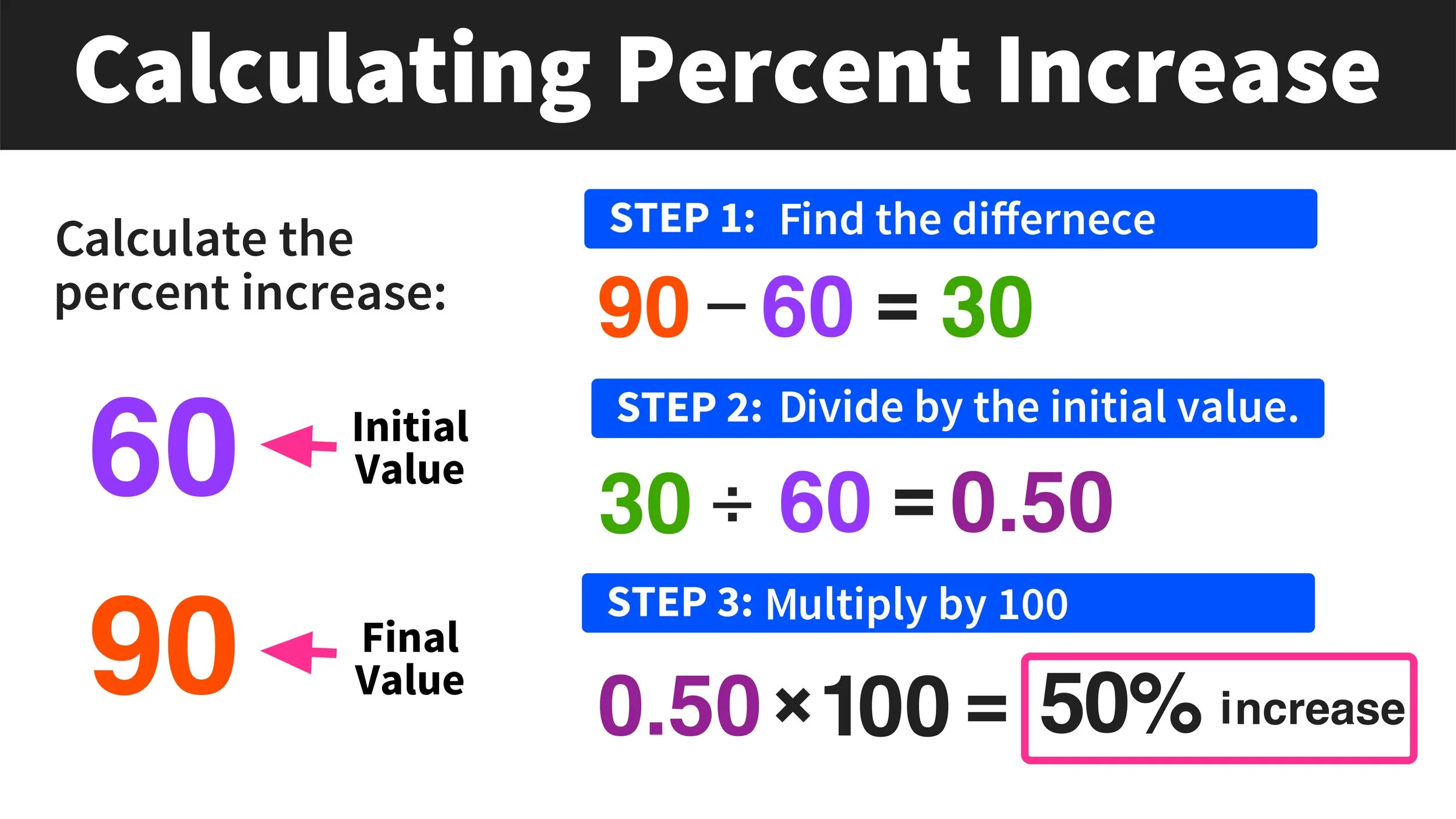
The Standard Formula: (New % – Old %) / Old %
To find the percentage increase, you use the standard percentage change formula, but you apply it to the percentage values themselves.
- Subtract the Old Percentage from the New Percentage: This gives you the change in percentage points. (18 – 15 = 3 percentage points).
- Divide the Difference by the Old Percentage: This shows the growth relative to the starting point. (3 / 15 = 0.2).
- Multiply by 100: This converts the decimal back into a percentage. (0.2 * 100 = 20%).
Therefore, a move from a 15% tax rate to an 18% tax rate is a 20% increase in the tax rate.
Real-World Example: Tracking Interest Rate Growth
Consider a small business owner with a variable-interest loan. If the interest rate was 5% last year and has risen to 6.5% this year, the owner needs to calculate the impact on their debt service.
- Change in points: 6.5 – 5 = 1.5 percentage points.
- Relative increase: 1.5 / 5 = 0.3.
- Percentage increase: 30%.
This 30% increase in the interest rate is a far more descriptive and alarming figure than simply saying the rate went up by “one and a half points,” as it directly correlates to the 30% increase in interest expenses the business will now face.
Practical Applications in Portfolio Management
In portfolio management, percentages are the primary language of success. However, looking at raw percentages can sometimes mask the true momentum of an investment.
Analyzing Dividend Yield Growth
Investors who focus on “Dividend Growth” strategies often look for companies that increase their dividend yield over time. Suppose a stock has a dividend yield of 2%. If the company increases its payout and the yield rises to 2.5%, the investor has seen a 25% increase in their yield on cost (assuming the stock price remained stable). By calculating the percentage increase of the percentage yield, investors can compare the growth rate of different income-producing assets more effectively.
Measuring Profit Margin Improvements
Corporate financial health is often judged by “margin expansion.” If a retail company has a net profit margin of 4% and through operational efficiencies increases it to 5%, they have achieved a 25% increase in profit efficiency. In the eyes of an analyst, a 25% increase in margin is a significant indicator of management’s ability to control costs, often more impressive than a simple increase in top-line revenue.
Assessing Inflation’s Impact on Returns
Inflation is expressed as a percentage. If inflation rises from 2% to 4%, it has doubled—a 100% increase. This calculation is crucial when determining “real” rates of return. If your investment portfolio returns are consistent at 8%, but inflation increases from 2% to 4%, the percentage increase in inflation significantly erodes your purchasing power. Understanding how much the inflation rate itself has increased allows for more realistic long-term retirement planning.
Common Pitfalls and How to Avoid Them
Even seasoned financial professionals can fall into traps when communicating changes in percentages. Avoiding these pitfalls ensures clarity in financial reporting and personal budgeting.
Confusing Relative Change with Absolute Change
The biggest pitfall is failing to specify whether an increase is in “percentage points” or is a “relative percentage.” In financial marketing, companies often use whichever number sounds more impressive. A bank might say their interest rate is “50% higher” than a competitor’s. If the competitor offers 1%, and the bank offers 1.5%, both statements are true. However, a customer might hear “50%” and expect a massive return. Always ask for the absolute numbers to verify the relative change.
The Danger of Compounding Errors in Financial Reporting
When percentages increase over multiple periods, the errors in calculation can compound. If a manager reports that a 10% margin increased by 10% each year for two years, the final margin isn’t 12% (10 + 1 + 1). It is 12.1%.
- Year 1: 10% + (10% of 10) = 11%
- Year 2: 11% + (10% of 11) = 12.1%
In business finance, failing to account for this compounding effect when calculating the percentage increase of a percentage can lead to missed targets and inaccurate budget allocations.
Leveraging Financial Tools for Complex Percentage Calculations
While the math can be done manually, modern financial tools allow for automation and deeper analysis, reducing the risk of human error.
Spreadsheet Formulas for Automation
In Excel or Google Sheets, calculating the percentage increase of a percentage is straightforward. If your old percentage is in cell A1 and your new percentage is in cell B1, the formula is:
=(B1-A1)/A1
Ensure that the cells are formatted as percentages. Spreadsheet software handles the underlying decimals automatically, meaning if you type “10%” and “12%”, the software sees 0.10 and 0.12 and will correctly return 0.2 (or 20% when formatted). This is the most efficient way to track large datasets, such as monthly changes in department margins or historical interest rate shifts.

Financial Calculators and Software Integration
For those managing complex business finances, accounting software like QuickBooks or ERP systems often provide “Variance Reports.” These reports are designed to automatically calculate the percentage increase of various financial ratios. Utilizing these tools allows for “Management by Exception,” where you only investigate areas where the percentage increase of a specific metric (like the percentage of wasted inventory) exceeds a certain threshold.
By mastering the calculation of a percentage increase of a percentage, you gain a sharper lens through which to view your financial world. Whether you are negotiating a loan, evaluating a stock, or running a business, this level of mathematical literacy ensures that you are never misled by ambiguous data and that your financial strategies are built on a foundation of absolute precision.
aViewFromTheCave is a participant in the Amazon Services LLC Associates Program, an affiliate advertising program designed to provide a means for sites to earn advertising fees by advertising and linking to Amazon.com. Amazon, the Amazon logo, AmazonSupply, and the AmazonSupply logo are trademarks of Amazon.com, Inc. or its affiliates. As an Amazon Associate we earn affiliate commissions from qualifying purchases.