
In the intricate world of personal and business finance, understanding percentages is not just a mathematical curiosity—it’s a critical life skill. From deciphering discounts on a new gadget to calculating tax liabilities, or even meticulously planning your monthly budget, the ability to quickly and accurately determine a percentage of a given number empowers you to make informed decisions. Among the myriad percentage calculations, finding “30 percent of a number” holds a particularly significant place, frequently appearing in financial rules of thumb, investment scenarios, and everyday consumer choices.
This article delves into the practical methods for calculating 30 percent, exploring its myriad applications within the realm of money. We’ll break down the concepts, provide actionable steps, and illustrate how mastering this seemingly simple calculation can dramatically enhance your financial literacy and decision-making capabilities. Whether you’re a seasoned investor, a meticulous budgeter, or just starting your financial journey, a firm grasp of percentage calculations, particularly the 30 percent mark, is an indispensable tool in your financial toolkit.
The Foundation: Understanding Percentages in Finance
Before we dive into the specific calculation of 30 percent, it’s crucial to lay a solid groundwork by understanding what percentages fundamentally represent and why they are so prevalent in financial contexts.
What Does “Percent” Really Mean?
The term “percent” originates from the Latin phrase “per centum,” meaning “by the hundred” or “out of every hundred.” Essentially, a percentage is a way of expressing a number or a ratio as a fraction of 100. So, 30 percent (written as 30%) simply means 30 out of every 100. This standardized way of expressing parts of a whole makes it incredibly useful for comparisons and calculations across different scales.
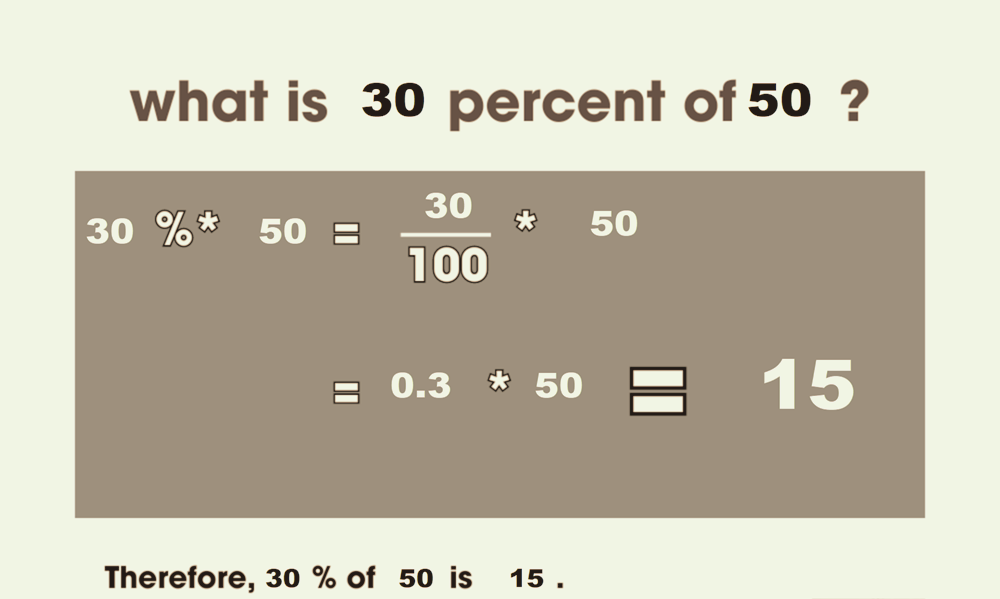
In financial applications, percentages allow us to understand proportions without getting bogged down by raw, absolute figures. For example, knowing that your investment grew by 30% tells you more about its performance relative to your initial capital than simply knowing it gained $300, without knowing if you invested $1,000 or $10,000. To perform calculations, percentages are often converted into decimals or fractions. For instance, 30% can be written as 0.30 (30 divided by 100) or as the fraction 30/100 (which simplifies to 3/10). This conversion is the first step in almost any percentage-based financial calculation.
Why 30 Percent? Common Applications in Money Matters
The figure of 30 percent isn’t arbitrarily chosen; it frequently appears in a variety of financial rules and scenarios, making its calculation a particularly valuable skill.
-
Budgeting Rules: One of the most famous budgeting guidelines is the “30% Rule” for housing costs. Many financial experts suggest that no more than 30% of your gross income should be allocated to housing expenses (rent or mortgage, property taxes, insurance). Similarly, limits on debt payments, savings goals, or discretionary spending might often hover around the 30% mark.
-
Taxes and Deductions: From income tax brackets to sales tax rates or certain deductions and credits, percentages are the backbone of taxation. While specific rates vary, understanding how to calculate a 30% tax liability on an income or a 30% deduction on an expense is fundamental to managing your cash flow and financial planning.
-
Discounts and Sales: Black Friday, seasonal clearances, and loyalty programs frequently offer discounts expressed as percentages. A “30% off” sale can represent significant savings, and knowing how to calculate this on the fly helps you make quick purchasing decisions and assess the true value of a deal.
-
Investment Returns or Losses: When assessing the performance of your portfolio, mutual funds, or individual stocks, gains and losses are almost always expressed as percentages. Understanding a 30% return or a 30% drawdown on an investment is crucial for evaluating risk and making future investment choices.
-
Business Profit Margins: For entrepreneurs and small business owners, calculating profit margins, cost markups, or sales commissions often involves percentages. Knowing that your product yields a 30% gross profit margin provides vital insight into your business’s financial health.
Practical Methods for Calculating 30 Percent
While the underlying principle is simple, there are several practical ways to calculate 30 percent of a number, each suitable for different situations and preferences.
Method 1: The Decimal Approach (The Most Common)
This is arguably the most straightforward and widely used method, especially when using a calculator.
-
Convert the percentage to a decimal: Divide 30 by 100, which gives you 0.30.
-
Multiply the number by the decimal: Take the original number and multiply it by 0.30.
Example: Calculate 30% of $250.
-
Convert 30% to 0.30.
-
Multiply: $250 * 0.30 = $75.
So, 30% of $250 is $75.
Method 2: The Fractional Approach (Simplifying for Mental Math)
This method involves converting the percentage into a simplified fraction, which can sometimes make mental calculations easier.
-
Convert the percentage to a fraction: 30% is 30/100.
-
Simplify the fraction: Both 30 and 100 are divisible by 10, so 30/100 simplifies to 3/10.
-
Multiply the number by the simplified fraction: Multiply the original number by the numerator (3) and then divide by the denominator (10).
Example: Calculate 30% of $250.
-
Convert 30% to 3/10.
-
Multiply by numerator, then divide by denominator: ($250 * 3) / 10 = $750 / 10 = $75.
Alternatively, divide by denominator first: ($250 / 10) * 3 = $25 * 3 = $75.
This method is particularly intuitive for numbers easily divisible by 10.
Method 3: The “Break It Down” Approach (Excellent for Mental Math)
This method leverages the simplicity of calculating 10 percent and then scaling it up. It’s fantastic for quick mental estimates.
-
Calculate 10% of the number: To find 10% of any number, simply move the decimal point one place to the left (which is equivalent to dividing by 10).
-
Multiply the 10% result by 3: Since 30% is three times 10%, multiply the result from step 1 by 3.
Example: Calculate 30% of $250.
-
Calculate 10% of $250: Move the decimal one place left, resulting in $25.00 (or $25).
-
Multiply $25 by 3: $25 * 3 = $75.
This method is incredibly useful for everyday situations where you need a quick calculation without a tool.

Method 4: Using a Calculator or Spreadsheet (Efficiency and Accuracy)
For larger numbers, multiple calculations, or ensuring absolute precision, digital tools are invaluable.
-
Basic Calculator: Simply enter the number, then multiply by 0.30 (e.g.,
250 * 0.30 =). Some calculators have a percentage button; you might enter250 * 30 % =. -
Spreadsheet (Excel, Google Sheets): This is ideal for financial planning, budgeting, or business analysis.
-
If your number is in cell A2, you can use the formula
=A2*0.30. -
Alternatively, you can directly use the percentage format:
=A2*30%.
-
Spreadsheets allow you to quickly apply the calculation to many numbers, automate processes, and reduce errors, making them a staple in professional financial management.
Real-World Financial Scenarios: Putting 30% to Work
Understanding the methods is only half the battle; applying them to real-world financial situations is where the true value lies.
Budgeting for the 30% Rule
Imagine your gross monthly income is $4,000. If you follow the common financial advice to allocate no more than 30% of your income to housing:
- Calculation: $4,000 * 0.30 = $1,200.
This tells you that your maximum comfortable housing budget should be around $1,200 per month. This simple calculation provides a crucial benchmark for evaluating rental costs, mortgage payments, and overall financial stability, preventing you from becoming “house poor.”
Decoding Discounts and Sales
You’ve found a new laptop priced at $800, and it’s advertised with a “30% off” discount.
-
Calculate the discount amount: $800 * 0.30 = $240.
-
Calculate the final price: $800 – $240 = $560.
By quickly calculating the discount, you can confirm your savings, compare deals, and ensure you’re getting the best value for your money.
Estimating Taxes or Commissions
Suppose you earned a commission of $1,500, and your company deducts a 30% tax withholding for self-employed individuals, or you need to set aside 30% for estimated taxes.
- Calculation: $1,500 * 0.30 = $450.
Knowing this, you understand that $450 will likely be withheld or needs to be set aside for tax purposes, allowing you to manage your cash flow effectively and avoid tax surprises. This is a vital step for freelancers, consultants, and small business owners.
Assessing Investment Growth or Drawdowns
If your investment portfolio is valued at $10,000 and experiences a 30% growth in a year:
-
Calculate the growth amount: $10,000 * 0.30 = $3,000.
-
New portfolio value: $10,000 + $3,000 = $13,000.
Conversely, if it experiences a 30% drawdown:
-
Calculate the loss amount: $10,000 * 0.30 = $3,000.
-
New portfolio value: $10,000 – $3,000 = $7,000.
These calculations help you understand the real impact of market fluctuations on your wealth and are essential for making informed investment decisions.
Beyond 30 Percent: Developing Broader Financial Fluency
While focusing on 30 percent, the principles discussed here extend to all percentage calculations, building a robust foundation for financial literacy.
The Power of Percentage Thinking
Mastering how to calculate 30 percent of a number is more than just a specific math skill; it cultivates a “percentage thinking” mindset. This mindset enables you to:
-
Compare Apples to Oranges: Easily compare investment returns, discount rates, or cost increases even when the base numbers are vastly different.
-
Identify Trends: Recognize relative changes and growth rates over time, whether for your income, expenses, or assets.
-
Make Quicker Decisions: Estimate financial impacts on the fly without needing a calculator for every scenario.
-
Negotiate Better: Understand the true value of a percentage-based offer, whether it’s a raise, a loan interest rate, or a supplier discount.
This analytical approach to numbers empowers you to navigate complex financial landscapes with greater confidence and make proactive choices rather than reactive ones. It’s about translating raw data into meaningful insights that directly affect your financial well-being.
When to Seek Expert Advice
While basic percentage calculations are fundamental, financial situations can quickly become complex. For intricate tax planning, large-scale investment strategies, retirement planning, or business financial modeling, relying solely on basic percentage calculations might not be sufficient.
-
Complex Tax Scenarios: Navigating progressive tax brackets, deductions, credits, and capital gains can be daunting.
-
Diversified Investment Portfolios: Balancing risk and return across various asset classes requires sophisticated analysis.
-
Business Financial Health: Detailed cash flow projections, profit and loss statements, and balance sheet analysis often require specialized accounting and financial planning software.
-
Estate Planning: Ensuring your assets are distributed according to your wishes requires legal and financial expertise.
In these instances, a financial advisor, tax professional, or accountant can provide tailored guidance, ensuring accuracy, optimizing outcomes, and helping you achieve your long-term financial goals without error. Their expertise goes beyond simple calculations, incorporating regulatory knowledge, market insights, and personalized strategies.
Conclusion
The ability to calculate 30 percent of a number is a seemingly small skill with profound implications across personal and business finance. From budgeting your income and evaluating sales to understanding investment performance and managing tax liabilities, this fundamental calculation underpins a vast array of financial decisions. By understanding the core concept of percentages and mastering practical methods like the decimal, fractional, or “break it down” approaches, you equip yourself with a powerful tool for financial empowerment.
Embrace these calculations not just as mathematical exercises but as vital steps toward greater financial literacy and independence. Practice these methods regularly, apply them to your daily financial interactions, and you’ll find yourself making more informed, confident, and ultimately, more successful financial choices. It’s a cornerstone skill that paves the way for a more secure and prosperous financial future.
aViewFromTheCave is a participant in the Amazon Services LLC Associates Program, an affiliate advertising program designed to provide a means for sites to earn advertising fees by advertising and linking to Amazon.com. Amazon, the Amazon logo, AmazonSupply, and the AmazonSupply logo are trademarks of Amazon.com, Inc. or its affiliates. As an Amazon Associate we earn affiliate commissions from qualifying purchases.