
Understanding how to calculate a percentage increase is a foundational skill for anyone navigating the complexities of personal finance, investment, or business. While seemingly simple, mastering this concept unlocks deeper insights into everything from salary negotiations and budgeting to investment returns and economic indicators like inflation. A 3 percent increase, in particular, is a frequently encountered figure – a modest yet significant shift that can impact your financial health in profound ways over time. This guide will meticulously break down the calculation, explore its real-world implications, and equip you with the knowledge to apply this essential financial tool effectively.

The Fundamental Importance of Percentage Increases in Finance
Percentages are the universal language of change in finance. They provide a standardized way to express relative shifts, making it easier to compare growth or decline across different scales and timeframes. A 3 percent increase might appear small in isolation, but its cumulative effect can be substantial. For instance, a 3% annual raise over a decade can significantly boost your lifetime earnings, just as a 3% annual inflation rate can erode your purchasing power if your income doesn’t keep pace.
Why 3% Isn’t Just a Number
In the financial world, 3% often serves as a benchmark or a critical threshold.
-
Inflation Targets: Central banks often aim for an inflation rate around 2-3% to maintain economic stability without hindering growth. If your assets or income aren’t growing at least at this rate, you’re effectively losing money.
-
Investment Returns: While aggressive investors aim higher, a consistent 3% return on certain conservative investments might be considered stable or indicative of low-risk growth. Understanding how this translates into actual dollar figures is crucial for financial planning.
-
Salary Adjustments: Annual salary increases or cost-of-living adjustments (COLAs) frequently hover around the 2-4% mark. Knowing how to calculate a 3% raise helps you understand the true impact on your take-home pay and living standards.
-
Loan Interest Rates: A 3% interest rate on a loan, while seemingly low, can accumulate significantly over long repayment periods, impacting your overall cost of borrowing.
-
Budgeting for Price Hikes: When stores announce a 3% price increase on everyday goods, knowing the calculation allows you to adjust your budget proactively.
These examples highlight that 3% is not an arbitrary figure but a common denominator in many financial conversations. Its true significance lies in its power to reflect real changes in your economic environment.
Everyday Scenarios for 3% Increases
The application of a 3% increase permeates various aspects of our daily financial lives:
-
Your Monthly Rent: If your landlord announces a 3% increase, you need to know the new rent amount immediately.
-
Investment Portfolio Growth: You check your investment statement and see a 3% gain this quarter. What does that mean for your overall wealth?
-
Credit Card Interest: While credit card rates are typically much higher, understanding how even a small percentage increase in a variable rate would impact your payments is vital.
-
Fuel Prices: A 3% hike in gas prices can noticeably affect your weekly budget if you commute frequently.
-
Retail Sales Tax: In some jurisdictions, a specific tax rate might increase by a percentage, directly affecting the final price of goods.
Being adept at calculating a 3% increase allows you to quickly assess the impact of these changes, empowering you to make informed financial decisions rather than being caught off guard. It moves you from a passive observer of financial changes to an active participant, capable of predicting and reacting to shifts in your economic landscape.
Mastering the Core Calculation Methods
Calculating a percentage increase is straightforward once you understand the underlying formula. There are several ways to approach it, each offering varying levels of detail and suitability depending on your tools and preferences.
The Manual Method: Step-by-Step Breakdown
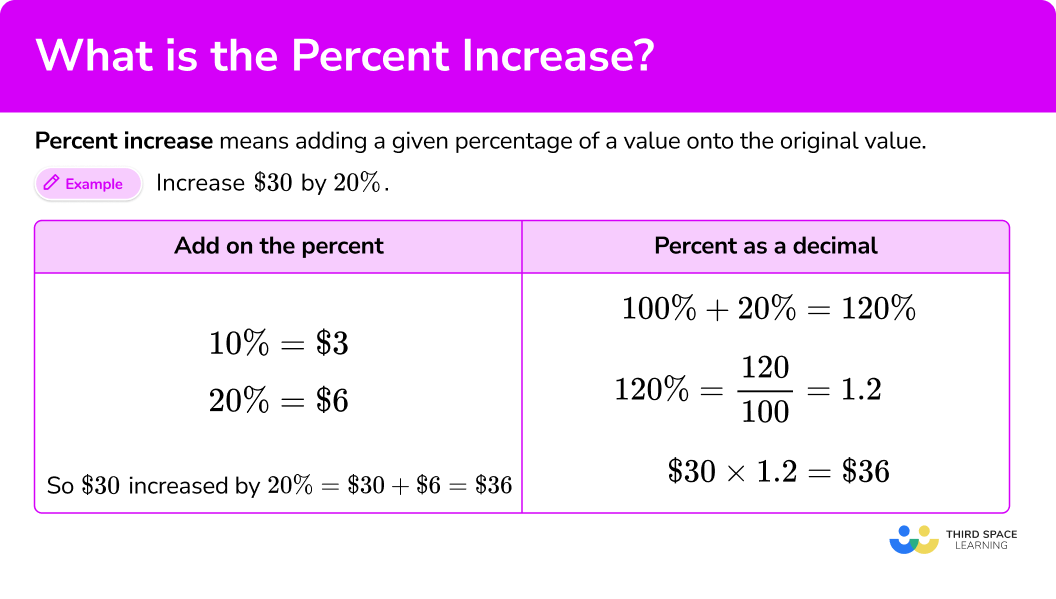
The most fundamental way to calculate a 3 percent increase involves two simple steps:
-
Calculate the percentage amount: Multiply the original amount by the percentage (expressed as a decimal).
-
Formula:
Percentage Amount = Original Amount × (Percentage / 100) -
For a 3% increase, this becomes:
Percentage Amount = Original Amount × (3 / 100)orOriginal Amount × 0.03
-
-
Add the percentage amount to the original amount:
- Formula:
New Amount = Original Amount + Percentage Amount
- Formula:
Example: You currently earn a salary of $50,000, and you’re offered a 3% raise.
-
Calculate the 3% amount:
- $50,000 × 0.03 = $1,500
(This means your raise is $1,500)
-
Add to the original amount:
- $50,000 + $1,500 = $51,500
(Your new salary will be $51,500)
An alternative, more streamlined manual method combines these steps into one:
-
Formula:
New Amount = Original Amount × (1 + (Percentage / 100)) -
For a 3% increase:
New Amount = Original Amount × (1 + 0.03)orOriginal Amount × 1.03
Using the same example:
- $50,000 × 1.03 = $51,500
This single-step method is often preferred for its efficiency, especially when dealing with multiple calculations or when only the final new amount is needed. Both manual methods yield the same accurate result.
Leveraging Calculators for Speed and Accuracy
For quick calculations, a standard calculator is your best friend. Most modern calculators, including those on smartphones, have a percentage button (%) which can simplify the process even further.
Method 1 (Two-Step on Calculator):
-
Enter the original amount (e.g.,
50000). -
Multiply by
3(e.g.,* 3). -
Press the percentage button (
%). This will display the 3% amount ($1,500). -
Add the original amount (e.g.,
+ 50000). -
Press
=to get the new amount ($51,500).
Method 2 (Streamlined on Calculator):
-
Enter the original amount (e.g.,
50000). -
Multiply by
1.03(e.g.,* 1.03). -
Press
=to get the new amount ($51,500).
The streamlined method is typically faster and less prone to user error on a calculator, as it requires fewer key presses. Familiarize yourself with your calculator’s specific percentage function, as its behavior can sometimes vary.
The Power of Spreadsheets (Excel/Google Sheets)
For managing multiple calculations, tracking historical data, or performing complex financial modeling, a spreadsheet program like Microsoft Excel or Google Sheets is indispensable. Spreadsheets automate the process, minimize errors, and allow for easy adjustments.
Example Setup in a Spreadsheet:
| Cell | Content | Explanation |
| :——- | :———————— | :———————————————– |
| A1 | Original Amount | Label for your original value |
| B1 | 50000 | Your initial value (e.g., salary) |
| A2 | Percentage Increase | Label for the percentage |
| B2 | 3% | The percentage (Excel/Sheets recognize “3%” as 0.03) |
| A3 | Increase Amount | Label for the calculated increase |
| B3 | =B1*B2 | Formula to calculate the 3% amount (50000 * 0.03) |
| A4 | New Amount | Label for the final value |
| B4 | =B1+B3 or =B1*(1+B2) | Formula for the new amount |
Using the formula =B1*(1+B2) in cell B4 is the most elegant and efficient way in a spreadsheet. If you change the value in B1 or B2, the result in B4 will update automatically. This feature is incredibly powerful for financial forecasting, budgeting scenarios, and investment analysis, allowing you to test different growth rates or starting amounts with ease. Spreadsheets are invaluable for financial professionals and anyone serious about managing their money effectively.
Real-World Applications Across Your Financial Life
The ability to calculate a 3 percent increase transcends simple arithmetic; it’s a vital tool for understanding and managing various aspects of your financial journey. From day-to-day personal finance decisions to long-term investment strategies and intricate business operations, this skill provides clarity and foresight.
Personal Finance: Budgeting, Salaries, and Debt
In personal finance, understanding percentage increases directly impacts your income and expenses, thereby shaping your budget and financial goals.
-
Salary Negotiations and Raises: When discussing a raise, knowing that a 3% increase on a $60,000 salary means an extra $1,800 annually (or $150 per month) provides concrete figures for planning. This helps you assess if the raise genuinely improves your financial standing relative to inflation or rising living costs.
-
Budgeting for Inflation: If the cost of living is expected to rise by 3% next year, you can anticipate higher spending on groceries, utilities, and transportation. By increasing your budget categories by 3%, you can ensure your financial plan remains realistic and sustainable. For example, if your current monthly grocery bill is $400, a 3% increase means you should budget an additional $12, bringing the new total to $412.
-
Understanding Loan Interest Accrual: While loan rates are often higher, imagine a small personal loan at 3% interest. If you borrow $10,000, that’s $300 in interest for the first year (assuming simple interest). For mortgages or car loans, the actual interest calculation is more complex due to amortization schedules, but the principle of percentage increase remains fundamental to how interest adds to your principal.
-
Healthcare Premiums and Deductibles: Insurance companies often announce annual increases in premiums or deductibles. A 3% hike on your $300 monthly premium means an extra $9 per month, which, over a year, adds up to an extra $108 you need to account for.
Investing: Understanding Growth and Compounding
In the realm of investments, percentage increases are the bedrock of growth, especially when considering the powerful effect of compounding.
-
Portfolio Growth: If your investment portfolio of $100,000 grows by 3% in a year, you’ve gained $3,000. This might seem modest, but the magic happens with compounding.
-
The Power of Compounding: If that $3,000 gain is reinvested, your new base for the next year’s growth is $103,000. A subsequent 3% increase would then be calculated on $103,000, yielding $3,090, rather than just $3,000. Over many years, these small additional gains snowball into significant wealth accumulation. For instance, $100,000 growing at 3% annually for 20 years would become approximately $180,611.12, an overall increase of over 80%.
-
Dividend Reinvestment: Many stocks pay dividends, and if you choose to reinvest them, these new shares effectively become part of your principal, leading to compounded growth based on future percentage increases.
-
Calculating Expected Returns: When evaluating different investment opportunities, understanding their projected percentage returns allows you to compare them on a like-for-like basis and project the potential monetary value of your investment.
Business Finance: Pricing, Revenue, and Cost Analysis
For businesses, percentage increases are critical for strategic planning, operational efficiency, and profitability.
-
Pricing Strategies: A business might decide to implement a 3% price increase on its products or services to offset rising operational costs or boost profit margins. Calculating this impact helps them understand potential changes in revenue and customer reaction. If a product sells for $100, a 3% increase makes it $103. The challenge is balancing revenue growth with maintaining competitiveness.
-
Revenue Growth Targets: Setting a 3% year-over-year revenue growth target means a business needs to project the dollar value of sales required to meet that goal. If current annual revenue is $1,000,000, a 3% increase means aiming for an additional $30,000, bringing the target to $1,030,000.
-
Cost Analysis: Businesses constantly monitor costs. If the cost of raw materials or labor increases by 3%, understanding the financial implication allows management to adjust budgets, seek alternative suppliers, or pass on some of the costs to consumers. A 3% increase on a $500,000 annual operating cost adds $15,000 to expenses.
-
Sales Commissions: Salespeople often earn commissions based on a percentage of their sales. While usually higher than 3%, the principle of calculating the percentage applies directly to determining their earnings.
-
Forecasting and Budgeting: Businesses use percentage increases (or decreases) to forecast future revenues, expenses, and profits. A 3% projected market growth, for example, might influence a company’s sales targets and investment in new capacity.
In essence, whether you’re managing your household budget, growing your wealth, or running a business, the ability to accurately calculate and interpret a 3 percent increase is an indispensable skill that underpins sound financial decision-making.
Beyond Simple Increases: Advanced Considerations
While the basic calculation of a 3 percent increase is fundamental, real-world financial scenarios often involve complexities that require a deeper understanding of how percentages behave. Exploring these nuances can prevent misinterpretations and lead to more accurate financial planning.
Consecutive Increases and the Magic of Compounding
One common misconception is to simply add percentages when multiple increases occur. However, consecutive percentage increases, especially in finance, almost always involve compounding. This means each subsequent percentage increase is applied to the new, higher value after the previous increase, not the original starting value.
Example: Your investment of $10,000 increases by 3% in Year 1 and then by another 3% in Year 2.
-
Incorrect Method (Simple Addition): 3% + 3% = 6%. So, $10,000 * 1.06 = $10,600.
-
Correct Method (Compounding):
-
Year 1: $10,000 * 1.03 = $10,300
-
Year 2: $10,300 * 1.03 = $10,609
-
The difference of $9 might seem small in this example, but over larger amounts and longer periods (e.g., a 3% annual return on a retirement fund over 30 years), the impact of compounding becomes enormous. This is the “magic” that makes long-term investing so powerful. The formula Original Amount * (1 + rate1) * (1 + rate2) * ... is used for sequential percentage changes.
Distinguishing Between Increase and Decrease
The methodology for calculating a percentage decrease is very similar to an increase, with a critical difference in the final step. Instead of adding the calculated percentage amount, you subtract it.
-
To calculate a 3% decrease:
-
Decrease Amount = Original Amount × 0.03 -
New Amount = Original Amount - Decrease Amount -
Or, in one step:
New Amount = Original Amount × (1 - 0.03)orOriginal Amount × 0.97
-
Example: A product originally priced at $100 is discounted by 3%.
$100 × 0.97 = $97
It’s crucial not to confuse an increase with a decrease, as applying the wrong operation will lead to significant errors in financial calculations, especially in budgeting or investment loss scenarios.
Annualized vs. One-Time Increases
Percentages can also be expressed over different timeframes, making context critical.
-
One-Time Increase: A single 3% raise on your salary, effective from a certain date, is a one-time event that changes your base pay.
-
Annualized Increase: This refers to the rate of increase over a full year, even if the actual increase occurred over a shorter period. For instance, if your investment account grew by 0.25% in one month, the annualized rate might be approximated as 0.25% * 12 = 3%. However, true annualization (especially for investments) should consider compounding within the year.
-
Monthly/Quarterly Increases: Often, financial figures are presented with monthly or quarterly percentage increases. To understand their full annual impact, you would typically compound them. A 3% monthly increase is far more significant than a 3% annual increase. If something increases by 3% monthly, after 12 months, the total increase would be
(1.03^12 - 1), which is approximately 42.57%, not just 36% (3% * 12).
Understanding the timeframe and whether an increase is a single event, annualized, or periodic (and thus subject to compounding) is paramount for accurate financial analysis and forecasting. Misinterpreting these distinctions can lead to substantial errors in projecting wealth growth, debt accumulation, or budgetary needs.
Common Pitfalls and Best Practices
While calculating a 3 percent increase seems straightforward, several common errors and oversights can lead to inaccurate results or flawed financial decisions. Being aware of these pitfalls and adopting best practices will enhance your financial literacy and precision.
Avoiding Calculation Errors
Even with simple percentages, mistakes can happen.
-
Misplacing the Decimal Point: This is perhaps the most frequent error. Remember that 3% is 0.03, not 0.3 or 3. If you multiply by 3 instead of 0.03, your result will be 100 times too large. Always double-check your decimal placement.
-
Incorrect Order of Operations: When combining steps, ensure you follow the mathematical order of operations (parentheses first, then multiplication/division, then addition/subtraction). The formula
Original Amount * (1 + 0.03)correctly combines the steps, whereasOriginal Amount * 1 + 0.03would lead to an incorrect result (it would first multiply by 1, then add 0.03). -
Using the Wrong Base: When dealing with multiple percentage changes, ensure you’re always applying the next percentage to the new amount, not the original starting amount. This is especially critical for compounding calculations.
-
Reliance on Mental Math for Complex Figures: For simple, round numbers, mental math is fine. But for larger or more precise figures, always use a calculator or spreadsheet to avoid errors.
The Contextual Significance of the Baseline
The “original amount” or “baseline” from which a percentage increase is calculated is just as important as the percentage itself.
-
What Does the 3% Apply To? Is it 3% of your gross income or net income? 3% of the total investment value or just the new contribution? Clarity on the base figure prevents misinterpretations. For example, a 3% increase on a $50,000 base salary is very different from a 3% increase on your total compensation package (which might include benefits).
-
Adjusting for Inflation: Sometimes, a “real” increase is more important than a “nominal” increase. If your salary increases by 3%, but inflation is also 3%, your purchasing power hasn’t actually increased. This highlights the importance of context and comparing your percentage increase against relevant economic benchmarks.
-
Year-over-Year vs. Quarter-over-Quarter: Ensure the baseline matches the period of comparison. A 3% increase over a quarter isn’t the same as a 3% increase over a year, and direct comparison without annualizing can be misleading.

Integrating Percentage Increases into Your Financial Planning
Mastering percentage increase calculations is not just about crunching numbers; it’s about empowering your financial planning.
-
Regular Review: Periodically review how percentage increases (and decreases) are affecting your budget, investments, and debt. Are your investments growing as expected? Is inflation eroding your savings faster than anticipated?
-
Scenario Planning: Use spreadsheet tools to model different scenarios. What if you get a 3% raise versus a 5% raise? How does a 3% average annual return versus a 5% average annual return impact your retirement savings over 20 years?
-
Educate Yourself: Continuously learn about financial concepts. The more you understand how percentages work in various financial contexts, the better equipped you will be to make informed decisions.
-
Seek Professional Advice When Needed: For complex financial planning, investment strategies, or business finance, don’t hesitate to consult with financial advisors or accountants who can provide expert guidance and ensure accuracy.
By diligently applying these best practices, you can ensure that your calculations of percentage increases are accurate, your interpretations are sound, and your financial decisions are well-informed, leading to greater financial confidence and success.
aViewFromTheCave is a participant in the Amazon Services LLC Associates Program, an affiliate advertising program designed to provide a means for sites to earn advertising fees by advertising and linking to Amazon.com. Amazon, the Amazon logo, AmazonSupply, and the AmazonSupply logo are trademarks of Amazon.com, Inc. or its affiliates. As an Amazon Associate we earn affiliate commissions from qualifying purchases.