
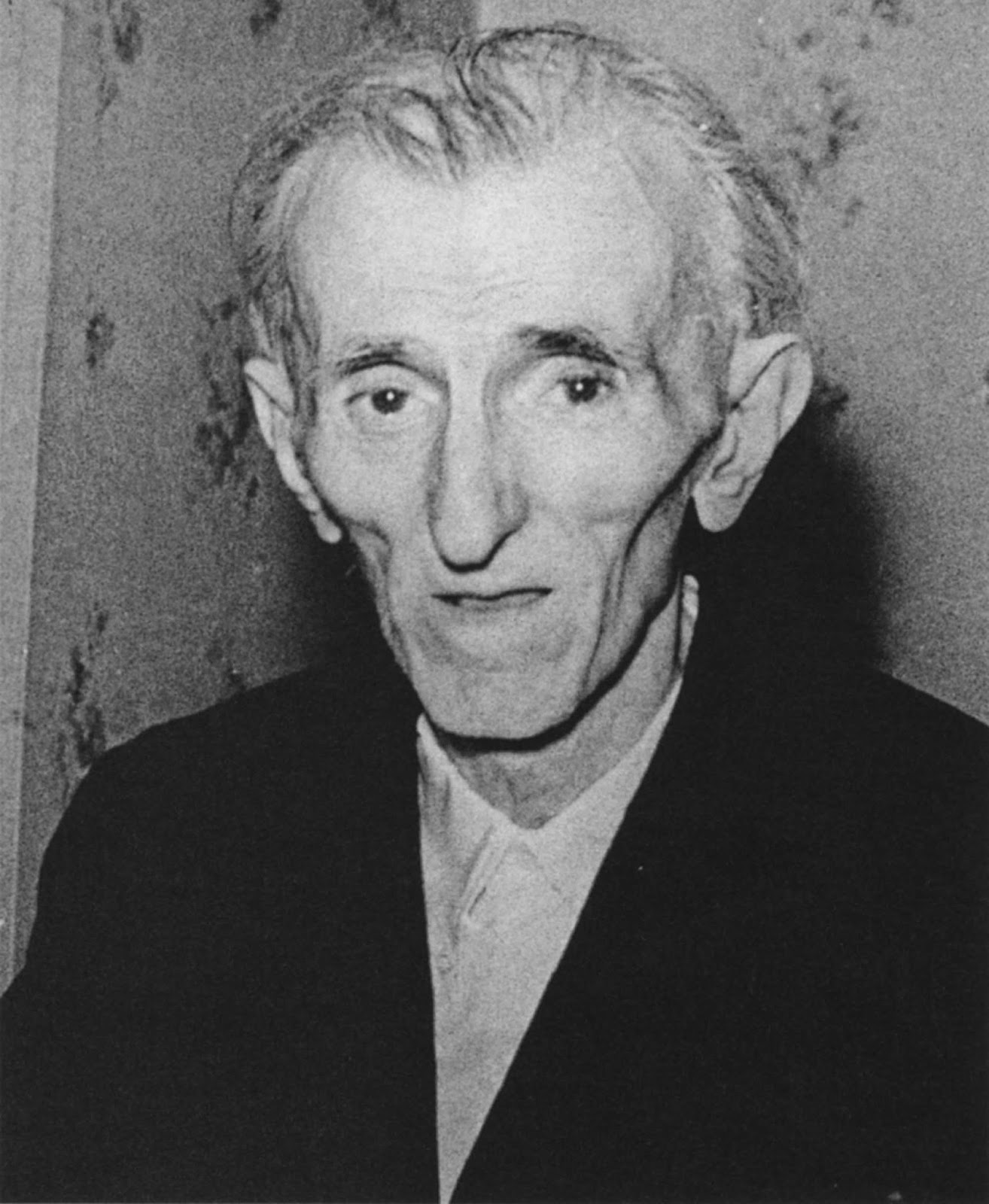
Nikola Tesla, one of history’s most visionary and often enigmatic inventors, passed away at the age of 86. On January 7, 1943, in Room 3327 of the Hotel New Yorker, the man who dreamed of a wirelessly powered world and laid the foundation for modern electrical systems quietly departed, leaving behind a legacy that would continue to unfold and profoundly shape the technological landscape for centuries to come. His death, during the tumultuous years of World War II, marked the end of an era for a singular genius whose ideas were often far too advanced for his contemporaries, yet utterly indispensable for the technological marvels we take for granted today. Understanding his life and death at 86 is not merely a biographical detail; it is an invitation to explore the profound depth of his contributions to technology, his struggles, and the enduring impact of a mind that literally illuminated the modern world.
The Unsung Architect of Modern Technology
Born in 1856 in Smiljan, Austrian Empire (modern-day Croatia), Nikola Tesla’s journey from a small village to the bustling technological frontier of late 19th and early 20th century America is a testament to an extraordinary intellect coupled with an almost prophetic imagination. His early life hinted at the prodigious talent that would later revolutionize entire industries, though the full scope of his genius often went unrecognized in his lifetime.
Early Life and a Spark of Genius
Tesla’s early education revealed a mind uniquely suited for understanding the intricate mechanisms of the natural world, particularly in the realm of electricity. He possessed an eidetic memory and an astonishing ability to visualize complex machinery in his mind, often without needing to draw schematics. This internal workshop allowed him to perfect inventions before a single component was ever manufactured, a technique that would prove invaluable throughout his career. He studied engineering at the Graz University of Technology and later at the University of Prague, though he never formally completed his degrees. His experiences during these formative years, including witnessing a demonstration of a Gramme dynamo operating as a generator and then as a motor, sparked an idea that would forever change the course of electrical engineering: the concept of the rotating magnetic field, the cornerstone of his alternating current (AC) motor.
The AC Revolution and the War of Currents
Upon arriving in the United States in 1884, Tesla briefly worked for Thomas Edison, but their fundamental disagreements over electrical systems soon led to a parting of ways. Edison was a staunch proponent of direct current (DC), a system that was practical for local power distribution but suffered significant power loss over long distances. Tesla, however, championed alternating current (AC), a system capable of transmitting electricity efficiently over vast expanses.
The “War of Currents” that ensued was a fierce battle for technological supremacy, and ultimately, for the future of electrification. Edison employed aggressive tactics, including publicly electrocuting animals with AC to portray it as dangerous. Yet, Tesla, with the backing of George Westinghouse, pressed on. His polyphase AC system, complete with generators, transformers, and induction motors, proved vastly superior. The successful illumination of the 1893 World’s Columbian Exposition in Chicago, powered by Westinghouse and Tesla’s AC system, was a pivotal moment. Two years later, the harnessing of Niagara Falls for long-distance power transmission to Buffalo, New York, using Tesla’s designs, cemented AC’s victory. This technological triumph directly led to the establishment of the modern electrical grid, making widespread electrification and industrial growth possible across continents. Without Tesla’s AC system, the technological advancements of the 20th century would have been severely hampered, if not impossible.
Beyond Electricity: A Polymath’s Prophecies
While the AC system alone secures Tesla’s place in history, his mind ventured far beyond conventional electrical engineering. He was a true polymath, envisioning and laying the groundwork for technologies that would only come to fruition decades after his death, demonstrating a foresight that bordered on the prescient.
Radio, Remote Control, and Robotics
Tesla’s contributions to wireless communication are often overshadowed by Guglielmo Marconi, yet historical evidence points to Tesla’s foundational work in radio. In 1893, he publicly demonstrated wireless communication, transmitting electromagnetic energy without wires. His patents for radio technology predated Marconi’s successful transatlantic transmission, and the U.S. Supreme Court eventually upheld Tesla’s priority for basic radio patents years after his death. His work established the principles of tuned radio frequency circuits, critical for modern broadcasting.
Even more astonishing were his experiments with remote control. In 1898, at Madison Square Garden, Tesla demonstrated a radio-controlled boat, navigating it across a pond using signals transmitted from a distance. This “teleautomatics,” as he called it, was the precursor to modern remote control technology, used today in everything from garage door openers to drones and space exploration rovers. He even conceptualized “automatons” or robots, envisioning machines that could perform tasks autonomously based on wireless commands – a vision that forms the very core of modern robotics and automation.
Wireless Power and Global Communication
Perhaps the most ambitious of Tesla’s visions was that of wireless power transmission and a global communication system. He believed that electrical energy could be broadcast through the earth and atmosphere, much like radio waves, eliminating the need for cumbersome and expensive power lines. His most significant, and ultimately tragic, endeavor in this pursuit was the Wardenclyffe Tower project on Long Island, New York.
Begun in 1901 with funding from J.P. Morgan, Wardenclyffe was intended to be a “World-System” – a massive global wireless communication and power facility. Tesla envisioned a world where information and energy could be transmitted instantaneously and freely to anyone, anywhere. He planned to distribute electricity wirelessly and enable transatlantic telephony, fax, and even image transmission. Unfortunately, Morgan pulled funding when he realized Tesla’s intention to provide “free” energy and that the project wouldn’t generate profits. Wardenclyffe was dismantled, a poignant symbol of a vision that was both too grand and too altruistic for the commercial realities of its time. Yet, the concept of wireless power, albeit on a much smaller scale (e.g., inductive charging pads), is seeing a resurgence in contemporary technology, a distant echo of Tesla’s audacious dream.
The Later Years: Solitude, Vision, and a Legacy Unfolding
Despite his monumental contributions, Tesla’s later life was marked by financial struggles, growing eccentricity, and a relative decline in public recognition, though his inventive spirit never truly waned.
Financial Struggles and Continued Innovation
Unlike many of his contemporaries, Tesla was not driven primarily by wealth. He famously tore up a royalty agreement with Westinghouse during the “War of Currents” to save the company from financial ruin, a decision that cost him billions in potential earnings. His focus remained squarely on invention and the advancement of humanity through technology. This lack of business acumen, combined with the exorbitant costs of his grand projects like Wardenclyffe, often left him in debt.
Nevertheless, he continued to innovate. In his later years, he proposed ideas for “beam weapons” or “death rays,” which, while never fully realized, hinted at concepts like directed energy weapons. He also continued to champion ideas of free energy and sustainable power, consistently pushing the boundaries of scientific thought, even when his ideas were met with skepticism or outright dismissal. His laboratory work, though less publicly celebrated, persisted with an undiminished zeal.
The Quiet Passing of a Titan
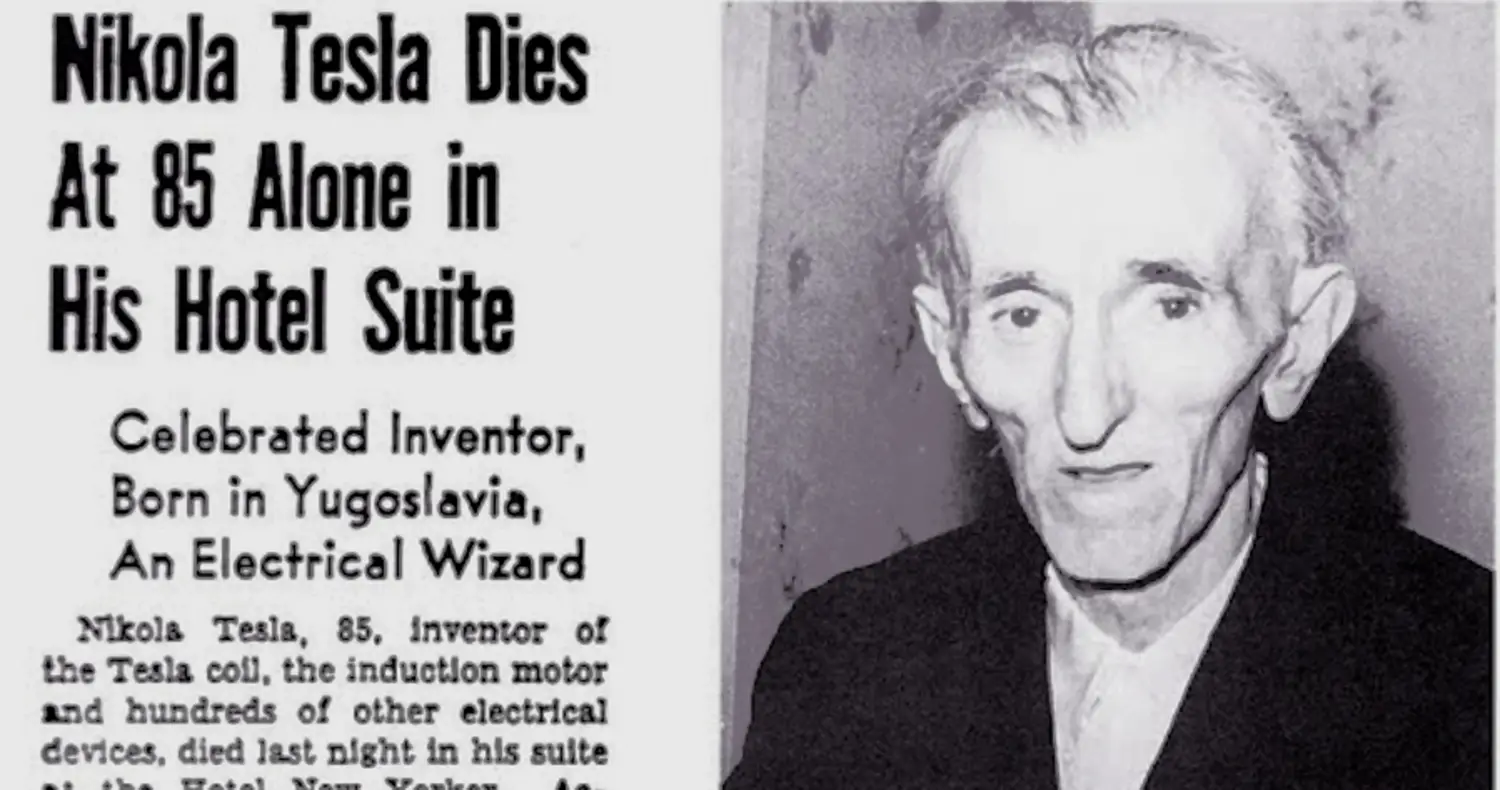
Nikola Tesla died alone, an overlooked figure to many, in his hotel room in New York City on January 7, 1943. He was 86 years old. A maid discovered his body two days later. The official cause of death was coronary thrombosis. The timing of his death, during the height of World War II, meant that his passing was largely overshadowed by global events. However, the U.S. government, particularly the FBI, immediately seized all of his papers, notes, and laboratory contents, recognizing the immense strategic value of his scientific ideas, even if they had not been fully realized or understood by the public. This act underscores the secret knowledge that some within the establishment knew of Tesla’s capabilities and potential future applications of his work.
His funeral was attended by over 2,000 people, including Nobel laureates, and eulogies were read by figures like Fiorello LaGuardia, the mayor of New York City. Despite this, the full appreciation of his legacy would truly blossom decades later, as technology caught up to his visions.
Tesla’s Enduring Technological Footprint in the 21st Century
The 86 years of Nikola Tesla’s life were a crucible for ideas that continue to shape the 21st century. His death did not diminish his influence; rather, it allowed time for the world to gradually catch up to his extraordinary foresight. Today, his name is synonymous with innovation, and his principles underpin much of our modern technological infrastructure.
From Power Grids to Smart Devices
The most obvious and pervasive of Tesla’s legacies is the alternating current electrical system. Every time a light switch is flicked, an appliance is powered, or an electric car is charged, the principles laid down by Tesla are at play. Our global power grids, from hydroelectric dams to nuclear power plants, rely on AC generation and transmission to deliver electricity to billions of people efficiently. Without AC, the world as we know it—with its interconnected cities, factories, and digital infrastructure—would simply not exist.
Furthermore, his pioneering work in wireless communication forms the bedrock of modern radio, television, Wi-Fi, Bluetooth, and cellular networks. The remote control, once a fantastical concept demonstrated with a toy boat, is now an integral part of countless devices, from smart home systems to industrial robotics. Even the concept of robotics, which he theorized about, has evolved into a multi-billion dollar industry driving automation and artificial intelligence.

The Resurgence of His Name and Ideas
In the decades following his death, Tesla’s contributions began to be more fully recognized. In 1960, the unit of magnetic flux density was named the “tesla” (T) in his honor by the International Electrotechnical Commission, a fitting tribute to a master of electromagnetism. More recently, the naming of the electric vehicle company Tesla, Inc. by Elon Musk has brought his name back into mainstream consciousness, symbolizing cutting-edge innovation and a futuristic vision for sustainable technology.
Beyond the namesake, there is a renewed interest in some of Tesla’s more speculative ideas. Wireless power transfer, though limited in range and efficiency compared to his grand vision, is actively being researched and implemented in smaller devices. Concepts related to his “World-System” resonate with aspirations for global connectivity and accessible energy, even if the methods differ. Researchers continue to explore his archived notes for insights into advanced energy systems and communication methods, seeking inspiration from a mind that consistently thought decades, if not centuries, ahead.
Nikola Tesla died at 86, a profound age for a man whose life spanned the transition from the gas lamp to the electric age, from nascent telegraphy to the dawn of radio. His passing marked the end of an individual life, but the beginning of the full, global realization of his technological dreams. He was more than an inventor; he was a prophet of technology, whose genius continues to electrify and inspire the world, proving that true innovation transcends time and space. His legacy is not merely a collection of patents and theories but the invisible infrastructure that powers our modern existence, a silent testament to a mind that truly saw the future.
aViewFromTheCave is a participant in the Amazon Services LLC Associates Program, an affiliate advertising program designed to provide a means for sites to earn advertising fees by advertising and linking to Amazon.com. Amazon, the Amazon logo, AmazonSupply, and the AmazonSupply logo are trademarks of Amazon.com, Inc. or its affiliates. As an Amazon Associate we earn affiliate commissions from qualifying purchases.