
Determining the ideal quantity of XRP for a digital asset portfolio is a question that balances individual financial goals, risk tolerance, and a fundamental understanding of the XRP Ledger’s (XRPL) utility. Unlike many cryptocurrencies that function primarily as a store of value or a medium for decentralized finance (DeFi), XRP was designed with a specific institutional purpose: to serve as a bridge currency for cross-border payments.
When asking “how much XRP should I own,” an investor must move beyond the noise of social media speculation and look at the asset through the lens of portfolio theory and the evolving landscape of global liquidity.

Defining the Role of XRP in a Modern Financial Portfolio
To decide on an allocation, one must first understand what they are buying. XRP is the native token of the XRP Ledger, an open-source, permissionless, and decentralized blockchain. Its primary value proposition lies in its ability to settle transactions in 3 to 5 seconds at a fraction of a cent, regardless of the geographic distance between the sender and the receiver.
In the world of personal finance and investing, XRP is often categorized as a “utility-based” alternative asset. While Bitcoin is frequently viewed as “digital gold” and Ethereum as a “global computer,” XRP positions itself as “digital liquidity.” For an investor, this means that the value of the holding is intrinsically tied to the adoption of the XRPL by financial institutions, payment providers, and central banks.
The 1% to 5% Rule
A common benchmark in professional wealth management for high-risk, high-reward assets—which includes most cryptocurrencies—is the 1% to 5% allocation rule. This suggests that an investor should allocate no more than 5% of their total investable net worth to speculative digital assets. Within that 5%, XRP might represent a portion alongside other major assets.
The rationale behind this conservative approach is simple: if the asset grows by 10x or 100x, a 2% allocation is enough to significantly impact one’s overall net worth. Conversely, if the asset experiences a 90% drawdown—a common occurrence in the crypto markets—the investor’s total financial health remains intact.
Diversification Within the Crypto Niche
Even for those who are “bullish” on the future of Ripple and the XRPL, owning only XRP presents a significant concentration risk. A balanced digital asset strategy often involves holding a core position in market leaders like Bitcoin, while using XRP as a strategic play on the disruption of the legacy banking system (SWIFT).
Calculating Your Position: Risk Assessment and Financial Goals
There is no “magic number” of tokens that guarantees financial freedom. However, investors often categorize their holdings into tiers based on their long-term objectives. When determining your own number, you must assess three critical factors: your time horizon, your liquidity needs, and your conviction level.
The Speculative Stake (Small Holding)
For many, a starting point is a “moon bag”—a relatively small amount of XRP that is held for the long term without the intention of active trading. This might range from 500 to 2,000 XRP. At this level, the financial risk is often negligible for the average professional, but the upside remains meaningful if XRP achieves mass institutional adoption. This tier is ideal for those who want exposure to the technology without the stress of daily price fluctuations.
The Strategic Allocation (Medium Holding)
An investor seeking to build significant wealth through digital assets might aim for a mid-tier holding, often cited in the community as 10,000 to 50,000 XRP. At this level, the investor is making a concerted bet on the XRPL becoming a standard for global settlement.
This level of ownership requires a deeper understanding of the ecosystem. It is no longer a “set and forget” investment; it requires monitoring regulatory developments, such as the status of Ripple’s legal standing in various jurisdictions, and the growth of the Interledger Protocol (ILP).
The Institutional-Scale Position (High Conviction)
High-net-worth individuals or those with extreme conviction may target holdings in the 100,000+ XRP range. At this scale, the investor is essentially acting as a liquidity provider within their own right. This tier carries substantial risk, as any negative regulatory shift or technical failure of the protocol would result in a significant loss of capital. However, for those who believe that XRP will eventually handle a portion of the trillions of dollars in daily cross-border volume, this is the level required to achieve “generational wealth.”
Distribution Tiers: Where Do You Fit in the XRPL Ecosystem?
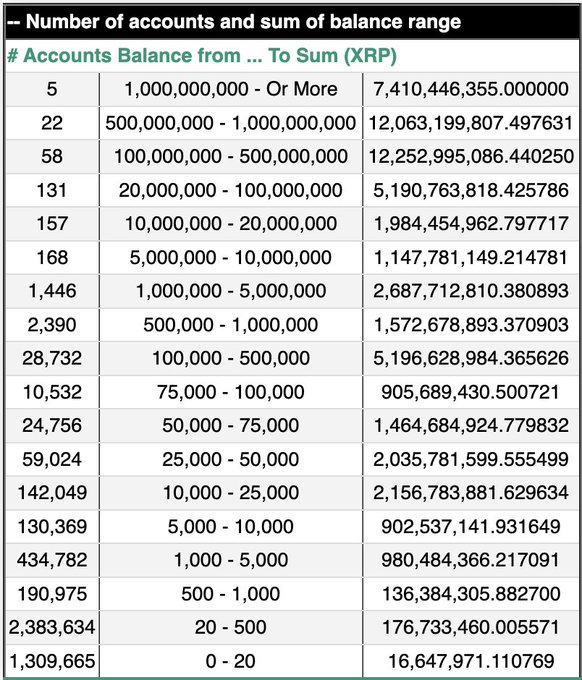
Analyzing the distribution of XRP across wallets provides a glimpse into where an investor stands relative to the rest of the market. While “whale” status is often cited as the ultimate goal, the reality is that the vast majority of XRP holders own fewer than 5,000 tokens.
Understanding Scarcity and Supply
XRP has a fixed maximum supply of 100 billion tokens. A significant portion of this is held in escrow by Ripple, the company, to be released predictably into the market for institutional use. Furthermore, every transaction on the XRPL “burns” a tiny amount of XRP as a fee, making the asset technically deflationary over a very long time horizon.
When you own 10,000 XRP, you are among a very small percentage of the global population. As digital asset adoption moves from the “early adopter” phase to the “early majority” phase, the perceived value of these tiers may shift. Owning a fixed amount of a capped-supply asset allows an investor to maintain their “share” of the network’s value as more participants enter the ecosystem.
The Concept of the “Rich List”
Publicly available data on the XRP “Rich List” shows that owning 50,000 XRP often puts an investor in the top 1% or 2% of all wallets. While this is an ego-boosting statistic, it should not be the primary driver for investment. Instead, investors should focus on their personal “number”—the amount of XRP that, if it reached a specific price target, would allow them to pay off a mortgage, fund a retirement, or achieve a specific financial milestone.
Navigating Volatility: The Psychological Side of Holding XRP
The question of “how much” is often secondary to the question of “how long.” XRP has historically been one of the most volatile assets in the financial world. It has endured multi-year bear markets and intense legal scrutiny. Therefore, you should only own an amount that allows you to remain emotionally detached from the price action.
The Danger of Over-Leveraging
The most common mistake in crypto investing is over-allocation. When an investor owns too much XRP relative to their liquid savings, they become prone to “panic selling” during market crashes. If a 20% drop in XRP’s price causes you to lose sleep or worry about your monthly bills, you own too much.
Dollar-Cost Averaging (DCA)
Rather than trying to hit a specific token count through a single lump-sum purchase, many successful investors use Dollar-Cost Averaging. By investing a fixed dollar amount every month, regardless of the price, you naturally buy more tokens when the price is low and fewer when the price is high. This strategy reduces the psychological pressure of “timing the market” and helps you reach your target quantity over time in a disciplined manner.
Future Utility and Price Potential: Scaling Your Investment
The ultimate decision on how much XRP to own should be rooted in your vision of the future financial system. XRP’s value is not derived from retail hype alone; it is derived from its potential to solve the “pre-funding” problem in global banking.
The CBDC and Liquidity Connection
Currently, banks must keep trillions of dollars in “nostro/vostro” accounts—pre-funded accounts in foreign currencies—to facilitate international payments. This is highly inefficient. If the XRPL is used to bridge Central Bank Digital Currencies (CBDCs), XRP could act as the universal liquidator.
If you believe this institutional shift is inevitable, your “ideal” amount of XRP might be higher. If you view it as a high-risk experiment, your holding should remain a small, speculative slice of your portfolio.
Setting Realistic Exit Strategies
Part of knowing how much to own is knowing when to sell. Professional investors rarely hold an asset “forever.” They set price targets where they will take profits to diversify into “hard” assets like real estate or gold. For example, an investor might decide to sell 25% of their XRP if it doubles in price, effectively “playing with house money” for the remainder of their holding.

Conclusion
“How much XRP should I own?” is a deeply personal question that depends on your current net worth, your future goals, and your risk tolerance. For the cautious observer, 1,000 XRP offers a low-stakes entry into the future of payments. For the strategic investor, 10,000 to 20,000 XRP provides a significant seat at the table.
The key is not to chase a specific number because of social media trends, but to build a position that aligns with a broader, diversified financial plan. In the volatile world of digital assets, the most successful investors are not necessarily those with the most tokens, but those with the most discipline, the clearest strategy, and the patience to let the technology’s utility eventually reflect in its market value.
aViewFromTheCave is a participant in the Amazon Services LLC Associates Program, an affiliate advertising program designed to provide a means for sites to earn advertising fees by advertising and linking to Amazon.com. Amazon, the Amazon logo, AmazonSupply, and the AmazonSupply logo are trademarks of Amazon.com, Inc. or its affiliates. As an Amazon Associate we earn affiliate commissions from qualifying purchases.