
Predicting the trajectory of Tesla (TSLA) over a ten-year horizon is perhaps one of the most complex exercises in modern financial modeling. Unlike traditional legacy automakers, Tesla does not fit neatly into the valuation metrics of the industrial sector. To understand what Tesla stock might be worth in 2034, investors must look beyond simple vehicle delivery numbers and evaluate the company as a multifaceted conglomerate spanning energy, artificial intelligence, robotics, and software.
The next decade will likely be defined by Tesla’s ability to transition from a high-growth automotive manufacturer into a dominant platform for autonomous transport and renewable energy infrastructure. For the long-term investor, the valuation hinges on whether Tesla can maintain its industry-leading margins while scaling into a global powerhouse with a market capitalization that could potentially rival or exceed the largest tech giants in the world.
The Evolution of the Automotive Revenue Engine
The core of Tesla’s current valuation remains its automotive division. However, the next ten years will see a shift in how this revenue is generated. We are moving away from the era of “first-mover advantage” in the electric vehicle (EV) space and into an era of mass-market saturation and manufacturing efficiency.
Scaling to the Mass Market
To justify a significantly higher stock price in ten years, Tesla must successfully launch and scale its next-generation vehicle platform. Often referred to in investor circles as the “Model 2” or the $25,000 car, this platform is the key to unlocking the mass-market demographic. By 2034, analysts expect Tesla to have a diversified fleet ranging from budget-friendly compacts to luxury sedans and high-utility trucks like the Cybertruck.
Financial analysts focus on the Compound Annual Growth Rate (CAGR) of vehicle deliveries. If Tesla can maintain an average delivery growth rate of 15% to 20% over the next decade, its annual production could reach between 6 million and 10 million units. At an average selling price (ASP) that balances high-end models with budget options, the sheer volume of hardware sales provides a massive foundation for the company’s cash flow.
Manufacturing Dominance and Margin Retention
The primary reason Tesla trades at a premium compared to Ford, GM, or Volkswagen is its operating margin. Through innovations like “unboxed” manufacturing processes and massive “Giga-press” castings, Tesla has lowered the cost of goods sold (COGS) per vehicle. Over the next decade, as battery costs continue to plummet due to internal chemistry improvements and vertical integration, Tesla’s ability to maintain 20%+ gross margins in a competitive environment will be the primary driver of its stock price.
Software as a Service: The Autonomy Multiplier
If Tesla were valued strictly as a car company, its stock might be considered overvalued by traditional metrics. However, the “bull case” for Tesla in ten years is almost entirely dependent on its transition to a Software as a Service (SaaS) business model through Full Self-Driving (FSD) and the proposed Robotaxi network.
The Economics of FSD and Recurring Revenue
Software margins are historically much higher than hardware margins—often exceeding 80%. Currently, FSD is sold as a one-time purchase or a monthly subscription. As the software matures and reaches “Level 4” or “Level 5” autonomy, the take-rate among Tesla owners is expected to skyrocket.
In ten years, if Tesla has a fleet of 20 million vehicles on the road and 40% of those owners subscribe to an autonomy package at $100–$200 per month, the resulting high-margin recurring revenue would be staggering. This shift would fundamentally re-rate TSLA stock, moving its Price-to-Earnings (P/E) ratio from that of a manufacturer to that of a high-growth software firm like Microsoft or Nvidia.
The Robotaxi Network
The ultimate disruption in Tesla’s financial future is the Robotaxi network. By utilizing customer vehicles and a dedicated fleet for autonomous ride-sharing, Tesla could capture a significant portion of the global transportation-as-a-service market. Financial models suggest that a functional Robotaxi network could generate hundreds of billions in high-margin revenue. If Tesla takes a 25-30% cut of every mile driven on its network—similar to the Apple App Store model—the impact on the company’s bottom line would be transformative, potentially adding trillions to its market capitalization by 2034.
Tesla Energy: The Sleeping Giant
While most of the media attention remains on the cars, Tesla’s Energy Generation and Storage division is growing at a rate that frequently outpaces the automotive segment. Over the next ten years, the global transition to renewable energy will require an unprecedented amount of stationary storage to stabilize the grid.
Megapack and the Utility-Scale Shift
The Tesla Megapack has become the gold standard for utility-scale battery storage. As coal and gas plants are decommissioned, grid operators are turning to massive battery arrays to manage the intermittent nature of solar and wind power. Tesla’s ability to scale Giga Nevada and other dedicated energy factories will allow it to capture a dominant share of the multi-trillion-dollar energy storage market. By 2034, it is entirely possible that Tesla Energy contributes 20% to 30% of the company’s total revenue, providing a stable, diversified income stream that reduces the stock’s sensitivity to automotive cycles.
Virtual Power Plants (VPPs)
The integration of the Powerwall for residential consumers creates what is known as a Virtual Power Plant. By aggregating thousands of home batteries, Tesla can sell power back to the grid during peak demand. This creates a “network effect” in the energy sector. As more homes adopt Tesla solar and storage, the network becomes more valuable, creating a moat that traditional utility companies will find difficult to breach. From an investment perspective, this represents a long-term play on infrastructure that is currently undervalued by the broader market.
Financial Risks and Macroeconomic Headwinds
No ten-year forecast is complete without addressing the risks that could suppress Tesla’s valuation. The path to a multi-trillion-dollar market cap is fraught with regulatory, competitive, and macroeconomic challenges.
Competition and Market Saturation
While Tesla currently leads the EV market, legacy automakers and Chinese firms like BYD are closing the gap. In ten years, the EV market will be a “red ocean” of intense competition. Tesla will need to innovate faster than its rivals to prevent margin compression. If Tesla is forced into a permanent price war to maintain market share, its earnings potential—and consequently its stock price—will suffer.
Regulatory and Key Man Risk
The development of autonomous driving is subject to stringent regulatory approval. A single high-profile failure or a restrictive legislative environment could delay the Robotaxi network by years, removing a core pillar of the long-term valuation. Furthermore, Tesla’s identity is closely tied to Elon Musk. “Key man risk” remains a significant factor; any leadership transition or distraction could lead to volatility and a potential de-risking by institutional investors.
Projecting the 2034 Market Cap: Bull, Bear, and Base Cases
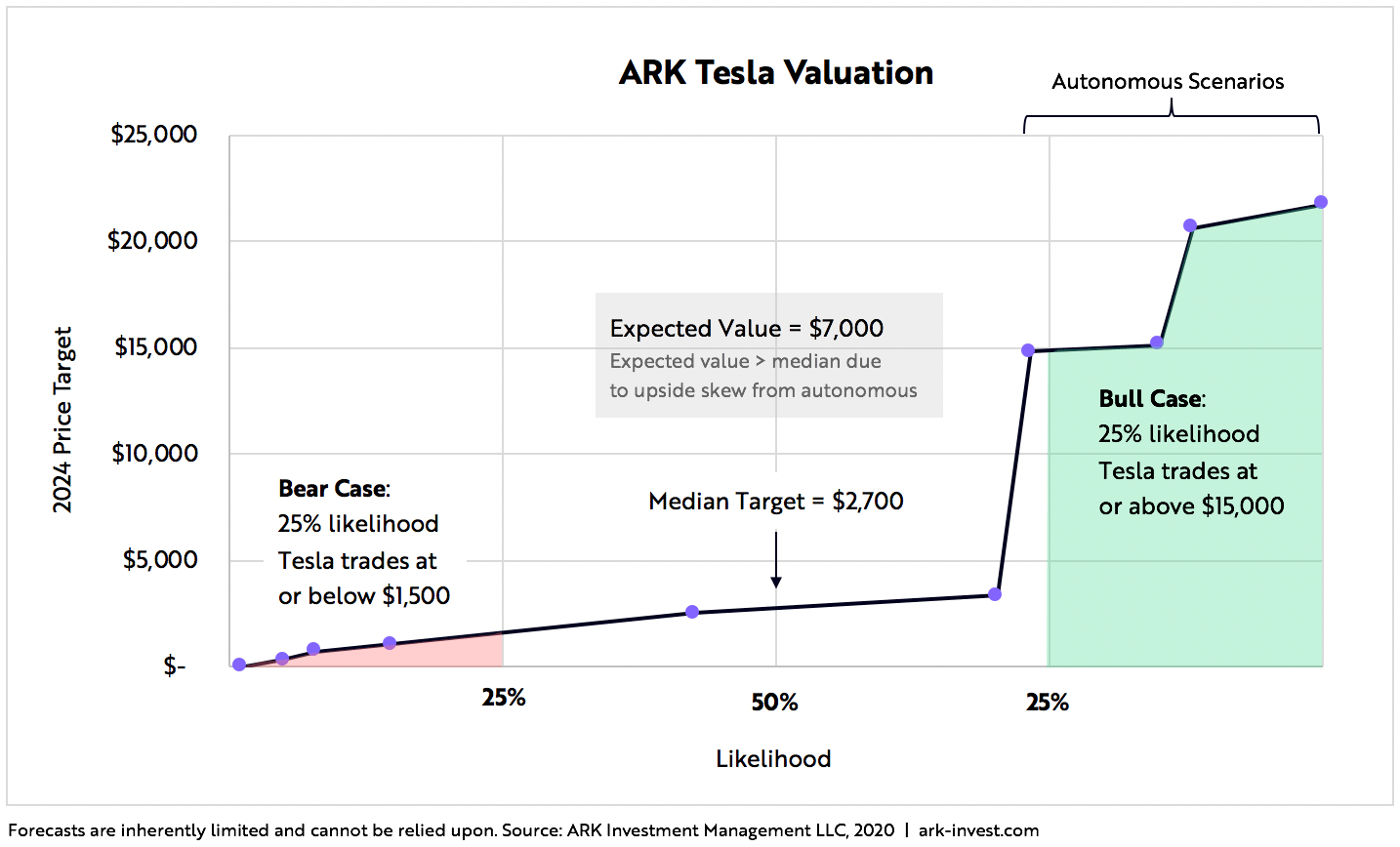
To determine what the stock will be worth, we must look at potential market cap outcomes based on projected earnings and P/E multiples.
-
The Bull Case: If Tesla successfully solves autonomy, scales the Megapack to a global utility standard, and maintains a 15% share of the global auto market, the company could see a market cap exceeding $5 trillion. In this scenario, share prices could see a 5x to 10x increase from current levels, accounting for potential stock splits along the way. This assumes Tesla becomes the “operating system” for transportation.
-
The Base Case: Tesla remains the dominant EV player and a major energy storage provider but faces moderate competition that keeps margins in check. Autonomy provides a solid revenue stream but does not completely replace private car ownership. In this case, a market cap of $1.5 trillion to $2.5 trillion is a reasonable expectation, reflecting a steady 10-12% annual return for shareholders.
-
The Bear Case: Regulatory hurdles stall FSD indefinitely, and Chinese manufacturers dominate the global mass market. Tesla becomes a highly profitable but “standard” luxury automaker with a secondary energy business. The market cap might stagnate or grow slowly, trailing the S&P 500 as the “innovation premium” evaporates from the stock price.

Conclusion: A Decade of Transformation
In ten years, Tesla will likely no longer be described as a “car company.” Its valuation in 2034 will be a reflection of its success in the AI and energy sectors. For investors, the stock represents a high-stakes bet on the future of automation and the electrification of the global economy.
While volatility is guaranteed, Tesla’s massive lead in data collection for AI training, its vertically integrated manufacturing, and its rapidly expanding energy business provide a cushion that few other companies possess. The next decade will determine if Tesla can execute its “Master Plan” and solidify its place as the most valuable company in history, or if it will face the reality of becoming just another—albeit highly successful—industrial giant. For those with a ten-year horizon, the focus should remain on the progress of FSD and the scaling of Giga-factories, as these are the true engines of Tesla’s future financial worth.
aViewFromTheCave is a participant in the Amazon Services LLC Associates Program, an affiliate advertising program designed to provide a means for sites to earn advertising fees by advertising and linking to Amazon.com. Amazon, the Amazon logo, AmazonSupply, and the AmazonSupply logo are trademarks of Amazon.com, Inc. or its affiliates. As an Amazon Associate we earn affiliate commissions from qualifying purchases.