
In the current landscape of global finance, Bitcoin is often discussed alongside gold, treasury bonds, and blue-chip stocks. However, to understand the magnitude of its growth, one must look back at a pivotal year in its history: 2012. At that time, Bitcoin was less of a recognized asset class and more of a digital experiment, priced at levels that seem unfathomable to modern investors. For those asking “how much was Bitcoin in 2012,” the answer is not just a number, but a window into the most significant wealth-creation event of the 21st century.
The Financial Landscape of 2012: Tracking Bitcoin’s Early Price Points
In early 2012, the global economy was still licking its wounds from the 2008 financial crisis. Trust in centralized banking was at an all-time low, yet the alternative—a decentralized peer-to-peer electronic cash system—was still flying under the radar of the average retail investor. To look at Bitcoin’s price in 2012 is to see a chart that reflects both extreme obscurity and the first stirrings of a massive bull market.
Starting the Year Under a Dollar
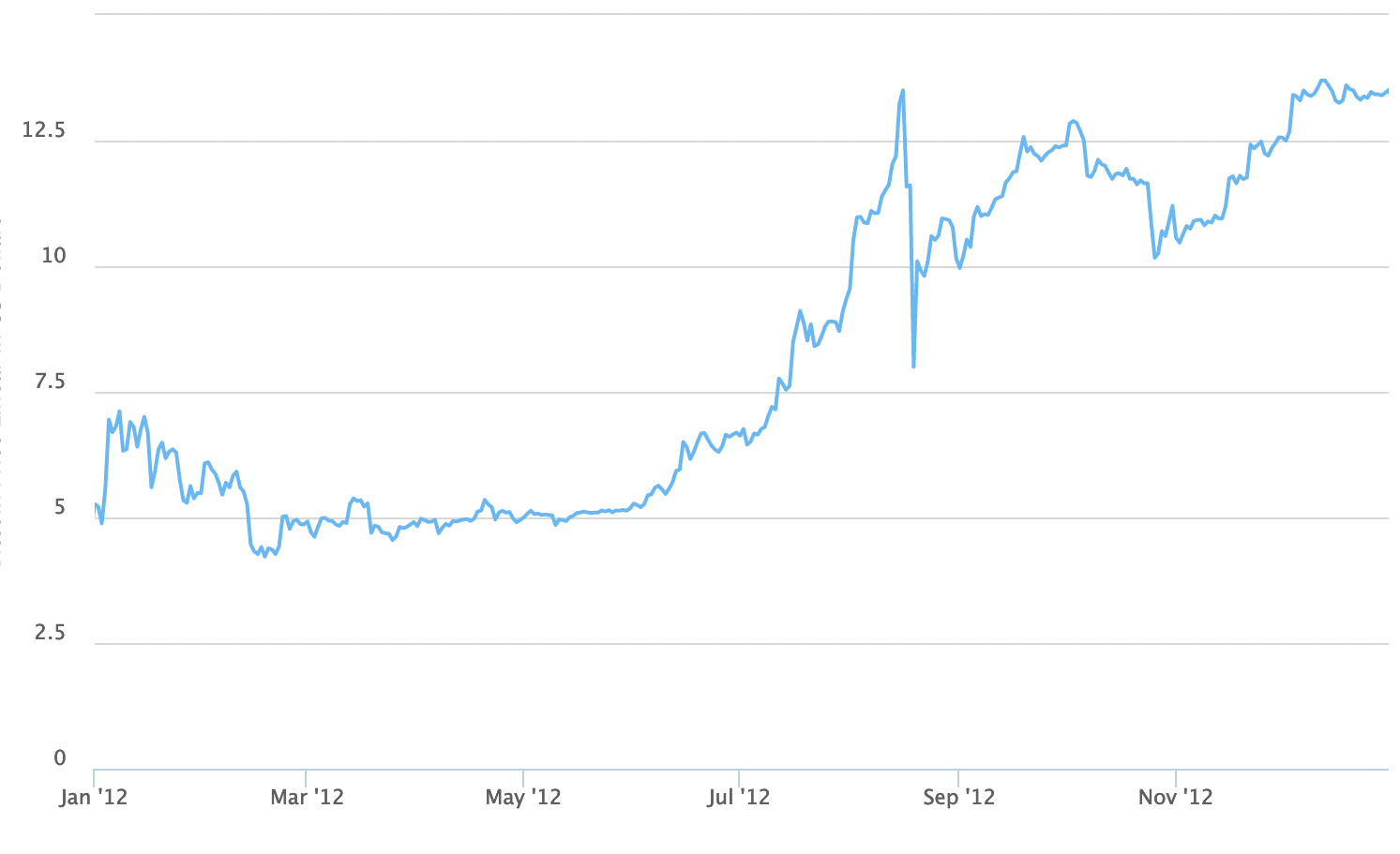
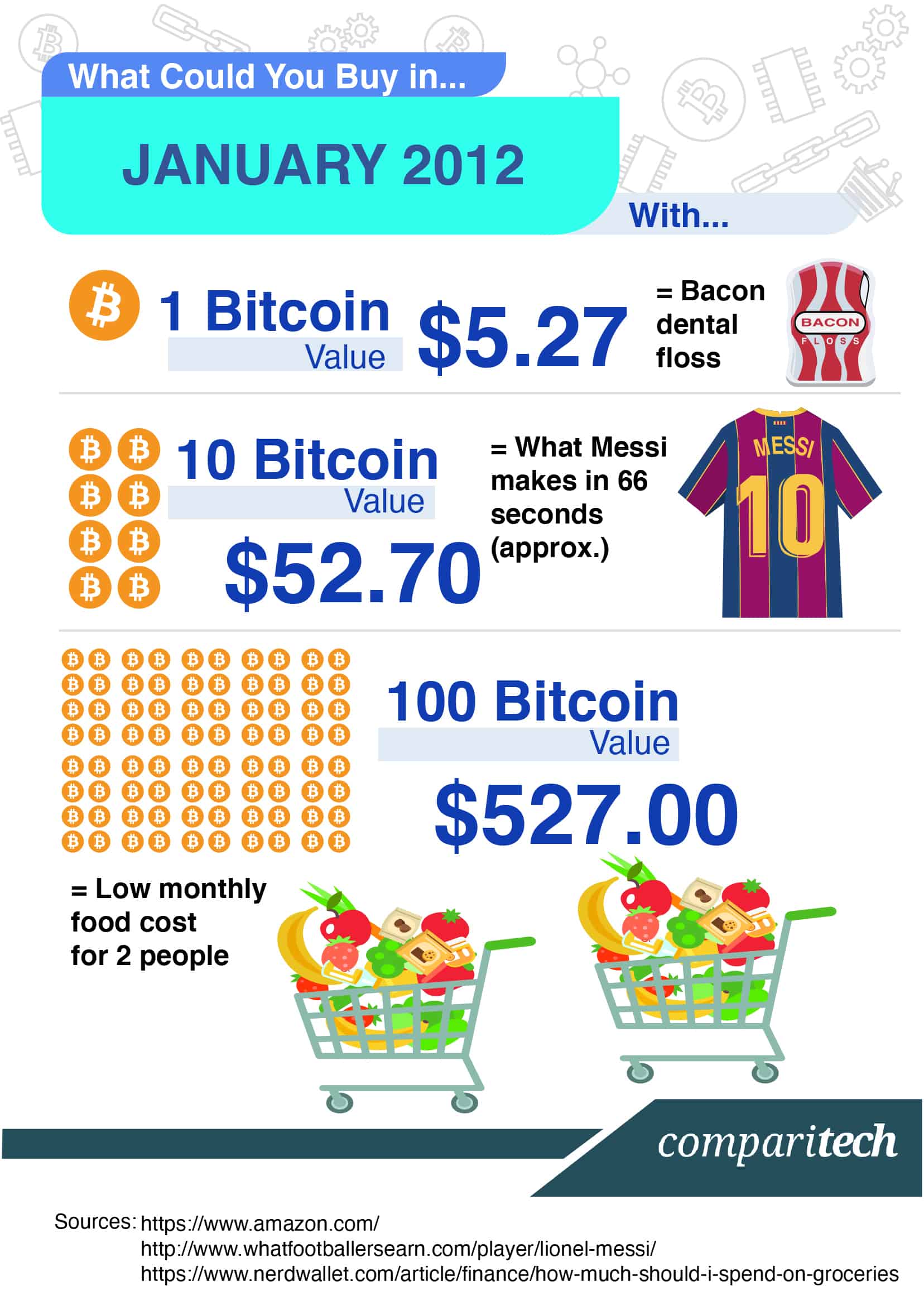
Bitcoin entered 2012 with a price tag that many today find hard to believe. On January 1, 2012, Bitcoin traded at approximately $4.72. For the price of a modern cup of coffee, an investor could have purchased an entire Bitcoin. Throughout the first quarter of the year, the price was relatively stagnant, even dipping toward the $4.00 mark. At this stage, the market capitalization of the entire Bitcoin network was negligible compared to today’s trillion-dollar valuations. It was a period of high skepticism where “liquidity” was a luxury and “volatility” was the only constant.
The First Halving Event and Its Impact on Valuation
The most significant economic event for Bitcoin in 2012 occurred on November 28: the first-ever “Halving.” This is a pre-programmed event in the Bitcoin code that reduces the reward for mining new blocks by 50%. Prior to this date, 50 BTC were issued every ten minutes; after the halving, that number dropped to 25 BTC.
From a supply-and-demand perspective, this was a watershed moment. Investors who understood the deflationary nature of the asset began to accumulate. Leading up to the halving, the price began to climb steadily. By August 2012, Bitcoin had reached double digits, hitting $10.00 for the first time in over a year. By the time the halving actually occurred in November, the price was hovering around $12.25.
Closing the Year: A Case for “Mooning” Potential
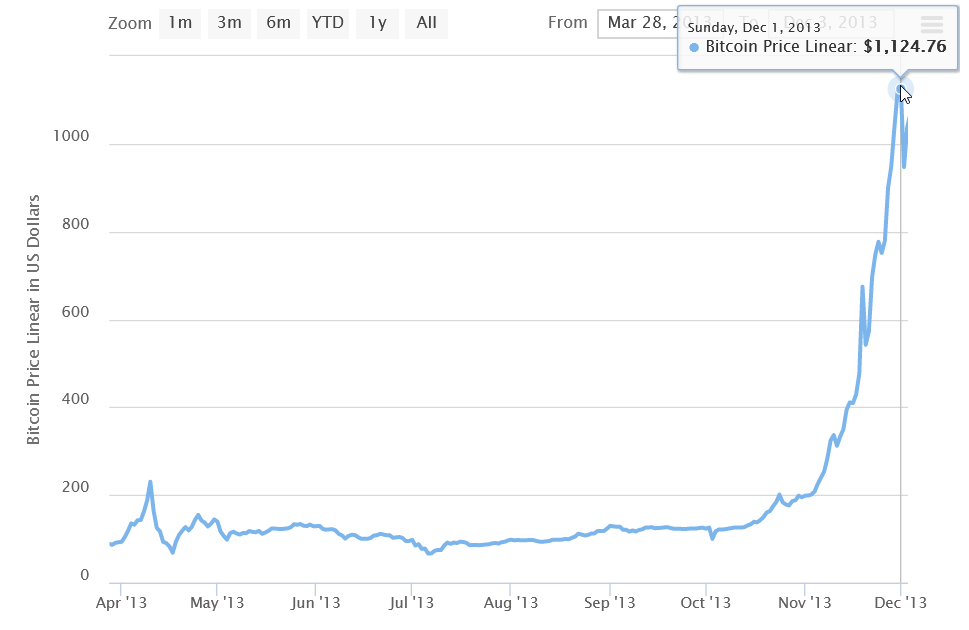
By the end of December 2012, Bitcoin closed at approximately $13.50. While this represents a modest figure in absolute terms, the percentage gain from the start of the year was over 185%. This performance began to catch the eye of more sophisticated “angel” investors and early tech-focused venture capitalists. It was the year Bitcoin proved it wasn’t going to zero, setting the stage for the massive 1,000% gains that would follow in 2013.
Investing in the “Magic Internet Money” Era: Risks and Rewards
Understanding the price in 2012 requires understanding the environment in which an investor had to operate. Today, one can buy Bitcoin on a smartphone in seconds. In 2012, the barriers to entry were high, and the risks were even higher.
The Difficulty of Acquisition (Mt. Gox and Early Exchanges)
In 2012, there were no regulated exchanges like Coinbase or Kraken at the scale we see today. The dominant player was Mt. Gox, a Tokyo-based exchange that handled the majority of all Bitcoin transactions. Buying Bitcoin often required complex bank wires to overseas accounts or using services like Liberty Reserve. The “Money” aspect of Bitcoin was hampered by poor infrastructure. Because it was so difficult to buy, the price remained suppressed. The low price of $5 to $13 was, in part, a reflection of the “friction” involved in acquiring the asset.
Volatility as a Feature, Not a Bug
Investors in 2012 had to stomach swings that would terrify a modern portfolio manager. It was not uncommon for the price to drop 20% or 30% in a single day based on a single forum post or a minor technical glitch. However, for the contrarian investor, this volatility was the price of admission for potential exponential returns. In 2012, Bitcoin was categorized by many as “gambling” rather than “investing.” Those who saw it as the latter were focused on the long-term scarcity of the 21-million-coin cap.
Regulatory Uncertainty and Investor Sentiment
There was virtually no regulatory framework for digital assets in 2012. This was a double-edged sword. On one hand, it allowed for rapid, unfettered growth; on the other, it meant that if your coins were stolen or an exchange went bust, there was no legal recourse. The “Value” of Bitcoin in 2012 was heavily discounted because of this existential risk. People weren’t just asking “how much is it?” but “will it exist tomorrow?”
The Wealth Multiplication Effect: Comparing 2012 to Today
To truly appreciate the 2012 price point, one must look at the Return on Investment (ROI) through the lens of modern wealth management. The numbers are a stark reminder of why Bitcoin is considered the best-performing asset of the decade.
Calculating the ROI of a $100 Investment
If an investor had taken a modest $100 and invested it in Bitcoin in early 2012 when the price was roughly $5.00, they would have acquired 20 BTC.
- In 2012: That investment was worth $100.
- At a $50,000 Bitcoin price: That same investment would be worth $1,000,000.
This 1,000,000% return is virtually unheard of in traditional stock markets or real estate within a 12-year timeframe. It highlights the concept of “asymmetric risk”—where the downside is limited (you can only lose $100) but the upside is theoretically infinite.
Bitcoin vs. Traditional Asset Classes
In 2012, the S&P 500 returned approximately 13.4%. Gold, often cited as Bitcoin’s primary competitor, ended the year up about 7%. Bitcoin, as previously mentioned, rose by over 185%. Even in its infancy, Bitcoin was outperforming the most robust traditional financial instruments. For a money manager in 2012, allocating even 1% of a portfolio to Bitcoin would have eventually outpaced the returns of the remaining 99% of the portfolio combined.
The Psychology of HODLing Through Extreme Gains
The real challenge for 2012 investors wasn’t buying Bitcoin—it was holding it. When the price went from $5 to $13, many investors sold to lock in a 160% profit. Most people find it psychologically impossible to hold an asset as it doubles, triples, and then grows by 10,000%. The “Money” lesson of 2012 is that generational wealth is often built not by active trading, but by having the conviction to hold through massive price discovery phases.
Building a Modern Portfolio: Lessons Learned from 2012
Looking back at the 2012 price of Bitcoin provides more than just nostalgia; it offers actionable financial lessons for contemporary investors looking for the “next” big opportunity.
Asymmetric Risk and Small Allocations
The 2012 era taught us that you don’t need to bet the house to change your financial future. Because of the exponential nature of digital assets, a 1% to 5% allocation is often enough to provide significant “alpha” (excess return) to a portfolio. The lesson for today’s personal finance is to identify assets with high upside potential and low entry costs, and to treat them as “venture” bets rather than stable savings.
The Importance of Digital Custody and Security
Many who bought Bitcoin for $5 in 2012 no longer have it. They lost private keys, forgot passwords to old laptops, or left their funds on exchanges that eventually failed. From a financial tools perspective, 2012 emphasized that wealth is only yours if you control the access points. Modern investors have better tools—hardware wallets and multi-sig vaults—but the fundamental rule remains: “Not your keys, not your coins.”
Identifying the Next Frontier in Financial Innovation
The 2012 Bitcoin price was low because the world didn’t yet understand what “decentralized scarcity” meant. Today, the “Money” sector is looking for similar misunderstandings in areas like decentralized finance (DeFi), AI-driven tokenomics, or Layer-2 scaling solutions. The key to 2012-level returns is finding an asset where the utility is high but the public perception is still rooted in skepticism or confusion.
In conclusion, while Bitcoin’s price in 2012—ranging from $4 to $13—is a historical footnote, its significance in the world of personal finance is monumental. It serves as a reminder that the greatest financial opportunities often arrive disguised as “toys” or “experiments.” For the modern investor, the story of 2012 isn’t about regret over what was missed, but about the importance of staying curious, managing risk, and understanding the power of a truly scarce digital asset.
aViewFromTheCave is a participant in the Amazon Services LLC Associates Program, an affiliate advertising program designed to provide a means for sites to earn advertising fees by advertising and linking to Amazon.com. Amazon, the Amazon logo, AmazonSupply, and the AmazonSupply logo are trademarks of Amazon.com, Inc. or its affiliates. As an Amazon Associate we earn affiliate commissions from qualifying purchases.