
Understanding the intricacies of Supplemental Security Income (SSI) can be a daunting task, yet it’s a critical financial lifeline for millions of Americans with limited income and resources. Designed to provide a basic level of financial assistance, SSI aims to help eligible individuals who are aged, blind, or disabled meet their fundamental needs for food and shelter. The core question on the minds of potential and current beneficiaries is often, “How much SSI can I get?” The answer, while seemingly straightforward, involves a careful evaluation of federal standards, individual circumstances, and state-specific variations. This article will demystify the process, breaking down the factors that determine your SSI benefit amount and guiding you through what you need to know.
Understanding Supplemental Security Income (SSI)
Before diving into the specifics of payment amounts, it’s essential to grasp the fundamental nature of SSI itself. Often confused with other disability benefits, SSI stands apart with distinct eligibility requirements and a unique funding structure.
What is SSI and Who is Eligible?
Supplemental Security Income (SSI) is a needs-based federal program administered by the Social Security Administration (SSA). Its primary purpose is to provide monthly cash payments to adults and children with disabilities or blindness who have income and resources below specific financial limits, as well as to individuals aged 65 or older who meet the same financial criteria.
It is crucial to distinguish SSI from Social Security Disability Insurance (SSDI). While both programs are administered by the SSA and provide benefits for disability, their eligibility criteria are fundamentally different:
- SSI (Supplemental Security Income): A “needs-based” program for individuals with limited income and resources, regardless of their work history. It’s funded by general tax revenues.
- SSDI (Social Security Disability Insurance): An “earned-benefit” program for individuals who have worked long enough and paid Social Security taxes. It’s funded by Social Security taxes.
To be eligible for SSI, an individual must meet several key criteria:
- Age, Blindness, or Disability: Be age 65 or older, or blind, or have a medical condition that meets the SSA’s definition of disability. For adults, disability means an inability to engage in any substantial gainful activity due to a medically determinable physical or mental impairment that is expected to last for a continuous period of not less than 12 months or result in death. For children, the disability definition is slightly different, focusing on marked and severe functional limitations.
- Limited Income: Your “countable” income must be below the federal benefit rate (FBR). Not all income counts; some is excluded, which we will detail later.
- Limited Resources: Your “countable” resources (assets) must not exceed $2,000 for an individual or $3,000 for a couple. Exclusions apply here too, such as the home you live in and one vehicle.
- U.S. Citizenship or Qualified Alien Status: Generally, recipients must be U.S. citizens or nationals, or certain categories of qualified aliens.
- Residency: You must reside in one of the 50 states, the District of Columbia, or the Northern Mariana Islands.
The Federal Benefit Rate (FBR): The Baseline
The cornerstone of SSI payment calculation is the Federal Benefit Rate (FBR). This is the maximum monthly SSI payment an eligible individual can receive from the federal government if they have no other countable income. The FBR is set annually and typically adjusted each year based on cost-of-living increases (COLA).
For instance, in 2024, the FBR for an eligible individual is $943 per month, and for an eligible couple, it is $1,415 per month. This rate serves as a baseline, but very few individuals receive the full FBR because most have some form of countable income or specific living arrangements that affect their final payment. It’s crucial to understand that the FBR is not a guaranteed payment; it’s the maximum federal payment before deductions for countable income. Your actual payment will be the FBR minus your countable income, potentially with the addition of a state supplement.
Factors Influencing Your SSI Payment Amount
While the FBR provides a starting point, several significant factors can either reduce your federal SSI payment or, in some cases, increase your overall monthly benefit through state supplements. Understanding these variables is key to estimating your actual payment.
Countable Income and Resources
The most significant factor affecting your SSI payment is your countable income. The SSA doesn’t count all your income dollar-for-dollar. They have specific rules for what they consider “countable” income and what they exclude.
Types of Income:
- Earned Income: Money you receive from wages, net earnings from self-employment, honoraria, and sheltered workshop payments.
- Unearned Income: Money you receive from sources other than work, such as Social Security benefits (other than SSI), pensions, veterans’ benefits, workers’ compensation, unemployment benefits, interest, dividends, and money from friends or relatives.
- In-Kind Income: Food or shelter you receive for free or for less than its fair market value.
Income Exclusions: The SSA excludes a portion of your income, which means it doesn’t count against your FBR:
- General Income Exclusion: The first $20 of most income received in a month (earned or unearned) is generally excluded.
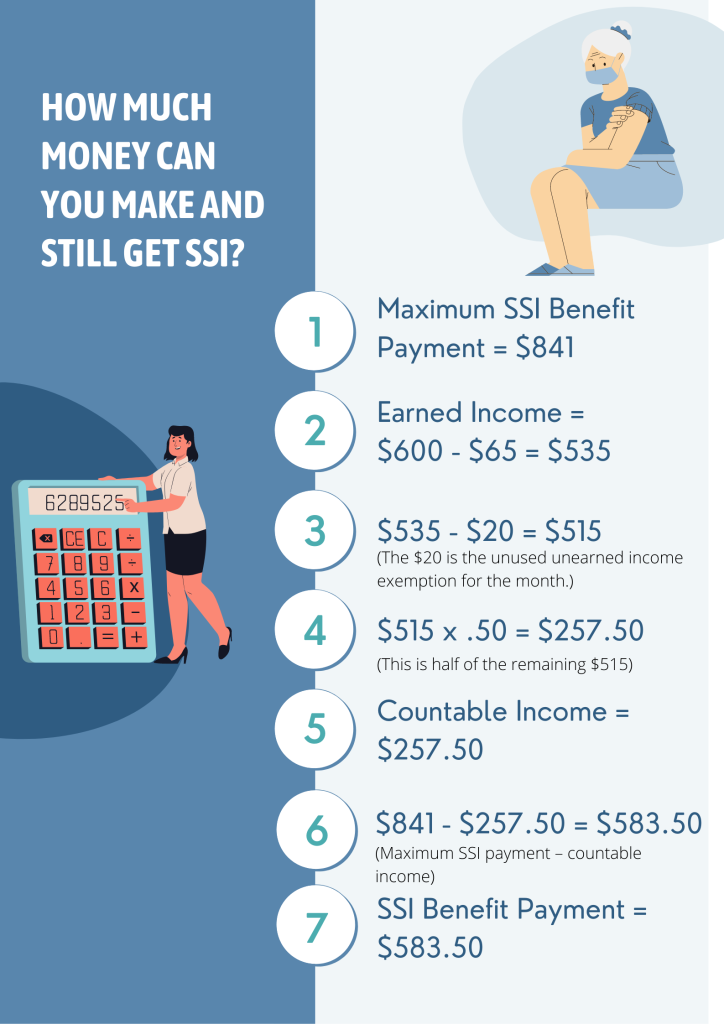
- Earned Income Exclusion: After the $20 general exclusion (if applied to earned income), the SSA excludes the first $65 of your earned income, plus one-half of the remaining earned income. This is a significant work incentive.
- Other Exclusions: Impairment-Related Work Expenses (IRWE), Blind Work Expenses (BWE), student earned income exclusion, certain public assistance payments, and most infrequent or irregular income are also excluded.
Deeming of Income: If you live with a spouse who doesn’t receive SSI, or with a parent (if you are a child), a portion of their income might be “deemed” to you. This means the SSA considers a portion of their income as available to you, which can reduce your SSI payment. Specific rules and exclusions apply to deeming.
Resource Limits: As mentioned, your countable resources must be $2,000 for an individual and $3,000 for a couple. Resources include cash, bank accounts, stocks, bonds, and some other assets. However, many significant assets are excluded, such as:
- The home you live in (primary residence).
- One vehicle, regardless of value, if used for transportation.
- Household goods and personal effects (within reasonable limits).
- Life insurance policies with a face value of $1,500 or less.
- Burial funds up to $1,500 for you and $1,500 for your spouse.
If your countable resources exceed these limits, you are generally ineligible for SSI until your resources are brought down to the allowable level.
Living Arrangements
Your living situation significantly impacts your SSI payment. The SSA applies different rules based on whether you live alone, with others, or in an institution.
- Living Alone/Paying Your Fair Share: If you live alone or pay your full share of household expenses (rent, utilities, food), you are generally eligible for the full FBR (minus countable income).
- Living with Others and Not Paying Your Share: If you live in someone else’s household and do not pay your share of food and shelter costs, the SSA may reduce your SSI payment by one-third of the FBR. This is known as the “in-kind support and maintenance” rule or the “one-third reduction rule.”
- Living in an Institution: If you live in a medical facility (like a hospital or nursing home) and Medicaid is paying for more than half the cost of your care, your SSI payment is typically limited to $30 per month. This is known as the “personal needs allowance.” Exceptions exist for temporary stays or specific types of facilities.
State Supplemental Payments
While SSI is a federal program, many states choose to supplement the federal SSI payment with their own funds. These State Supplemental Payments (SSPs) can significantly increase the total monthly benefit an individual receives.
- Varying Amounts: SSP amounts vary widely from state to state. Some states offer substantial supplements, while others offer none at all.
- State Administration: Some states administer their own SSP programs, setting their own eligibility criteria and payment amounts. Others allow the SSA to administer the SSP on their behalf, typically following federal SSI rules for eligibility.
- Impact on Total Benefit: If you live in a state that provides an SSP, your total monthly payment will be the federal FBR (minus your countable income) plus the state supplement. This can make a considerable difference in your overall financial support. It’s crucial to check with your specific state’s social services or welfare department, or the SSA, to determine if your state offers an SSP and what the criteria are.
Special Circumstances
A variety of other situations can influence your SSI payment amount:
- Temporary Institutionalization: If you are institutionalized for a short period (e.g., less than a full calendar month), your payment might not be immediately reduced to the $30 personal needs allowance.
- Temporary Medical Treatment: Certain temporary absences for medical treatment may also have specific rules.
- Deeming of Income and Resources for Children: If an SSI-eligible child lives with their parent(s), a portion of the parent’s income and resources may be “deemed” to the child, reducing the child’s SSI payment.
- Spousal Deeming: For married couples, the income and resources of the ineligible spouse can be deemed to the eligible spouse, affecting their SSI payment.
- Foster Care: Specific rules apply to children in foster care.
Calculating Your Potential SSI Benefit
Putting all these factors together, the calculation of your specific SSI benefit amount follows a basic formula, though its application can become complex due to the various exclusions and rules.
The Basic Formula
At its core, your federal SSI payment is determined by this simplified formula:

Maximum Federal Benefit (FBR) – Your Countable Income = Your Federal SSI Payment
If your state provides a supplement, then:
Your Federal SSI Payment + State Supplemental Payment = Your Total Monthly SSI Payment
Remember, “countable income” is not your gross income. It’s your income after all applicable exclusions and deductions have been applied.
Example Scenarios
Let’s illustrate with a few simplified examples using the 2024 FBR of $943 for an individual:
Scenario 1: Single Individual with No Countable Income
- FBR: $943
- Countable Income: $0
- Federal SSI Payment: $943 – $0 = $943
- If this individual lives in a state with a $50 SSP, their total payment would be $943 + $50 = $993.
Scenario 2: Single Individual with Only Unearned Income
- Suppose an individual receives a $100 monthly pension (unearned income).
- FBR: $943
- Unearned Income Exclusion: The first $20 of unearned income is excluded.
- Countable Unearned Income: $100 – $20 = $80
- Federal SSI Payment: $943 – $80 = $863
- Their total payment would be $863 plus any applicable state supplement.
Scenario 3: Single Individual with Only Earned Income
- Suppose an individual earns $300 per month from part-time work (earned income).
- FBR: $943
- General Income Exclusion: The first $20 is applied to the earned income: $300 – $20 = $280
- Earned Income Exclusion: The first $65 of the remaining earned income is excluded: $280 – $65 = $215
- Half of Remaining Earned Income Exclusion: Half of the rest is excluded: $215 / 2 = $107.50
- Countable Earned Income: $107.50
- Federal SSI Payment: $943 – $107.50 = $835.50
- Notice how the work incentives significantly reduce the countable income.
Scenario 4: Couple with No Countable Income
- FBR for a couple: $1,415
- Countable Income: $0
- Federal SSI Payment: $1,415 – $0 = $1,415
- If this couple lives in a state with a $100 SSP, their total payment would be $1,415 + $100 = $1,515.
These examples highlight how crucial the income exclusions are in determining the final payment.
Income Exclusions and Deductions
To reiterate and emphasize the importance of these, here are the primary income exclusions and deductions that most frequently impact SSI benefit calculations:
- General Income Exclusion: The first $20 of most income (earned or unearned) received in a month is not counted.
- Earned Income Exclusion: The first $65 of earned income, plus half of the remaining earned income, is not counted. This is explicitly designed to encourage work by allowing recipients to earn a significant amount without losing all their benefits.
- Impairment-Related Work Expenses (IRWE): Costs for certain items and services that a person with a disability needs to work (e.g., wheelchairs, attendant care) can be deducted from earned income.
- Blind Work Expenses (BWE): Costs incurred by blind individuals to work (e.g., guide dog expenses, transportation to work) can be deducted from earned income.
- Student Earned Income Exclusion: For students under age 22 who are regularly attending school, a portion of their earned income (up to a monthly and annual limit) is excluded.
Understanding and applying these exclusions correctly is vital, as they directly increase the amount of income you can have while still receiving SSI benefits.
Applying for SSI and Managing Your Benefits
Navigating the application process and understanding your ongoing responsibilities as an SSI recipient are just as important as knowing how your benefit is calculated. Mistakes or omissions can lead to delays, denials, or even overpayments.
The Application Process
Applying for SSI is a multi-step process that can take several months. It generally involves:
- Online Application (Partial): You can start the application for SSI online, but the process is not fully digital for disability applications.
- Contacting the SSA: You’ll need to schedule an appointment with your local Social Security office, either in person or by phone, to complete the application.
- Required Documents: Gather essential documents, including proof of age, citizenship or alien status, income, resources, living arrangements, medical records, and work history.
- Disability Determination (if applicable): If applying based on disability or blindness, the SSA’s Disability Determination Services (DDS) will review your medical evidence to determine if you meet the strict disability criteria. This often involves providing detailed medical records from doctors, hospitals, and clinics.
- Interviews: You may be interviewed by an SSA representative to discuss your financial situation and living arrangements.
- Decision: Once all information is gathered and reviewed, the SSA will send you a written decision regarding your eligibility and benefit amount. If denied, you have the right to appeal.
It’s highly recommended to be thorough and provide as much detail as possible during the application process to avoid delays.
Reporting Changes
Receiving SSI is conditional upon meeting ongoing income and resource limits, as well as maintaining eligible living arrangements. Therefore, it is absolutely critical to report changes to the Social Security Administration promptly. Failing to report changes can lead to:
- Overpayments: If you receive more money than you were entitled to due to unreported changes, you will likely have to pay it back to the SSA. This can be a significant financial burden.
- Underpayments: While less common, unreported changes could also lead to you receiving less than you’re entitled to.
- Benefit Suspension or Termination: Egregious or repeated failures to report can result in your benefits being suspended or terminated.
What to Report:
- Changes in income (earned or unearned)
- Changes in resources (e.g., receiving an inheritance, selling an asset)
- Changes in living arrangements (e.g., moving, getting married, divorce, moving into an institution)
- Changes in marital status
- Absence from the U.S. for 30 consecutive days or more
- Changes in school attendance (for student beneficiaries)
- Changes in your disability or medical condition (if you are returning to work)
You should report changes as soon as they happen, typically by the 10th day of the month following the change, to avoid penalties.
Work Incentives
The SSA understands that many individuals with disabilities want to work and be as self-sufficient as possible. To support this, they have established various work incentives that allow SSI recipients to work without immediately losing their vital benefits. These include:
- Earned Income Exclusion: As discussed, this allows a significant portion of earned income to be disregarded.
- Impairment-Related Work Expenses (IRWE) & Blind Work Expenses (BWE): These deductions further reduce countable earned income.
- Plan to Achieve Self-Support (PASS): A PASS allows an individual to set aside money and/or resources for a specific work goal (e.g., education, vocational training, starting a business) that will reduce their reliance on SSI. This money doesn’t count against SSI income or resource limits.
- Continued Medicaid Eligibility: Even if earnings become too high for a cash SSI payment, recipients may still be able to retain their Medicaid coverage, which is crucial for individuals with disabilities.
- Section 1619(a) and 1619(b): These provisions allow individuals to continue receiving SSI cash payments (1619(a)) or Medicaid (1619(b)) even if their earned income exceeds the amount that normally stops SSI payments, provided their total gross income is still below a certain threshold.
These work incentives are complex but can be incredibly valuable tools for individuals looking to increase their financial independence. It is highly recommended to consult with an SSA benefits planner or a work incentive specialist to understand how these programs can benefit your specific situation.
Conclusion
Determining “how much SSI can I get” is not a simple calculation but rather a comprehensive assessment of your personal circumstances against a backdrop of federal and state regulations. The Federal Benefit Rate serves as the maximum federal baseline, but your countable income, living arrangements, and the presence of any state supplemental payments will ultimately shape your final monthly benefit.
SSI is designed to be a safety net, providing crucial financial support to some of the most vulnerable members of society. By understanding the eligibility criteria, the various factors influencing payment amounts, and your responsibilities as a recipient, you can better navigate this essential program. Given the complexity of the rules, particularly concerning income exclusions, deeming, and work incentives, prospective and current beneficiaries are strongly encouraged to seek personalized guidance from the Social Security Administration or a qualified benefits counselor. This proactive approach ensures you receive the maximum benefit you are entitled to while adhering to all program requirements.
aViewFromTheCave is a participant in the Amazon Services LLC Associates Program, an affiliate advertising program designed to provide a means for sites to earn advertising fees by advertising and linking to Amazon.com. Amazon, the Amazon logo, AmazonSupply, and the AmazonSupply logo are trademarks of Amazon.com, Inc. or its affiliates. As an Amazon Associate we earn affiliate commissions from qualifying purchases.