
Deciding when to start claiming Social Security benefits is one of the most significant financial decisions many Americans will make as they approach retirement. While age 62 is the earliest you can begin receiving benefits, it’s crucial to understand the implications of this choice, as it permanently impacts the amount of income you’ll receive throughout your retirement. For many, the allure of immediate income can be strong, but a thorough grasp of how early claiming affects your monthly payout is essential for making an informed, financially sound decision. This article will delve into the intricacies of claiming Social Security at 62, helping you understand the calculations, the trade-offs, and whether it’s the right strategy for your personal financial landscape.

Understanding Your Social Security Benefit Foundation
Before we can calculate what you might receive at 62, it’s vital to understand the basic mechanics of how Social Security retirement benefits are determined. This foundation will illuminate why the timing of your claim has such a profound effect on your monthly checks.
What is Social Security and How Does It Work?
Social Security is a federal insurance program primarily funded through payroll taxes (FICA taxes). These taxes are deducted from the earnings of most American workers and employers, flowing into trust funds that pay benefits to current retirees, their survivors, and people with disabilities. It’s not a savings account in your name; rather, it’s a pay-as-you-go system where today’s workers fund today’s beneficiaries. Your future benefits are based on your lifetime earnings, not on what you directly paid into the system.
Key Factors Determining Your Benefit Amount
Several crucial factors come into play when the Social Security Administration (SSA) calculates your monthly benefit:
- Earnings History: The SSA calculates your average indexed monthly earnings (AIME) based on your 35 highest-earning years. If you have fewer than 35 years of earnings, zero earnings years will be factored into the average, which can lower your AIME.
- Primary Insurance Amount (PIA): Your PIA is the benefit you would receive if you start collecting benefits exactly at your Full Retirement Age (FRA). It’s calculated using a progressive formula that gives a higher percentage of replacement for lower earners. This means PIA is not a simple percentage of your earnings, but rather a stepped formula.
- Age of Claiming: This is perhaps the most direct determinant of your actual monthly check. While your PIA is fixed (based on your earnings), the age at which you begin receiving benefits dictates whether you get more or less than your PIA.
The Concept of Full Retirement Age (FRA)
Your Full Retirement Age (FRA), sometimes called “normal retirement age,” is the age at which you are entitled to receive 100% of your Primary Insurance Amount (PIA). This age isn’t 65 for everyone; it depends on your birth year. For those born in 1943 through 1954, FRA is 66. For those born between 1955 and 1960, FRA gradually increases by two months per year, reaching 67 for anyone born in 1960 or later. Knowing your FRA is critical because claiming benefits before or after this age directly impacts your monthly benefit amount. Claiming at 62 means you are initiating benefits well before your FRA, leading to a permanent reduction.
Claiming Social Security at Age 62: The Early Bird’s Perspective
The earliest age you can claim Social Security retirement benefits is 62. While this offers immediate income, it comes with a significant and permanent reduction in your monthly payout.
The Actuarial Reduction Explained
When you claim Social Security benefits before your Full Retirement Age (FRA), your monthly payment is permanently reduced. This reduction is not a temporary penalty; it is an actuarial adjustment designed to compensate for the fact that you will likely receive benefits for a longer period. The SSA calculates this reduction based on the number of months you claim before your FRA.
The reduction percentage is calculated as follows:
- 5/9 of 1% for each of the first 36 months you claim before your FRA.
- 5/12 of 1% for each additional month beyond 36 months.
Calculating Your Reduced Benefit at 62
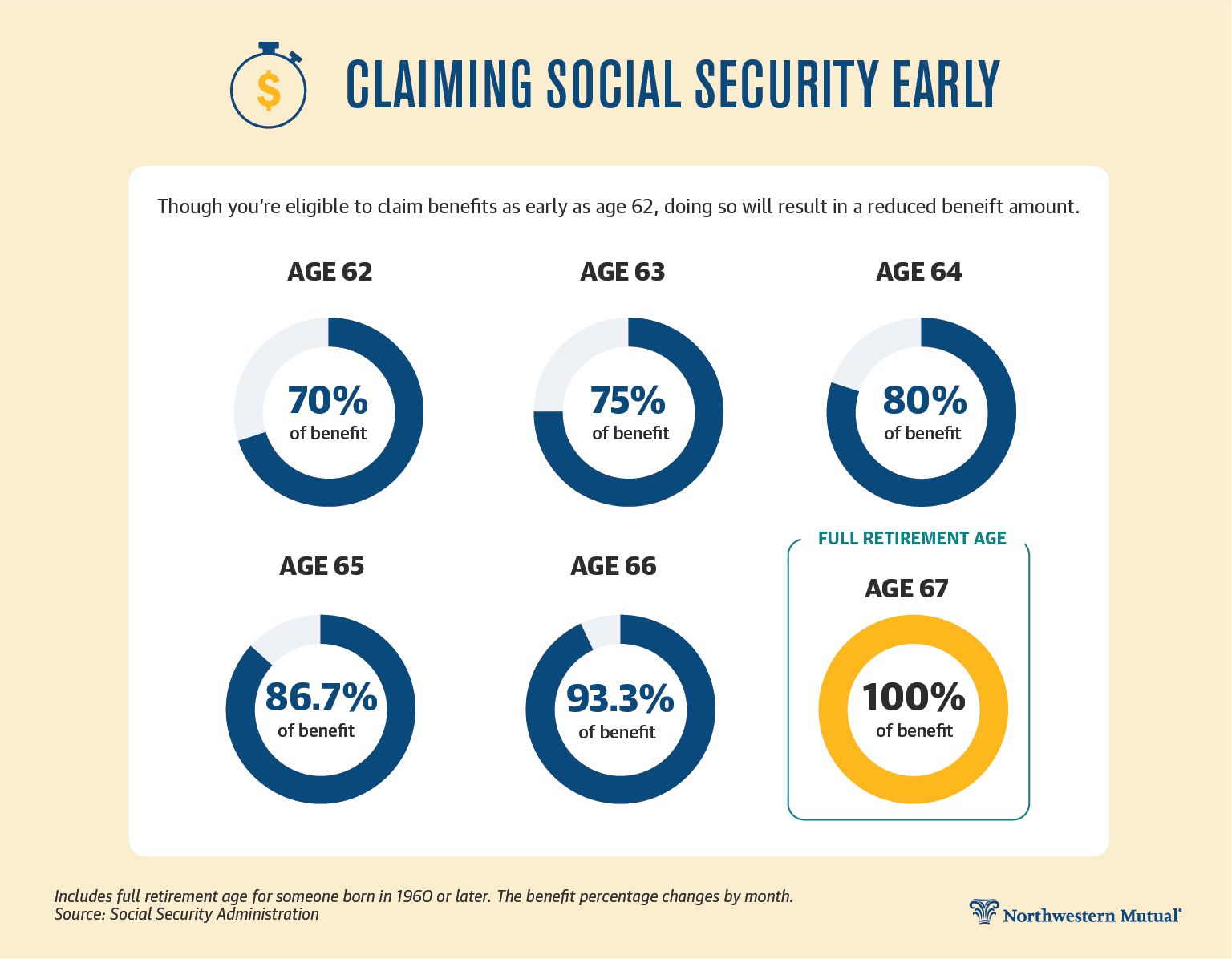
Let’s illustrate with an example. If your Full Retirement Age (FRA) is 67, and you decide to claim benefits at age 62, you would be claiming 60 months (5 years) early.
- The first 36 months of early claiming incur a reduction of 36 * (5/9 of 1%) = 36 * 0.00555… = 20%.
- The remaining 24 months (60 – 36) incur a reduction of 24 * (5/12 of 1%) = 24 * 0.00416… = 10%.
- Total reduction = 20% + 10% = 30%.
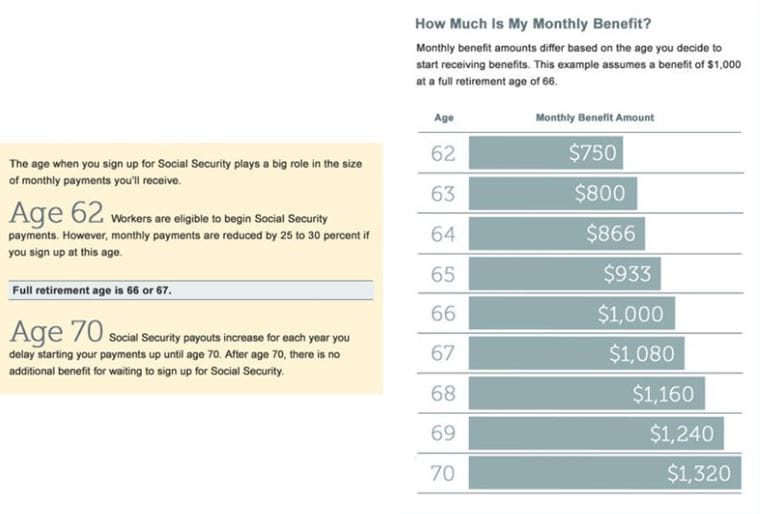
So, if your PIA (the amount you’d receive at FRA) was, for example, $1,800, claiming at 62 would reduce your monthly benefit to $1,800 * (1 – 0.30) = $1,260. This is a substantial reduction, meaning you would receive only 70% of your PIA. The exact percentage reduction depends on your birth year and corresponding FRA, but for anyone with an FRA of 67, claiming at 62 results in a 30% reduction.
Factors to Consider Before Claiming Early
Deciding to claim at 62 isn’t just about the numbers; it involves a host of personal considerations:
- Health and Longevity: If you have a serious health condition that may shorten your lifespan, claiming early might make sense to maximize your total lifetime benefits. Conversely, if you expect to live a very long life, delaying could yield significantly more in total benefits.
- Other Income and Financial Needs: Do you need the income immediately to cover living expenses, or do you have sufficient savings, pensions, or other income sources? Claiming early out of necessity is different from claiming early by choice.
- Spousal and Dependent Benefits: Your decision can impact your spouse’s potential benefits. If you claim early, your spouse’s potential spousal benefit (if they claim based on your record) will also be reduced.
- Employment Status: Are you still working or planning to work? This is a critical consideration due to Social Security’s earnings limit (discussed next).
The Impact of Working While Receiving Benefits
Many individuals who claim Social Security at age 62 continue to work, either full-time or part-time. It’s crucial to understand that if you claim benefits before your Full Retirement Age and continue to work, your benefits may be temporarily withheld if your earnings exceed a certain limit.
Social Security Earnings Limit at 62
For those who claim benefits before their FRA, the SSA imposes an annual earnings limit. If your earnings exceed this limit, a portion of your Social Security benefits will be withheld. The specific limit changes annually.
- Under FRA for the entire year: In 2024, if you are under your FRA for the entire year, the earnings limit is $22,320. For every $2 you earn above this limit, $1 of your Social Security benefits will be withheld.
- Year you reach FRA: In the year you reach your FRA, a higher earnings limit applies, and the withholding rate is different. In 2024, this limit is $59,520, and $1 is withheld for every $3 you earn above the limit, only counting earnings before the month you reach FRA.
- At or after FRA: Once you reach your Full Retirement Age, the earnings limit no longer applies, and you can earn any amount without your Social Security benefits being reduced.
How Withheld Benefits Are Recalculated Later
It’s important to note that any benefits withheld due to the earnings limit are not lost forever. When you reach your Full Retirement Age, the SSA recalculates your benefit amount to account for the months benefits were withheld. Essentially, they credit you for the months you didn’t receive benefits, increasing your monthly payment going forward. This calculation means that while your benefits might be reduced initially, the withheld amounts effectively mean you claimed later than 62 for those specific months.
Planning Around the Earnings Limit
If you plan to work while receiving benefits before your FRA, you have several options:
- Monitor Earnings: Keep track of your income to avoid exceeding the limit if you want to receive full benefits.
- Adjust Work Hours: Consider reducing your work hours or taking on less lucrative roles if staying under the limit is a priority.
- Embrace Withholding: If you enjoy working and your income exceeds the limit, understand that your benefits will be withheld. This might act as an enforced savings, leading to a higher monthly benefit once you reach FRA.
- Delay Claiming: If your earnings are consistently high and would result in significant withholding, it might be more advantageous to delay claiming your benefits until you reach your FRA or even later, to avoid the earnings test altogether and maximize your monthly payout.
Strategies and Considerations for Maximizing Your Benefits
While claiming at 62 offers immediate gratification, there are strategies to consider that could significantly increase your total lifetime Social Security income.
Delaying Benefits: The Power of Delayed Retirement Credits
For every year you delay claiming benefits past your Full Retirement Age, up to age 70, you earn “Delayed Retirement Credits.” These credits permanently increase your monthly benefit. The increase is 8% per year (or 2/3 of 1% per month) for those born in 1943 or later.
For example, if your FRA is 67 and you delay claiming until age 70, you would gain 3 years of Delayed Retirement Credits. This would result in a permanent increase of 24% (3 years * 8% per year) on top of your PIA. Combining this with the fact that you avoid the 30% reduction from claiming at 62, the difference between claiming at 62 and 70 can be substantial – potentially a 70% vs. 124% of PIA difference. This is a powerful incentive for those who can afford to wait.
Spousal and Survivor Benefits at 62
Your claiming decision can also impact spousal and survivor benefits:
- Spousal Benefits: If your spouse claims spousal benefits based on your work record, their maximum spousal benefit is 50% of your PIA (not your reduced benefit if you claim early). However, if your spouse claims spousal benefits before their own FRA, their spousal benefit will also be reduced. If you claim at 62, and your spouse claims spousal benefits at their earliest age, both benefits will be permanently reduced.
- Survivor Benefits: If you pass away, your surviving spouse or children may be eligible for survivor benefits based on your record. The amount of the survivor benefit is generally based on your full benefit amount. If you delayed claiming and accrued delayed retirement credits, this will result in a higher survivor benefit for your eligible beneficiaries.
Understanding these interconnected benefits is vital for couples to develop a coordinated claiming strategy that maximizes their combined household income over their lifetimes.
Tools and Resources for Estimating Your Benefits
The Social Security Administration provides excellent tools to help you estimate your benefits:
- My Social Security Account: This is your most valuable resource. By creating an account at ssa.gov/myaccount, you can view your earnings record, get personalized benefit estimates at different claiming ages (62, FRA, 70), and review your Social Security Statement. This online statement provides estimates based on your actual earnings history.
- Online Calculators: The SSA website also offers various calculators that allow you to model different scenarios, such as the impact of future earnings, different claiming ages, and spousal benefits.
- Financial Advisors: For complex situations or integrated retirement planning, a qualified financial advisor specializing in retirement can provide personalized guidance and help you run detailed projections.
Is Claiming at 62 Right for You? Making an Informed Decision
The question of “how much Social Security will I receive at 62” is often followed by “should I claim at 62?” The answer is highly personal and depends on a combination of financial, health, and lifestyle factors.
Pros and Cons of Early Claiming
Pros:
- Immediate Income: Provides crucial income for those who need it to retire, cover living expenses, or manage unexpected costs.
- Flexibility: Allows you to retire earlier or reduce work hours, offering more freedom in your early 60s.
- Longevity Concerns: If you have a shorter life expectancy due to health issues, claiming early might mean receiving more total benefits over your lifetime.
- Fund Other Investments: Some might claim early to invest the money, hoping for returns that outweigh the Social Security reduction, though this carries investment risk.
Cons:
- Permanent Reduction: A significant and permanent reduction in your monthly benefit (up to 30% if your FRA is 67).
- Lower Survivor Benefits: Can result in lower survivor benefits for your spouse.
- Earnings Limit Impact: If you continue to work, your benefits may be temporarily withheld.
- Missed Growth: Forfeits the opportunity for higher monthly benefits available by delaying to FRA or age 70.
The Breakeven Point Fallacy and Reality
Many people think about a “breakeven point”—the age at which the cumulative benefits from delaying claiming catch up to and surpass the cumulative benefits from claiming early. While breakeven points are real (often in your late 70s or early 80s), focusing solely on them can be misleading.
The reality is that once you pass the breakeven age, the financial advantage of delaying benefits grows significantly every month you live. For someone who lives into their late 80s or 90s, the total difference in lifetime benefits between claiming at 62 and 70 can amount to hundreds of thousands of dollars. Therefore, a decision based purely on a breakeven point might overlook the long-term financial security provided by higher monthly payments in your later years, especially when healthcare costs tend to rise.
Consulting with a Financial Advisor
Given the complexity and the significant financial implications, it is highly recommended to consult with a qualified financial advisor. They can help you:
- Analyze your personal financial situation, including other retirement savings, income sources, and expenses.
- Project your longevity based on family history and health.
- Model different claiming strategies for you and your spouse to optimize combined lifetime benefits.
- Integrate your Social Security decision into your broader retirement and estate planning.
A personalized approach ensures that your Social Security claiming strategy aligns with your overall financial goals and lifestyle aspirations, helping you secure the retirement you envision. The amount of Social Security you receive at 62 is a concrete number, but the decision to take it at that age is a nuanced one with long-lasting consequences.
aViewFromTheCave is a participant in the Amazon Services LLC Associates Program, an affiliate advertising program designed to provide a means for sites to earn advertising fees by advertising and linking to Amazon.com. Amazon, the Amazon logo, AmazonSupply, and the AmazonSupply logo are trademarks of Amazon.com, Inc. or its affiliates. As an Amazon Associate we earn affiliate commissions from qualifying purchases.