
For many Americans, the prospect of claiming Social Security benefits at age 62 represents an exciting step towards retirement. It’s the earliest age at which you can begin receiving retirement benefits, offering a potential lifeline or a supplement to other income streams. However, the decision to claim at 62 comes with significant and permanent financial implications that warrant a thorough understanding. While the allure of early income is strong, it’s crucial to weigh it against the long-term impact on your lifetime benefits.
The Lure and Long-Term Implications of Early Claiming
Claiming Social Security benefits at age 62 means initiating your payments five years earlier than the most common Full Retirement Age (FRA) of 67. While this provides immediate income, it also triggers a permanent reduction in your monthly benefit amount. This reduction is a critical factor in determining your overall financial health throughout retirement.

What “Full Retirement Age” Means
Your Full Retirement Age (FRA) is the age at which the Social Security Administration (SSA) determines you are eligible to receive 100% of your Primary Insurance Amount (PIA). This age isn’t fixed for everyone; it depends on your birth year. For those born in 1943 through 1954, FRA is 66. For those born between 1955 and 1959, FRA gradually increases. For anyone born in 1960 or later, FRA is 67. Claiming benefits before your FRA is considered early filing, and it results in a reduced monthly payment.
The Permanent Reduction Formula
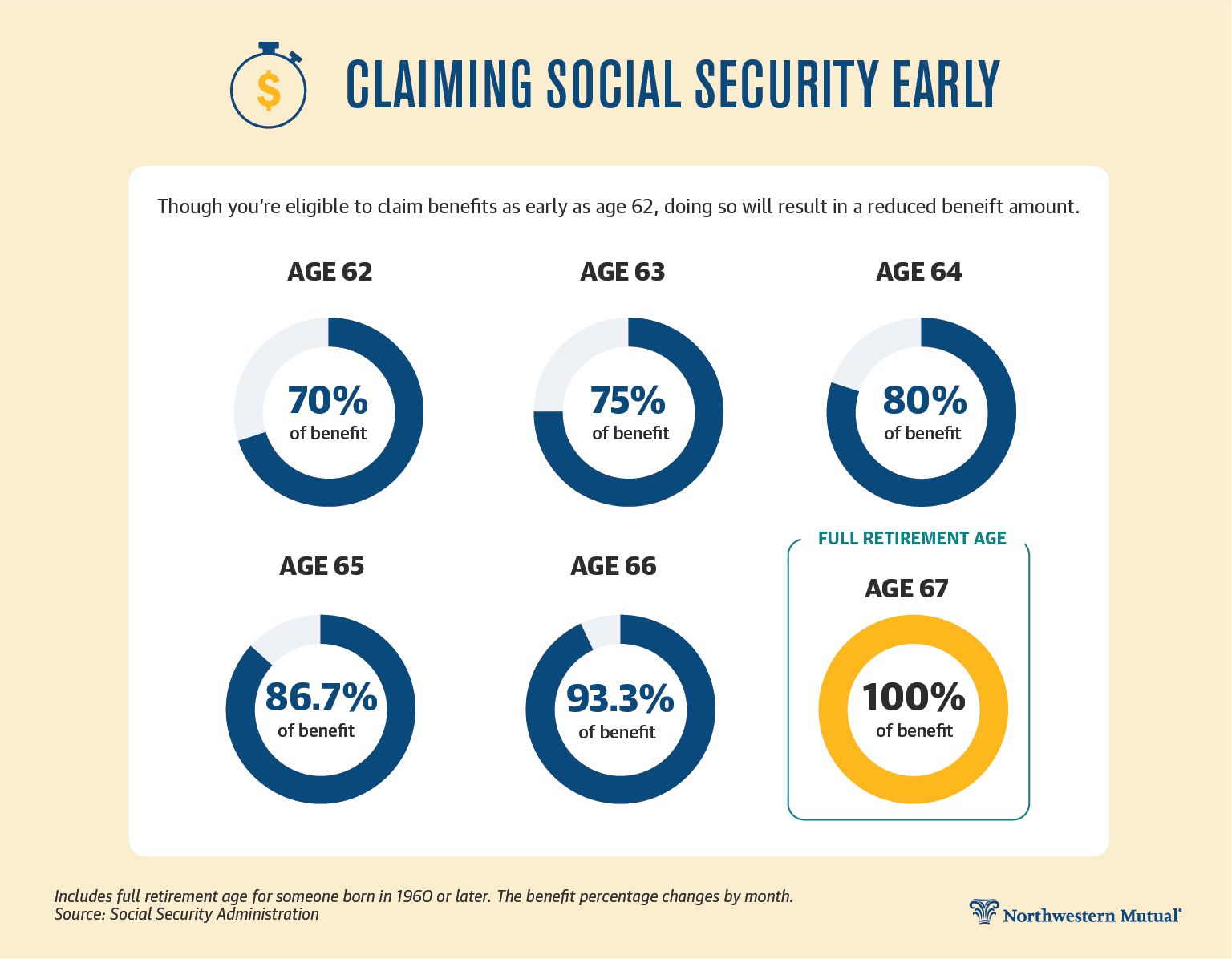
The Social Security system is designed to provide incentives for delaying benefits. When you claim at 62, your monthly benefit is reduced permanently. The reduction percentage varies based on how many months you are away from your FRA. For someone with an FRA of 67, claiming at 62 means receiving benefits for 60 months (5 years) earlier. This translates to a permanent reduction of approximately 30% of your PIA. If your FRA is 66, claiming at 62 (4 years early) results in a 25% reduction. This isn’t a temporary reduction; it lasts for the entirety of your retirement.
Why Some Choose to Claim Early
Despite the significant reduction, many individuals opt to claim Social Security at 62. Common reasons include:
- Health Issues: A declining health outlook or a family history of shorter lifespans might make early claiming seem more beneficial, ensuring they receive some benefits.
- Job Loss or Inability to Work: Unexpected unemployment or a disability that prevents continued work can force individuals to claim early out of financial necessity.
- Desire for Earlier Retirement: Some people simply wish to retire as soon as possible and use Social Security to supplement other retirement savings, even if it means a reduced amount.
- Immediate Financial Need: Urgent expenses, high-interest debt, or a lack of sufficient emergency savings can push individuals to access funds at the earliest opportunity.
Deconstructing Your Social Security Benefit Calculation
Understanding how your Social Security benefit is calculated is fundamental to making an informed decision about when to claim. The SSA uses a specific formula based on your lifetime earnings.
The Average Indexed Monthly Earnings (AIME)
The first step in calculating your benefit involves determining your Average Indexed Monthly Earnings (AIME). The SSA takes your highest 35 years of earnings, adjusted (indexed) for historical wage growth, and averages them to arrive at your AIME. If you have fewer than 35 years of earnings, the missing years are counted as zeros, which can significantly lower your AIME and, consequently, your benefit. This highlights the importance of a consistent work history.
Primary Insurance Amount (PIA)
Your AIME is then used to calculate your Primary Insurance Amount (PIA). The PIA is the monthly benefit you would receive if you claimed exactly at your Full Retirement Age. The SSA applies a progressive formula to your AIME, using “bend points” that are updated annually. This formula ensures that lower earners receive a higher percentage of their earnings back in benefits compared to high earners, though higher earners still receive a larger absolute dollar amount. For example, in 2024, the formula applies 90% to the first segment of AIME, 32% to the next segment, and 15% to the final segment.
Estimating Your Benefit: Tools and Resources
The best way to understand your potential benefit at age 62, at your FRA, or even later, is to use the resources provided by the Social Security Administration:
- my Social Security Account: This is your primary online portal. By creating an account at SSA.gov, you can access your personalized earnings record, review your estimated benefits at different claiming ages, and track your work history. This is the most accurate estimate available to you.
- SSA.gov Calculators: The SSA website offers various calculators that allow you to plug in different scenarios (e.g., stopping work early, continuing to work) to see how they might affect your benefits.
- Annual Social Security Statement: Historically mailed to individuals age 25 and older, these statements are now primarily available online through your “my Social Security” account. They provide a summary of your earnings record and estimates of your future benefits.
The Financial Trade-offs: A Deep Dive into Reduced Benefits
The decision to claim at 62 is irreversible in terms of the initial benefit reduction. Understanding the precise financial impact is crucial for long-term retirement planning.
The Exact Reduction Rate for Age 62
For individuals with a Full Retirement Age (FRA) of 67, claiming at age 62 means a permanent benefit reduction of approximately 30%. This is calculated as 5/9 of 1% for each of the first 36 months early, and 5/12 of 1% for each month beyond 36 months. For example, if your FRA is 67 (60 months after age 62):
- For the first 36 months (up to age 65): 36 months * (5/9 of 1%) = 20% reduction.
- For the next 24 months (age 65 to 67): 24 months * (5/12 of 1%) = 10% reduction.
- Total reduction: 20% + 10% = 30%.
This means if your PIA at FRA 67 would have been $2,000, claiming at 62 would reduce your monthly benefit to $1,400.
The Lifetime Impact
A $600 difference per month ($2,000 – $1,400) might seem manageable initially, but over a retirement that could span 20, 25, or even 30+ years, this accumulates to a substantial sum. Over 25 years, that’s an additional $180,000 you forgo in benefits. This lost income directly impacts your purchasing power and financial security in your later years.
Break-Even Analysis: Is It Worth It?
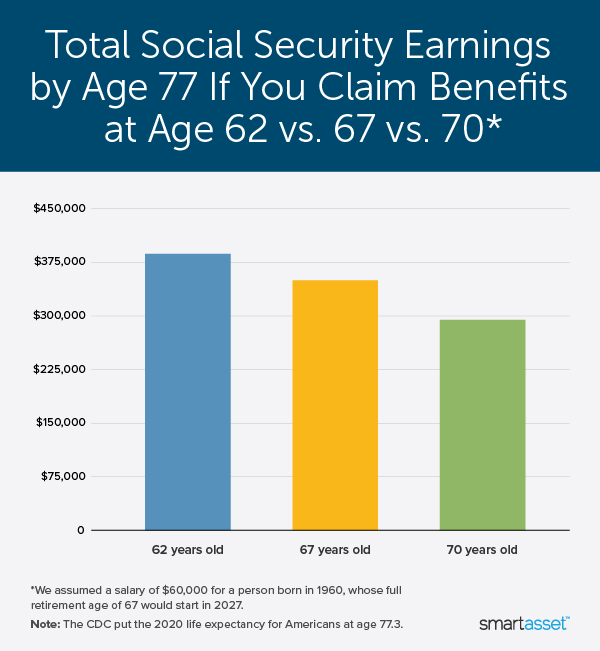
A break-even analysis helps determine the age at which the total cumulative benefits received by delaying exceed the total cumulative benefits received by claiming early. While specific break-even ages vary based on individual circumstances and PIA, for many, the break-even point typically falls in their mid-70s to early 80s. If you live past this age, delaying your benefits usually results in a higher total payout over your lifetime. For example, while you receive payments for an additional five years by claiming at 62, the higher monthly payments from waiting even a few years can quickly catch up and surpass the early claimant’s total.
Cost-of-Living Adjustments (COLAs)
It’s important to remember that annual Cost-of-Living Adjustments (COLAs) are applied to your reduced benefit amount, not your original PIA. If your benefit is permanently set at $1,400 due to early claiming, any COLA percentage increase will be applied to that $1,400, meaning the absolute dollar increase will be smaller than if it were applied to a $2,000 benefit. This further compounds the long-term impact of early claiming.
Beyond the Basics: Earnings Limits and Spousal Benefits at 62
Claiming Social Security at age 62 involves more than just the benefit reduction. Other rules, particularly if you plan to continue working or if you have a spouse, can significantly influence your net benefit.
The Retirement Earnings Test
If you claim Social Security benefits before your Full Retirement Age and continue to work, your benefits may be subject to the Retirement Earnings Test. For 2024, if you are under FRA for the entire year, the SSA will deduct $1 from your benefits for every $2 you earn above an annual limit of $22,320. In the year you reach your FRA, a higher earnings limit applies ($59,520 for 2024), and the deduction rate is $1 for every $3 earned above the limit, until the month you reach FRA. Once you reach your FRA, the earnings test no longer applies, and you can earn any amount without your Social Security benefits being reduced. This means if you claim at 62 and plan to work, your actual received benefit could be much lower or even $0 until your earnings drop below the limit. The good news is that any benefits withheld due to the earnings test are not permanently lost; your future benefits will be recalculated at your FRA to account for the withheld payments, effectively increasing your monthly amount from then on.
Spousal Benefits: When Your Partner Claims Early
Your decision to claim at 62 can also impact your spouse’s potential spousal benefits. A spouse can receive up to 50% of your Primary Insurance Amount (PIA) if they claim at their own Full Retirement Age. However, if you claim your benefits early (at 62), your own benefit is reduced. More importantly, if your spouse claims spousal benefits based on your record before their own Full Retirement Age, their spousal benefit will also be permanently reduced. While your spouse’s spousal benefit is based on your PIA, if you claim early, it might indirectly affect the maximum benefit they could potentially receive, although their reduction percentage is based on their own claiming age. It’s a complex interplay that requires careful planning, especially if one spouse has significantly lower earnings.
Survivor Benefits
The amount of survivor benefits a widow or widower can receive is also influenced by the deceased worker’s claiming age. While survivor benefits have their own distinct claiming rules and often allow for claiming at age 60 (or 50 if disabled), the maximum survivor benefit is generally based on the deceased worker’s PIA or the benefit they would have received if they had lived. If you claim your benefits early, the maximum survivor benefit your spouse could receive would also be lower than if you had claimed at your FRA or later.
Strategic Considerations for Claiming at 62
The decision to claim Social Security benefits at age 62 is highly personal and should be part of a broader, well-thought-out retirement plan. Here are strategic considerations to guide your choice:
Assess Your Health and Longevity Expectations
If you have significant health challenges or a family history of shorter lifespans, claiming at 62 might be a reasonable strategy to maximize your total lifetime benefits. In such cases, the reduced monthly payment might be offset by receiving benefits for more years. Conversely, if you expect to live a long life, delaying benefits often leads to a higher cumulative payout.
Evaluate Your Other Income Sources and Savings
Do you need the Social Security income at 62, or are you just eager to start receiving it? If you have ample retirement savings, pensions, or other income streams, delaying Social Security might be a better strategy to allow your benefits to grow, effectively creating an additional “longevity insurance” stream of guaranteed income later in life. Conversely, if Social Security is your primary source of retirement income, claiming at 62 might be a necessity, despite the reduction.
Debt Management
In specific scenarios, using early Social Security benefits to pay off high-interest debt (like credit card debt) could be a valid strategy. Eliminating expensive debt can improve your overall financial stability and potentially free up cash flow that outweighs the long-term reduction in Social Security income, at least in the short term. This decision requires a careful cost-benefit analysis.
Delaying vs. Claiming: The Long-Term Perspective
Generally, delaying Social Security benefits beyond age 62 results in a higher monthly payment. Each year you delay past 62 until your FRA increases your benefit. Even better, delaying past your FRA, up to age 70, earns you Delayed Retirement Credits (DRCs) that further boost your benefit by 8% per year. This growth is guaranteed and inflation-adjusted, making it an excellent return on investment for many individuals. For those who can afford to wait, delaying can significantly enhance their financial security in their later years.
Professional Financial Advice
Navigating the complexities of Social Security and integrating it into your overall retirement strategy can be challenging. Consulting a qualified financial advisor who specializes in retirement planning is highly recommended. An advisor can help you analyze your specific financial situation, health, longevity expectations, and other income sources to determine the optimal claiming strategy for you and your family. They can provide personalized projections and help you understand the full scope of your decision, ensuring you make the most informed choice for your future.
aViewFromTheCave is a participant in the Amazon Services LLC Associates Program, an affiliate advertising program designed to provide a means for sites to earn advertising fees by advertising and linking to Amazon.com. Amazon, the Amazon logo, AmazonSupply, and the AmazonSupply logo are trademarks of Amazon.com, Inc. or its affiliates. As an Amazon Associate we earn affiliate commissions from qualifying purchases.