
When an investor asks, “How much is a Tesla stock?” they are rarely looking for a simple real-time quote. Because Tesla (ticker: TSLA) is one of the most volatile and heavily traded equities on the Nasdaq, its “price” is a moving target that reflects the collective sentiment of millions of retail and institutional investors. Understanding the cost of a Tesla share requires looking beyond the immediate ticker price and examining the underlying financial metrics, market psychology, and long-term growth projections that justify its unique position in the financial markets.
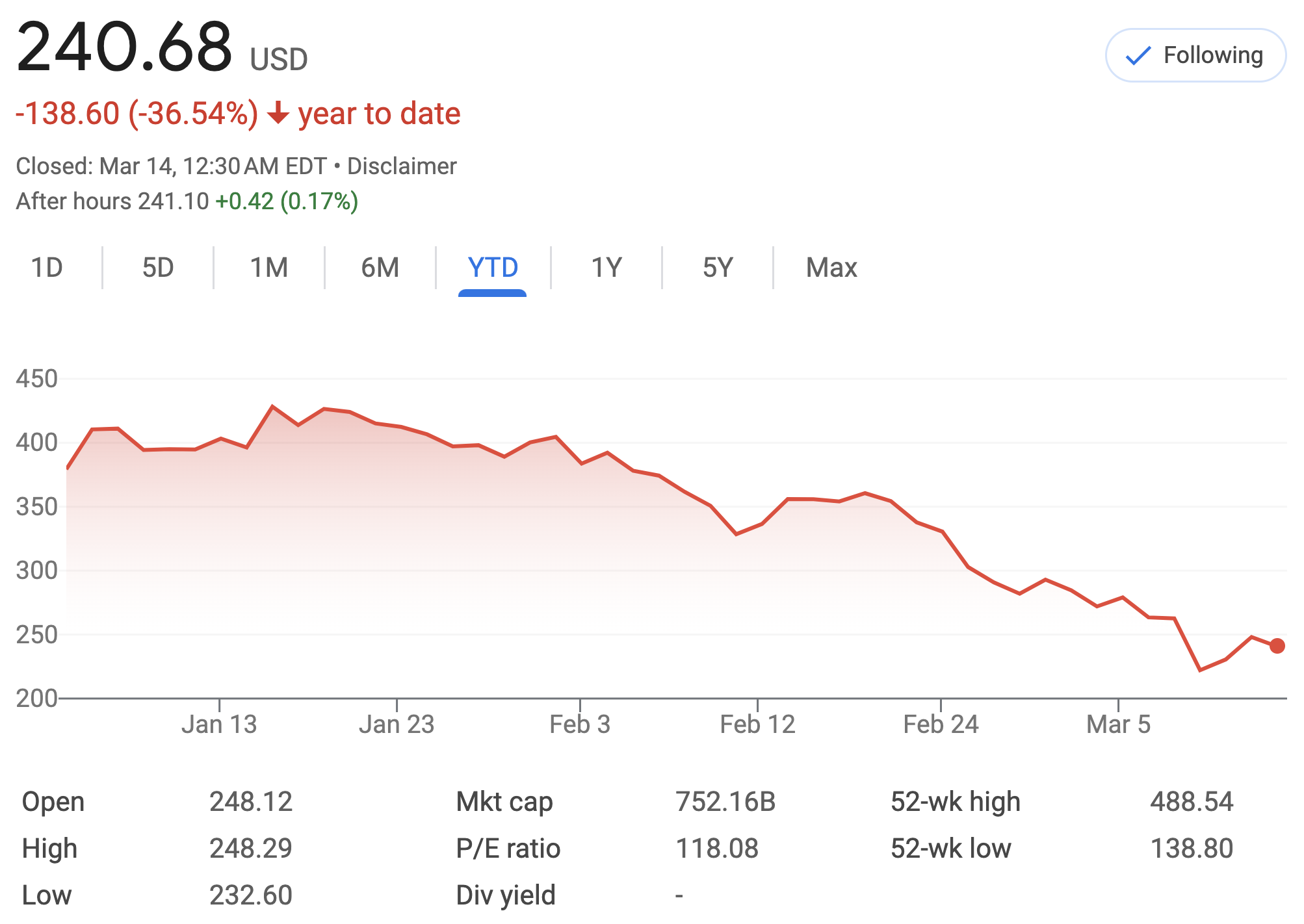
In this article, we will explore the financial landscape of Tesla, Inc., analyzing how its stock price is determined, the factors that drive its notorious volatility, and the strategic considerations every investor should weigh before adding it to their portfolio.
Understanding Tesla’s Market Valuation and Share Structure
The nominal price of a single share of Tesla is only one piece of the puzzle. To truly understand how much the stock is “worth,” an investor must look at the market capitalization and the company’s historical share adjustments.
The Impact of Stock Splits on Share Price
For those looking at historical charts, the price of Tesla stock can appear confusing. Tesla has undergone multiple stock splits—most notably a 5-for-1 split in 2020 and a 3-for-1 split in 2022. These splits do not change the fundamental value of the company or an investor’s total equity; rather, they increase the number of shares while proportionally lowering the price per share. This strategy is primarily aimed at making the stock more accessible to retail investors and improving liquidity. When asking “how much” the stock is, one must ensure they are looking at “split-adjusted” historical data to make accurate comparisons.
Market Capitalization vs. Share Price
Tesla’s share price multiplied by its total outstanding shares gives us its market capitalization. For several years, Tesla has maintained a valuation that dwarfs traditional automakers like Toyota, Volkswagen, and Ford combined. This discrepancy is a focal point of financial debate. While traditional automotive companies are valued based on their current production capacity and modest profit margins, Tesla’s market cap reflects the “Money” narrative of a high-growth tech firm. Investors are paying for future cash flows, not just today’s car sales.
Financial Drivers of TSLA Stock Volatility
Tesla is often cited as a “battleground stock.” Its price movements are frequently decoupled from the broader market, driven by specific financial catalysts that can cause double-digit swings in a single trading week.
Delivery Reports and Production Margins
On a quarterly basis, the most significant driver of Tesla’s stock price is its delivery and production report. In the world of personal finance and institutional investing, these numbers are the ultimate litmus test for growth. If Tesla misses delivery estimates by even a small margin, the stock often faces a sell-off. Conversely, a beat on delivery numbers can trigger a massive rally.
Beyond just the number of cars sold, sophisticated investors focus on “Gross Margins.” Tesla historically enjoyed higher margins than traditional OEMs (Original Equipment Manufacturers). However, recent price-cutting strategies to maintain market share in a high-interest-rate environment have pressured these margins, leading to fluctuations in the stock’s valuation as analysts recalibrate their profit models.
The “Musk Premium” and Macroeconomic Pressures
The stock price of Tesla is inextricably linked to its CEO, Elon Musk. From a financial perspective, this creates a “Key Person Risk.” Musk’s activities in other ventures, his public statements, and his sales of TSLA shares to fund other acquisitions (like X, formerly Twitter) have historically created downward pressure or extreme volatility.
Furthermore, as a growth stock, Tesla is highly sensitive to interest rates. When the Federal Reserve raises rates, the “discount rate” applied to future earnings increases, which typically lowers the present value of growth stocks. This macroeconomic lever is a primary reason why the “cost” of Tesla stock can fluctuate even when the company’s internal operations are performing well.
Fundamental vs. Technical Analysis: Evaluating the Price

To determine if the current price of Tesla is a “good deal,” investors typically employ two different methodologies: fundamental analysis and technical analysis.
The Price-to-Earnings (P/E) Ratio Debate
The most common metric used to evaluate if a stock is expensive is the P/E ratio. Tesla has historically traded at a P/E ratio significantly higher than the S&P 500 average. Bears argue that this makes the stock “overvalued” compared to its actual earnings. Bulls, however, argue that the P/E ratio is a backwards-looking metric that fails to account for Tesla’s diversified revenue streams, such as its energy storage business (Tesla Energy) and its future potential in autonomous driving software (FSD). When assessing “how much” to pay for Tesla, you are essentially deciding whether you believe in its transition from a hardware company to a high-margin software and energy company.
Identifying Support and Resistance Levels
For short-term traders, the “price” of Tesla is often dictated by technical levels. Because of its high trading volume, TSLA tends to respect certain psychological price points—such as round numbers or historical “support” levels where buyers have previously stepped in. Technical analysis helps investors identify entry points, suggesting that “how much” you pay is just as important as “what” you buy. Understanding these trends can prevent investors from “buying the top” during a period of irrational exuberance.
Long-Term Investment Considerations: Risks and Rewards
Investing in Tesla is not merely a play on the electric vehicle (EV) market; it is a complex financial decision involving multiple sectors of the economy.
Competitive Risks and Regulatory Scrutiny
One cannot discuss the value of Tesla stock without acknowledging the growing competition. With Chinese manufacturers like BYD offering lower-cost alternatives and legacy automakers like Hyundai and BMW catching up in the premium EV space, Tesla’s “moat” is under constant pressure. Additionally, regulatory investigations into its Autopilot and Full Self-Driving (FSD) features represent a financial risk. Any adverse ruling or mandated recall can result in significant legal costs and a hit to the brand’s valuation, directly impacting the share price.
The Upside: AI, Robotics, and Energy Storage
The bull case for Tesla’s stock price rests on its non-automotive sectors. Tesla Energy is a rapidly growing segment that provides battery storage solutions for residential and utility-scale projects. Furthermore, many institutional investors view Tesla as an Artificial Intelligence (AI) and robotics company rather than a car manufacturer. If Tesla successfully monetizes its Optimus robot or achieves “Level 5” autonomy, the current stock price might eventually be seen as a bargain. In this context, the “money” being invested today is a bet on the future of global infrastructure.
How to Strategically Approach Buying Tesla Stock
Given its volatility, jumping into a full position in Tesla can be daunting for the average investor. Strategic financial planning can mitigate some of the risks associated with its price swings.
The Power of Dollar-Cost Averaging (DCA)
Because it is nearly impossible to time the bottom of a Tesla price correction, many financial advisors suggest Dollar-Cost Averaging. By investing a fixed amount of money at regular intervals—regardless of the share price—investors buy more shares when the price is low and fewer shares when the price is high. This reduces the emotional stress of watching the daily “how much is a Tesla stock” ticker and focuses on long-term wealth accumulation.
Portfolio Diversification and Risk Management
No matter how much an investor believes in the Tesla mission, financial prudence dictates that it should not be the only asset in a portfolio. Tesla’s high Beta (a measure of volatility relative to the market) means that it will likely swing more violently than the general index. Balancing a position in TSLA with more stable value stocks or broad-market ETFs (Exchange-Traded Funds) can provide a “financial cushion,” allowing an investor to hold through Tesla’s inevitable downturns without compromising their overall financial security.

Conclusion: The True Value of Tesla
In conclusion, the question “how much is a tesla stock” is answered not just by a number on a screen, but by an understanding of the company’s financial health, its growth trajectory, and the macroeconomic environment. Whether the stock is trading at $150, $250, or $400, its value is derived from its ability to innovate and dominate the future of energy and transport.
For the savvy investor, Tesla represents a unique intersection of high-risk and high-reward. By focusing on fundamental metrics like gross margins and P/E ratios, while remaining mindful of technical support levels and broader market trends, one can navigate the complexities of TSLA. Ultimately, the cost of the stock is the price you pay for admission into one of the most ambitious corporate experiments of the 21st century. Whether that price is “cheap” or “expensive” depends entirely on your time horizon and your belief in the sustainable energy transition.
aViewFromTheCave is a participant in the Amazon Services LLC Associates Program, an affiliate advertising program designed to provide a means for sites to earn advertising fees by advertising and linking to Amazon.com. Amazon, the Amazon logo, AmazonSupply, and the AmazonSupply logo are trademarks of Amazon.com, Inc. or its affiliates. As an Amazon Associate we earn affiliate commissions from qualifying purchases.