
The question of “how much for one bitcoin” is perhaps the most frequently asked query in the digital asset space, yet the answer is rarely a simple number. Unlike traditional fiat currencies or even established stocks, the price of Bitcoin is a living, breathing metric that fluctuates second by second across global exchanges. To understand the cost of a single Bitcoin, one must look beyond the immediate ticker price and delve into the fundamental mechanics of supply and demand, institutional adoption, and the macroeconomic factors that dictate its perceived value.

In the early days of 2009, a single Bitcoin was practically worthless, traded for pennies among cryptography enthusiasts. Today, it represents a trillion-dollar asset class. Whether you are a retail investor looking to buy your first fraction of a coin or a high-net-worth individual considering a significant allocation, understanding what drives the price is essential for navigating this high-stakes financial frontier.
Understanding the Price Mechanics of Bitcoin
At its core, the price of Bitcoin is determined by the intersection of absolute scarcity and fluctuating demand. Unlike the U.S. Dollar or the Euro, which central banks can print in response to economic crises, Bitcoin’s supply is governed by a decentralized protocol. This “monetary policy” is hard-coded and transparent, providing a level of predictability that is unique in the financial world.
The Power of Absolute Scarcity
There will only ever be 21 million Bitcoins. This hard cap is the cornerstone of its value proposition. Currently, over 19.7 million coins have already been “mined” or issued into circulation. The remaining supply is released through a process called mining, which involves computers solving complex mathematical puzzles to secure the network.
Every four years, an event known as “the halving” occurs. This event reduces the reward given to miners by 50%, effectively cutting the new supply of Bitcoin entering the market in half. Historically, these halving events have served as major catalysts for price appreciation. When the rate of new supply drops while demand remains constant or increases, the price must adjust upward to find a new equilibrium. For an investor, the question of “how much” is often a question of where we currently sit in this four-year cycle.
Market Sentiment and Liquidity
Because Bitcoin operates on a 24/7 global market, it is highly sensitive to sentiment. News of a major corporation adding Bitcoin to its balance sheet can cause an immediate price surge, while rumors of a regulatory crackdown can trigger a sharp sell-off.
Liquidity—the ease with which Bitcoin can be bought or sold without affecting its price—also plays a role. On major exchanges like Coinbase or Binance, liquidity is high, meaning large trades can happen with minimal “slippage.” However, during periods of extreme volatility, liquidity can thin out, leading to the rapid price swings that characterize the crypto markets.
Factors Influencing Bitcoin’s Value Today
In the current financial landscape, Bitcoin is no longer viewed merely as an experimental digital currency. It has transitioned into a legitimate macro-asset, often referred to as “digital gold.” This shift has brought new drivers into the fold, moving the price based on global economic trends.
Institutional Adoption and the Spot ETF Era
One of the most significant developments in Bitcoin’s pricing history occurred with the approval of Spot Bitcoin Exchange-Traded Funds (ETFs) in the United States. Before these financial products existed, institutional investors—such as pension funds and insurance companies—faced significant hurdles in acquiring Bitcoin due to regulatory and custodial concerns.
The entry of giants like BlackRock and Fidelity has fundamentally changed the “how much” equation. These ETFs create a massive, persistent source of demand. When billions of dollars flow into these funds, the fund managers must purchase the underlying Bitcoin, removing it from the open market. This institutional “on-ramp” has provided a floor for the price that did not exist in previous market cycles, potentially reducing long-term volatility while driving the price toward new all-time highs.
Macroeconomic Factors and Inflation Hedges
Bitcoin is often traded as a “risk-on” asset, similar to high-growth tech stocks. When the Federal Reserve lowers interest rates and increases the money supply, investors seek higher returns in assets like Bitcoin, driving the price up. Conversely, when interest rates rise, investors often retreat to the safety of government bonds, putting downward pressure on Bitcoin’s price.
However, a secondary narrative views Bitcoin as a hedge against currency devaluation. In countries experiencing hyperinflation, the “price” of one Bitcoin in local currency terms often reaches record highs daily. On a global scale, as investors become concerned about the long-term purchasing power of fiat currencies, they allocate capital to Bitcoin as a way to “opt-out” of inflationary monetary systems.

The Cost of Acquisition: More Than Just the Market Price
When asking “how much for one bitcoin,” a prospective buyer must also account for the various costs associated with the transaction. The price you see on Google or a financial news site is the “spot price,” but the “all-in” cost of owning Bitcoin involves several other variables.
Transaction Fees and Exchange Spreads
If you buy Bitcoin on a retail platform, you will rarely pay the exact spot price. Exchanges charge a “spread”—the difference between the buy and sell price—and a transaction fee. These fees vary wildly. A simple “one-click” purchase on a mobile app might carry a fee as high as 1.5% to 3%, whereas using a “Pro” trading interface on the same platform might reduce that fee to 0.4% or lower.
Furthermore, if you intend to move your Bitcoin off the exchange and into a private wallet (a practice highly recommended for security), you must pay a network fee. These “miner fees” fluctuate based on how congested the Bitcoin network is at that moment. During busy periods, moving your Bitcoin could cost anywhere from a few dollars to over fifty dollars.
The “Satoshi” Factor: Buying in Fractions
It is a common misconception that you must buy one full Bitcoin. Because the price of a single coin is now out of reach for many, it is important to remember that Bitcoin is divisible to eight decimal places. The smallest unit is called a “Satoshi” (named after the anonymous creator, Satoshi Nakamoto).
One Bitcoin equals 100,000,000 Satoshis. This means you can invest as little as $10 or $100 and receive the corresponding fraction of a coin. For the average person, the question shouldn’t be “how much for one bitcoin,” but rather “how much Bitcoin can I afford to own given my current financial goals?”
Strategic Approaches to Investing in Bitcoin
Given the volatility and the significant price tag of a whole coin, savvy investors utilize specific strategies to manage risk and build their positions over time.
Dollar-Cost Averaging (DCA)
Dollar-cost averaging is the practice of investing a fixed amount of money at regular intervals, regardless of the price. For example, an investor might decide to buy $200 worth of Bitcoin every two weeks.
This strategy removes the emotional stress of trying to “time the market.” When the price is high, your $200 buys less Bitcoin; when the price is low, your $200 buys more. Over time, this tends to result in a lower average purchase price and protects the investor from the psychological trap of buying at the “top” due to FOMO (Fear Of Missing Out).
Storage and Security Costs
The “cost” of Bitcoin also includes the cost of securing it. Leaving a significant amount of money on an exchange is risky, as exchanges can be hacked or freeze accounts. Professional investors typically invest in “Cold Storage”—hardware devices that keep the private keys to their Bitcoin offline. While these devices cost between $60 and $200, they are a necessary expense for anyone serious about protecting their investment.
Future Outlook: Valuation Models and Predictions
While no one can predict the future price of Bitcoin with certainty, financial analysts use several models to estimate its potential value.
The Stock-to-Flow (S2F) model compares the existing supply of Bitcoin (the stock) to the new supply entering the market (the flow). This model suggests that as the “flow” decreases due to halving events, the price must increase exponentially. While it has faced criticism for not accounting for demand shifts, it remains a popular framework for long-term bulls.
Another perspective is the Metcalfe’s Law approach, which suggests that the value of a network is proportional to the square of the number of its users. As more people, businesses, and nations adopt Bitcoin, the network’s value—and thus the price of a single coin—should theoretically rise.
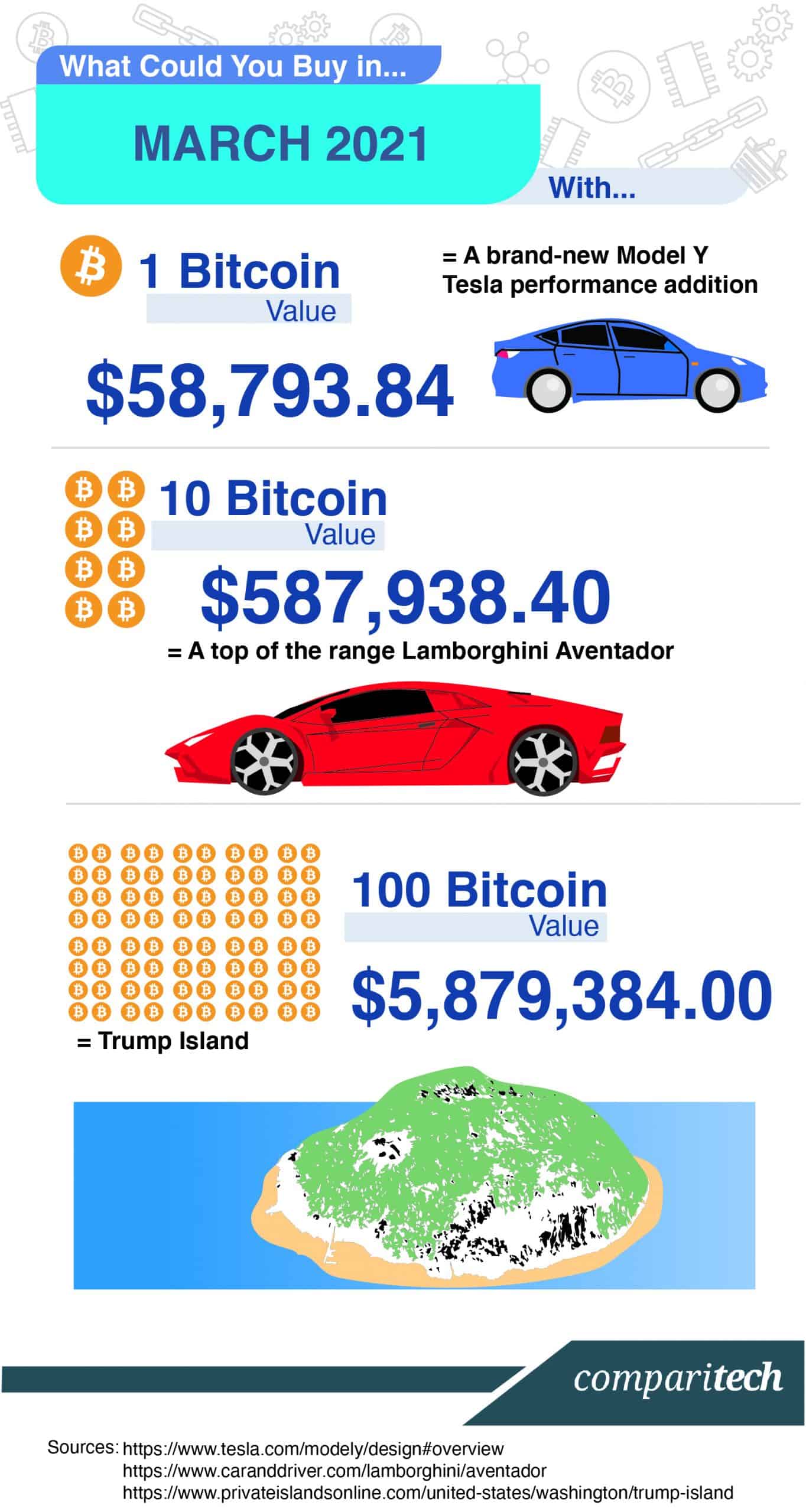
Ultimately, the answer to “how much for one bitcoin” will continue to evolve. It is an asset that combines the properties of technology, money, and a social movement. Whether it is valued at $50,000 or $500,000 in the future depends on its continued utility as a store of value and its integration into the global financial system. For the modern investor, the key is not to chase the price, but to understand the value of the underlying network and the role it plays in a diversified financial portfolio.
aViewFromTheCave is a participant in the Amazon Services LLC Associates Program, an affiliate advertising program designed to provide a means for sites to earn advertising fees by advertising and linking to Amazon.com. Amazon, the Amazon logo, AmazonSupply, and the AmazonSupply logo are trademarks of Amazon.com, Inc. or its affiliates. As an Amazon Associate we earn affiliate commissions from qualifying purchases.