
Solar panels have moved from a niche, futuristic concept to a mainstream, increasingly essential technology in the global energy landscape. Their promise is clear: harness the sun’s abundant energy to power our homes, businesses, and even our vehicles. But for those considering the leap into solar, a fundamental question often arises: “How much energy can a solar panel really produce?” The answer, while seemingly straightforward, is a nuanced blend of technical specifications, environmental factors, and system design choices. Understanding these elements is key to appreciating the true potential of photovoltaic technology and making informed decisions about its deployment.
This article will delve into the core mechanics of solar energy production, explore the myriad factors that influence a panel’s output, guide you through calculating potential energy generation, and highlight the ongoing technological advancements that are continually pushing the boundaries of what solar panels can achieve. By the end, you’ll have a comprehensive grasp of the real-world energy production capabilities of these remarkable devices.
The Core Mechanics of Solar Energy Production
At its heart, a solar panel is an ingenious device designed to convert sunlight directly into electricity. This process, known as the photovoltaic effect, is the bedrock of all modern solar energy systems.
Photovoltaic Effect: Converting Sunlight to Electricity
The term “photovoltaic” itself offers a clue: “photo” meaning light, and “voltaic” referring to electricity. The magic happens within individual solar cells, typically made from silicon. When photons (particles of light) from the sun strike the silicon atom, they excite electrons, knocking them loose from their atomic bonds. These freed electrons then flow through an electrical circuit, creating an electric current – direct current (DC) electricity, to be precise. This DC current is what powers devices or charges batteries directly, although for most household applications, it needs to be converted into alternating current (AC) by an inverter.
Key Components: Cells, Modules, and Arrays
A single solar cell produces only a small amount of electricity, typically around 0.5 to 0.6 volts. To generate a usable amount of power, multiple cells are connected together.
- Solar Cell: The fundamental unit that converts light into electricity.
- Solar Module (Panel): Multiple solar cells encapsulated within a protective frame (usually glass and aluminum) and wired together to produce a higher voltage and current. This is what we commonly refer to as a “solar panel.” Standard residential panels typically contain 60, 72, or 96 cells.
- Solar Array: Multiple solar modules connected together to form a larger system, capable of generating substantial amounts of power for homes, businesses, or utility-scale operations.
Understanding Panel Ratings: Watts and Efficiency
When you look at a solar panel’s specifications, two terms are paramount: its wattage and its efficiency.
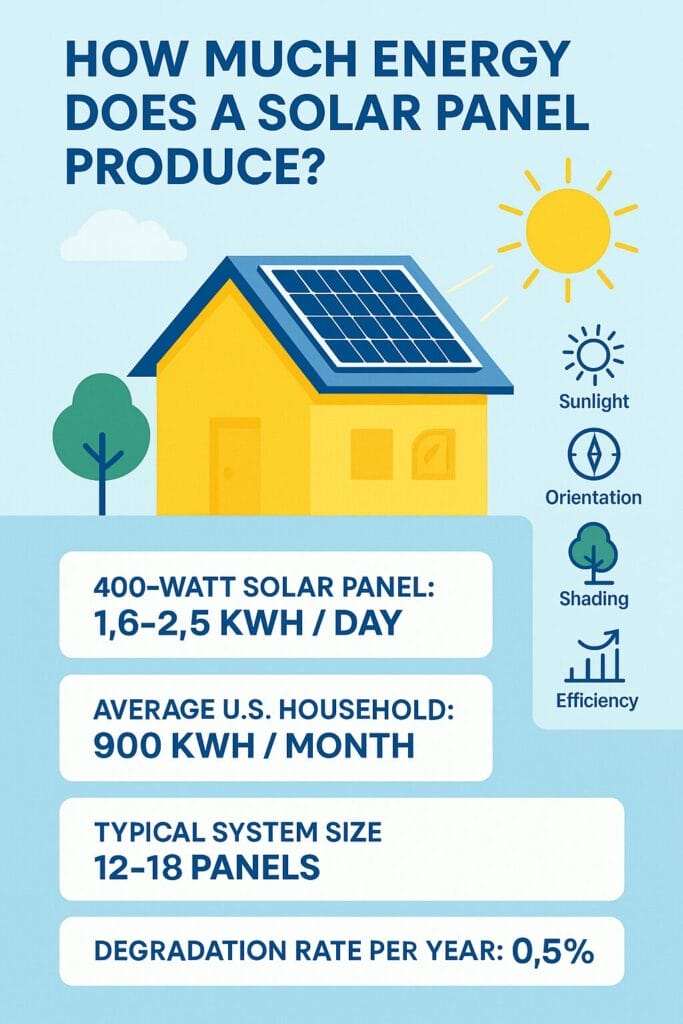
- Wattage (Wp): This is the panel’s nominal power rating, expressed in watts-peak (Wp). It represents the maximum power the panel can produce under Standard Test Conditions (STC). STC specifies an irradiance of 1000 watts per square meter (W/m²), a cell temperature of 25°C (77°F), and an air mass of 1.5. In essence, a 400 Wp panel is rated to produce 400 watts of power under these ideal laboratory conditions.
- Efficiency: This percentage indicates how effectively the panel converts sunlight into electricity. For example, a 20% efficient panel means that 20% of the sunlight striking its surface is converted into usable electricity. Higher efficiency panels generate more power from a smaller footprint, making them ideal for limited roof space. Modern residential panels typically range from 17% to over 22% efficiency.
It’s crucial to remember that STC are laboratory conditions. Real-world performance will always vary due to a multitude of factors.
Factors Influencing Solar Panel Output
While a panel’s wattage rating provides a baseline, its actual energy production in kilowatt-hours (kWh) over time is influenced by a dynamic interplay of environmental and technical variables. Understanding these factors is crucial for predicting and maximizing energy yield.
Sunlight Intensity and Irradiation Levels
This is arguably the most significant factor. The amount of solar energy (irradiance) reaching the panel directly dictates how much electricity it can produce. Regions closer to the equator and those with consistently clear skies receive more intense and prolonged sunlight. This is measured in “peak sun hours” – the equivalent number of hours per day when solar irradiance averages 1000 W/m². A location with 5 peak sun hours will generate significantly more energy than one with 3, even with the same panel. Cloud cover, haze, and time of day all reduce effective irradiance.
Panel Efficiency and Material Science
As mentioned, higher efficiency panels convert a greater percentage of incident sunlight into electricity. This is a direct function of the semiconductor materials used and the manufacturing processes. Ongoing research into new materials like perovskites and advances in silicon crystal structures (e.g., n-type cells) continue to push efficiency limits.
Temperature: The Silent Performance Killer
Counterintuitively, solar panels perform less efficiently as their temperature increases beyond the 25°C STC benchmark. Silicon-based panels have a negative temperature coefficient, meaning their power output decreases by a certain percentage (typically 0.3% to 0.5% per degree Celsius) for every degree above 25°C. On a hot, sunny day, a panel on a dark roof can reach 60°C or more, leading to a noticeable drop in output compared to its rated power. Proper ventilation beneath panels can help mitigate this.
Shading and Obstructions
Even partial shading can dramatically reduce a panel’s output, and potentially the output of an entire string of panels if they are wired in series without proper optimization. A single shaded cell can act as a resistor, crippling the performance of others. This is why careful site assessment to avoid tree shadows, chimneys, or neighboring buildings is paramount. Technologies like microinverters and power optimizers are designed to mitigate the impact of shading by allowing each panel to operate independently at its maximum power point.
Panel Orientation and Tilt Angle
For fixed-tilt systems, the orientation (azimuth) and tilt angle are critical for maximizing annual energy production. In the Northern Hemisphere, panels should ideally face true south (not magnetic south) to capture the most direct sunlight throughout the day. The optimal tilt angle is generally close to the local latitude, though it might be adjusted slightly to favor summer or winter production depending on specific energy needs. Tracking systems, which follow the sun’s path, can increase output by 25-40% but come with higher costs and maintenance.
Maintenance and Degradation
Like any outdoor equipment, solar panels require some maintenance, primarily cleaning, to perform optimally. Dust, dirt, pollen, bird droppings, and other debris can accumulate on the surface, blocking sunlight and reducing output. While rain often helps, periodic cleaning (especially in dry or dusty climates) can improve production by several percentage points. Panels also degrade over time; most manufacturers guarantee a minimum of 80-85% of original power output after 25 years, with the annual degradation rate typically around 0.5% to 0.7%.
Calculating Your Potential Solar Output
Beyond understanding the factors, the practical question is: how do I estimate my potential energy production? While precise figures require detailed simulations, several tools and methods provide excellent approximations.
Daily vs. Annual Production Estimates
Energy production is typically measured in kilowatt-hours (kWh). You might hear about a panel producing X kWh per day or Y kWh per year. A common rule of thumb for average US conditions (around 4-5 peak sun hours/day) is that a 1 kW (1000 Wp) solar system will produce approximately 4-5 kWh per day, or 120-150 kWh per month, totaling around 1,460-1,825 kWh per year. This is a very rough estimate, emphasizing the need for more precise calculations.
Tools and Resources for Estimation (e.g., PVWatts Calculator)
The most widely used and reliable public tool for estimating solar production in the United States is the PVWatts Calculator developed by the National Renewable Energy Laboratory (NREL). You input your location, system size (kW), panel type, array type (fixed, tracking), tilt, and azimuth, and it provides monthly and annual energy production estimates based on extensive meteorological data for that specific area. Similar tools exist globally. For more complex commercial or utility-scale projects, professional solar design software (e.g., PVSyst, Helioscope) is used.
The Role of Inverters and System Sizing
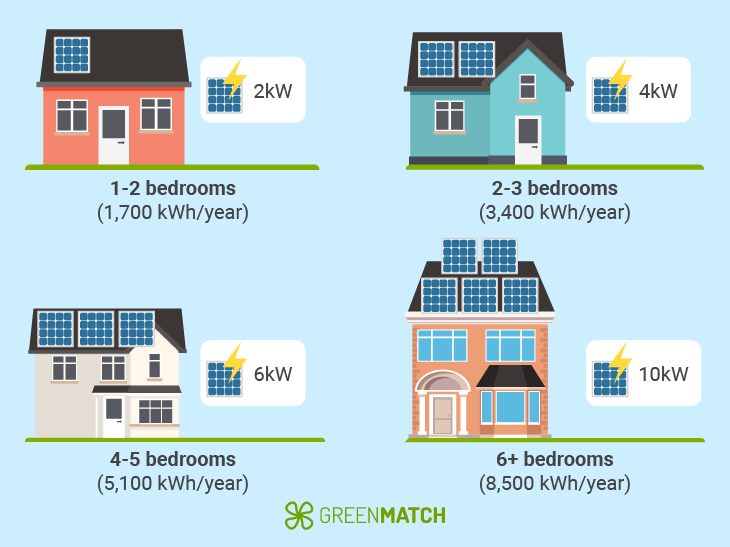
The inverter is a crucial component that converts the DC electricity from your panels into AC electricity usable by your home or the grid. The inverter’s efficiency (typically 95-99%) and its sizing relative to the array’s DC capacity are important. An undersized inverter might clip peak production, while an oversized one might be less efficient at lower loads. Furthermore, the overall system sizing (how many panels you install) is determined by your energy consumption needs, available roof space, and budget.
Storage Solutions: Batteries and Grid Interaction
While not directly related to producing energy, how that energy is managed impacts its overall utility. Battery storage allows you to store excess solar production for use during the night or during grid outages, increasing self-consumption. Most grid-tied solar systems also participate in “net metering,” where excess electricity is sent back to the grid, and you receive credits for it, effectively using the grid as a large battery.
Advances in Solar Panel Technology
The solar industry is a hotbed of innovation, with continuous advancements improving panel performance, durability, and cost-effectiveness. These technological leaps directly impact how much energy a panel can produce and under what conditions.
Monocrystalline vs. Polycrystalline vs. Thin-Film
These represent the primary types of solar panel technology:
- Monocrystalline: Made from a single, pure silicon crystal, these panels are typically the most efficient (18-22%+) and have a sleek, uniform dark appearance. They perform well in low-light conditions.
- Polycrystalline: Made from multiple silicon crystals fused together, these are slightly less efficient (15-18%) and have a bluer, speckled appearance. They are generally more cost-effective.
- Thin-Film: These panels use various semiconductor materials (e.g., cadmium telluride, amorphous silicon) deposited in thin layers. They are less efficient but can be flexible, lightweight, and perform better in high temperatures or partial shading. Their niche is typically in large-scale commercial applications or specialized uses.
PERC, Bifacial, and Half-Cut Cell Technologies
Recent innovations are pushing conventional silicon panel efficiency further:
- PERC (Passivated Emitter Rear Cell): This technology adds a reflective layer to the back of a standard solar cell, allowing unabsorbed sunlight to reflect back into the cell for a second absorption attempt. This significantly boosts efficiency, especially in high-temperature conditions.
- Bifacial Panels: These panels can capture sunlight from both their front and rear sides. By reflecting sunlight off a light-colored roof or ground surface onto the back of the panel, they can generate 5-30% more energy than monofacial panels, particularly when installed on elevated racks or ground mounts.
- Half-Cut Cell Technologies: By cutting traditional solar cells in half, these panels reduce resistive losses, increase durability, and improve performance under shading. When a half-cut panel is partially shaded, only the affected half-cells lose power, minimizing the overall impact on the panel’s output.
Smart Solar: Monitoring and Optimization
Modern solar systems integrate smart technologies for enhanced performance. Module-level power electronics (MLPEs) like microinverters and power optimizers are attached to individual panels. They allow each panel to operate independently, maximizing its output regardless of shading or performance issues on other panels. This also provides granular monitoring data, allowing homeowners and installers to track performance down to the individual panel level and quickly identify any underperforming units.
Emerging Photovoltaic Materials
The future of solar energy is bright with new materials like perovskites showing immense promise for higher efficiencies, lower manufacturing costs, and potentially even transparent or flexible applications. While still largely in research and development, these materials could revolutionize solar panel production and significantly increase energy yield per square meter.
Maximizing Your Solar Panel’s Energy Production
Getting the most out of your solar investment involves strategic planning, proper installation, and ongoing care.
Strategic Installation and Site Assessment
The journey to maximum energy production begins with a thorough site assessment. This includes evaluating your roof’s structural integrity, identifying potential shading issues throughout the year, and determining the optimal panel orientation (azimuth) and tilt angle. Professional installers use specialized software to model sun paths and shade patterns to design the most efficient layout. For ground-mount systems, even greater flexibility exists to perfectly angle panels.
Regular Maintenance and Cleaning
While solar panels are generally low-maintenance, keeping them clean is paramount. Dust, pollen, bird droppings, and environmental pollutants can accumulate on the surface, reducing the amount of sunlight reaching the cells. A simple rinse with a garden hose (preferably in the morning or evening when panels are cool) a few times a year is often sufficient. In very dry or dusty regions, more frequent cleaning might be necessary. Avoid abrasive cleaners or high-pressure washers, which can damage the panel surface.
Upgrading Components: Inverters and Optimizers
If your current system is older, consider upgrading to more advanced inverters or adding power optimizers. Newer string inverters boast higher efficiencies and more sophisticated monitoring. Microinverters or power optimizers can significantly boost output, especially in systems prone to partial shading or module-level performance variations, by ensuring each panel operates at its peak potential. This is a cost-effective way to revitalize an existing system’s output.
Future-Proofing with Scalable Systems
Designing a solar system with future expansion in mind can be a wise strategy. If your energy needs are likely to grow (e.g., adding an electric vehicle, heat pump, or expanding your home), oversizing conduit runs, selecting an inverter with spare capacity, or choosing modular microinverter-based systems can make it easier and more affordable to add panels later, allowing you to scale your energy production as required.
In conclusion, the question of “how much energy can a solar panel produce” doesn’t have a single, universal answer. It’s a dynamic calculation influenced by a panel’s inherent technology, its surrounding environment, and the design of the overall system. While a standard 400-watt panel under ideal conditions might produce 400 watts instantaneously, its daily and annual kilowatt-hour output will vary. By understanding the core principles, considering the influential factors, utilizing available calculation tools, and embracing technological advancements, you can unlock and optimize the substantial real-world potential of solar energy.
aViewFromTheCave is a participant in the Amazon Services LLC Associates Program, an affiliate advertising program designed to provide a means for sites to earn advertising fees by advertising and linking to Amazon.com. Amazon, the Amazon logo, AmazonSupply, and the AmazonSupply logo are trademarks of Amazon.com, Inc. or its affiliates. As an Amazon Associate we earn affiliate commissions from qualifying purchases.