
Navigating the landscape of government benefits can be complex, especially when seeking financial support due to age, blindness, or disability. Supplemental Security Income (SSI) is a critical federal program designed to provide a financial safety net for those who qualify, yet a common question remains: “How much do you actually get for SSI?” Understanding the intricacies of SSI benefit calculations, eligibility criteria, and the factors that influence payment amounts is essential for current recipients and prospective applicants alike. This comprehensive guide will demystify SSI payments, offering professional insights into what you can expect and how the system works.
Understanding Supplemental Security Income (SSI)
Before diving into the numbers, it’s crucial to grasp the fundamental nature of SSI. Unlike Social Security Disability Insurance (SSDI), which is based on an individual’s work history and contributions to Social Security taxes, SSI is a needs-based program. It provides a minimum level of income to eligible individuals who have limited income and resources.
Who is SSI For? Eligibility Requirements
SSI is designed for specific populations. To qualify, an individual must be:
- Aged 65 or older: Without requiring a disability.
- Blind: Meeting the Social Security Administration’s (SSA) definition of blindness.
- Disabled: Meeting the SSA’s definition of disability, which generally means being unable to engage in any substantial gainful activity due to a medically determinable physical or mental impairment that is expected to last for a continuous period of not less than 12 months or result in death.
Beyond these primary criteria, applicants must also meet strict financial limitations:
- Limited Income: The SSA considers most types of income, including earned wages, unearned income (like pensions or other benefits), and “in-kind” support (food or shelter received from others). Certain types of income are excluded or partially excluded from the calculation.
- Limited Resources: Resources are assets an individual owns and could convert to cash to pay for food and shelter. This includes cash, bank accounts, stocks, bonds, and real estate (other than one’s primary residence). For 2024, the resource limit is $2,000 for an individual and $3,000 for a couple. Not all resources count towards this limit; for instance, a primary home, one vehicle, and household goods typically do not.
Applicants must also be U.S. citizens or legal residents who meet specific immigration requirements.
The Difference Between SSI and SSDI
While both SSI and SSDI are administered by the Social Security Administration, they serve distinct purposes and have different qualification standards.
- SSI (Supplemental Security Income): A needs-based program for low-income individuals who are aged, blind, or disabled, regardless of their work history. It is funded by general U.S. Treasury funds, not by Social Security taxes.
- SSDI (Social Security Disability Insurance): An entitlement program for individuals who have worked and paid Social Security taxes for a sufficient period. Eligibility is based on past work history and disability, not on financial need. It is funded by Social Security taxes.
It’s possible for an individual to receive both SSI and SSDI if their SSDI benefit is low enough to still meet SSI’s income limits. This is often referred to as “concurrent benefits.”
Calculating Your SSI Benefit Amount
The amount you receive for SSI is not a fixed sum for everyone. It is determined by a combination of federal standards and individual circumstances, particularly your income and living arrangements.
The Federal Benefit Rate (FBR)
The foundation of your SSI payment is the Federal Benefit Rate (FBR). This is the maximum federal SSI payment an eligible individual can receive. The FBR is set annually by Congress and typically adjusts each year based on the cost-of-living adjustment (COLA) applied to Social Security benefits. For 2024, the FBR is $943 per month for an eligible individual and $1,415 per month for an eligible couple.
It’s crucial to understand that very few people actually receive the full FBR. This is because most individuals have some form of countable income or receive in-kind support, which reduces their federal payment.
State Supplemental Payments: How They Vary
Many states recognize that the FBR alone may not be sufficient to cover basic living expenses. As a result, 46 states and the District of Columbia provide an additional payment on top of the federal SSI benefit. These are known as State Supplemental Payments (SSPs). The amount of an SSP varies significantly by state, and sometimes even within a state based on factors like living arrangements (e.g., living independently vs. living in a nursing home).
Some states administer their own SSPs directly, while others have the SSA administer them on their behalf. The existence and amount of an SSP can significantly increase the total monthly SSI payment an individual receives. For example, a state with a generous SSP might provide an additional few hundred dollars per month, while others may offer only a small supplement or none at all.
Impact of Countable Income and Resources
Your monthly SSI payment is directly impacted by your countable income. The SSA uses a specific formula to determine how much of your income counts against your FBR.
- General Income Exclusion: The first $20 of most unearned income per month is excluded.
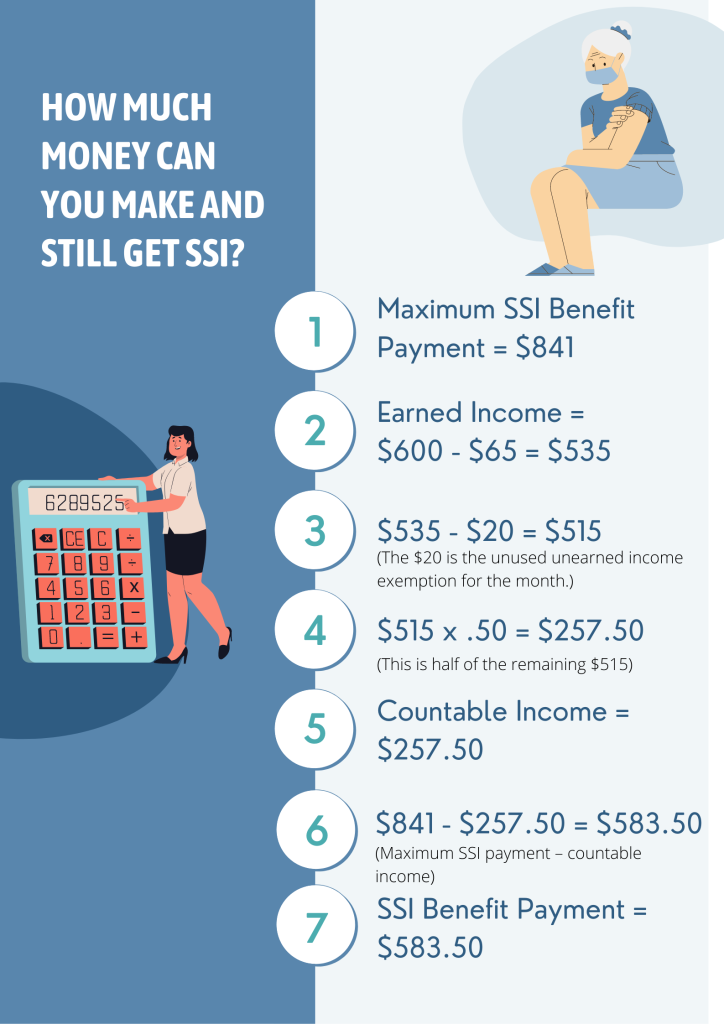
- Earned Income Exclusion: The first $65 of earned income plus half of the remainder is excluded. This means that for every $2 you earn above $65, your SSI benefit is reduced by $1.
- Other Exclusions: Various other exclusions exist for specific types of income, such as certain student earnings, infrequent or irregular income, and income set aside for an approved Plan to Achieve Self-Support (PASS).
The calculation works like this:
- Start with the FBR.
- Subtract your countable income (after applying all exclusions).
- The result is your federal SSI payment.
For example, if the FBR is $943 and you have $200 in countable income, your federal SSI payment would be $743 ($943 – $200). If you also receive a state supplement, that would be added to this amount.
Factors That Can Affect Your SSI Payments
Beyond income, several other critical factors can influence the final amount of your monthly SSI check. These include your living situation, whether you receive support from others, and any changes in your financial circumstances.
Living Arrangements and Their Financial Implications
One of the most significant factors affecting your SSI payment is your living arrangement. The SSA assumes that if you live with others and contribute less than your share of household expenses, you are receiving “in-kind” support and maintenance.
- Living Alone/Paying Your Share: If you live alone, or if you live with others and pay your pro-rata share of household expenses, you are generally eligible for the full FBR (minus countable income).
- Living in Another Person’s Household: If you live in someone else’s household and do not pay your share of food and shelter costs, your SSI benefit may be reduced by one-third of the FBR. This is known as the “one-third reduction rule” (VTR).
- Living in a Medical Facility: If you are in a hospital, nursing home, or other medical facility where Medicaid pays for more than half of your care, your SSI benefit is typically reduced to a small personal needs allowance (e.g., $30 per month).

It is vital to report any changes in living arrangements to the SSA promptly, as they can directly impact your benefit amount.
In-Kind Support and Maintenance (ISM)
In-Kind Support and Maintenance (ISM) refers to food or shelter that someone else provides to you. If the one-third reduction rule does not apply (e.g., you live in your own household but someone else pays your rent), the SSA uses the “Presumed Maximum Value” (PMV) rule. Under this rule, the value of the ISM is presumed to be one-third of the FBR plus $20, unless you can prove the actual value is less. This presumed value is then counted as unearned income, reducing your SSI payment. Understanding ISM is critical, as seemingly helpful gestures from friends or family could lead to a reduction in benefits if not reported correctly.
Earned and Unearned Income Deductions
While we touched upon income exclusions in the calculation section, it’s worth reiterating their importance. The earned income exclusion (first $65 + half of the remainder) is a significant work incentive for SSI recipients, allowing them to earn some income without losing all their benefits. Unearned income (pensions, Social Security benefits, gifts, interest) is generally counted dollar-for-dollar after the $20 general income exclusion. Gifts, even small ones, can impact benefits if they exceed the exclusion limits. Maintaining accurate records of all income sources and understanding what is countable versus excludable is paramount.
Managing Your SSI Benefits and Related Considerations
Receiving SSI benefits comes with responsibilities and opportunities. Proactive management and awareness of related programs can significantly enhance your overall well-being.
Reporting Changes to the SSA
The responsibility to report changes to the Social Security Administration rests with the recipient. Failure to report changes promptly can lead to overpayments, which the SSA will then seek to recover, potentially reducing future benefits or even requiring repayment. Reportable changes include:
- Changes in income (earned or unearned)
- Changes in resources (e.g., receiving an inheritance, selling an asset)
- Changes in living arrangements
- Changes in marital status
- Changes in school attendance (for child recipients)
- Going in or out of a medical facility
- Changes in citizenship or alien status
- Leaving the U.S. for 30 consecutive days or more
Most changes should be reported within 10 days of the month following the change.
SSI and Other Government Benefits (Medicaid, SNAP)
One of the most significant advantages of receiving SSI is the automatic eligibility for other crucial government assistance programs in most states.
- Medicaid: In many states, SSI recipients are automatically eligible for Medicaid, which provides comprehensive health care coverage. This is a vital benefit, especially for individuals with disabilities or chronic health conditions.
- SNAP (Supplemental Nutrition Assistance Program): SSI recipients often qualify for SNAP (food stamps), which helps purchase groceries.
- Other Housing and Energy Assistance: Eligibility for SSI can also open doors to other local or state programs offering housing assistance, energy bill support, and other social services.
These collateral benefits significantly enhance the value of SSI beyond the cash payment itself, contributing to an individual’s overall financial and health stability.
Working While Receiving SSI: Work Incentives
The SSA offers several work incentives to encourage SSI recipients to work and become more self-sufficient without immediately losing their benefits. These include:
- Earned Income Exclusion: As mentioned, a significant portion of earned income is disregarded.
- Plan to Achieve Self-Support (PASS): A PASS allows individuals to set aside income and resources for a specific work goal (e.g., education, vocational training, starting a business). The money set aside in a PASS does not count against SSI income or resource limits.
- Student Earned Income Exclusion (SEIE): For students under age 22 who are regularly attending school, a portion of their earned income can be excluded, allowing them to work and continue their education.
- Continued Medicaid Eligibility (1619(b)): This provision allows individuals to continue receiving Medicaid even if their earned income becomes too high to receive a cash SSI payment, provided they still meet the medical disability requirements and need Medicaid to work.
These incentives demonstrate the SSA’s commitment to supporting individuals with disabilities in their efforts to gain employment and achieve greater independence.
Applying for SSI: What You Need to Know
The application process for SSI can be lengthy and requires meticulous attention to detail. Preparing adequately can streamline the process.
The Application Process
Applying for SSI generally involves several steps:
- Contacting the SSA: You can start by calling the SSA, visiting a local office, or beginning an application online (though often an in-person or phone interview is required to complete it).
- Initial Application: This involves providing personal information, financial details, and information about your medical condition.
- Disability Determination (if applicable): For disability-based applications, the SSA will forward your medical information to a state Disability Determination Services (DDS) agency. DDS will gather medical records, potentially request additional examinations, and make a decision on your disability status.
- Financial Review: Concurrently, the SSA will review your income and resources to ensure you meet the financial eligibility criteria.
- Decision: You will receive a written notice of the SSA’s decision.
The process can take several months, and it’s not uncommon for initial applications to be denied, particularly for disability claims.
Gathering Necessary Documentation
To facilitate a smoother application, gather all relevant documents beforehand. This typically includes:
- Social Security card or record of your Social Security number.
- Proof of age (birth certificate).
- Proof of U.S. citizenship or lawful alien status.
- Income and resource information (bank statements, pay stubs, pension awards).
- Proof of living arrangements (rent receipts, lease agreements).
- Medical records (doctors’ reports, test results, hospital summaries).
- Information about previous jobs (if applying for disability).
Having these documents organized and readily available will significantly help during the application process.
Appealing a Decision
If your initial application for SSI is denied, you have the right to appeal the decision. The appeals process has several levels:
- Reconsideration: Your case is reviewed by someone new who was not involved in the initial decision.
- Hearing by an Administrative Law Judge (ALJ): If reconsideration is denied, you can request a hearing before an ALJ. This is an opportunity to present your case, bring witnesses, and submit additional evidence.
- Appeals Council Review: If the ALJ denies your claim, you can ask the Appeals Council to review the ALJ’s decision.
- Federal Court Review: As a last resort, you can file a lawsuit in federal district court.
Many applicants find it beneficial to seek assistance from a disability advocate or attorney during the appeals process, particularly for ALJ hearings and beyond.
In conclusion, the question “how much do you get for SSI” has no single answer. It depends on a dynamic interplay of federal regulations, state supplements, individual income, resources, and living arrangements. By understanding these factors, reporting changes diligently, and leveraging available work incentives, recipients can maximize their benefits and effectively manage their financial well-being under the SSI program.
aViewFromTheCave is a participant in the Amazon Services LLC Associates Program, an affiliate advertising program designed to provide a means for sites to earn advertising fees by advertising and linking to Amazon.com. Amazon, the Amazon logo, AmazonSupply, and the AmazonSupply logo are trademarks of Amazon.com, Inc. or its affiliates. As an Amazon Associate we earn affiliate commissions from qualifying purchases.