
In today’s dynamic economic landscape, understanding the true value of your time and labor is more critical than ever. Whether you’re a salaried employee, an hourly worker, a freelancer, or an entrepreneur, knowing your effective hourly rate is a powerful metric that transcends the simple number on your paycheck. It’s a foundational element for informed financial planning, strategic career decisions, and ultimately, building lasting wealth. The “How Much Do I Make an Hour Calculator” isn’t just a tool for basic arithmetic; it’s a gateway to deeper financial insight, empowering individuals to negotiate better, budget smarter, and value their time more effectively.

This article delves into the intricacies of calculating your hourly wage, exploring why this figure is paramount, how to accurately determine it for various employment structures, and most importantly, how to leverage this knowledge to enhance your financial well-being and career trajectory. We’ll demystify the calculation process, highlight the often-overlooked factors that influence your true hourly worth, and provide a framework for using this understanding to your advantage.
Understanding Your Hourly Worth: More Than Just a Number
At its core, your hourly wage represents the financial remuneration you receive for each hour of work performed. However, the concept extends far beyond a simple division of your weekly pay by your hours worked. A comprehensive understanding of your hourly worth involves considering various financial and time-related factors that collectively paint a complete picture of your compensation. This deeper dive allows individuals to make more strategic decisions about their time, career, and financial future.
Why Calculating Your Hourly Rate Matters
The immediate benefit of knowing your hourly rate is clarity. It provides a standardized metric to compare different job opportunities, evaluate the financial viability of side hustles, or even assess the true cost of commuting. For salaried employees, converting an annual salary into an hourly figure often reveals a surprising reality, bringing to light the financial impact of unpaid overtime or the value of benefits packages. For hourly workers, it’s a baseline for understanding the impact of raises, overtime, and differing shift structures. For freelancers, it’s the bedrock of sustainable pricing strategies. Without this calculation, individuals often operate with a foggy sense of their economic value, potentially leading to undervaluation or missed opportunities.
Differentiating Between Gross and Net Hourly Pay
A common pitfall in calculating hourly rates is failing to distinguish between gross and net pay. Your gross hourly pay is the total amount you earn per hour before any deductions. This is the figure typically used in job offers and salary discussions. However, your net hourly pay (or take-home pay) is what you actually receive after taxes (federal, state, local), social security, Medicare, and other deductions like health insurance premiums, retirement contributions, or union dues have been withheld. While gross pay is important for high-level comparisons, net pay gives you a realistic understanding of your disposable income per hour, which is crucial for budgeting and day-to-day financial management. A true financial calculator will often ask for these distinctions.
Beyond the Paycheck: Hidden Costs and Benefits
Your financial compensation isn’t just the direct money you receive. Many factors subtly influence your effective hourly worth, both positively and negatively. On the positive side, employer-provided benefits such as health insurance, retirement plan matching, paid time off (PTO), life insurance, disability insurance, professional development opportunities, and even free snacks or gym memberships add significant value. These benefits, though not liquid cash, are part of your total compensation package and would otherwise be out-of-pocket expenses.
On the negative side, “hidden costs” can erode your perceived hourly rate. These include commuting expenses (fuel, public transport, vehicle maintenance, time spent commuting), work-related expenses not reimbursed by your employer (uniforms, tools, home office utilities), and even the emotional and physical toll of a stressful job. For freelancers, this list expands to include self-employment taxes, business insurance, software subscriptions, and administrative time that isn’t directly billable. A truly insightful calculation of your hourly worth should attempt to factor in these elements to present a more holistic picture.
The Mechanics of Hourly Rate Calculation
Accurately determining your hourly rate varies significantly depending on your employment structure. What works for a salaried employee will differ from a freelancer. Understanding these nuances is key to getting a precise figure from any “how much do I make an hour calculator.”
For Salaried Employees: Converting Annual to Hourly
Converting an annual salary to an hourly rate requires a few straightforward steps, but also some careful considerations. The most common method involves dividing your annual salary by the total number of working hours in a year.
-
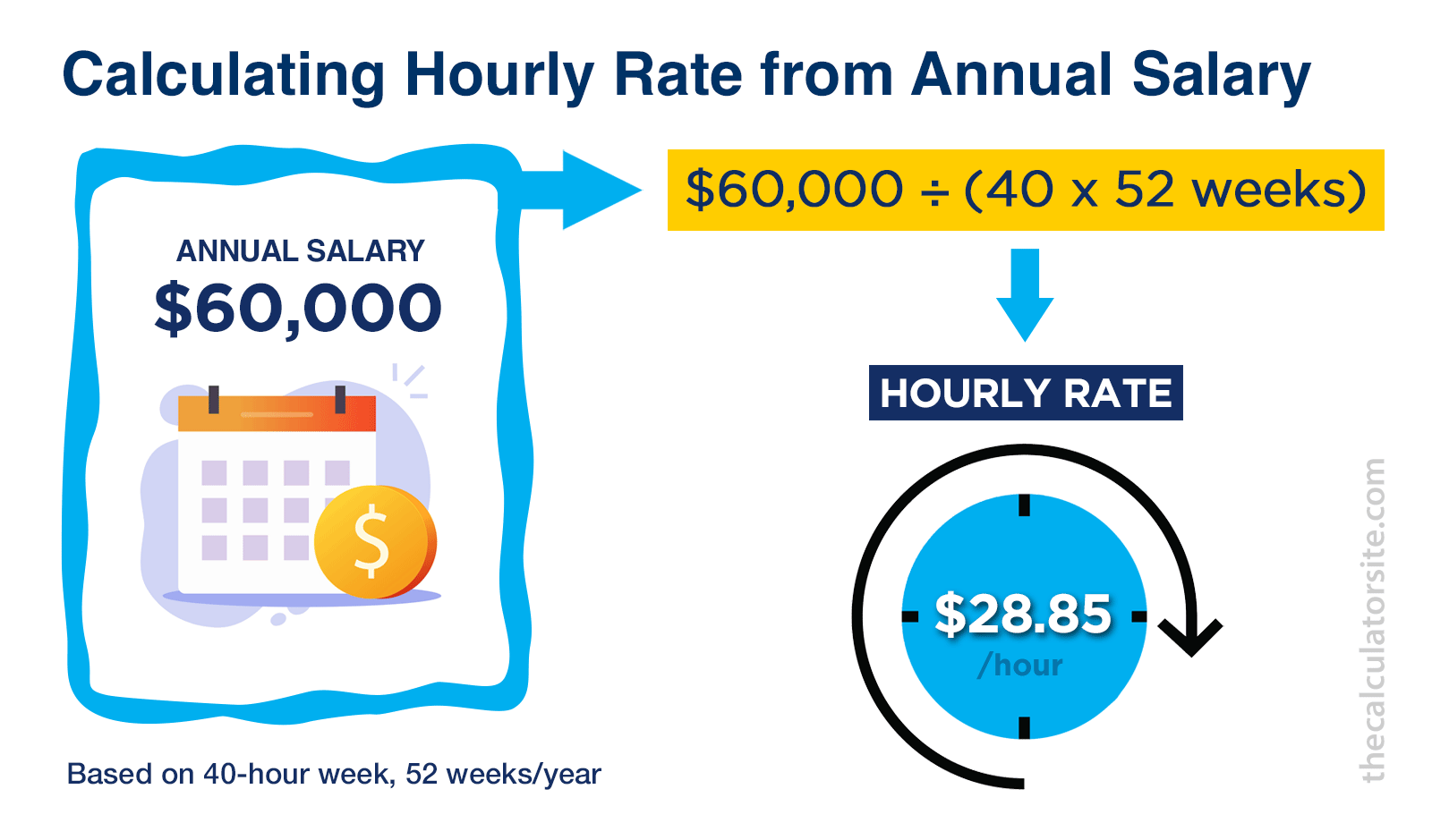
Standard Method: Assuming a 40-hour work week and 52 weeks in a year, the total standard working hours are 2,080 (40 hours/week * 52 weeks/year).
- Formula: Annual Salary / 2080 hours = Hourly Rate
-
Adjusting for Paid Time Off (PTO): If you have paid holidays or vacation days, you could argue for a slightly higher effective hourly rate if you want to consider hours worked versus hours paid. However, for consistency and comparison, the 2080-hour baseline is widely accepted.
-
Considering Overtime: If you consistently work more than 40 hours per week without additional compensation (as is common in many salaried roles), your effective hourly rate decreases significantly. For example, a $60,000 salary over 2080 hours is approximately $28.85/hour. If you routinely work 50 hours a week (2600 hours annually), your actual hourly rate drops to $23.08/hour ($60,000 / 2600). This demonstrates the importance of tracking your actual hours worked, not just the standard.
For Hourly Workers: Simple Division and Overtime Considerations
For those paid on an hourly basis, the calculation seems simpler at first glance.
-
Basic Calculation: Total weekly pay / Total hours worked = Hourly Rate.
-
Overtime Pay: Many hourly positions offer time-and-a-half or double-time for hours worked beyond a standard threshold (e.g., 40 hours in a week). When calculating your average hourly rate for a specific pay period, you must factor in these higher rates for overtime hours.
- Example: If you earn $15/hour and work 45 hours in a week (5 hours of overtime at time-and-a-half), your total pay would be (40 hours * $15) + (5 hours * $15 * 1.5) = $600 + $112.50 = $712.50. Your average hourly rate for that week would be $712.50 / 45 hours = $15.83/hour. This provides a more accurate picture of your earnings for that period.
For Freelancers and Contractors: Factoring in Expenses and Downtime
Freelancers and contractors face the most complex calculation, as they must account for business expenses, non-billable time, self-employment taxes, and the absence of employer-provided benefits.
-
Identify Gross Project Income: This is the total revenue generated from client work.
-
Subtract Business Expenses: Deduct all costs associated with running your business, such as software, marketing, insurance, home office expenses, professional development, and travel.
-
Account for Non-Billable Hours: Freelancers spend a significant amount of time on administrative tasks, marketing, invoicing, client communication, and professional development – hours for which they are not directly paid by a client. It’s crucial to estimate these hours.
-
Estimate Working Hours: This includes both billable and non-billable hours.
-
Consider Self-Employment Taxes: As a self-employed individual, you are responsible for both the employee and employer portions of Social Security and Medicare taxes (currently 15.3% on net earnings up to a certain threshold). This significantly reduces your take-home pay compared to an employed person.
-
Formula (Simplified): (Gross Project Income – Business Expenses – Estimated Self-Employment Taxes) / Total Actual Hours Worked (Billable + Non-Billable) = Effective Hourly Rate.
This calculation helps freelancers set appropriate rates to ensure profitability and financial stability, rather than merely covering costs.
The Benefits of Knowing Your True Hourly Rate
Beyond satisfying curiosity, a precise understanding of your hourly worth unlocks a myriad of financial advantages and empowers more strategic decision-making in various aspects of your life.
Informed Negotiation and Salary Discussions
When you approach a salary negotiation armed with your effective hourly rate, you shift the conversation from arbitrary figures to tangible value. For new job offers, you can compare the proposed salary and benefits package against your calculated hourly worth, taking into account expected work hours and commute. For current roles, knowing your hourly rate (especially if you track overtime) can provide concrete evidence for requesting a raise or advocating for better work-life balance. It allows you to articulate exactly how much your time is worth to the employer and to yourself.
Budgeting and Financial Planning Made Easier
An accurate hourly rate is a powerful budgeting tool. It allows you to translate expenses into “hours worked.” For instance, buying a new gadget might equate to 10 hours of work. This perspective can foster more mindful spending habits. Furthermore, for financial planning, knowing your net hourly rate helps you project how much you can save or invest per week or month, making goal setting for retirement, a down payment, or debt repayment more realistic and achievable. It provides a clearer picture of your capacity to earn and, consequently, your capacity to save.
Evaluating Side Hustles and New Opportunities
The gig economy thrives on hourly rates. When considering a side hustle, a part-time job, or a new entrepreneurial venture, comparing the potential income against your current effective hourly rate is crucial. This helps you determine if the new opportunity is a financially worthwhile use of your limited time and energy. It allows you to prioritize ventures that offer the best return on your time investment, rather than just chasing any additional income source. You can quickly discern whether a new opportunity truly adds to your financial well-being or simply drains your valuable hours for minimal gain.
Maximizing Your Time and Productivity
Beyond the financial implications, understanding your hourly worth encourages a more deliberate approach to time management. If you know your time is worth, say, $30 an hour, you might think twice about spending an hour on a task you could outsource for $15, or an activity that doesn’t align with your personal or professional goals. It encourages you to optimize your productivity during working hours and to guard your non-working hours more fiercely, valuing them for rest, personal development, or leisure. This mindset shift can lead to better work-life balance and a greater sense of control over your schedule.
Leveraging Financial Tools: The “How Much Do I Make An Hour” Calculator
In an age of digital convenience, manual calculations can be cumbersome and prone to error. This is where dedicated online calculators and financial tools prove invaluable. They streamline the process, offer comprehensive inputs, and provide immediate results, making it easier to regularly track and understand your hourly earnings.
What to Look for in an Online Hourly Rate Calculator
Not all calculators are created equal. When seeking an effective “how much do I make an hour calculator,” consider these features:
-
Comprehensive Input Fields: It should allow for annual salary, hourly wage, total hours worked per week/month, overtime rates, and ideally, fields for benefits value (like health insurance premiums paid by employer) and deductions (taxes, 401k).
-
Gross vs. Net Calculation: The best calculators will offer both gross and net pay calculations, factoring in estimated taxes and common deductions.
-
Freelancer/Contractor Options: For self-employed individuals, look for calculators that can account for business expenses, self-employment taxes, and non-billable hours.
-
User-Friendly Interface: The tool should be intuitive and easy to navigate, with clear explanations for each input.
-
Privacy and Security: Ensure the website respects your data privacy, especially if it asks for sensitive financial information.
Step-by-Step Guide to Using a Calculator Effectively
-
Gather Your Data: Collect your annual salary or hourly wage, typical work hours per week, pay stub (to see deductions), and an estimate of your benefits package value (e.g., employer’s contribution to health insurance).
-
Input Basic Information: Enter your salary or hourly rate into the appropriate fields.
-
Specify Work Hours: Accurately input the number of hours you typically work in a week or month, including any regular unpaid or paid overtime.
-
Add Deductions and Benefits (Optional but Recommended): If the calculator allows, input your pre-tax deductions (like 401k contributions, health insurance premiums) and the estimated value of employer-provided benefits.
-
Review Gross vs. Net: Analyze both figures. The gross will show your total earning capacity, while the net will show your disposable income.
-
Adjust for Scenarios: Use the calculator to play with different scenarios – what if you get a raise? What if you work fewer hours? This can inform career decisions.
Advanced Considerations: Taxes, Benefits, and Time Off
A truly advanced calculation of your hourly worth goes beyond the simple paycheck. It attempts to monetize your benefits. For example, if your employer contributes $500 per month to your health insurance, that’s an additional $3.125 per hour ($500 / 160 standard hours) in value that isn’t reflected in your base pay. Similarly, paid time off (vacation, holidays, sick leave) has a monetary value. If you receive 10 paid holidays and 10 vacation days, that’s 160 hours of paid time you’re not actively working. Including these elements provides the most accurate and comprehensive representation of your total compensation package, which is your true hourly value. When utilizing an online calculator, be sure it can accommodate these advanced inputs for the most insightful results.
Strategies to Increase Your Hourly Value
Knowing your current hourly rate is just the beginning. The next step is to strategize on how to enhance it. Increasing your hourly value isn’t solely about demanding a higher wage; it involves a holistic approach to your career, skills, and financial acumen.
Skill Enhancement and Professional Development
The most direct path to increasing your hourly value is by becoming more valuable to your employer or clients. This involves acquiring new skills, pursuing certifications, completing higher education, or mastering specialized software. As your expertise grows, so does your marketability and, consequently, your earning potential. Investing in professional development is an investment in your personal human capital, which directly translates into a higher hourly rate. Continual learning ensures you remain competitive and indispensable in your field.
Negotiating for Better Compensation
Armed with a clear understanding of your hourly worth and market rates for your skills, you are in a stronger position to negotiate. Whether it’s during a job offer, an annual review, or a promotion discussion, articulate your value based on contributions, market research, and your calculated hourly rate. Don’t just ask for more money; justify it with data and your demonstrated impact. Remember to negotiate not just salary, but also benefits, bonuses, and even work-life flexibility, all of which contribute to your total compensation and effective hourly rate.
Optimizing Your Work Efficiency
For hourly workers and freelancers, increasing efficiency can directly boost your effective hourly rate. If you can complete tasks in less time without compromising quality, you free up hours for more billable work or personal pursuits. This might involve adopting new productivity tools, streamlining workflows, delegating tasks, or eliminating time-wasting activities. For salaried employees, increased efficiency can lead to better performance reviews, higher raises, and potential promotions, all of which eventually translate to a higher hourly rate.
Exploring Additional Income Streams
If increasing your rate in your primary role proves challenging in the short term, consider diversifying your income through side hustles or passive income streams. These could include freelance work, consulting, online courses, investing, or real estate. By adding additional sources of income, you effectively increase your overall hourly income for your combined efforts, boosting your total financial picture and reducing reliance on a single income source. Each new stream contributes to a higher aggregate hourly value for your entire economic output.
In conclusion, the “How Much Do I Make an Hour Calculator” is an indispensable financial tool that empowers individuals across all employment types. It moves beyond superficial wage assessments to provide a profound understanding of one’s economic value. By accurately calculating your hourly rate and considering all the contributing factors, you unlock the ability to make smarter financial decisions, negotiate with confidence, and strategically plan for a prosperous future. This knowledge transforms your perspective on work and personal finance, enabling you to truly master your monetary journey.
aViewFromTheCave is a participant in the Amazon Services LLC Associates Program, an affiliate advertising program designed to provide a means for sites to earn advertising fees by advertising and linking to Amazon.com. Amazon, the Amazon logo, AmazonSupply, and the AmazonSupply logo are trademarks of Amazon.com, Inc. or its affiliates. As an Amazon Associate we earn affiliate commissions from qualifying purchases.