
Purchasing a car is often one of the most significant financial decisions an individual makes, second only to buying a home. It’s an exciting prospect – the freedom of the open road, the convenience of personal transport, and the pride of ownership. However, without careful financial planning, the dream can quickly turn into a significant burden. This is where the crucial question arises: “How much car payment can I truly afford?” Rather than relying on gut feelings or the persuasive tactics of a salesperson, a systematic approach, often aided by a car payment affordability calculator, is essential. This guide will walk you through understanding the real costs, leveraging financial tools, and strategizing to make a smart, sustainable vehicle purchase.

Understanding the True Cost of Car Ownership
Many prospective car buyers make the mistake of focusing solely on the monthly payment. While undoubtedly a significant factor, it represents only a fraction of the total financial commitment. A holistic view is critical to avoid financial strain down the road.
Beyond the Monthly Payment: Hidden Expenses
The price tag and the loan repayment are just the tip of the iceberg. Several other recurring and unforeseen costs contribute to the true expense of owning a vehicle:
-
Insurance: Car insurance is a non-negotiable expense. Premiums vary significantly based on the car’s make and model, your driving history, age, location, and the type of coverage you choose. A more expensive or powerful car almost always means higher insurance costs.
-
Fuel: Unless you opt for an electric vehicle and charge primarily at home, fuel costs will be a regular expenditure. Consider the car’s fuel efficiency (MPG or MPGe) and your typical driving habits.
-
Maintenance and Repairs: All cars require regular maintenance like oil changes, tire rotations, and brake inspections. As a car ages, the likelihood of more significant repairs increases. Newer, luxury, or specialty vehicles often have higher parts and labor costs. Factor in a contingency fund for unexpected breakdowns.
-
Registration and Licensing Fees: Annual or biennial fees are required by state or provincial governments to keep your vehicle legally registered and on the road.
-
Taxes: Sales tax on the purchase price is typically a one-time cost, but it can be substantial and often financed into the loan, increasing your overall interest paid.
-
Parking and Tolls: If you live or work in an urban area, parking fees can add up quickly. Toll roads are another potential recurring cost.
-
Depreciation: While not an out-of-pocket expense in the traditional sense, depreciation is the loss in value of your car over time. It’s a significant factor in the total cost of ownership, especially if you plan to trade in or sell your car within a few years.
Ignoring these “hidden” costs can lead to financial distress, where the car itself becomes an expense you can no longer comfortably manage, even if the monthly payment seemed affordable initially.
The Importance of a Realistic Budget
Before even looking at cars or using a calculator, you need a clear picture of your overall financial health. A comprehensive personal budget is your foundation. List all your income sources and all your fixed and variable monthly expenses (rent/mortgage, utilities, groceries, existing debt payments, entertainment, savings contributions, etc.). The money left over after essential expenses and savings is your discretionary income, and a portion of this will be available for a car payment and its associated costs. Be honest with yourself about what you can comfortably allocate without sacrificing other financial goals or necessities.
Deciphering the “Affordability” Equation
“Affordability” is a subjective term, but in personal finance, it can be quantified using established benchmarks and by thoroughly evaluating your financial profile.
The 20/4/10 Rule and Other Financial Benchmarks
Financial experts often recommend the “20/4/10 Rule” as a guideline for car purchases:
-
20% Down Payment: Aim to put down at least 20% of the car’s purchase price. A larger down payment reduces the amount you need to borrow, lowers your monthly payments, and helps you avoid being “upside down” (owing more than the car is worth) early in the loan term due to depreciation.
-
4-Year Loan Term (Maximum): Keep your loan term to four years (48 months) or less. While longer terms (5, 6, or even 7 years) offer lower monthly payments, they significantly increase the total interest paid and keep you in debt longer. They also put you at greater risk of driving a car you still owe money on even after its warranty expires and maintenance costs increase.
-
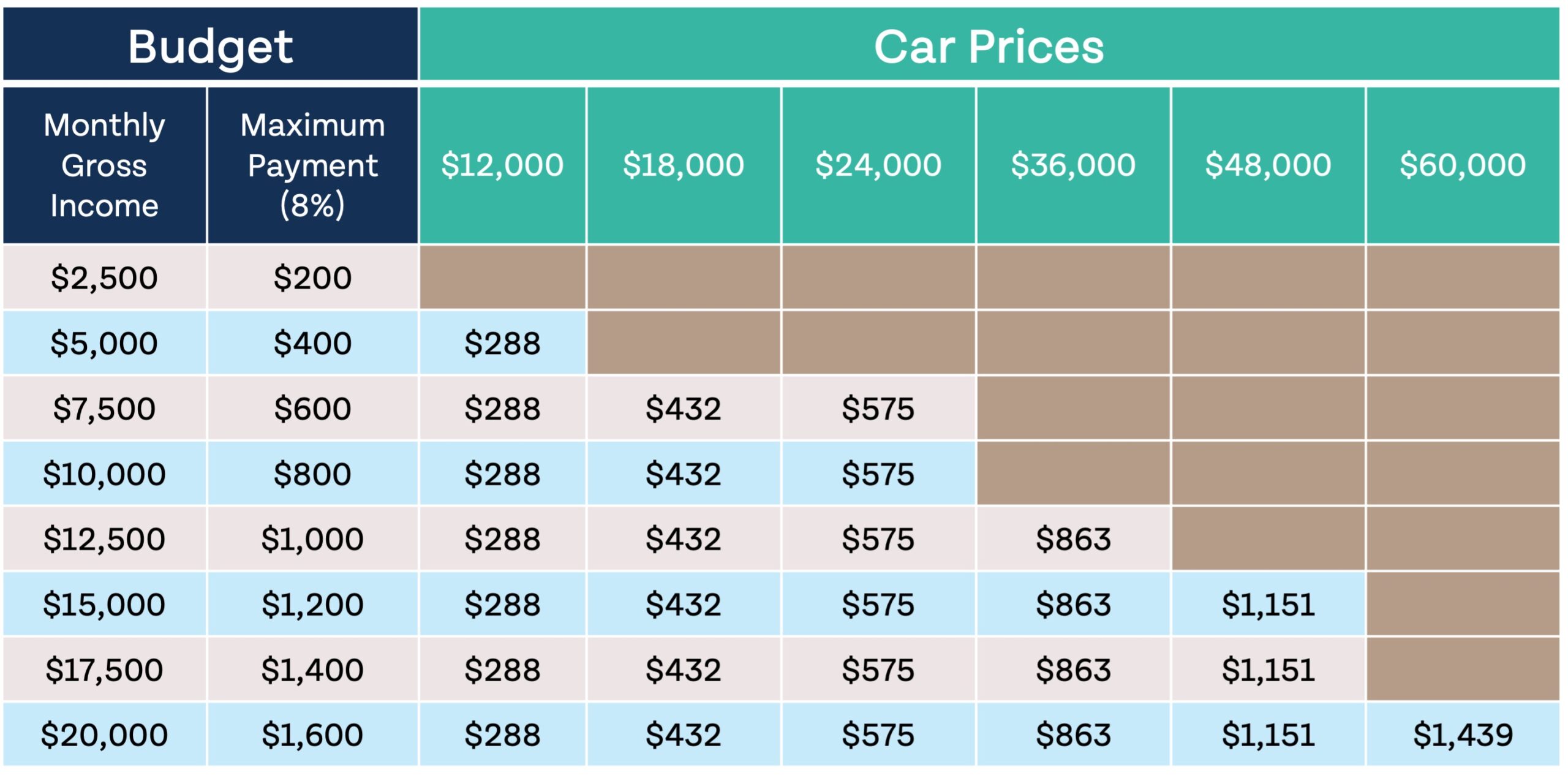
10% of Gross Income for Car Expenses: The total of your monthly car payment, insurance, and fuel should not exceed 10% of your gross (pre-tax) monthly income. This guideline ensures that your car doesn’t consume an outsized portion of your earnings, leaving room for other financial priorities.
While this rule is a good starting point, it’s a guideline, not a rigid law. Your specific financial situation might warrant slight adjustments, but straying too far from these recommendations can be risky.
Your Income, Debt-to-Income Ratio, and Credit Score
Lenders assess your ability to repay a loan based on several key financial indicators:
-
Income: Your stable, verifiable income is crucial. Lenders want to see that you have a consistent source of funds to make payments.
-
Debt-to-Income (DTI) Ratio: This ratio compares your total monthly debt payments (including your prospective car payment) to your gross monthly income. A lower DTI ratio indicates you have more disposable income to cover new debt. Lenders typically prefer a DTI ratio below 36-43%, though this can vary. A high DTI can signal to lenders that you’re overextended and might struggle with new payments.
-
Credit Score: Your credit score is a numerical representation of your creditworthiness. A higher score (e.g., 700+) indicates a lower risk to lenders and generally qualifies you for lower interest rates, saving you thousands over the life of the loan. Conversely, a lower score will result in higher interest rates, significantly increasing your monthly payment and total cost. Before applying for a car loan, it’s wise to check your credit score and report for any errors and work to improve it if necessary.
The Role of Down Payment and Trade-In Value
A substantial down payment is one of the most effective ways to reduce your monthly car payment and the total interest paid. It also creates immediate equity in the vehicle, protecting you from negative equity. If you have an existing vehicle, its trade-in value can act as a de facto down payment, reducing the principal amount you need to finance. Research your current car’s market value using reliable sources like Kelley Blue Book (KBB) or Edmunds to get a realistic estimate before approaching a dealer.
How a Car Payment Affordability Calculator Works
A car payment affordability calculator is a powerful online tool designed to help you determine a realistic monthly car payment based on your financial inputs. It takes the guesswork out of the equation and provides a clear, actionable range.
Key Inputs: What Information You’ll Need
To get the most accurate results from a calculator, you’ll need to input several pieces of information:
-
Desired Monthly Payment (Optional): Some calculators let you start with a desired payment and work backward to show you the car price range.
-
Total Loan Amount (or Car Price): This is the purchase price of the car minus any down payment or trade-in value.
-
Down Payment: The amount of cash you plan to put upfront.
-
Trade-In Value: The estimated value of your current car if you plan to trade it in.
-
Loan Term (Months): The number of months you wish to take to repay the loan (e.g., 36, 48, 60, 72 months). Remember, shorter is generally better.
-
Interest Rate (APR): This is the annual percentage rate you expect to pay on the loan. Your credit score will heavily influence this. You can get pre-qualified for a loan with your bank or credit union to get an estimate.
-
Sales Tax Rate: The sales tax rate in your state or province.
-
Other Fees: Any additional fees like documentation fees, registration fees, or extended warranty costs you might finance.
Interpreting the Outputs: More Than Just a Number
The primary output of the calculator is usually the estimated monthly payment. However, a good calculator will also show you:
-
Total Interest Paid: This figure is crucial as it reveals the true cost of borrowing. You might be surprised how much interest adds up, especially with longer loan terms or higher APRs.
-
Total Cost of the Car: This sums the principal amount, interest, and any financed taxes/fees, giving you the overall expenditure.
-
Affordability Range: Some advanced calculators help you adjust inputs to see how different down payments, loan terms, or interest rates impact your monthly payment, allowing you to find your optimal affordability range.
Don’t just look at the monthly payment in isolation. Compare the total interest paid across different scenarios. A slightly higher monthly payment for a shorter term can save you thousands in interest over the life of the loan.
Limitations of Calculators: The Human Element
While incredibly useful, car payment calculators have limitations:
-
Estimates Only: The results are based on the information you provide. The actual interest rate you qualify for may differ.
-
Doesn’t Include All Costs: Most calculators don’t automatically factor in insurance, fuel, maintenance, or parking costs. You must manually add these to your budget to get the complete picture of affordability.
-
Assumes Fixed Interest: Most calculators assume a fixed interest rate throughout the loan term, which is typical for car loans, but it’s important to understand this.
-
No Personal Financial Advice: A calculator is a tool, not a financial advisor. It cannot assess your unique financial goals, risk tolerance, or future earning potential.
Always use the calculator as a starting point and cross-reference its outputs with your comprehensive personal budget and long-term financial plan.
Strategies for Optimizing Your Car Affordability
Once you understand the numbers, you can employ various strategies to ensure your car purchase is financially sound and sustainable.
Boosting Your Down Payment
This is arguably the most impactful strategy. The more cash you put down, the less you borrow, which translates to lower monthly payments and less interest paid over the loan’s lifetime. Consider saving aggressively for a few months longer or selling assets you no longer need to increase your down payment.
Improving Your Credit Score
A higher credit score unlocks lower interest rates, which directly reduces your monthly payment and total loan cost. If your score is not ideal, take steps to improve it before applying for a loan: pay bills on time, reduce existing debt, and avoid opening new credit lines. Even a few points increase can make a significant difference in the APR offered.
Negotiating the Best Deal
The price of the car itself is negotiable, as is the trade-in value of your old car. Do your research on fair market values for the specific make and model you’re interested in, and be prepared to walk away if the dealer isn’t offering a competitive price. Shopping around for financing from multiple lenders (banks, credit unions) before you visit the dealership can also give you leverage to secure the best interest rate.
Considering Alternatives: Used Cars, Leasing
-
Used Cars: Purchasing a reliable used car can offer significant savings. New cars depreciate rapidly in their first few years. A well-maintained used car can be a far more economical option, often allowing you to get a better model for your budget or reduce your monthly payment significantly.
-
Leasing: Leasing involves paying to use a car for a set period (typically 2-4 years) rather than owning it. Monthly lease payments are generally lower than loan payments for the same car because you’re only paying for the depreciation during the lease term, not the full purchase price. However, leasing comes with mileage restrictions, wear-and-tear charges, and you don’t build equity. It’s suitable for those who like to drive a new car every few years, have predictable mileage, and don’t mind not owning the vehicle.
Making the Final Decision: A Holistic Approach
The decision of how much car payment you can afford should integrate logical financial analysis with your personal values and long-term goals.
Aligning with Your Financial Goals
Does buying this particular car, with its associated payment, derail your other financial objectives? Will it prevent you from saving for a down payment on a home, retirement, or your children’s education? A car is a tool for transportation, but it shouldn’t come at the expense of your broader financial security and aspirations. Prioritize your financial well-being over fleeting desires for a specific make or model.

Long-Term Impact and Future Planning
Think beyond the immediate purchase. How will this car payment affect your budget in 3, 5, or 7 years? Will your income likely increase or decrease? Are there major life events on the horizon (marriage, children, career change) that might impact your finances? Choose a car payment that not only fits your current budget but also provides flexibility for future financial changes. A smart car purchase is one that serves your needs without becoming a persistent financial burden, allowing you to enjoy the convenience of your vehicle without sacrificing your financial freedom.
aViewFromTheCave is a participant in the Amazon Services LLC Associates Program, an affiliate advertising program designed to provide a means for sites to earn advertising fees by advertising and linking to Amazon.com. Amazon, the Amazon logo, AmazonSupply, and the AmazonSupply logo are trademarks of Amazon.com, Inc. or its affiliates. As an Amazon Associate we earn affiliate commissions from qualifying purchases.