
Solar energy, once a niche technology, has rapidly transitioned into a mainstream power source, offering a sustainable and increasingly cost-effective alternative to traditional electricity generation. At the heart of this revolution lies the solar panel, a marvel of engineering that harnesses the sun’s abundant energy and converts it into usable electricity. Understanding “how much” a solar panel can generate is crucial for homeowners, businesses, and policymakers alike, impacting decisions from initial investment to long-term energy strategy. This article delves into the intricate mechanisms, influential factors, and technological advancements that dictate a solar panel’s electricity output, providing a comprehensive insight into its capabilities within the broader technological landscape.
Understanding the Fundamentals of Solar Power Generation
To appreciate the output of a solar panel, one must first grasp the core scientific principles and components that enable this transformation. It’s a journey from sunlight to electrical current, orchestrated by sophisticated photovoltaic technology.
The Photovoltaic Effect: Core Technology
The magic of a solar panel lies in the photovoltaic (PV) effect. This phenomenon, discovered in 1839 by Edmond Becquerel, describes the creation of an electric current in a material upon exposure to light. Modern solar panels utilize semiconductor materials, predominantly silicon, to achieve this effect. When photons from sunlight strike the silicon atoms, they knock electrons loose from their orbits, creating an electric current. This current is then captured and directed, ultimately forming the electricity we use.
A typical solar panel is composed of multiple PV cells, each a small semiconductor device designed to maximize this conversion. These cells are wired together in series and parallel to achieve desired voltage and current outputs, then encapsulated to protect them from environmental elements like rain, hail, and dust. The efficiency of a cell refers to the percentage of sunlight energy it can convert into electricity.
Key Components of a Solar Panel System
A standalone solar panel doesn’t operate in isolation; it’s part of a larger system designed to capture, convert, store, and deliver electricity efficiently.
- Solar Panels (PV Modules): These are the primary collectors, absorbing sunlight and initiating the photovoltaic effect. Their number and individual capacity determine the system’s raw generation potential.
- Inverter: Solar panels produce direct current (DC) electricity. Most household appliances and the electrical grid use alternating current (AC). The inverter is the crucial device that converts DC electricity from the panels into usable AC electricity. There are string inverters, microinverters (one per panel), and power optimizers (per panel, working with a string inverter), each offering different advantages in terms of efficiency, monitoring, and shading mitigation.
- Mounting System: This hardware secures the panels to the roof or ground, ensuring optimal tilt and orientation while withstanding various weather conditions.
- Wiring and Electrical Safety Components: These ensure the safe and efficient transmission of electricity throughout the system, including circuit breakers and disconnect switches.
- Battery Storage (Optional): For grid-tied systems, excess electricity is often fed back to the grid. For off-grid systems or those seeking energy independence, batteries store surplus electricity generated during the day for use at night or during cloudy periods.
- Monitoring System: Modern solar installations often include software and hardware that allow homeowners to track their system’s performance in real-time, view historical data, and identify any issues.
Standard Measurement Units: Watts, Kilowatts, Kilowatt-hours
Understanding the language of electricity is vital for assessing solar panel output:
- Watt (W): The basic unit of power. A solar panel’s power rating is typically expressed in watts. For example, a 400W panel.
- Kilowatt (kW): 1,000 watts. A system’s total power capacity is often stated in kilowatts, e.g., a 10 kW system. This represents the instantaneous power output under ideal conditions.
- Kilowatt-hour (kWh): This is the unit of energy, representing the power consumed or generated over time. It’s the standard unit for measuring electricity usage and generation over a period (e.g., daily, monthly, yearly). If a 1 kW system operates at full capacity for one hour, it generates 1 kWh of electricity.
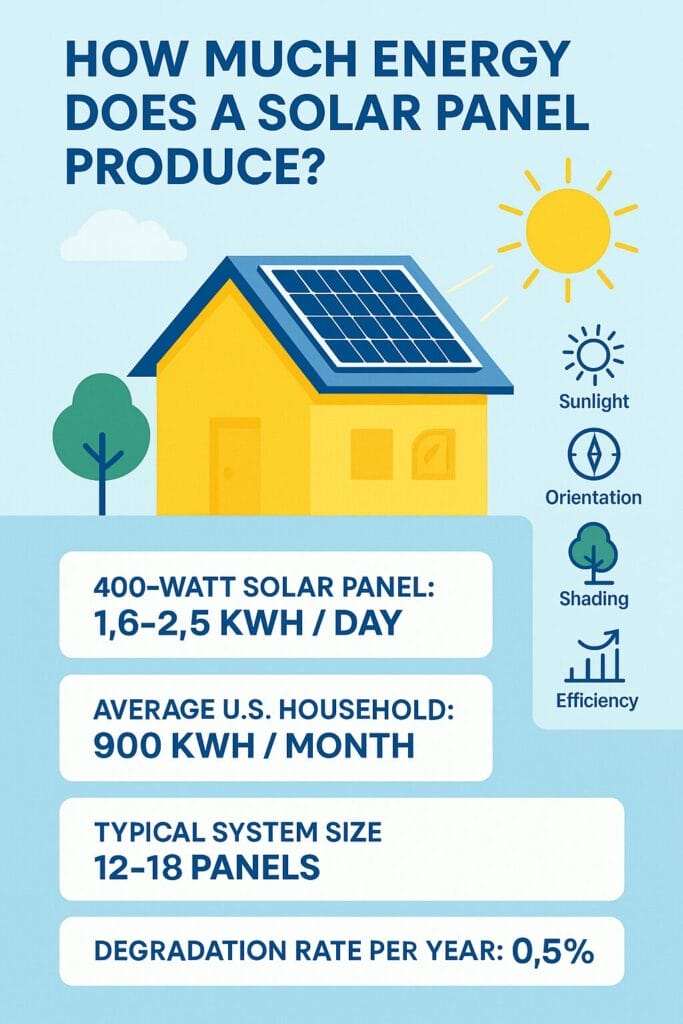
When discussing “how much electricity” a solar panel generates, we are primarily interested in its energy output over time, measured in kWh. A single solar panel typically has a nameplate capacity ranging from 300 to 450 watts. However, its actual daily or annual energy production in kWh depends on a myriad of factors.
Factors Influencing Solar Panel Electricity Output
The nameplate capacity of a solar panel represents its maximum power output under standard test conditions (STC), which are an ideal set of laboratory conditions (1000 W/m² irradiance, 25°C cell temperature, AM1.5 spectrum). In the real world, several dynamic factors constantly modulate a panel’s actual electricity generation.
Panel Efficiency and Type
The inherent efficiency of a solar panel is a primary determinant. Panels typically range from 15% to over 22% efficiency. A higher efficiency panel will convert a greater percentage of the sunlight it receives into electricity, meaning it can generate more power in a smaller footprint.
- Monocrystalline Panels: These are made from a single crystal of silicon, offering high efficiency (18-22%+) and a sleek, uniform black appearance. They perform well in high-temperature conditions.
- Polycrystalline Panels: Made from multiple silicon crystals, they are generally less efficient (15-17%) and have a bluer, mottled appearance. They are often more cost-effective.
- Thin-Film Panels: These are made by depositing thin layers of photovoltaic material onto a substrate. They are typically the least efficient (10-13%) but can be flexible and perform well in low-light conditions, though they require a larger area to generate the same amount of power.
Irradiation and Sunlight Hours
This is perhaps the most significant external factor. The amount of solar energy (irradiation) hitting the Earth’s surface varies dramatically by:
- Geographic Location: Regions closer to the equator and those with consistently sunny climates (e.g., deserts, Mediterranean regions) receive more intense and prolonged sunlight.
- Seasons: Sunlight hours are longer in summer and shorter in winter, leading to higher generation in warmer months. The sun’s angle also changes, affecting the intensity of light striking the panels.
- Time of Day: Generation peaks around midday when the sun is highest in the sky and declines towards morning and evening.
- Weather Conditions: Cloud cover, fog, and precipitation significantly reduce the amount of direct sunlight reaching the panels, thus decreasing output.
Installation Angle and Orientation
Optimizing the tilt angle and orientation of panels relative to the sun is critical for maximizing energy capture throughout the year.
- Orientation: In the Northern Hemisphere, panels ideally face due south to capture the most sunlight. In the Southern Hemisphere, they face due north. Deviations from this ideal can reduce output.
- Tilt Angle: The optimal tilt angle typically corresponds to the latitude of the location. However, many systems are installed flush with the roof’s slope. Adjustable mounting systems or seasonal adjustments can help optimize for different times of the year, though these are less common for residential systems due to added cost and complexity.
Temperature Effects and Degradation
Unlike common intuition, solar panels perform best in cooler temperatures. As the temperature of the solar cells increases, their efficiency slightly decreases. Most panels have a temperature coefficient, indicating how much their power output drops for every degree Celsius above 25°C.
- Degradation: Solar panels naturally degrade over time, typically losing about 0.5% to 1% of their efficiency per year. Most manufacturers offer performance warranties guaranteeing a certain percentage of original output (e.g., 80% after 25 years).
Shading and Obstructions
Even partial shading from trees, chimneys, adjacent buildings, or even dirt and bird droppings can drastically reduce the output of an entire string of panels if a conventional string inverter is used. This is because panels in a series circuit are limited by the weakest performer. Microinverters or power optimizers can mitigate this by allowing each panel to operate independently, minimizing the impact of shading on the overall system.
System Maintenance and Cleanliness
Regular cleaning of panels to remove dust, pollen, leaves, and other debris can prevent efficiency losses. While rain often provides a natural cleaning, accumulated grime can significantly block sunlight. Furthermore, ensuring all electrical connections are secure and performing periodic checks on the inverter and wiring contribute to sustained optimal performance.
Calculating and Estimating Your Solar Panel Output
Given the multitude of influencing factors, precisely predicting solar panel output can seem daunting. However, several tools and methodologies exist to provide reliable estimations.
Rated Power vs. Real-World Performance
As mentioned, a panel’s rated power (e.g., 400W) is under STC. In real-world conditions, factors like temperature, less-than-ideal irradiance, and minor shading mean that a panel will rarely produce its full rated power. The Performance Ratio (PR) is a key metric used to assess the actual efficiency of a PV system in real-world conditions, accounting for all system losses. A typical good quality residential system might have a PR of 0.75 to 0.85, meaning it converts 75-85% of the theoretically available energy from the panels’ rated power.
Online Calculators and Tools
Many organizations and solar companies provide online calculators that can estimate a system’s output based on location, roof size, and average electricity consumption. These tools typically use databases of solar irradiation data for specific geographic areas and factor in general assumptions about panel efficiency, tilt, and shading. While useful for initial estimates, they provide a broad approximation. Popular examples include the National Renewable Energy Laboratory’s (NREL) PVWatts Calculator in the US.
Professional Energy Audits and System Design
For accurate and tailored estimates, a professional solar installer will conduct a detailed site assessment. This involves:
- Sun Path Analysis: Using specialized tools (e.g., Solmetric SunEye, drone mapping), they analyze potential shading throughout the year.
- Roof Inspection: Assessing roof angle, orientation, structural integrity, and available space.
- Energy Consumption Analysis: Reviewing past electricity bills to determine average daily/annual energy needs (kWh).
- System Sizing: Designing a system that matches energy demands, available space, and budget, optimizing panel selection, inverter type, and layout.
- Detailed Output Prediction: Using sophisticated software that incorporates local weather data, panel specifications, and system losses to provide a highly accurate prediction of annual and monthly kWh generation.
Monitoring Systems and Data Analysis
Once installed, monitoring systems provide real-time data on electricity generation. These systems often come with user-friendly apps or web portals that allow owners to:
- Track Daily/Monthly/Annual Output: See exactly how many kWh the system is producing.
- Identify Performance Issues: Detect if a panel or inverter is underperforming due to shading, malfunction, or dirt.
- Compare to Estimates: Benchmark actual performance against initial predictions.
- Analyze Trends: Understand how seasons, weather, and time of day affect generation. This data is invaluable for understanding the true “how much” and making informed decisions about energy usage.
Technological Advancements Enhancing Solar Generation
The solar industry is characterized by continuous innovation, with new technologies constantly pushing the boundaries of efficiency, durability, and cost-effectiveness. These advancements are directly impacting “how much” electricity panels can generate from the same amount of sunlight or over their lifespan.
Bifacial Panels and PERC Technology
- Bifacial Panels: Traditional solar panels only absorb light from their front surface. Bifacial panels are designed to capture sunlight from both sides, including light reflected off the roof or ground (albedo effect). This can increase energy yield by 5-25% depending on the installation environment.
- PERC (Passivated Emitter and Rear Cell) Technology: This is a widely adopted enhancement for monocrystalline cells. By adding a passivation layer on the rear side of the cell, PERC technology improves light absorption and internal reflection, allowing the cell to capture more photons and generate more electricity, especially in low-light conditions.
Microinverters and Power Optimizers
These technologies are critical for maximizing system output, especially in complex installations or those prone to shading.
- Microinverters: Instead of one central string inverter for all panels, microinverters are installed on each individual panel. This allows each panel to operate independently, converting DC to AC at the panel level. If one panel is shaded or underperforms, it doesn’t affect the output of the others.
- Power Optimizers: These are also installed at the panel level but work in conjunction with a central string inverter. They condition the DC power from each panel, ensuring it operates at its maximum power point (MPPT) before sending it to the string inverter. Both technologies mitigate the impact of shading and allow for panel-level monitoring, significantly improving overall system efficiency and “how much” the entire array can generate.
Smart Grid Integration and Energy Storage Solutions
The ability of solar systems to interact intelligently with the broader electrical grid is enhancing their value and output utilization.
- Smart Grid: Advanced inverters are becoming “grid-interactive,” capable of communicating with the utility to manage power flow, support grid stability, and respond to demand signals. This optimizes the use of generated solar electricity, both locally and system-wide.
- Enhanced Energy Storage: Advances in battery technology (e.g., lithium-ion) have made energy storage more efficient, compact, and affordable. This allows homeowners to store excess solar generation for use during peak demand hours or at night, increasing self-consumption and reducing reliance on the grid. Integrating solar with smart home energy management systems further optimizes when electricity is generated, stored, and consumed.
Emerging Photovoltaic Technologies
The research landscape for solar technology is vibrant, promising even greater generation capabilities in the future.
- Perovskite Solar Cells: These cells offer high efficiency potential (already exceeding silicon in lab settings) and are cheap to produce, potentially even being transparent or flexible. While stability issues remain a challenge, they could revolutionize solar power.
- Quantum Dot Solar Cells: Utilizing nanocrystals that absorb specific wavelengths of light, these cells could potentially capture a broader spectrum of sunlight, leading to higher efficiencies.
- Concentrated Photovoltaics (CPV): These systems use lenses or mirrors to focus a large amount of sunlight onto a small area of highly efficient PV cells. Best suited for areas with direct, intense sunlight, they can achieve very high efficiencies.
The Future Landscape of Solar Generation
The trajectory of solar technology is unequivocally upward, driven by relentless innovation and a global push towards sustainable energy. The question of “how much” a solar panel can generate will continue to evolve, with projections indicating significant leaps in capability.
Increasing Efficiency and Durability
Future solar panels are expected to achieve even higher efficiencies, meaning more electricity from the same footprint. Research is focused on multi-junction cells that capture a wider spectrum of light, advanced materials that minimize energy losses, and manufacturing processes that reduce defects. Concurrently, improvements in encapsulation and material science will lead to more durable panels with longer lifespans and even slower degradation rates, ensuring sustained high output for decades.
Lowering Costs and Accessibility
As manufacturing processes become more refined and economies of scale continue to expand, the cost per watt of solar generation is projected to continue its downward trend. This will make solar power more accessible to a broader demographic, including developing nations and communities currently reliant on fossil fuels. Technological advancements in inverter technology, mounting systems, and installation techniques will also contribute to overall system cost reductions, making the generation of substantial amounts of electricity more economically viable for everyone.
The Role of AI and IoT in Optimization
The integration of Artificial Intelligence (AI) and the Internet of Things (IoT) is poised to revolutionize solar energy management.
- Predictive Analytics: AI can analyze vast datasets of weather patterns, historical generation, and energy consumption to predict future solar output and demand with unprecedented accuracy. This enables utilities and homeowners to optimize energy storage and usage.
- Smart Energy Management: IoT-enabled devices will create highly interconnected home and grid systems where solar generation, battery storage, and appliance usage are intelligently orchestrated in real-time. AI algorithms will continuously fine-tune these systems to maximize self-consumption, minimize grid reliance, and take advantage of dynamic energy pricing.
- Proactive Maintenance: AI-driven monitoring can detect subtle performance anomalies and predict potential equipment failures before they occur, allowing for proactive maintenance that ensures continuous optimal generation.
In conclusion, “how much” a solar panel can generate is a complex interplay of inherent technological capacity and dynamic environmental factors. While a single panel might have a nameplate capacity of 300-450W, its real-world energy production (in kWh) is a function of its efficiency, local sunlight conditions, optimal installation, and the overall system design. As technology continues to advance, we can anticipate even more efficient, durable, and intelligent solar solutions, further solidifying solar power’s role as a cornerstone of our future energy landscape, consistently generating more clean electricity for our world.
aViewFromTheCave is a participant in the Amazon Services LLC Associates Program, an affiliate advertising program designed to provide a means for sites to earn advertising fees by advertising and linking to Amazon.com. Amazon, the Amazon logo, AmazonSupply, and the AmazonSupply logo are trademarks of Amazon.com, Inc. or its affiliates. As an Amazon Associate we earn affiliate commissions from qualifying purchases.