
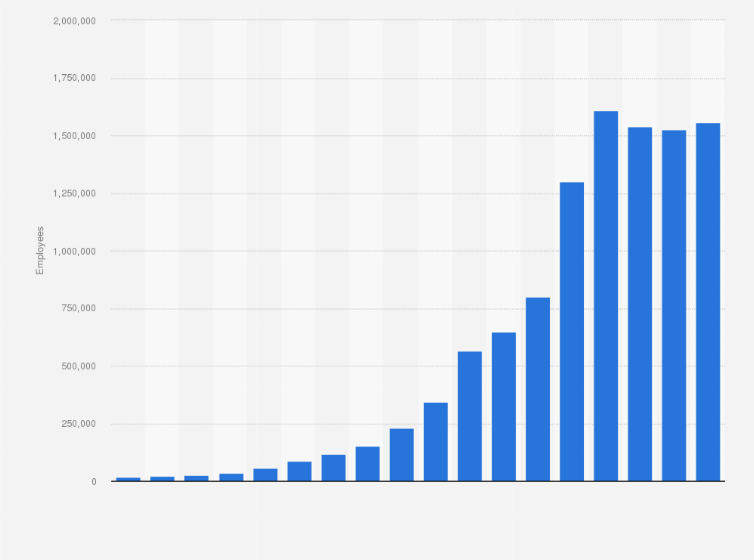
In the landscape of modern commerce, few metrics are as staggering as the size of Amazon’s workforce. As a cornerstone of the global economy, Amazon’s payroll is more than just a headcount; it is a barometer for the health of global logistics, the shift toward e-commerce, and the massive financial investment required to maintain a “next-day delivery” world. To understand how many workers Amazon has is to understand the mechanics of one of the most complex business operations ever conceived. As of recent filings, Amazon employs approximately 1.5 million full-time and part-time workers globally, a figure that places it as the second-largest private employer in the world, trailing only Walmart.

From a business finance perspective, this labor force represents both Amazon’s greatest asset and its most significant operating challenge. The management of 1.5 million people requires a sophisticated infrastructure of payroll management, benefit administration, and recruitment strategy that rivals the GDP of some mid-sized nations.
The Structure of the Workforce: Beyond the Warehouse Floor
While the public image of an Amazon worker is often someone navigating a massive fulfillment center, the company’s labor structure is highly diversified. To analyze Amazon’s headcount through a financial lens, we must break down where these workers are distributed across the company’s various business units.
Fulfillment and Logistics: The Engine Room
The vast majority of Amazon’s 1.5 million employees are concentrated in its fulfillment and logistics network. These are the individuals responsible for receiving, sorting, picking, and packing millions of items daily. From a corporate finance standpoint, this segment of the workforce is heavily tied to “cost of sales.” When Amazon reports its quarterly earnings, the efficiency of these workers directly impacts the company’s operating margins. During peak seasons, such as Prime Day or the Q4 holiday rush, Amazon frequently adds hundreds of thousands of seasonal workers, a temporary expansion that requires massive capital outlays in short windows.
Corporate and Amazon Web Services (AWS)
While smaller in number compared to warehouse staff, Amazon’s corporate and AWS workforce represents a disproportionate amount of the company’s labor costs. These roles include software engineers, data scientists, and cloud architects. In the tech and business sectors, these employees are categorized as “high-value human capital.” AWS, specifically, is Amazon’s primary profit driver. The engineers managing this infrastructure are the backbone of the company’s high-margin revenue streams, making their retention a top priority for the company’s long-term financial health.
Physical Retail: Whole Foods and Amazon Fresh
Since the acquisition of Whole Foods Market in 2017, Amazon has also become a major player in the grocery sector. This added tens of thousands of workers to its headcount in roles traditional to brick-and-mortar retail. Integrating these employees into the Amazon ecosystem required a fundamental shift in how the company manages labor costs, moving from the purely digital and logistical realm into the high-turnover, customer-facing world of grocery retail.
The Financial Trajectory: From Startup to 1.5 Million Employees
The growth of Amazon’s workforce is a case study in aggressive corporate scaling. In the early 2000s, Amazon was a relatively lean organization. However, the decision to pivot from a bookstore to the “everything store” necessitated a radical expansion of physical infrastructure and human labor.
The Pandemic Surge and Post-Pandemic Correction
The most dramatic shift in Amazon’s headcount occurred between 2019 and 2022. As the global pandemic forced consumers online, Amazon saw a decade’s worth of growth in a matter of months. To meet this unprecedented demand, the company embarked on a hiring spree that saw its workforce nearly double. Financially, this was a period of massive expansion in operating expenses.
However, as consumer behavior stabilized in late 2022 and 2023, Amazon, like many other tech giants, faced a “right-sizing” period. This led to high-profile layoffs, particularly in corporate and Alexa divisions. For investors, these layoffs were seen as a necessary move to protect margins and refocus on core profitability after a period of hyper-expansion. This cycle highlights the volatility of managing a workforce of this scale in response to global economic shifts.

The Hidden Workforce: Delivery Service Partners (DSPs)
It is important to note that the “1.5 million” figure often cited in financial reports does not tell the whole story. Amazon utilizes a “Delivery Service Partner” (DSP) model for much of its “last-mile” delivery. These drivers, who wear Amazon uniforms and drive Amazon-branded vans, are technically employees of independent small businesses, not Amazon itself. When these contractors and third-party logistics partners are factored in, the total number of people working within the Amazon ecosystem likely exceeds 2 million. This model is a strategic financial move that allows Amazon to scale its delivery capabilities without the long-term liabilities associated with direct employment.
Labor Costs and the Bottom Line: A Fiscal Analysis
In the realm of business finance, labor is often the largest line item on the balance sheet. For Amazon, the cost of maintaining such a massive workforce is subject to constant scrutiny from Wall Street and internal leadership.
The Impact of Minimum Wage and Benefits
Amazon was one of the first major retailers to implement a $15 per hour minimum wage across its U.S. operations, a figure that has since risen in many markets to stay competitive. From a financial perspective, a $1 increase in the average hourly wage for a workforce of 1.5 million results in billions of dollars in additional annual operating costs. Amazon justifies this expenditure as a necessary cost of “labor certainty”—ensuring they have the staff required to meet customer promises in a tight labor market.
Recruitment and Turnover Expenses
One of the most significant financial drains on Amazon is the cost of employee turnover. In high-intensity fulfillment roles, turnover rates are traditionally high. The cost to recruit, onboard, and train a new worker is estimated to be several thousand dollars per person. When multiplied by hundreds of thousands of hires annually, turnover becomes a multi-billion dollar financial challenge. Amazon has invested heavily in “Career Choice” programs and tuition assistance, not just as a perk, but as a strategic financial tool to increase retention and lower the long-term cost of labor.
The Future of Labor: Automation vs. Human Capital
As we look toward the future of Amazon’s workforce, the central theme is the intersection of human labor and robotics. The financial implications of this transition are profound.
Capital Expenditure in Robotics
Amazon has deployed over 750,000 robots across its fulfillment centers. From a business finance perspective, this represents a shift from “Operating Expense” (wages) to “Capital Expenditure” (robotics and AI). While robots require a massive upfront investment, they do not require healthcare, benefits, or hourly wages, and they can operate 24/7. Amazon’s long-term financial strategy involves using automation to handle repetitive tasks, allowing the company to slow the growth of its human headcount even as its shipping volume increases.
The Evolution of Roles
The narrative that robots will simply “replace” the 1.5 million workers is a simplification. Instead, the nature of the jobs is shifting. Amazon is increasingly hiring for roles that involve maintaining and supervising automated systems. These roles typically command higher wages but require more specialized training. For the company’s finance department, the goal is to achieve a higher “revenue per employee” ratio, a key metric used by investors to judge the efficiency of a business.
Labor as a Strategic Investment
Understanding how many workers Amazon has requires looking past the raw numbers and into the strategic intent behind them. Amazon’s 1.5 million employees are the physical manifestation of the company’s dominance in the global marketplace.
For the investor and the business analyst, the headcount is a double-edged sword. On one hand, it represents the unrivaled capacity to deliver goods to nearly any corner of the globe within 24 to 48 hours. On the other hand, it represents a massive, complex, and expensive human infrastructure that must be managed with surgical precision to maintain profitability.
As Amazon continues to navigate the complexities of labor relations, unionization efforts, and the push toward automation, its workforce will remain one of the most important financial stories in the corporate world. Whether the headcount continues to grow or begins to shrink in favor of silicon and steel, the scale of Amazon’s labor force will continue to define the boundaries of what is possible in modern global business.
aViewFromTheCave is a participant in the Amazon Services LLC Associates Program, an affiliate advertising program designed to provide a means for sites to earn advertising fees by advertising and linking to Amazon.com. Amazon, the Amazon logo, AmazonSupply, and the AmazonSupply logo are trademarks of Amazon.com, Inc. or its affiliates. As an Amazon Associate we earn affiliate commissions from qualifying purchases.