
For serious investors, traders, and anyone meticulously managing their finances, understanding the structure of the financial calendar is as crucial as analyzing market trends or evaluating company fundamentals. The number of trading days within a given year profoundly impacts everything from portfolio rebalancing schedules and options expiration cycles to tax-loss harvesting strategies and liquidity planning. As we look towards 2025, knowing precisely how many opportunities the market will provide for transactions and strategic maneuvers becomes a cornerstone of effective financial planning.
This guide delves into the specifics of calculating trading days for 2025, exploring the critical factors that influence this count and, most importantly, outlining why this often-overlooked metric holds such significant weight for your investment strategy.
Understanding the Essence of a Trading Day
Before we can count the remaining trading days in 2025, it’s essential to define what constitutes a “trading day.” It’s not simply any day that isn’t a weekend; market holidays play an equally critical role in shaping the financial calendar.
Defining a Standard Trading Day
A standard trading day refers to any weekday (Monday through Friday) when the major financial exchanges are open for regular business hours. In the United States, this primarily refers to the New York Stock Exchange (NYSE) and NASDAQ, which typically operate from 9:30 AM to 4:00 PM Eastern Time. These hours are when most market activity, price discovery, and order execution occur.
While some financial instruments and platforms offer extended-hours trading (pre-market and after-hours), and certain foreign exchange (forex) markets operate 24/5, for the purposes of calculating the total number of “trading days” that affect the vast majority of stock and bond market participants, we focus on these regular session hours. The liquidity and volume during these core hours are generally far superior, making them the most significant for strategic investing.
The Impact of Weekends and Market Holidays
The primary factors that reduce the number of potential trading days from a calendar year are weekends and official market holidays.
- Weekends: Saturdays and Sundays consistently account for 104 days in any standard year, irrespective of holiday overlaps. These days are universally non-trading days across major exchanges.
- Market Holidays: These are specific dates when exchanges are closed, even if they fall on a weekday. These closures can be for federal holidays, such as New Year’s Day, Independence Day, or Christmas, or for other observances specifically recognized by the financial markets, like Good Friday. It’s important to note that not all federal holidays are market holidays, and sometimes market holidays are not federal holidays. For instance, bond markets may close early or entirely on days when equity markets remain open, though for the purpose of “trading days,” the equity market schedule is typically the benchmark.
The precise list of market holidays can vary slightly year-to-year if a holiday falls on a weekend and is observed on an adjacent weekday, or if new national holidays are introduced. Therefore, consulting the official exchange calendars for 2025 is vital for an exact count.
Calculating Trading Days in 2025: A Detailed Breakdown
To ascertain the total number of trading days in 2025, we follow a straightforward, subtractive method. This ensures accuracy and provides a clear picture for planning.
The Baseline: Total Calendar Days
A standard year, like 2025, consists of 365 calendar days. This is our starting point for the calculation.
- Total Calendar Days in 2025: 365
Subtracting Weekends and Fixed Holidays
Next, we subtract the non-trading days.
-
Weekends: There are always 52 weeks in a year, meaning 52 Saturdays and 52 Sundays.
365 (Total Days) - 104 (Weekend Days) = 261 Potential Trading Days
-
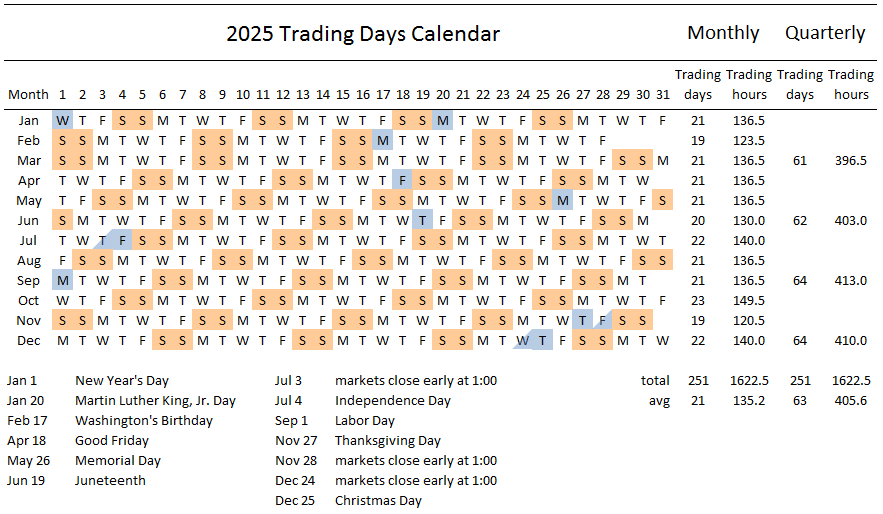
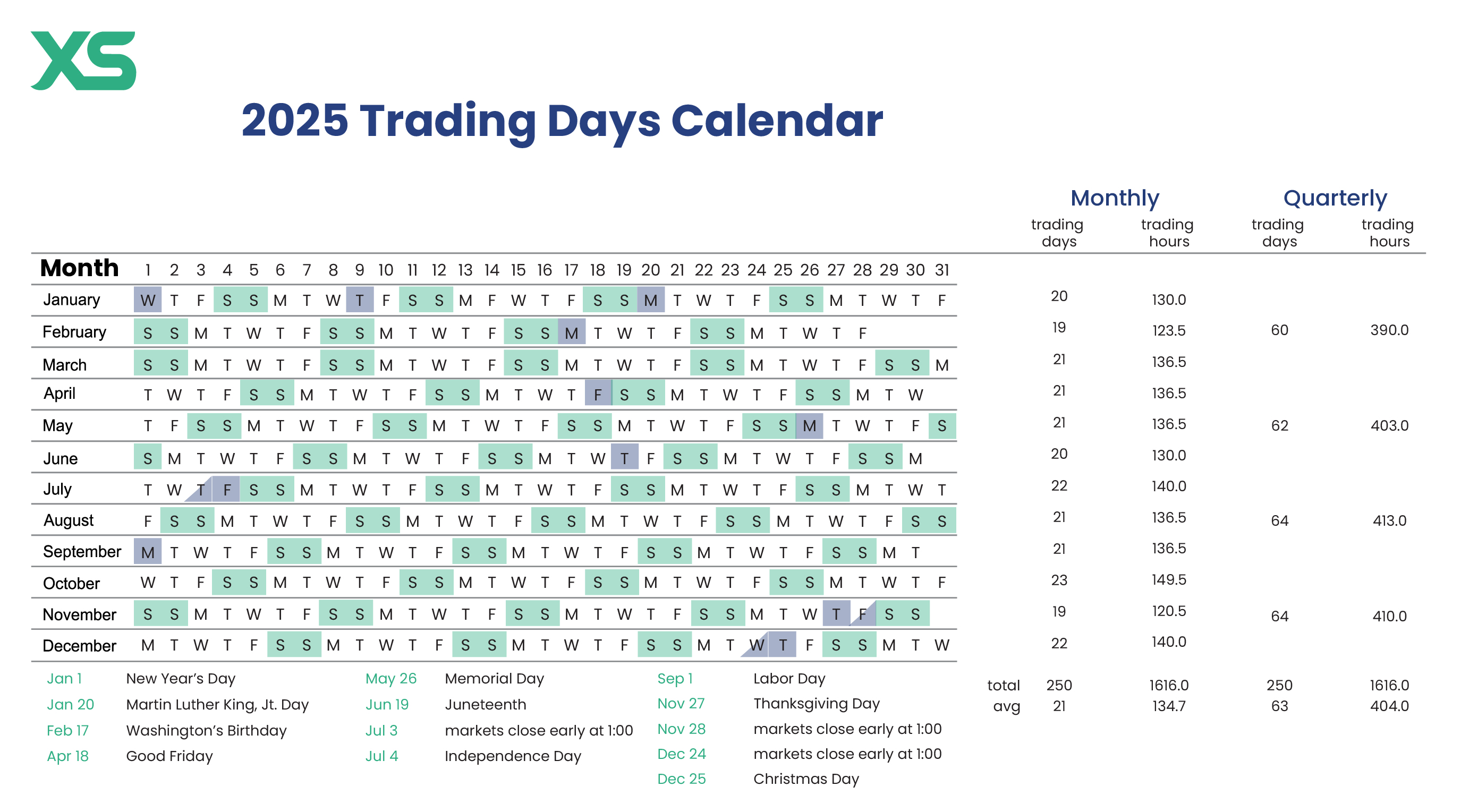
Market Holidays for 2025 (U.S. Example): While the official 2025 holiday schedule from major exchanges like NYSE and NASDAQ is the definitive source, we can anticipate a standard set of closures based on historical patterns. For illustrative purposes, here are the likely market holidays for 2025:
- January 1 (Wednesday): New Year’s Day
- January 20 (Monday): Martin Luther King, Jr. Day
- February 17 (Monday): Presidents’ Day
- April 18 (Friday): Good Friday
- May 26 (Monday): Memorial Day
- June 19 (Thursday): Juneteenth National Independence Day
- July 4 (Friday): Independence Day
- September 1 (Monday): Labor Day
- November 27 (Thursday): Thanksgiving Day
- December 25 (Thursday): Christmas Day
Assuming these 10 holidays, which fall on weekdays, result in market closures:
261 (Potential Trading Days) - 10 (Anticipated Holidays) = 251 Total Trading Days
Therefore, for the U.S. markets, there will likely be 251 trading days in 2025.
Accounting for Variable Market Closures and “Remaining” Days
It’s crucial to acknowledge that the calculation above provides the total number of trading days for the entire year. The number of “trading days left in 2025″ will depend entirely on the specific date you are performing this calculation.
To determine the remaining days:
- Identify Today’s Date: For example, if today is June 1, 2025.
- Count Elapsed Trading Days: Calculate how many trading days have already passed between January 1, 2025, and your current date (June 1, 2025), using the same methodology of subtracting weekends and market holidays within that period.
- Subtract from Total:
Total Trading Days in 2025 - Elapsed Trading Days = Remaining Trading Days in 2025.
Investors should regularly consult the official holiday schedules published by their respective exchanges (e.g., NYSE, NASDAQ, London Stock Exchange, Tokyo Stock Exchange) as the year progresses. This is particularly important for international investors, as global market holidays vary significantly.
Why the Count Matters: Strategic Implications for Investors
Knowing the exact number of trading days isn’t just a trivial statistic; it’s a fundamental piece of information that underpins various critical investment strategies and financial planning decisions.
Market Liquidity and Volatility Planning
Fewer trading days often correlate with periods of lower market liquidity. For instance, the week between Christmas and New Year’s typically sees significantly reduced trading volumes as many market participants are on holiday. This reduced liquidity can lead to higher volatility, wider bid-ask spreads, and potentially more exaggerated price movements on light news.
- Strategic Insight: Investors planning large transactions, entering or exiting positions, or managing options with imminent expiry dates, need to be aware of these periods. Executing trades during low-liquidity times can result in less favorable pricing. Conversely, some traders might seek out these volatile periods for specific strategies.
Portfolio Management and Rebalancing Opportunities
Many investors rebalance their portfolios quarterly or annually. The trading day count influences when these actions can realistically be taken and how frequently reviews can occur. Tax-efficient rebalancing strategies, in particular, need to align with trading days.
- Strategic Insight: If you aim to rebalance at year-end, understanding the finite number of trading days in December is critical. It allows you to schedule your review and execution well in advance, avoiding the rush or missing opportunities due to market closures. For instance, a December 25th market closure means you can’t trade on that day, potentially pushing your schedule earlier.
Options and Futures Expiration Cycles
Options and futures contracts have specific expiration dates, which are almost exclusively trading days. Missing an expiration date or being unable to execute a strategy due to a market holiday can have significant financial consequences.
- Strategic Insight: Traders dealing with derivatives must meticulously track market holidays. If an option’s typical expiration day (often the third Friday of the month) falls on a market holiday, the expiration date is usually moved to the preceding trading day. This minor shift can dramatically impact an options strategy, requiring prompt action to avoid unexpected outcomes or forced liquidations.
Year-End Tax Loss Harvesting and Gain Realization
The end of the year brings a critical window for tax planning, particularly for tax-loss harvesting and realizing gains. Investors might sell losing positions to offset capital gains or realize gains to hit specific income targets. These actions must occur on a trading day before the year’s final close.
- Strategic Insight: Knowing the last trading day of 2025 is paramount. For U.S. markets, it will typically be December 31st (if a weekday and not a holiday, otherwise the closest preceding weekday). This exact date dictates the absolute deadline for executing trades that will count towards your 2025 tax obligations. Miscalculating this can mean missing out on significant tax savings or inadvertently triggering unwanted tax events.
Maximizing Your Remaining Trading Days in 2025
With a clear understanding of the trading calendar, investors can adopt proactive strategies to make the most of every market opportunity in 2025.
Proactive Calendar Integration and Planning
Integrate the official 2025 market holiday schedule directly into your personal and financial planning calendars. Set reminders for key dates, especially those relevant to your specific investment strategies, such as options expirations, dividend payment dates, and rebalancing windows.
- Actionable Tip: Don’t just note the market closures; also highlight periods known for low liquidity (e.g., around major holidays) and plan your activities accordingly.
Setting Realistic Goals and Reviewing Performance
The number of trading days can influence the feasibility of short-term goals. For instance, a trading strategy designed to capture frequent small gains might perform differently in a month with fewer trading days compared to a full month.
- Actionable Tip: Periodically review your investment performance against your goals, considering the actual number of trading days that have passed. Adjust expectations or strategies if market closures are significantly impacting your ability to execute trades or achieve desired outcomes.
Staying Informed on Global Market Schedules
For investors with diversified portfolios that include international assets, keeping abreast of global market holidays is equally crucial. A market closure in London or Tokyo can impact the prices of globally traded ETFs or ADRs even if U.S. markets are open.
- Actionable Tip: Subscribe to financial news sources that provide international market calendars. Tools that aggregate global market opening and closing times can be invaluable for active global investors.
Conclusion: Perpetual Market Readiness
The question “how many trading days left in 2025?” is more than a simple numerical query; it’s a prompt for strategic introspection and meticulous planning. For the astute investor, it highlights the finite nature of market opportunities and underscores the importance of proactive engagement with the financial calendar. By understanding the definition of a trading day, meticulously calculating the total for 2025, and internalizing its broad implications for liquidity, portfolio management, and tax planning, you equip yourself with a powerful advantage.
As 2025 unfolds, leverage this knowledge to refine your strategies, anticipate market behavior during slow periods, and ensure that every action you take is informed, timely, and aligned with your broader financial objectives. Remaining perpetually ready and informed about the market’s rhythm is not just about reacting to news; it’s about anticipating the very structure within which that news unfolds.
aViewFromTheCave is a participant in the Amazon Services LLC Associates Program, an affiliate advertising program designed to provide a means for sites to earn advertising fees by advertising and linking to Amazon.com. Amazon, the Amazon logo, AmazonSupply, and the AmazonSupply logo are trademarks of Amazon.com, Inc. or its affiliates. As an Amazon Associate we earn affiliate commissions from qualifying purchases.