
The Nasdaq Composite Index is one of the most widely followed stock market indices in the world, often serving as the primary barometer for the health of the technology sector and the broader growth economy. For investors, understanding the composition of this index is not merely an academic exercise in counting tickers; it is a fundamental step in comprehending how market sentiment, sector concentration, and capitalization-weighting influence personal portfolios and global financial trends.
While many investors use the terms “Nasdaq” and “Nasdaq-100” interchangeably, they represent two very different financial products. The Nasdaq Composite is a broad-based index that tracks nearly all stocks listed on the Nasdaq Stock Market. Because the list of publicly traded companies is in a constant state of flux due to initial public offerings (IPOs), mergers, acquisitions, and delistings, the exact number of stocks in the Nasdaq Composite changes daily.
Composition and Diversity of the Nasdaq Composite
The Nasdaq Composite Index is a vast universe of equities, currently comprising over 3,000 distinct securities. Unlike the Dow Jones Industrial Average, which contains only 30 blue-chip companies, or the S&P 500, which is capped at approximately 500 large-cap firms, the Nasdaq Composite offers a far more expansive view of the equity market.
The Current Number of Listings
As of the current market cycle, the Nasdaq Composite typically fluctuates between 3,000 and 3,700 constituent stocks. This high number is a result of the index’s inclusive nature. To be included in the Composite, a security must be listed exclusively on the Nasdaq Stock Market. This includes common stocks, ordinary shares, American Depositary Receipts (ADRs), Real Estate Investment Trusts (REITs), and tracking stocks.
The fluid nature of the count is driven by the lifecycle of public companies. When a high-growth startup launches an IPO on the Nasdaq, it is added to the Composite. Conversely, when a company fails to meet listing requirements—such as maintaining a minimum share price—or is acquired by a private equity firm, it is removed. This constant evolution makes the Nasdaq Composite a “living” index that reflects the real-time expansion and contraction of the public corporate landscape.
Eligibility Requirements for Inclusion
Not every security traded on the Nasdaq exchange qualifies for the Composite index. To maintain the integrity of the benchmark as a representation of corporate equity, certain security types are excluded. These exclusions generally include closed-end funds, exchange-traded funds (ETFs), preferred stocks, and derivative securities like warrants or rights.
Furthermore, the eligibility criteria require that the security must be listed on the Nasdaq Global Select Market, Nasdaq Global Market, or the Nasdaq Capital Market. This tiered structure allows for the inclusion of everything from trillion-dollar tech titans to “micro-cap” companies that are in the early stages of their growth trajectory. This wide net is what gives the Nasdaq Composite its reputation as a “growth” index; it captures the innovators before they become household names.
The Weighting Mechanism: Market Cap vs. Equal Weight
While the Nasdaq Composite contains thousands of stocks, it is important for investors to realize that not all stocks are created equal within the index. The Nasdaq Composite is a market-capitalization-weighted index. This means that the impact of a single stock’s price movement on the index is proportional to its total market value.
The Influence of the “Magnificent Seven”
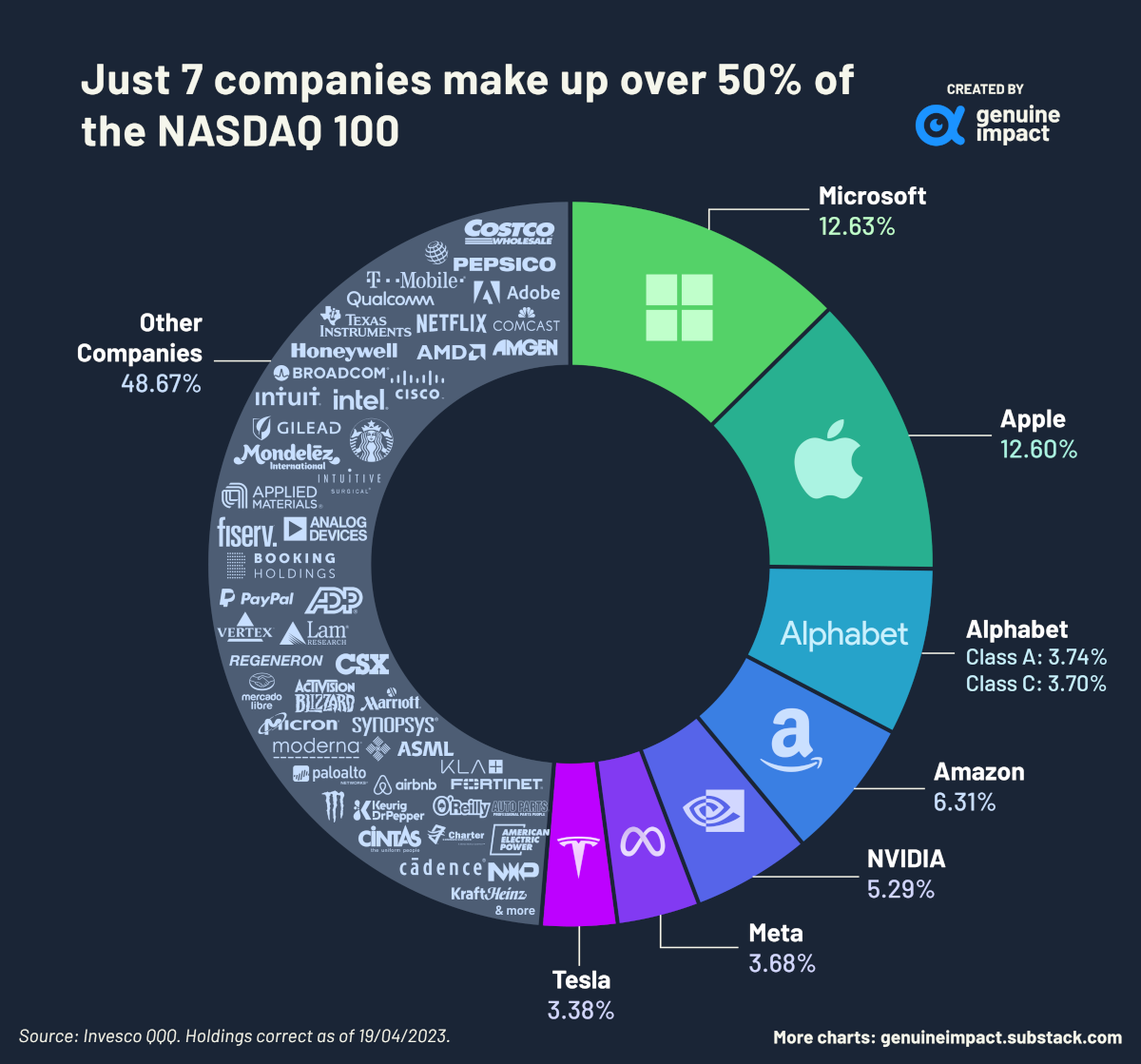
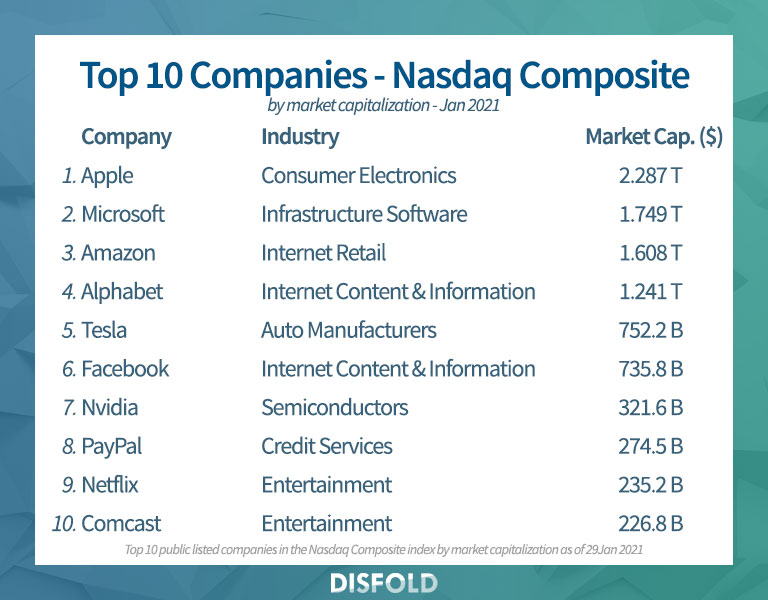
The concentration of wealth at the top of the Nasdaq Composite is significant. A handful of mega-cap technology companies—often referred to as the “Magnificent Seven” (Apple, Microsoft, Alphabet, Amazon, Nvidia, Meta, and Tesla)—account for a disproportionate share of the index’s total value. Even though there are over 3,000 stocks in the index, the top 10 holdings frequently represent more than 30% to 40% of the index’s total weight.
This creates a unique dynamic for investors. When the largest tech companies experience a rally, the Nasdaq Composite can post significant gains even if the majority of the other 2,900+ stocks are trading flat or down. Conversely, if the tech giants face regulatory headwinds or earnings misses, the index can suffer even if smaller, “hidden gem” companies within the Composite are performing well. Understanding this weighting is crucial for risk management, as it highlights the index’s sensitivity to the tech sector’s volatility.
How Rebalancing Affects the Index
To ensure that the index accurately reflects the current state of the market, the Nasdaq Composite undergoes a continuous rebalancing process. While the index is calculated throughout the trading day, the weights of the individual components are adjusted based on changes in shares outstanding.
In some rare instances, the index providers may implement a “special rebalance” if the concentration of the largest companies becomes too extreme, potentially threatening the index’s status as a diversified benchmark. However, for the most part, the Nasdaq Composite remains a pure reflection of market-cap dominance, rewarding the companies that grow the fastest and achieve the largest scale.
Comparing the Nasdaq Composite to Other Major Indices
To truly understand the value of the Nasdaq Composite, one must compare it to its peers. Each index serves a different purpose for an investor’s portfolio, and the “how many stocks” question is central to these differences.
Nasdaq Composite vs. Nasdaq-100
The most frequent point of confusion is between the Nasdaq Composite and the Nasdaq-100. While the Composite includes almost every company on the exchange (3,000+), the Nasdaq-100 is a subset consisting of the 100 largest non-financial companies listed on the Nasdaq.
The Nasdaq-100 is much more concentrated and is the basis for the famous QQQ ETF. If you are looking for exposure to the “cream of the crop” in technology and innovation, the Nasdaq-100 is the tool. However, if you want exposure to the broader ecosystem, including mid-cap and small-cap growth stocks that have not yet reached the top 100, the Nasdaq Composite is the superior benchmark.
Nasdaq Composite vs. S&P 500
The S&P 500 is often considered the definitive gauge of the U.S. economy, but it differs from the Nasdaq Composite in two major ways: diversity of exchanges and sector balance. The S&P 500 includes companies listed on both the New York Stock Exchange (NYSE) and the Nasdaq.
Furthermore, the S&P 500 has a much higher weighting in sectors like Financials, Energy, and Utilities, which are underrepresented in the Nasdaq Composite. While the Nasdaq Composite is often 50% or more weighted toward Technology and Consumer Discretionary sectors, the S&P 500 provides a more “all-weather” view of the industrial and financial backbone of America.
Why the Nasdaq Composite Matters for Modern Investors
For the individual investor, the Nasdaq Composite is more than a number on a screen; it is a strategic tool for growth-oriented investing. It captures the “innovation premium” that has driven much of the stock market’s outperformance over the last two decades.
A Barometer for Growth and Innovation
The Nasdaq exchange has historically been the home of choice for disruptive companies. From the early days of personal computing to the current explosion of Artificial Intelligence (AI) and biotechnology, the Nasdaq Composite has been the primary venue for these companies to go public.
Investors track the Composite to gauge the “risk-on” or “risk-off” sentiment of the market. When the Nasdaq Composite is outperforming the Dow or the S&P 500, it generally indicates that investors are confident in future growth and are willing to pay a premium for earnings that may occur years down the line. When it underperforms, it often signals a flight to safety and a preference for value stocks and dividends.
Sector Allocation: Beyond Just Technology
While “Nasdaq” is often synonymous with “Tech,” the Composite is more diverse than many realize. It contains significant allocations to:
-
Health Care: Specifically biotechnology and pharmaceutical firms that utilize the Nasdaq to fund research and development.
-
Consumer Discretionary: Major retailers and e-commerce giants that have redefined how the world shops.
-
Industrials: Innovative transportation and green energy companies that are moving away from traditional fossil fuels.
By tracking the thousands of stocks in the Composite rather than just the top 100, an investor gains a much broader perspective on how these various sectors are interacting with technological advancement.
Strategies for Investing in the Nasdaq Composite
Knowing how many stocks are in the index is the first step; the second is knowing how to gain exposure to them. Because the Nasdaq Composite contains thousands of stocks, it is impossible for an individual investor to manually buy every share.
ETFs and Mutual Funds
The most efficient way to invest in the entire Nasdaq Composite is through an Exchange-Traded Fund (ETF) that tracks the index, such as the Fidelity Nasdaq Composite Index ETF (ONEQ). This allows an investor to own a fractional piece of all 3,000+ companies with a single trade. This approach provides instant diversification, ensuring that a failure in one specific company—even a large one—does not catastrophicly impact the entire investment.

Managing Risk and Volatility
Investors must remain aware that the Nasdaq Composite is inherently more volatile than broader indices like the S&P 500. Because it is heavily weighted toward growth and technology, it is more sensitive to interest rate changes. When the Federal Reserve raises interest rates, the “discount rate” applied to future earnings increases, which can lead to sharp sell-offs in Nasdaq stocks.
To manage this risk, savvy investors often use the Nasdaq Composite as the “growth engine” of their portfolio while balancing it with more stable assets like bonds or value-oriented mutual funds. By understanding that the index represents over 3,000 companies but is driven by the top few, investors can make more informed decisions about when to lean into growth and when to hedge their bets.
The Nasdaq Composite remains a vital pillar of the financial world. Its massive breadth of 3,000+ stocks provides a unique look at the entrepreneurial spirit of the global economy, making it an essential focus for anyone serious about building long-term wealth through equity investing.
aViewFromTheCave is a participant in the Amazon Services LLC Associates Program, an affiliate advertising program designed to provide a means for sites to earn advertising fees by advertising and linking to Amazon.com. Amazon, the Amazon logo, AmazonSupply, and the AmazonSupply logo are trademarks of Amazon.com, Inc. or its affiliates. As an Amazon Associate we earn affiliate commissions from qualifying purchases.