
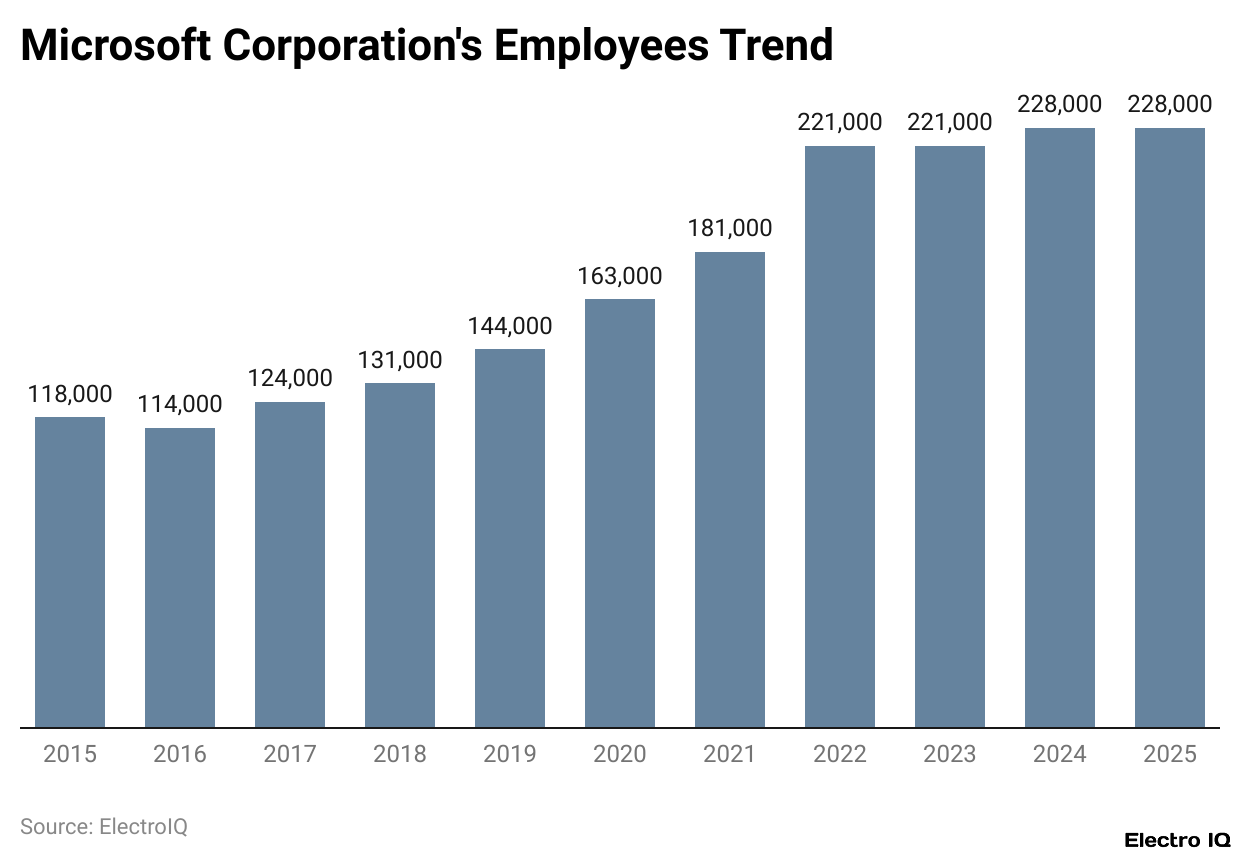
Microsoft Corporation stands as a titan of the modern economy, not merely because of its ubiquitous software but because of its staggering operational scale. As of the most recent fiscal reports, Microsoft employs approximately 221,000 full-time workers globally. This figure represents more than just a headcount; it is a reflection of a massive financial engine that powers global productivity. For investors, market analysts, and business enthusiasts, understanding the size and distribution of Microsoft’s workforce is essential to grasping the company’s fiscal health, its expansion strategy, and its long-term value proposition.

The journey from a small garage startup in 1975 to a workforce exceeding 200,000 individuals illustrates a trajectory of aggressive reinvestment and strategic scaling. In the realm of business finance, human capital is often the largest line item on the balance sheet. For Microsoft, managing this vast sea of talent requires a sophisticated approach to payroll logistics, regional economic considerations, and the financial integration of massive acquisitions.
The Financial Evolution of Microsoft’s Workforce
Microsoft’s workforce has undergone several distinct phases of growth, each corresponding to a major shift in the company’s revenue model. During the 1990s and early 2000s, the company’s headcount grew in tandem with the dominance of the Windows operating system and the Office suite. However, the most dramatic surge in hiring and acquisition-led growth has occurred over the last decade, fueled by the company’s pivot to cloud computing and enterprise services.
Historical Growth and Capital Expenditure
In the early 2000s, Microsoft’s workforce hovered around 50,000 employees. By 2010, that number had nearly doubled. The transition to the “Cloud First, Mobile First” era under CEO Satya Nadella saw a transformation not just in technology, but in how capital was deployed toward human resources. Today, the 221,000-strong workforce is divided roughly between 120,000 employees in the United States and approximately 101,000 internationally.
From a business finance perspective, this growth is a direct result of Microsoft’s massive Operating Expenses (OpEx). Maintaining a workforce of this size involves billions of dollars in annual compensation, benefits, and equity-based incentives. For shareholders, the question is always whether the increase in headcount translates to a proportional increase in Net Income.
The Role of M&A in Headcount Expansion
A significant portion of Microsoft’s current workforce arrived through multi-billion dollar acquisitions. When Microsoft acquires a company, it isn’t just buying intellectual property; it is absorbing thousands of specialists and their associated costs.
-
LinkedIn: The 2016 acquisition added over 10,000 employees to the roster.
-
GitHub: This acquisition integrated a leaner but highly specialized team of developers.
-
Activision Blizzard: The most recent and massive acquisition added nearly 13,000 employees, significantly boosting Microsoft’s presence in the gaming sector and adding a substantial new payroll obligation to the balance sheet.
Revenue per Employee: A Key Metric for Investors
In the world of corporate finance, one of the most revealing metrics for assessing efficiency is “Revenue per Employee.” This figure helps investors understand how effectively a company is leveraging its human capital to generate top-line growth.
Benchmarking against Industry Peers
With a total annual revenue recently surpassing the $245 billion mark, Microsoft generates over $1.1 million in revenue for every single person it employs. When compared to other “Magnificent Seven” companies, Microsoft maintains a highly competitive efficiency ratio. While it may not reach the astronomical per-employee revenue of a leaner entity like Apple, it consistently outperforms traditional enterprise hardware and service providers.
This high efficiency is largely driven by the scalability of software and cloud services. Unlike manufacturing-intensive industries, where adding revenue often requires a linear increase in labor, Microsoft’s Azure cloud platform allows for exponential revenue growth with a more controlled increase in headcount.
Labor Costs and Profit Margins
The financial burden of a 221,000-person workforce is substantial. Microsoft’s “General and Administrative” expenses, along with “Research and Development” costs, are heavily weighted toward employee salaries. However, because Microsoft maintains high gross margins—often exceeding 68%—the company can afford to sustain a massive payroll while still returning significant value to shareholders through dividends and stock buybacks. The ability to balance a growing workforce with expanding profit margins is a hallmark of Microsoft’s disciplined financial management.
Geographic Distribution and Regional Economic Impact
The distribution of Microsoft’s employees is a strategic financial decision that influences tax liabilities, currency hedging, and labor cost optimization. While the heart of the company remains in Redmond, Washington, its global footprint is a masterclass in international business finance.
The Redmond Campus and the US Economy
In the United States, Microsoft is a major economic engine, particularly in the Pacific Northwest. The Redmond campus houses tens of thousands of employees, contributing billions of dollars to the local economy through secondary spending and property taxes. From a corporate finance standpoint, concentrating a large portion of the workforce in a single “hub” allows for centralized administrative costs and localized tax incentives.
International Operations and Cost Optimization
Microsoft’s 100,000+ international employees are spread across Europe, Asia, and Latin America. Strategic hubs in regions like India (Microsoft India Development Center) and Ireland serve as critical nodes for global operations. By diversifying its workforce geographically, Microsoft can:
-
Access Global Talent Pools: Hiring in emerging markets allows the company to find specialized talent at different cost structures.
-
Mitigate Currency Risk: Having local operations helps balance revenue earned in foreign currencies with local expenses.
-
Optimize Tax Efficiency: Operating in various jurisdictions allows the company to take advantage of R&D tax credits and other international financial incentives.
Workforce Segmentation: Where the Investment Goes
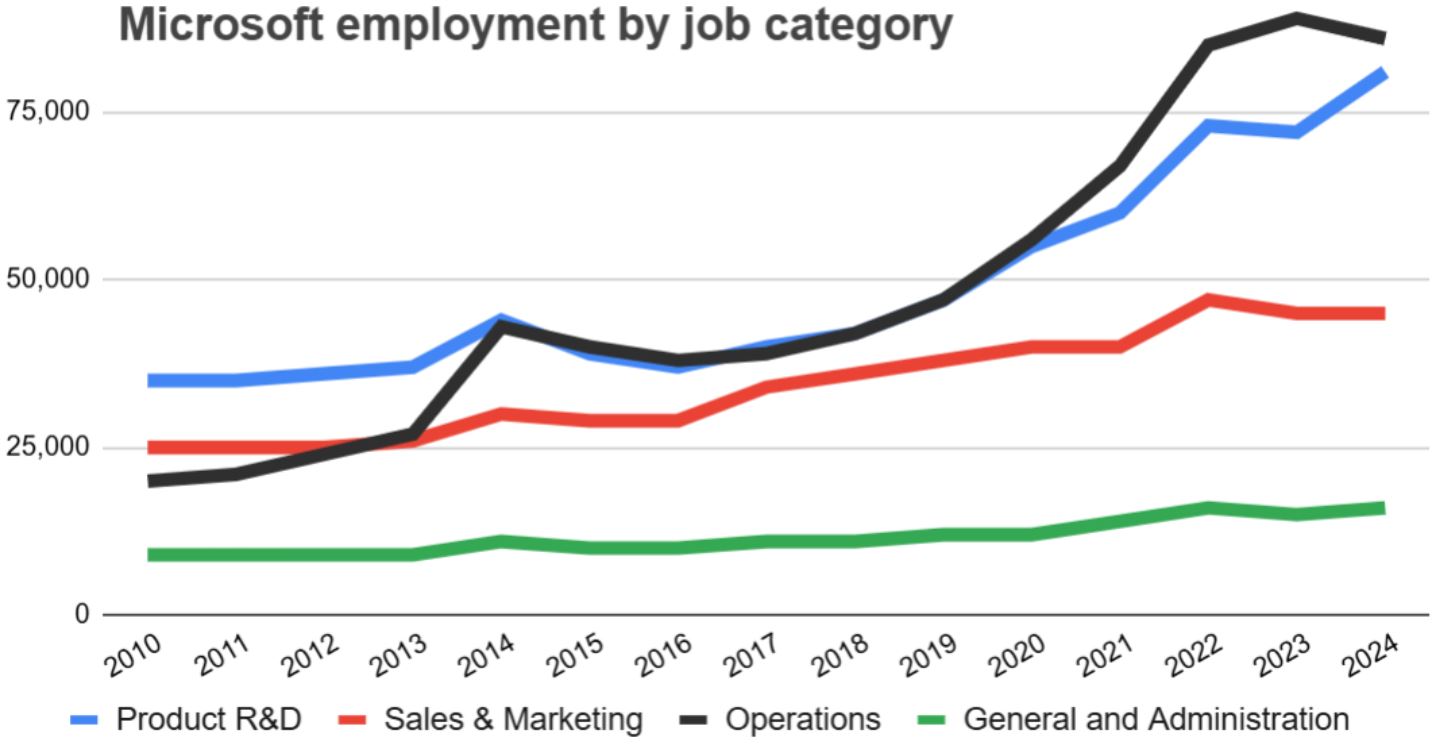
To understand how many people work at Microsoft, one must look at what they do. The company’s internal structure is a roadmap of its financial priorities. The workforce is generally segmented into engineering, sales and marketing, and general operations.
Research and Development (R&D)
The largest portion of Microsoft’s workforce is dedicated to engineering and R&D. This is the company’s “innovation engine.” In the most recent fiscal years, Microsoft has funneled over $27 billion into R&D. This investment pays for the salaries of software engineers, data scientists, and AI researchers who develop the products that will drive future revenue. In business terms, this is considered a long-term investment in intangible assets.
Sales and Marketing
A significant percentage of the workforce—roughly 20-25%—is focused on sales and marketing. This group is responsible for the enterprise relationships that sustain the Office 365 and Azure ecosystems. The financial structure of this segment often includes commission-based incentives, which aligns employee performance with the company’s quarterly revenue targets.
Operations and Activision Integration
With the inclusion of Activision Blizzard, a new segment of the workforce is dedicated to the high-growth, high-cost world of AAA gaming. Integrating these employees requires a careful alignment of corporate cultures and financial systems to ensure that the $69 billion investment eventually yields a positive Return on Investment (ROI).
The Future of the Microsoft Workforce: AI and Efficiency
As Microsoft enters the era of Artificial Intelligence, the relationship between headcount and revenue is expected to evolve. The company is currently at a crossroads where it must decide how to scale its workforce in an age of automation.
The AI Efficiency Frontier
Microsoft is a leader in integrating AI tools like Copilot into the workplace. Paradoxically, while Microsoft is hiring AI specialists at high salaries, it is also looking for ways to use AI to make its existing 221,000 employees more productive. If AI can handle routine coding tasks or administrative functions, Microsoft may be able to slow the rate of headcount growth while continuing to see double-digit revenue increases. This “decoupling” of labor from growth is the “holy grail” of business finance.
Managing Downsizing and Reallocation
In recent years, Microsoft has not been immune to the broader tech industry’s trend of “right-sizing.” Despite overall growth, the company has implemented targeted layoffs to prune underperforming divisions or to pivot resources toward AI. From a financial perspective, these moves are often viewed favorably by the market as they demonstrate fiscal discipline and a commitment to protecting profit margins.
Conclusion: The Magnitude of Human Capital
How many people work in Microsoft? The answer—221,000—is a number that signifies one of the most complex financial and organizational undertakings in the world. Each employee represents a calculated investment in the future of digital infrastructure.
For the investor, the workforce size is a metric of both risk and reward. It represents a massive fixed cost that must be covered by consistent innovation and sales. Yet, it also represents a formidable “moat”—a global army of talent that competitors find nearly impossible to replicate. As Microsoft continues to navigate the complexities of the global economy, its ability to manage, compensate, and inspire this vast workforce will remain the primary driver of its multi-trillion-dollar valuation. Understanding the “people” side of Microsoft is, ultimately, the only way to truly understand the “money” side of the business.
aViewFromTheCave is a participant in the Amazon Services LLC Associates Program, an affiliate advertising program designed to provide a means for sites to earn advertising fees by advertising and linking to Amazon.com. Amazon, the Amazon logo, AmazonSupply, and the AmazonSupply logo are trademarks of Amazon.com, Inc. or its affiliates. As an Amazon Associate we earn affiliate commissions from qualifying purchases.