
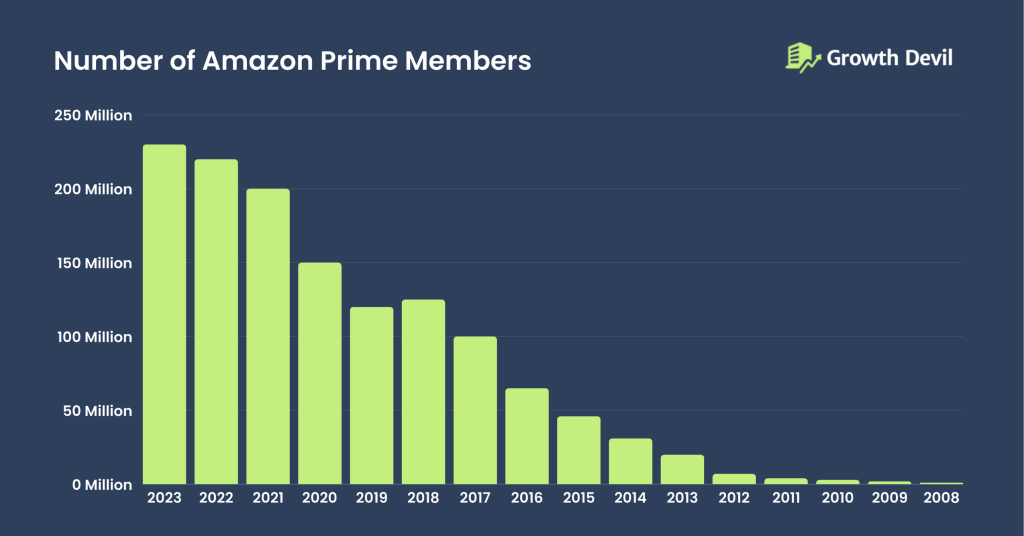
In the landscape of modern commerce, few brand initiatives have achieved the structural significance of Amazon Prime. What began in 2005 as a relatively simple experiment in expedited shipping has metastasized into a global ecosystem that redefines the relationship between a corporation and its consumer base. To ask “how many members are in Amazon Prime” is to do more than query a database; it is to measure the reach of one of the most successful brand loyalty strategies in history. As of recent disclosures and industry estimations, Amazon Prime boasts over 200 million paid members worldwide, a figure that places the service in a category of influence that rivals the populations of entire nations.

The success of Amazon Prime is not merely a feat of logistics; it is a masterclass in brand strategy. By transitioning the consumer’s mindset from “where should I buy this?” to “I already pay for Prime, I should buy this here,” Amazon has effectively built a moat around its market share. This strategic pivot—from a transactional retail platform to a membership-driven identity—has become the gold standard for corporate identity in the digital age.
Decoding the Numbers: Global Growth and Market Dominance
The trajectory of Amazon Prime’s membership numbers provides a roadmap of the brand’s global expansion. For years, Amazon remained tight-lipped about specific subscriber counts, but the veil was lifted in 2018 when then-CEO Jeff Bezos revealed the service had surpassed 100 million members. By 2021, that number had surged past 200 million. This rapid acceleration was fueled not just by the convenience of delivery, but by the strategic integration of diverse services into a single brand identity.
The 200 Million Milestone and Beyond
The 200 million member threshold represents a critical mass that changes the mechanics of retail. When a brand secures such a vast number of recurring subscribers, it shifts its financial model from reliance on individual sales to a predictable, high-margin subscription revenue stream. This capital allows the brand to reinvest in infrastructure—such as its own cargo fleet and robotics-driven fulfillment centers—which in turn reinforces the brand promise of speed and reliability.
Current estimates suggest that the United States remains the stronghold for the service, with over 160 million members domestic to the US. This means that roughly two-thirds of American households are Prime members. Such saturation suggests that in its primary market, Amazon Prime is no longer a “luxury” or an “add-on”; it is a utility.
International Expansion and Emerging Frontiers
While the US market approaches saturation, the growth of Prime membership is increasingly driven by international markets. Brands like Amazon face unique challenges when exporting a membership model to diverse economic landscapes. In India, for example, Amazon adapted its brand strategy by offering tiered pricing and mobile-only plans, recognizing that the “Prime” identity must be flexible to remain relevant.
The expansion into Europe, Japan, and Latin America reflects a localized brand strategy. In each region, the membership numbers serve as a barometer for how well the brand has localized its logistics and content offerings. The goal remains consistent: to become the “everything store” through a unified membership experience.
The Psychology of the Prime Brand: Why Millions Stay Subscribed
The sheer volume of Prime members is a testament to a psychological shift in consumer behavior. Amazon has successfully leveraged “the sunk cost fallacy” to its advantage. Once a consumer pays an annual fee, they feel a psychological urge to “get their money’s worth.” This drives them to use Amazon for even the smallest purchases, effectively training the consumer to bypass search engines and competitors entirely.
Frictionless Commerce as a Brand Identity
At its core, the Prime brand is built on the elimination of friction. Every hurdle removed—be it shipping costs, long wait times, or complicated checkout processes—strengthens the brand’s position in the consumer’s life. The membership number is a direct reflection of how many people prioritize “ease” above almost any other factor.
This frictionless identity extends into the digital realm. With features like “One-Click” ordering and voice-activated shopping via Alexa, the Prime brand has become synonymous with the path of least resistance. For the 200 million members, Amazon is not just a place to shop; it is the default state of their digital consumption.

The Flywheel Effect: Value Beyond Logistics
The “Amazon Flywheel” is a core tenet of the company’s brand strategy. It suggests that a better customer experience leads to more traffic, which attracts more sellers, which allows for a wider selection and lower prices, which further improves the customer experience. Prime is the fuel for this flywheel.
By bundling Prime Video, Prime Music, Prime Reading, and exclusive gaming content into the membership, Amazon has moved the brand from “utility” to “lifestyle.” A member may join for the free shipping, but they stay for the original television programming or the grocery discounts at Whole Foods. This multi-pronged value proposition makes the membership “sticky,” leading to retention rates that are the envy of the corporate world—often cited as being above 90% for members who renew for a second year.
Membership as a Strategic Moat: Case Studies in Brand Retention
The health of a brand is often measured by its “moat”—the competitive advantage that protects it from rivals. For Amazon, the Prime membership count is the primary component of that moat. It creates a ecosystem where the cost of leaving the brand (losing access to video, music, shipping, and storage) outweighs the benefits of switching to a competitor.
Content Strategy: Prime Video’s Role in Brand Building
One of the most significant shifts in the Prime brand identity was the heavy investment in original content. By producing award-winning series and acquiring high-profile sports rights (such as the NFL’s Thursday Night Football), Amazon transformed Prime into a media powerhouse.
From a brand strategy perspective, this is genius. It allows Amazon to capture the consumer’s “leisure time” in addition to their “shopping time.” Every hour spent watching Prime Video is an hour spent within the Amazon ecosystem, reinforcing the brand’s presence. Data suggests that members who engage with Prime Video are more likely to renew their subscriptions and have higher lifetime values than those who do not, proving that entertainment is a critical pillar of retail brand loyalty.
Prime Day: The Creation of a Brand-Owned Holiday
Perhaps no single event illustrates the power of the Prime membership numbers more than Prime Day. By inventing a holiday, Amazon created a focal point for its brand that generates billions in revenue in a matter of 48 hours.
Prime Day serves two strategic purposes. First, it acts as a massive acquisition tool, offering deep discounts to lure new members into the ecosystem. Second, it rewards existing members, reinforcing the idea that “membership has its privileges.” The event has become so influential that it has forced the entire retail industry to adjust, with competitors like Walmart and Target launching their own mid-summer sales to keep pace. The membership numbers typically see a significant spike during this period, demonstrating the brand’s ability to manufacture its own market demand.
Future Projections: Can the Growth Subside?
As Amazon Prime membership numbers continue to climb, the brand faces the inevitable challenge of diminishing returns. In markets like the US, where membership is nearly ubiquitous among high-income households, the strategy must shift from “acquisition” to “optimization.”
Market Saturation and Pricing Sensitivity
Recent years have seen Amazon increase the price of Prime membership. This is a delicate brand maneuver. How much can a brand charge before the “frictionless” value proposition is outweighed by the cost? So far, the membership numbers have remained resilient, suggesting that the brand’s perceived value still exceeds its price point.
However, as inflation affects global markets, Amazon must work harder to justify the subscription. This involves expanding the brand’s footprint into new sectors, such as healthcare (with Amazon Clinic and RxPass) and expanded grocery services. The goal is to make the Prime membership so essential to daily life that it becomes one of the last expenses a household would consider cutting.
The Evolution of the Prime Identity
The future of the Prime brand will likely focus on personalization and AI-driven integration. As the membership count grows, the ability to treat 200 million people as individuals becomes the next frontier of brand strategy. Predictive shipping—where Amazon anticipates what a member needs before they even order it—and deeply personalized content recommendations will be the next steps in deepening the brand’s relationship with its members.
In conclusion, the number of Amazon Prime members is more than a statistic; it is a testament to the power of a unified brand ecosystem. By prioritizing the long-term loyalty of a subscriber base over the short-term profit of a single sale, Amazon has built a brand that is integrated into the very fabric of global commerce. As long as the company continues to innovate within the Prime framework, those membership numbers will remain the most important metric for its continued dominance in the marketplace. The evolution from a shipping perk to a global cultural and economic force demonstrates that in the modern economy, the most valuable asset a brand can own is not a product, but a permanent place in the consumer’s life.
aViewFromTheCave is a participant in the Amazon Services LLC Associates Program, an affiliate advertising program designed to provide a means for sites to earn advertising fees by advertising and linking to Amazon.com. Amazon, the Amazon logo, AmazonSupply, and the AmazonSupply logo are trademarks of Amazon.com, Inc. or its affiliates. As an Amazon Associate we earn affiliate commissions from qualifying purchases.