
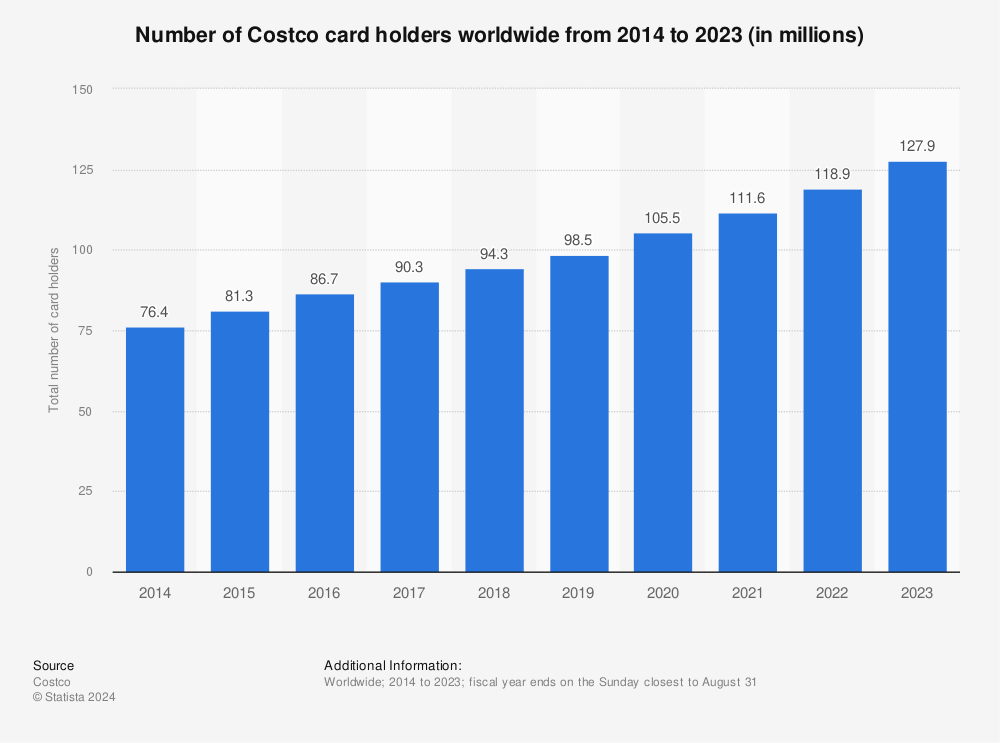
Costco Wholesale Corporation is often cited as a retail anomaly. While most retailers struggle to maintain razor-thin margins in the face of e-commerce giants and fluctuating consumer sentiment, Costco has built a fortress around its business model. At the heart of this fortress is a single metric that analysts, investors, and competitors watch with eagle-eyed precision: the membership count. As of the most recent fiscal reports, Costco boasts over 128 million cardholders across more than 70 million households globally. However, these numbers represent more than just a customer base; they represent a sophisticated financial engine that dictates the company’s stock valuation, its pricing power, and its long-term viability as a blue-chip investment.
The Financial Engine of Costco: Membership Revenue vs. Product Margins
To understand the weight of Costco’s membership numbers, one must first understand the company’s unconventional approach to profit. Unlike traditional supermarkets that aim for a 25% to 35% markup on goods, Costco intentionally caps its margins at approximately 14% to 15%. In many cases, particularly with their “loss leaders” like the rotisserie chicken or the hot dog combo, the margin is zero or negative.
How Membership Fees Drive Net Profit
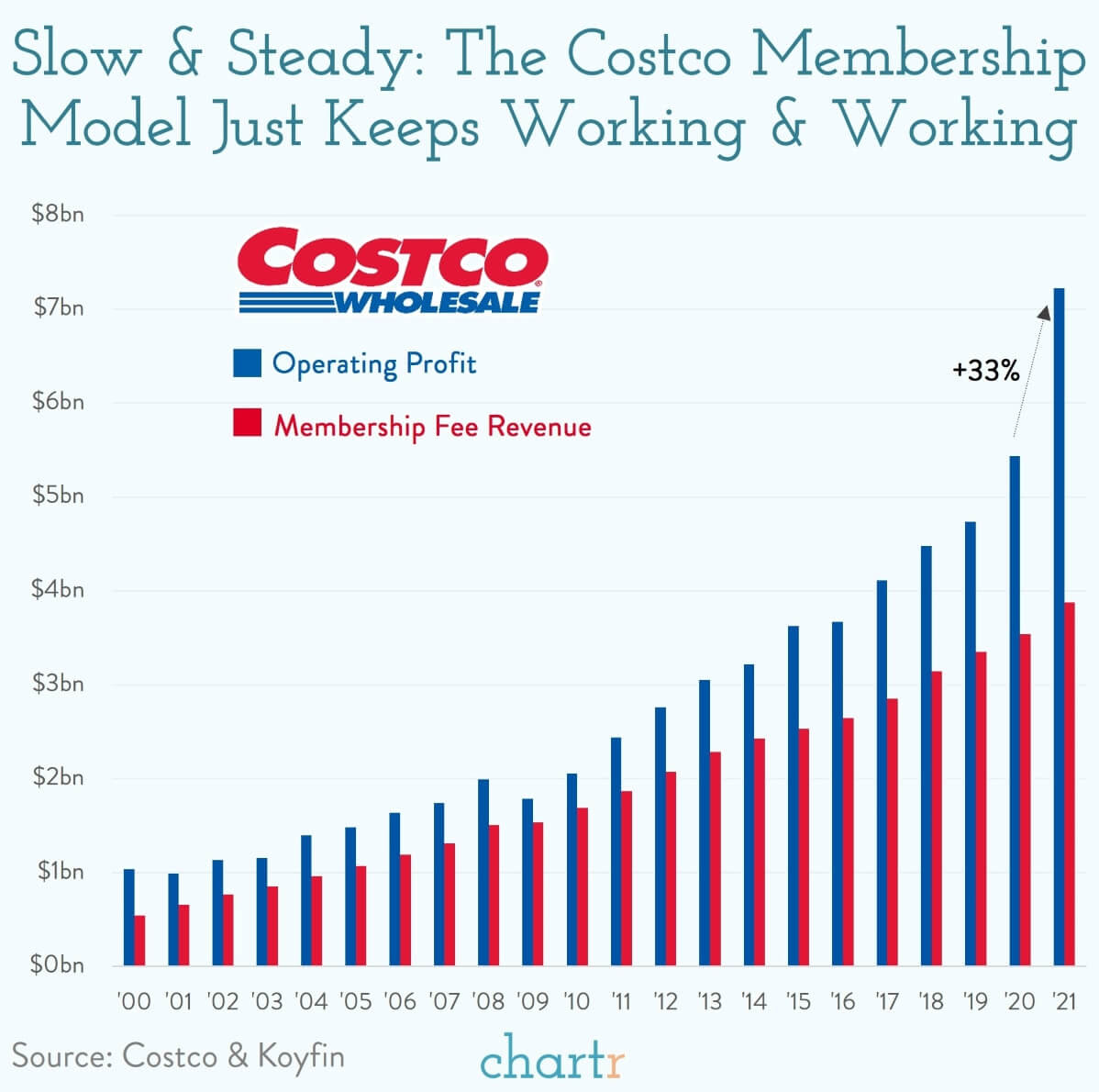
In the world of business finance, Costco is less a retailer and more a subscription service. The membership fees—currently $60 for Gold Star and $120 for Executive members in the U.S.—account for the vast majority of the company’s operating income. In a typical fiscal year, membership fees can represent between 70% and 80% of Costco’s total net income. This means that while the physical goods pay for the lights, the staff, and the logistics, the membership dues provide the actual profit that goes to shareholders.
For an investor, this creates a “predictable revenue” model similar to software-as-a-service (SaaS) companies. Because the revenue is collected upfront, Costco has a massive cash float that it can use to negotiate better prices with suppliers or invest back into warehouse expansion.
The “Break-Even” Strategy on Goods
By relying on membership fees for profit, Costco can afford to be the price leader in the market. This creates a virtuous cycle: lower prices lead to higher member satisfaction, which leads to higher renewal rates, which in turn provides more capital to drive prices even lower. This financial “flywheel” is the primary reason why Costco can sustain such a massive member base despite the increasing competition from Amazon and Walmart’s Sam’s Club.
Analyzing Membership Growth and Retention Rates
The sheer number of members—surpassing 130 million when including add-on cards—is impressive, but for those analyzing the company from a “Money” perspective, the retention rate is the more vital statistic.
The Gold Standard of Renewal Rates
In the retail industry, customer loyalty is notoriously fickle. Yet, Costco maintains a membership renewal rate of approximately 92% to 93% in the United States and Canada, and roughly 90% worldwide. This level of retention is almost unheard of in the consumer discretionary sector.
From a financial planning perspective, high retention rates lower the “Customer Acquisition Cost” (CAC). Costco does not spend heavily on traditional advertising or marketing campaigns. Instead, it relies on the organic growth of its membership base. When 92% of your customers return every year, the cost of maintaining your revenue stream is significantly lower than a business that must “buy” its customers every month through digital ads.
North American vs. International Expansion
While the North American market is reaching a point of high saturation, Costco’s international growth provides a significant upside for investors. The company’s entry into markets like China, Japan, and Western Europe has seen unprecedented demand. For instance, the opening of Costco’s first warehouse in Shanghai saw such massive crowds that the store had to close early on its first day.
For the business finance analyst, this indicates that the “Club” model is a global commodity. As Costco continues to open 20 to 30 new warehouses per year, the membership pool is projected to grow by 3% to 5% annually, providing a consistent tailwind for the company’s valuation.

Costco as an Investment: What the Numbers Mean for Shareholders
For those looking at Costco through the lens of a personal portfolio or institutional investment, the membership numbers serve as a leading indicator of stock performance. Costco (NASDAQ: COST) often trades at a higher Price-to-Earnings (P/E) ratio than its peers, such as Target or Walmart. This “Costco Premium” is directly tied to the stability of its membership revenue.
Key Performance Indicators (KPIs) Beyond Sales
When Costco releases its quarterly earnings, the “Comparable Sales” (Comp Sales) are important, but the “Membership Fee Income” is the metric that often dictates the stock’s movement. If membership income grows faster than sales, it suggests that the company is becoming more efficient at capturing value from its base.
Furthermore, the “Executive Membership” tier is a crucial KPI. Executive members pay double the standard fee but receive a 2% reward on purchases. These members represent a minority of the total membership count but account for nearly 75% of total sales. An increase in Executive Member conversion is a bullish signal, as it indicates a more “sticky” and higher-spending customer.
The Impact of Membership Fee Hikes
Historically, Costco increases its membership fees approximately every five to six years. Because these fees flow almost entirely to the bottom line, even a $5 or $10 increase results in an immediate and massive surge in net profit. Analysts often treat these periodic hikes as a “built-in” dividend for the company’s financial health. For shareholders, the anticipation of a fee hike often acts as a catalyst for stock price appreciation, as it promises an expansion of margins without requiring any increase in operational overhead.
The Value Proposition for Consumers: Is it Worth the Annual Fee?
From a personal finance perspective, the question isn’t just “how many members does Costco have,” but “should I be one of them?” The decision to join Costco is a financial calculation of ROI (Return on Investment).
Calculating the ROI of a Membership
To justify a $60 Gold Star membership, a household must save at least $60 a year compared to shopping at a standard grocer or online retailer. Given that Costco’s prices are often 20% to 40% lower than traditional retail, a consumer spending just $300 a year on staples (toilet paper, coffee, gasoline) usually reaches the break-even point.
The financial benefit becomes even more pronounced when considering “Costco Services.” The company leverages its massive member base to negotiate lower rates on insurance, mortgages, travel, and tire installations. For many families, the savings on a single set of tires or a vacation package can pay for a decade of membership fees.
Executive vs. Gold Star: A Financial Comparison
The Executive Membership ($120) is a specific financial tool for high-volume shoppers. To break even on the additional $60 cost of the Executive upgrade, a member must spend $3,000 annually at Costco (which equates to $250 per month).
- Spend < $3,000/year: The Gold Star membership is more cost-effective.
- Spend > $3,000/year: The 2% reward exceeds the cost of the upgrade, essentially making the membership “free” or even profitable for the consumer.
This tiered system is a masterclass in behavioral economics. It encourages members to consolidate their spending at Costco to reach that $3,000 threshold, further driving the company’s top-line revenue.
The Future of the Costco Ecosystem
As we look toward the next decade, the “Money” story of Costco will be defined by its ability to digitize its membership base without losing the “treasure hunt” experience of its physical warehouses. While e-commerce represents a growing segment of their business, the core value remains the physical card in the wallet.
The membership count—currently hovering around 128 million—is more than a census of shoppers; it is a testament to a business model that prioritizes long-term stability over short-term price gouging. By keeping margins low and membership loyalty high, Costco has created a financial moat that is incredibly difficult to breach. For the consumer, it represents a calculated avenue for savings; for the investor, it represents one of the most reliable recurring revenue streams in the history of retail. Whether you are looking at the company’s balance sheet or your own household budget, the power of the Costco membership is undeniable.
aViewFromTheCave is a participant in the Amazon Services LLC Associates Program, an affiliate advertising program designed to provide a means for sites to earn advertising fees by advertising and linking to Amazon.com. Amazon, the Amazon logo, AmazonSupply, and the AmazonSupply logo are trademarks of Amazon.com, Inc. or its affiliates. As an Amazon Associate we earn affiliate commissions from qualifying purchases.