
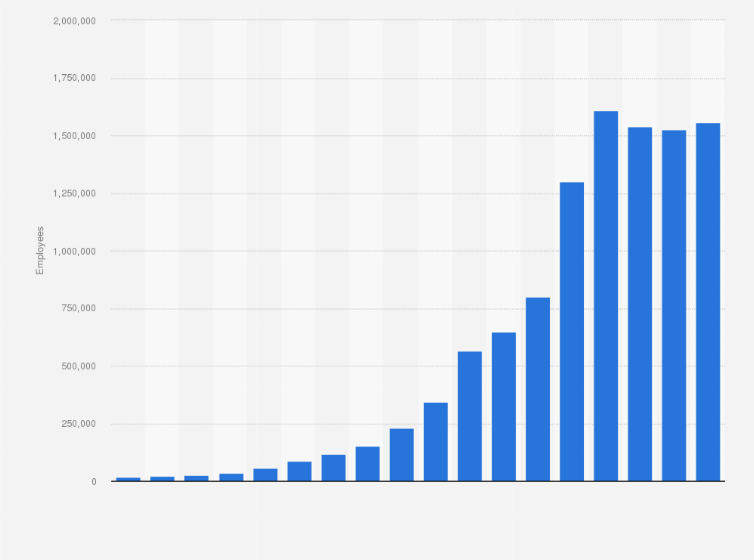
In the landscape of global commerce, few metrics serve as a more potent indicator of corporate scale and economic influence than the size of a company’s workforce. When asking “how many employees work at Amazon,” the answer is not merely a static number, but a reflection of the company’s aggressive expansion, its dominance in the retail and cloud sectors, and its massive footprint in the global labor market. As of the most recent fiscal reporting periods, Amazon employs approximately 1.5 million people worldwide. This figure positions the company as the second-largest private employer in the world, trailing only Walmart.

For investors, business analysts, and financial enthusiasts, understanding the composition and growth of Amazon’s workforce is essential. The headcount represents both the company’s greatest operational strength and its most significant financial liability. To grasp the true scale of this enterprise, one must look beyond the surface level and analyze how this massive human capital investment drives one of the most complex business engines in history.
Analyzing the Growth Trajectory: From Garage Startup to Global Employer
The evolution of Amazon’s workforce is a case study in exponential growth. In its early days as an online bookseller, the company operated with a lean team. However, as Jeff Bezos pivoted the business model from a “store for everything” to an “infrastructure for everything,” the need for physical labor exploded.
The Post-Pandemic Correction
Between 2019 and 2022, Amazon underwent a hiring spree that was unprecedented in the corporate world. Driven by the global shift toward e-commerce during the COVID-19 pandemic, the company nearly doubled its workforce in just two years. At its peak, the company was adding hundreds of thousands of workers to manage the surge in demand for home delivery and cloud services.
However, the financial reality of 2023 and 2024 brought a period of “right-sizing.” Like many of its peers in the tech and retail sectors, Amazon had to reconcile its massive headcount with a cooling economy and rising operational costs. This led to high-profile layoffs in various divisions, particularly in devices, advertising, and human resources. Despite these cuts, the total headcount remains near historic highs, signaling that while the company is trimming “white-collar” fat, its operational core remains massive.
Breaking Down the Workforce: Corporate vs. Operations
To understand the financial health of Amazon, it is necessary to distinguish between its two primary types of employees: the corporate/tech staff and the fulfillment/logistics staff. These two groups represent vastly different cost structures and value propositions for the company.
The Impact of Logistics and Fulfillment on Headcount
The vast majority of Amazon’s 1.5 million employees do not work in high-rise offices in Seattle or Arlington. Instead, they work in fulfillment centers, sortation centers, and delivery stations. This “blue-collar” segment of the workforce is the backbone of Amazon’s retail dominance.
From a business finance perspective, this segment is high-volume and high-churn. The cost of recruiting, training, and retaining these workers is a major line item on Amazon’s balance sheet. Furthermore, the company relies on a secondary “shadow workforce” of independent contractors through the Amazon Flex program and third-party Delivery Service Partners (DSPs). While these individuals do not count toward the official 1.5 million headcount, they are integral to the company’s operational capacity and financial performance.
AWS and the High-Value Tech Segment
On the other side of the spectrum is Amazon Web Services (AWS) and the company’s corporate divisions. While these employees represent a smaller fraction of the total headcount, they generate a disproportionate amount of the company’s operating income.
The employees in these sectors are highly skilled software engineers, data scientists, and cloud architects. For investors, the “revenue per employee” in the AWS division is significantly higher than in the retail division. This divergence highlights Amazon’s unique position as a hybrid company: a capital-intensive logistics giant and a high-margin technology powerhouse.
The Financial Implications of a Massive Headcount

Maintaining a workforce of 1.5 million people presents unique financial challenges and opportunities. In the world of business finance, labor is often the largest controllable expense, and for Amazon, even a small percentage change in wages or benefits can result in billions of dollars in shifting costs.
Labor Costs and Operating Margins
Amazon has consistently faced pressure to increase its minimum wage and improve worker benefits. In the United States, the company established a $15 minimum wage years ago, which has since increased in many regions due to market competition.
From an investing standpoint, these rising labor costs are a double-edged sword. On one hand, they ensure that Amazon can attract the labor necessary to maintain its delivery promises—its primary competitive advantage. On the other hand, they compress operating margins. Analysts watch Amazon’s “fulfillment costs” closely, as these are directly tied to headcount and wage inflation. When fulfillment costs as a percentage of net sales rise, it can signal a decrease in operational efficiency.
Automation vs. Human Capital: The ROI Perspective
To mitigate the rising costs of a massive human workforce, Amazon is investing billions into robotics and artificial intelligence. The deployment of technologies like the “Proteus” autonomous mobile robot and the “Sparrow” robotic arm is a strategic move to decouple growth from headcount.
For the business-minded observer, the transition toward automation is a long-term capital expenditure (CapEx) strategy intended to improve long-term Return on Investment (ROI). By automating repetitive tasks in fulfillment centers, Amazon aims to reduce its reliance on seasonal hiring and minimize the financial impact of labor shortages. The goal is not necessarily to reduce the total number of employees, but to increase the output per human worker, thereby widening the company’s profit margins.
Amazon as an Economic Indicator
Because of its sheer size, Amazon’s hiring and firing patterns are often viewed as a bellwether for the broader economy. The company’s workforce data provides insights into consumer confidence, the health of the labor market, and the shift in global commerce.
Seasonal Hiring and Macroeconomic Trends
Every year, Amazon typically hires between 100,000 and 250,000 seasonal workers to handle the Q4 holiday rush. The scale of this seasonal surge is so large that it can actually influence national unemployment statistics and wage growth data in the United Kingdom and the United States.
When Amazon announces a robust seasonal hiring plan, it often signals an optimistic outlook for consumer spending. Conversely, a more conservative approach to hiring—or an increase in automation during peak periods—indicates a focus on cost-cutting and fiscal discipline. For those monitoring the markets, Amazon’s HR department is as much a source of data as its quarterly earnings reports.
Comparing Amazon to Other Retail Giants
When comparing Amazon to Walmart, the differences in workforce utilization are striking. While Walmart has a larger total headcount (approximately 2.1 million), Amazon’s revenue per employee has historically been higher due to its high-margin cloud and advertising businesses.
However, in the retail space, Amazon’s shift toward physical stores (via Whole Foods and Amazon Fresh) has brought its workforce model closer to that of traditional brick-and-mortar retailers. This diversification requires a different type of labor management and introduces new variables into the company’s financial planning, such as regional labor laws and unionization efforts, which can impact long-term valuation.
Future Outlook: Scalability in the Age of AI
As we look toward the future, the question of “how many employees work at Amazon” may become less about raw numbers and more about the quality and efficiency of those roles. The company is currently at a crossroads where it must balance its identity as a massive employer with its goals of becoming the most technologically advanced logistics company on earth.
The integration of Generative AI into corporate workflows and the continued rollout of robotics in warehouses suggest a shift toward a “human-plus-machine” model. In this scenario, Amazon might maintain a workforce of over a million people, but the nature of their work will shift from manual labor to system oversight and maintenance.
For the business professional and the investor, Amazon’s headcount will remain a critical metric. It is the ultimate barometer of the company’s physical reach. As long as Amazon continues to deliver millions of packages a day and host a significant portion of the internet’s data, its workforce will remain one of the most significant and scrutinized collections of human capital in the world. Whether the number climbs toward 2 million or stabilizes through the use of technology, the financial implications of Amazon’s employment strategy will continue to shape the global economic landscape for decades to come.
aViewFromTheCave is a participant in the Amazon Services LLC Associates Program, an affiliate advertising program designed to provide a means for sites to earn advertising fees by advertising and linking to Amazon.com. Amazon, the Amazon logo, AmazonSupply, and the AmazonSupply logo are trademarks of Amazon.com, Inc. or its affiliates. As an Amazon Associate we earn affiliate commissions from qualifying purchases.