
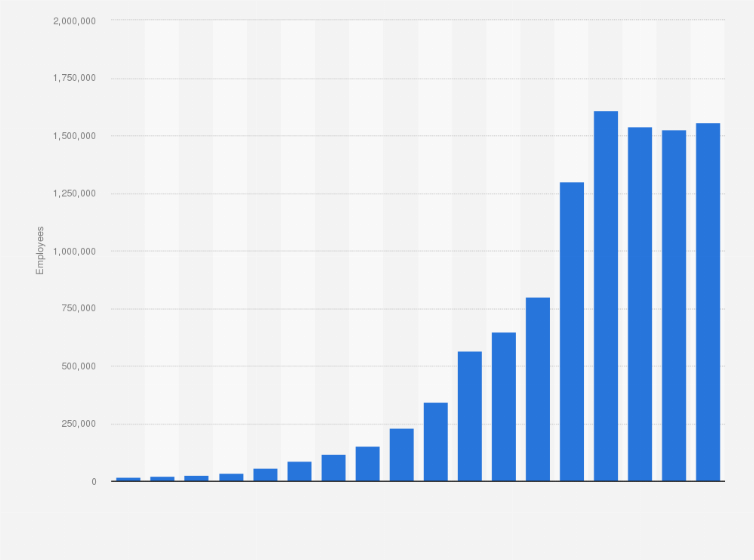
Amazon stands as one of the most significant economic engines of the 21st century. To understand the sheer scale of the company, one needs to look beyond its stock ticker (AMZN) or its ubiquity in e-commerce and dive into the most complex aspect of its balance sheet: its workforce. As of the most recent fiscal reports, Amazon employs approximately 1.5 million people globally. This figure does not just represent a headcount; it represents a massive financial undertaking that influences global labor markets, corporate tax structures, and investor sentiment.

When analysts ask “how many employees does Amazon have,” they are rarely looking for a simple integer. They are seeking to understand the operational efficiency, the sustainability of the company’s growth, and the fiscal implications of managing a population larger than that of many sovereign nations. In the realm of business finance, Amazon’s workforce is both its greatest asset and its most significant liability.
The Financial Scale of the Amazon Workforce
The financial footprint of 1.5 million employees is staggering. For most corporations, labor is a controllable expense, but for Amazon, it is the core infrastructure of their “Flywheel” effect. The cost of maintaining this workforce is reflected in the company’s operating expenses, specifically within the fulfillment and technology/content categories.
Deciphering the Latest Quarterly Earnings Reports
According to Amazon’s most recent SEC filings and quarterly earnings reports, the headcount has seen a period of stabilization following the unprecedented surge during the COVID-19 pandemic. Between 2019 and 2022, Amazon nearly doubled its workforce to meet the explosion in online shopping demand. Financially, this was a period of massive capital expenditure.
In recent quarters, however, the focus has shifted from headcount expansion to “cost to serve” optimization. Investors closely watch the “Number of Employees” line item in the 10-K and 10-Q filings because it serves as a proxy for the company’s confidence in consumer demand. A shrinking or plateauing headcount often signals a pivot toward profitability and operational discipline, which Wall Street historically rewards with higher valuation multiples.
Labor Costs as a Percentage of Revenue
From a business finance perspective, the absolute number of employees is less critical than the ratio of labor costs to total revenue. Amazon’s business model is unique because it bifurcates into two distinct financial profiles: the high-margin, lower-headcount Amazon Web Services (AWS) and the lower-margin, high-headcount retail and fulfillment division.
While AWS generates a disproportionate share of the company’s operating income with a relatively small percentage of the total staff, the retail division requires a massive human contingent to manage the “last mile” of logistics. Financial analysts calculate the “labor intensity” of the retail segment to determine if Amazon is effectively leveraging its scale. When the company increases its minimum wage or expands benefits, it creates a billion-dollar ripple across its quarterly profit margins, making the management of headcount a delicate balancing act between social responsibility and shareholder returns.
Efficiency and Growth: Comparing Headcount to Market Capitalization
The valuation of Amazon is often debated in the context of its human capital. Unlike “asset-light” tech giants like Meta or Alphabet, Amazon is an “asset-heavy” hybrid. This makes the metric of “Revenue per Employee” a vital tool for institutional investors looking to gauge the health of the enterprise.
Revenue per Employee: A Key Metric for Investors
In the world of finance, “Revenue per Employee” provides insight into how much value each worker contributes to the bottom line. For a traditional software company, this number might exceed $1 million. For Amazon, the blended nature of its business—combining cloud computing with warehouse labor—results in a lower overall average, but a highly complex financial narrative.
By maintaining a massive workforce, Amazon achieves a level of vertical integration that competitors cannot match. This scale allows them to internalize costs that other companies would have to pay to third-party logistics providers like UPS or FedEx. Therefore, the “cost” of the 1.5 million employees is offset by the “savings” of not outsourcing their primary value proposition: speed of delivery.
The Impact of Post-Pandemic Workforce Rightsizing
In 2023 and early 2024, Amazon made headlines for significant layoffs, particularly within its corporate and Alexa divisions. From a financial management standpoint, this was a strategic “rightsizing.” After the hiring frenzy of the previous three years, the company faced a mismatch between its fixed labor costs and the cooling global economy.

These layoffs, totaling over 27,000 roles, were a signal to the market that Amazon was prioritizing “Operating Income” over “Growth at All Costs.” For investors, this move was viewed as a maturation of the company’s financial strategy. It demonstrated a shift toward leaner operations, ensuring that the headcount remains an engine for profit rather than a drag on the balance sheet during periods of high inflation and rising interest rates.
The Economic Ripple Effect of Amazon’s Hiring Strategy
Amazon’s headcount does not exist in a vacuum; it acts as a significant driver of regional and national economies. When Amazon decides to open a new fulfillment center, the financial implications extend to local tax bases, real estate markets, and competitive wage floors.
Regional Economic Impact and Job Creation
The addition of tens of thousands of jobs in specific geographic hubs—such as the HQ2 in Arlington, Virginia—creates a localized “multiplier effect.” From a business finance perspective, Amazon uses these hiring surges as leverage for economic development incentives and tax credits. These incentives are crucial to the company’s long-term fiscal strategy, as they help offset the massive overhead associated with such a large workforce.
Furthermore, Amazon’s internal “minimum wage” policy (currently $15–$20+ depending on the region) has forced a shift in the labor market. Competitors in the retail and logistics sectors are often forced to raise their own wages to compete for the same talent pool, effectively raising the cost of labor across the board. This “Amazon Effect” on wages is a primary study point for economists and financial planners tracking inflationary trends.
Investment in Training and Retention Programs
High turnover is one of the most significant hidden costs in Amazon’s business model. To combat the financial drain of recruiting and training new staff, Amazon has invested billions into programs like “Career Choice,” which pays for employee tuition.
From a purely financial standpoint, these are not just philanthropic efforts; they are retention strategies designed to lower the “Cost of Vacancy” and “Cost of Turnover.” In the logistics industry, replacing a worker can cost between 1.5 to 2 times that worker’s annual salary when accounting for lost productivity and training expenses. By investing in the existing 1.5 million employees, Amazon is protecting its operational stability and reducing its long-term SG&A (Selling, General, and Administrative) expenses.
Future Outlook: Automation vs. Human Capital Investment
As we look toward the next decade, the question of “how many employees does Amazon have” will increasingly be influenced by the company’s investment in robotics and artificial intelligence. The financial tug-of-war between human labor and capital-intensive automation is the defining challenge for Amazon’s future.
The CAPEX of Robotics and the Shift in Labor Requirements
Amazon Robotics (formerly Kiva Systems) has already deployed hundreds of thousands of robots across its fulfillment centers. From a business finance perspective, this represents a shift from “Variable Costs” (wages) to “Fixed Costs” (capital expenditure on technology).
While robots require significant upfront investment (CAPEX), they do not require healthcare, pensions, or pay raises. For shareholders, the gradual replacement or augmentation of human labor with robotics suggests a path toward significantly higher margins in the retail sector. However, the transition is slow and expensive. Currently, the 1.5 million human employees remain essential for tasks requiring fine motor skills and complex decision-making that AI has yet to master.
Long-term Financial Sustainability of a Multi-Million Person Staff
Can Amazon continue to grow its headcount indefinitely? There are financial and mathematical limits to labor pool penetration. In some markets, Amazon has hired such a large percentage of the available workforce that they face “labor supply” risks.
To maintain its financial trajectory, Amazon must find a way to increase its “Output per Headcount.” Whether through better AI integration, streamlined logistics software, or the expansion of its high-margin advertising and cloud businesses, the goal is to decouple revenue growth from headcount growth. If Amazon can continue to increase its trillion-dollar valuation while keeping its employee count stable or even slightly reduced through efficiency, it will solidify its position as the most fiscally disciplined titan of the modern era.
In conclusion, the 1.5 million employees of Amazon represent more than just a workforce; they are a fundamental component of the global financial ecosystem. Every hiring spree, layoff, and wage adjustment is a calculated move on a giant financial chessboard, designed to maintain Amazon’s dominance in a competitive and ever-changing market. For the business-minded observer, the number of employees is the ultimate indicator of how Amazon balances the scales of growth, efficiency, and profit.
aViewFromTheCave is a participant in the Amazon Services LLC Associates Program, an affiliate advertising program designed to provide a means for sites to earn advertising fees by advertising and linking to Amazon.com. Amazon, the Amazon logo, AmazonSupply, and the AmazonSupply logo are trademarks of Amazon.com, Inc. or its affiliates. As an Amazon Associate we earn affiliate commissions from qualifying purchases.