
The Dow Jones Industrial Average (DJIA), often referred to simply as “the Dow,” is arguably the most recognized financial benchmark in the world. When news anchors report that “the market is up,” they are almost always referring to the movement of this specific index. For the casual observer and the seasoned investor alike, understanding the structure of the Dow is fundamental to grasping the health of the American economy. While the name suggests a vast collection of enterprises, the Dow is actually composed of exactly 30 companies.

Despite its relatively small sample size, these 30 companies are intended to represent the “blue-chip” sector of the United States economy. These are the giants—the industry leaders that possess a long history of stability, growth, and reliability. However, the number 30 is not a random figure, and the companies that fill these slots are constantly under scrutiny to ensure they accurately reflect the shifting landscape of modern business.
The 30 Pillars: Understanding the Composition of the Dow
The Dow Jones Industrial Average is a price-weighted index, which sets it apart from other major indices like the S&P 500, which is market-capitalization-weighted. Because it only tracks 30 companies, each constituent carries a significant amount of weight. These companies are selected from major industries, excluding transportation and utilities, which have their own specific Dow averages.
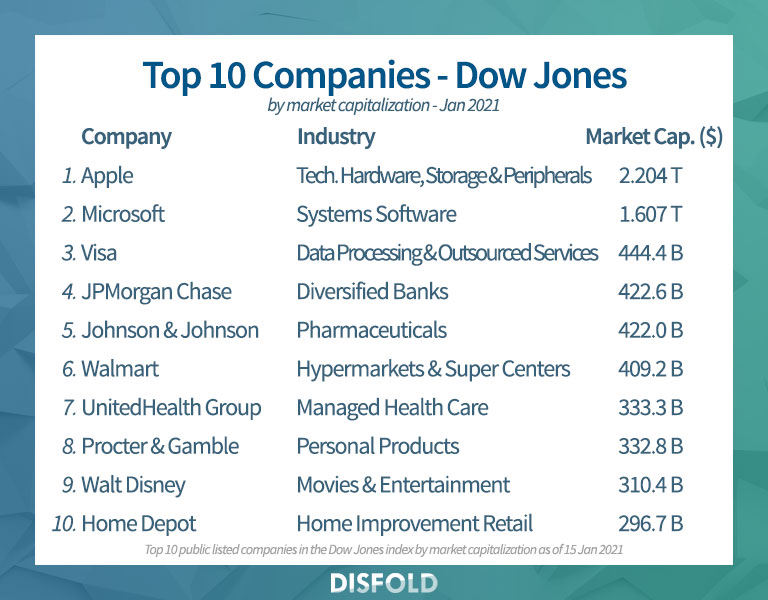
The current roster of the Dow includes household names across various sectors, including technology, healthcare, consumer goods, and financial services. Companies like Apple, Microsoft, UnitedHealth Group, and JPMorgan Chase are staples of the index. The selection process is unique; unlike the S&P 500, which has strict quantitative rules for inclusion, the Dow’s components are selected by a committee at S&P Dow Jones Indices.
The Role of the Selection Committee
The committee’s goal is to maintain a group of companies that provides a representative sample of the U.S. economy. There are no rigid rules for inclusion, but the committee generally looks for companies with an excellent reputation, a history of sustained growth, and a high level of interest among investors. Furthermore, because the index is price-weighted, the committee must consider the share price of a potential newcomer. A company with an exceptionally high share price could disproportionately influence the index, while one with a very low share price might have negligible impact, regardless of its market cap.
Why Only 30 Companies?
In an era where thousands of companies are publicly traded, 30 may seem like a statistically insignificant number. However, the Dow was created in 1896, a time when the industrial landscape was much simpler. While the index has expanded from its original 12 components to the current 30, the number has remained fixed since 1928. The rationale is that 30 large, diversified companies can serve as a “heartbeat” for the broader market. If the top 30 companies in the country are struggling, it is a strong indicator of systemic economic pressure.
The Evolution of the Dow: From Smoke Stacks to Silicon
The “Industrial” part of the Dow Jones Industrial Average is largely a legacy term. When Charles Dow and Edward Jones launched the index in the late 19th century, the American economy was driven by heavy industry—railroads, cotton, gas, sugar, and tobacco. Of the original 12 companies, only General Electric survived as a constituent for over a century, and even it was eventually removed in 2018.
The Shift Toward Technology and Services
As the U.S. transitioned from a manufacturing-based economy to one driven by services and technology, the Dow evolved accordingly. The removal of industrial stalwarts in favor of tech giants like Salesforce and Apple reflects the reality of the 21st-century marketplace. Today, the index is more of a “Commercial and Tech Average” than an industrial one.
This evolution is critical for investors to understand. If the Dow were still comprised of steel and oil companies, it would no longer be a relevant benchmark for the modern portfolio. By swapping out stagnant industries for growth sectors, the index maintains its status as a premier indicator of economic momentum.
Historical Milestones in the Index
The Dow has seen numerous “reshuffles” over the decades. One of the most significant occurred in the late 1990s, when Microsoft and Intel became the first companies from the Nasdaq exchange to be added to the Dow. This signaled the official recognition of the Information Age as the dominant driver of American wealth. More recently, the addition of Amazon replaced Walgreens Boots Alliance, further emphasizing the dominance of e-commerce and cloud computing in the current financial era.
The Price-Weighting Mechanism: A Unique Financial Tool

To truly understand how the 30 companies make up the Dow, one must understand the math behind the index. Most modern indices use market capitalization (share price multiplied by total shares outstanding) to determine a company’s influence. The Dow, however, uses a price-weighted system. This means that companies with a higher stock price have a greater impact on the index’s movements than those with lower stock prices.
The Dow Divisor
If you simply added up the prices of the 30 stocks and divided by 30, the index would fluctuate wildly every time a company performed a stock split or paid a special dividend. To prevent this, the “Dow Divisor” was created. The divisor is a continuously adjusted figure that accounts for corporate actions. When a company splits its stock, the divisor is adjusted so that the numerical value of the Dow remains the same despite the change in share prices.
This mechanism is a point of contention among some financial analysts. They argue that a company like Goldman Sachs, because of its high share price, has more “power” over the Dow than a company with a massive market cap but a lower share price. For the personal investor, this means that the Dow tracks the price movements of its components rather than the total value of the companies themselves.
The Impact of Stock Splits
Stock splits have a fascinating effect on the Dow’s composition. When a high-priced stock like Apple or Nvidia undergoes a split, its weight within the Dow drops significantly. This can lead to situations where the committee may choose to remove or add companies based on their price levels to ensure the index remains balanced. For an investor, monitoring the share prices of the 30 components is just as important as monitoring their earnings reports.
Why the Number 30 Still Matters in Modern Investing
Critics often argue that the S&P 500 is a better benchmark because it tracks 500 companies and uses market-cap weighting. However, the Dow persists as the primary reference point for the general public and many professional traders. The reason lies in its exclusivity and its psychological impact.
A Mirror of Consumer Sentiment
The 30 companies in the Dow are typically “household names.” Because these are companies that people interact with daily—using an iPhone, drinking a Coca-Cola, or using a Visa card—the Dow feels more tangible to the average person than broader indices. When the Dow drops 500 points, it triggers a psychological response in the consumer base that can lead to changes in spending habits and economic sentiment.
Diversification via the “Blue-Chip” Strategy
For the personal finance enthusiast, the Dow represents a curated list of high-quality assets. While it lacks the high-growth volatility of the tech-heavy Nasdaq, it offers a level of stability that is attractive for long-term wealth preservation. The 30 companies are essentially a pre-vetted list of the most robust organizations in the country. For those looking for “safe haven” investments, the Dow components are often the first place they look.
Strategic Investing: Leveraging the Dow Jones for Your Portfolio
Knowing that there are 30 companies in the Dow is the first step; knowing how to invest in them is the second. Most individual investors do not buy all 30 stocks individually, as the transaction costs and rebalancing would be cumbersome. Instead, they turn to financial tools designed to track the index.
Index Funds and ETFs
The most common way to invest in the Dow is through Exchange-Traded Funds (ETFs). The most famous of these is the SPDR Dow Jones Industrial Average ETF Trust, known by its ticker symbol “DIA” or “Diamonds.” By purchasing shares of this ETF, an investor gains proportional exposure to all 30 companies. This provides instant diversification across various sectors of the U.S. economy with a single trade.
The “Dogs of the Dow” Strategy
A popular value-investing strategy involving these 30 companies is the “Dogs of the Dow.” This strategy involves identifying the 10 companies in the index with the highest dividend yields at the end of the year and investing in them for the following twelve months. The theory is that blue-chip companies with high yields are temporarily undervalued and are likely to experience a price rebound. This approach highlights how the small number of companies in the Dow makes it easier for individual investors to conduct deep-dive analysis and execute specific trading strategies.
Conclusion: The Enduring Legacy of the 30
The question of “how many companies make up the Dow” is simple to answer—30—but the implications of that number are vast. These 30 companies represent the historical narrative of American capitalism, the current state of industrial innovation, and a roadmap for future economic shifts. While it may not be as broad as other indices, the Dow’s selectivity is its strength. It provides a focused, high-level view of the corporate giants that move the needle of the global economy. For any investor looking to build a stable financial foundation, keeping a close eye on these 30 titans is not just a suggestion; it is a necessity.
aViewFromTheCave is a participant in the Amazon Services LLC Associates Program, an affiliate advertising program designed to provide a means for sites to earn advertising fees by advertising and linking to Amazon.com. Amazon, the Amazon logo, AmazonSupply, and the AmazonSupply logo are trademarks of Amazon.com, Inc. or its affiliates. As an Amazon Associate we earn affiliate commissions from qualifying purchases.