
When investors and financial analysts talk about “the market,” they are most often referring to the S&P 500. For decades, this index has served as the definitive barometer for the health of the United States economy and the primary benchmark for equity performance. However, for those beginning their journey into personal finance or institutional investing, a common question arises: “How many companies are in the S&P 500?” While the name suggests a straightforward answer, the reality of the index’s composition is more nuanced, involving a rigorous selection process, specific share class structures, and a complex weighting system that dictates the flow of trillions of dollars in global capital.
The Magic Number: Why It’s 500 (and Sometimes More)
At its most basic level, the S&P 500 (Standard & Poor’s 500 Index) is designed to track the performance of 500 leading publicly traded companies in the United States. While the number “500” is fixed in the title, the actual number of stock listings within the index often fluctuates slightly above that figure.
The Difference Between Companies and Tickers
One of the most frequent points of confusion for investors is why their brokerage platform might show 503 or 505 listings for the S&P 500. This occurs because certain companies included in the index issue multiple classes of stock. For instance, Alphabet Inc. (the parent company of Google) has two separate share classes included in the index: Class A (GOOGL) and Class C (GOOG). Because both are significant enough to warrant inclusion, they represent two “tickers” but only one “company.” As of the most recent rebalancing, there are exactly 500 companies, but the number of constituents—the individual stocks—is slightly higher.
Historical Context of the 500 Milestone
The index didn’t always house 500 names. When Standard & Poor’s introduced its first stock index in 1923, it tracked a small handful of companies. It wasn’t until March 4, 1957, that the index expanded to its current 500-company format. This expansion was designed to provide a more comprehensive look at the industrial, utility, and financial sectors of the American economy. Over the decades, the “500” has become a psychological and mathematical standard for diversification in the world of finance.
Eligibility Requirements: How a Company Enters the “S”
Becoming one of the 500 companies in this elite index is not merely a matter of being “large.” The S&P Index Committee, a team of professionals at S&P Dow Jones Indices, follows a strict set of quantitative and qualitative criteria to ensure the index remains a reliable proxy for the investable U.S. equity market.
Market Capitalization Thresholds
To be considered for inclusion, a company must meet a specific unadjusted market capitalization requirement. As of 2024, this threshold generally sits around $15.8 billion or greater, though this number is periodically adjusted to reflect changes in market conditions. This ensures that the index only represents “Large Cap” stocks—those with enough stability and scale to influence the broader economy.
Liquidity and Financial Viability Standards
Size is only the first hurdle. A company must also prove that its shares are highly liquid, meaning they are easy to buy and sell without causing massive price swings. Specifically, the ratio of annual dollar value traded to float-adjusted market capitalization should be at least 0.75. Furthermore, the company must be a “viable” entity, defined by S&P as having positive earnings over the most recent quarter, as well as the sum of the most recent four consecutive quarters. This “profitability rule” distinguishes the S&P 500 from other indexes, like the Russell 1000, which may include companies that are large but currently losing money.
The Role of the S&P Index Committee
Unlike some indexes that are purely governed by a mathematical formula, the S&P 500 has a human element. The Index Committee meets monthly to review the constituents. They have the discretion to add or remove companies based on corporate actions (like mergers and acquisitions) or shifts in the economic landscape. This oversight ensures that the index doesn’t just track the biggest companies, but the most representative ones.
Market Cap Weighting: Why Not All 500 Are Created Equal

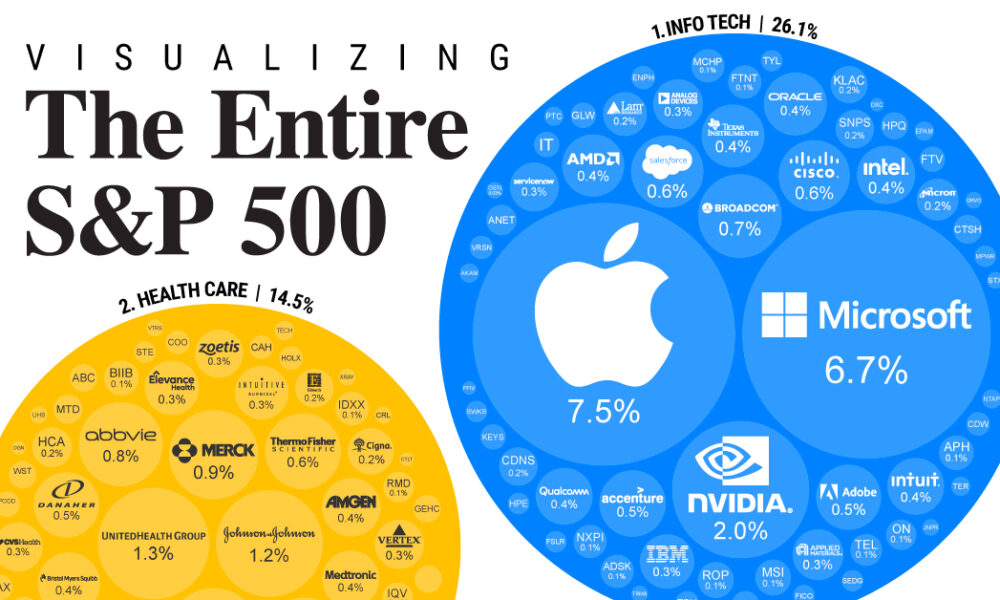
A common misconception among novice investors is that each of the 500 companies contributes equally to the index’s performance. In reality, the S&P 500 is a “float-adjusted market-capitalization-weighted” index. This means that the larger a company is, the more influence it has on the index’s daily movement.
The Dominance of “The Magnificent Seven”
In recent years, the index has become increasingly top-heavy. A small group of technology and consumer discretionary giants—often referred to as the “Magnificent Seven” (Apple, Microsoft, Alphabet, Amazon, Nvidia, Meta, and Tesla)—now account for a significant percentage of the index’s total value. For example, if Apple’s stock drops by 2%, it has a much larger impact on an S&P 500 index fund than if the bottom 50 companies in the index were to drop by the same percentage.
Diversification vs. Concentration Risks
While having 500 companies provides a safety net against the failure of any single firm, the capitalization-weighting method introduces concentration risk. When a few sectors—like Technology or Healthcare—dominate the market cap of the index, the “S” becomes highly sensitive to the trends affecting those specific industries. Investors seeking true diversification must understand that while they own 500 companies, their capital is heavily concentrated in the top 10% of those firms.
The Significance for Personal Finance and Portfolios
The structure and count of the S&P 500 aren’t just academic figures; they are the foundation of modern retirement planning and wealth building. Because the index is so well-regulated and representative, it has become the gold standard for passive investing.
Passive Investing and Index Funds
The rise of the “Index Fund,” pioneered by John Bogle and Vanguard, changed the face of personal finance. Instead of trying to pick individual winning stocks—a task that most professional money managers fail to do consistently—investors can buy an S&P 500 ETF (Exchange-Traded Fund) like SPY, VOO, or IVV. By doing so, they are essentially buying a small piece of all 500 companies. This “set it and forget it” strategy relies on the fact that while individual companies may rise and fall, the collective 500 largest U.S. companies have historically trended upward over long time horizons.
Using the S&P 500 as a Performance Benchmark
For those who do choose to invest in individual stocks or actively managed mutual funds, the S&P 500 serves as the ultimate yardstick. If a financial advisor or a specific fund cannot “beat the S” over a 5-to-10-year period after fees, the investor is technically losing money compared to what they could have earned in a low-cost index fund. This has led to a massive shift in capital over the last two decades, moving from active management into passive vehicles that simply track these 500 companies.
The Future of the Index: Rebalancing and Evolution
The S&P 500 is not a static list; it is a living organism that evolves with the American economy. As industries emerge and others fade, the composition of the “500” shifts to reflect the modern world.
How Often Does the List Change?
The index undergoes a formal rebalancing on a quarterly basis (in March, June, September, and December). During these windows, companies that have shrunk in value or fallen into financial distress are removed, and rising stars that meet the eligibility criteria are added. This constant “survival of the fittest” is one reason why the index performs well over decades; it systematically removes losers and adds winners.

Emerging Industries and the Shift Toward Technology
If you looked at the S&P 500 forty years ago, it was dominated by oil companies, industrial manufacturers, and automakers. Today, the index is heavily weighted toward Information Technology, Communication Services, and Consumer Discretionary sectors. This shift highlights the transition of the U.S. economy from a manufacturing-based system to a service and technology-driven powerhouse. As we move further into the age of Artificial Intelligence and Biotechnology, the 500 companies of the future will likely look vastly different from those of today, ensuring the index remains the most relevant financial tool for the next generation of investors.
In conclusion, while the answer to “how many companies are in the S&P 500” is literally five hundred, the index represents so much more. It is a carefully curated selection of the engines driving the global economy. For the individual investor, understanding the rules, the weighting, and the evolution of these 500 companies is the first step toward building a sophisticated and resilient financial future.
aViewFromTheCave is a participant in the Amazon Services LLC Associates Program, an affiliate advertising program designed to provide a means for sites to earn advertising fees by advertising and linking to Amazon.com. Amazon, the Amazon logo, AmazonSupply, and the AmazonSupply logo are trademarks of Amazon.com, Inc. or its affiliates. As an Amazon Associate we earn affiliate commissions from qualifying purchases.