
The Dow Jones Industrial Average (DJIA), often simply referred to as “the Dow,” stands as one of the most recognizable and frequently quoted stock market indices globally. For decades, it has served as a benchmark, a talking point, and a general barometer for the health of the U.S. economy and its corporate giants. While its daily fluctuations capture headlines and influence investor sentiment, a fundamental question often arises for those new to the financial world, or even seasoned observers seeking clarity: exactly how many companies make up this storied index? The answer, both simple and nuanced, is a constant 30.

This seemingly straightforward number belies a complex selection process and a rich history, reflecting the evolution of American industry itself. Understanding the Dow isn’t just about knowing the count; it’s about appreciating its role in financial markets, its methodology, and its continued relevance in a rapidly changing economic landscape.
The Iconic Index: Understanding the Dow Jones Industrial Average
The Dow Jones Industrial Average is more than just a list of companies; it’s a window into the historical performance of the American stock market. Conceived in the late 19th century, it has evolved from a simple average to a sophisticated, albeit sometimes criticized, indicator of market trends.
A Brief History and Purpose
First published on May 26, 1896, by Charles Dow, editor of The Wall Street Journal and co-founder of Dow Jones & Company, the index initially comprised just 12 industrial stocks. Its original intent was to provide a clear, concise measure of the performance of the U.S. industrial sector. At a time when financial data was less accessible, the Dow offered a novel way to track the overall market direction. Over the years, as the American economy diversified beyond heavy industry, the “Industrial” in its name became more a legacy term, with the index now representing a broad spectrum of major U.S. industries, from technology and retail to healthcare and finance. Its primary purpose remains unchanged: to serve as a bellwether for the U.S. stock market and, by extension, the broader economy.
Beyond a Simple Number: Market Representation
While only 30 companies strong, the Dow’s components are carefully selected to represent some of the largest, most stable, and most influential publicly traded corporations in the United States. These aren’t just any companies; they are typically “blue-chip” firms with long histories, strong brand recognition, and significant market capitalization. The idea is that the collective performance of these 30 giants offers a reliable snapshot of the broader market’s health and investor confidence. Despite the limited number, these companies collectively account for a substantial portion of the U.S. equity market value, making their movements highly impactful on investor portfolios and economic sentiment.
The Magic Number: Decoding the Dow’s Composition
The number 30 is integral to the Dow’s identity, a constant that provides continuity despite the ever-changing roster of companies within it. This fixed size is a defining characteristic that differentiates it from other indices.
Always 30: A Constant but Evolving Roster
Unlike other indices such as the S&P 500, which contains 500 companies, or broader market indices with thousands of constituents, the Dow has maintained its 30-company structure for over a century. This constancy in number ensures that its historical data remains comparable in terms of its breadth of representation. However, this doesn’t mean the companies within the Dow are static. Far from it. The individual companies making up the index are periodically reviewed and changed to ensure the Dow continues to reflect the evolving landscape of American industry and economic leadership. Companies that lose their market dominance, face significant financial troubles, or become less representative of the broader economy may be removed, while new, influential players are added. This dynamic internal composition, within a fixed external count, is key to the Dow’s sustained relevance.
Why 30? The Rationale Behind the Selection
The choice of 30 companies is not arbitrary. It represents a balance. A smaller number might make the index too volatile or unrepresentative, while a much larger number could dilute the impact of individual blue-chip companies and make the index unwieldy to calculate (especially in its early, manual days). Thirty companies were deemed sufficient to provide a significant, diversified sample of market leaders without becoming overly complex. This relatively small number allows the index to highlight the performance of truly dominant firms, whose movements are seen as indicative of broader trends within their respective sectors and the economy at large. The aim is to capture a meaningful cross-section of the most important economic actors.
The Selection Process: What Makes a Dow Component?
The inclusion in the Dow Jones Industrial Average is a coveted status, a testament to a company’s stature and influence. The process is not based on rigid mathematical formulas but on expert judgment.
Criteria for Inclusion: Blue Chips and Industry Leadership
Companies considered for the Dow typically share several key characteristics. They are almost invariably “blue-chip” stocks—large, well-established, financially sound companies with a history of stable earnings and dividend payments. These companies are leaders in their respective industries, often household names with global operations. The committee responsible for selection looks for companies with excellent reputations, sustained growth, and broad investor interest. Furthermore, the committee aims for diversification across sectors to ensure the index isn’t overly dominated by any single industry, even though the “industrial” moniker might suggest otherwise. The goal is to create an index that serves as an effective proxy for the overall U.S. stock market and economic health.

The Role of the S&P Dow Jones Indices Committee
The decisions regarding which companies enter or exit the Dow are made by the Averages Committee, a group of representatives from S&P Dow Jones Indices and The Wall Street Journal. This committee meets as needed, not on a fixed schedule, to assess the composition of the index. Their decisions are based on qualitative factors, weighing a company’s reputation, sustained growth, and representation within its industry against the broader economic landscape. Unlike the S&P 500, which has more quantitative rules regarding market capitalization and liquidity, the Dow’s selection process involves a greater degree of discretion and expert judgment. This allows the committee to respond to significant shifts in the economy and corporate world, ensuring the Dow remains relevant.
Notable Additions and Deletions
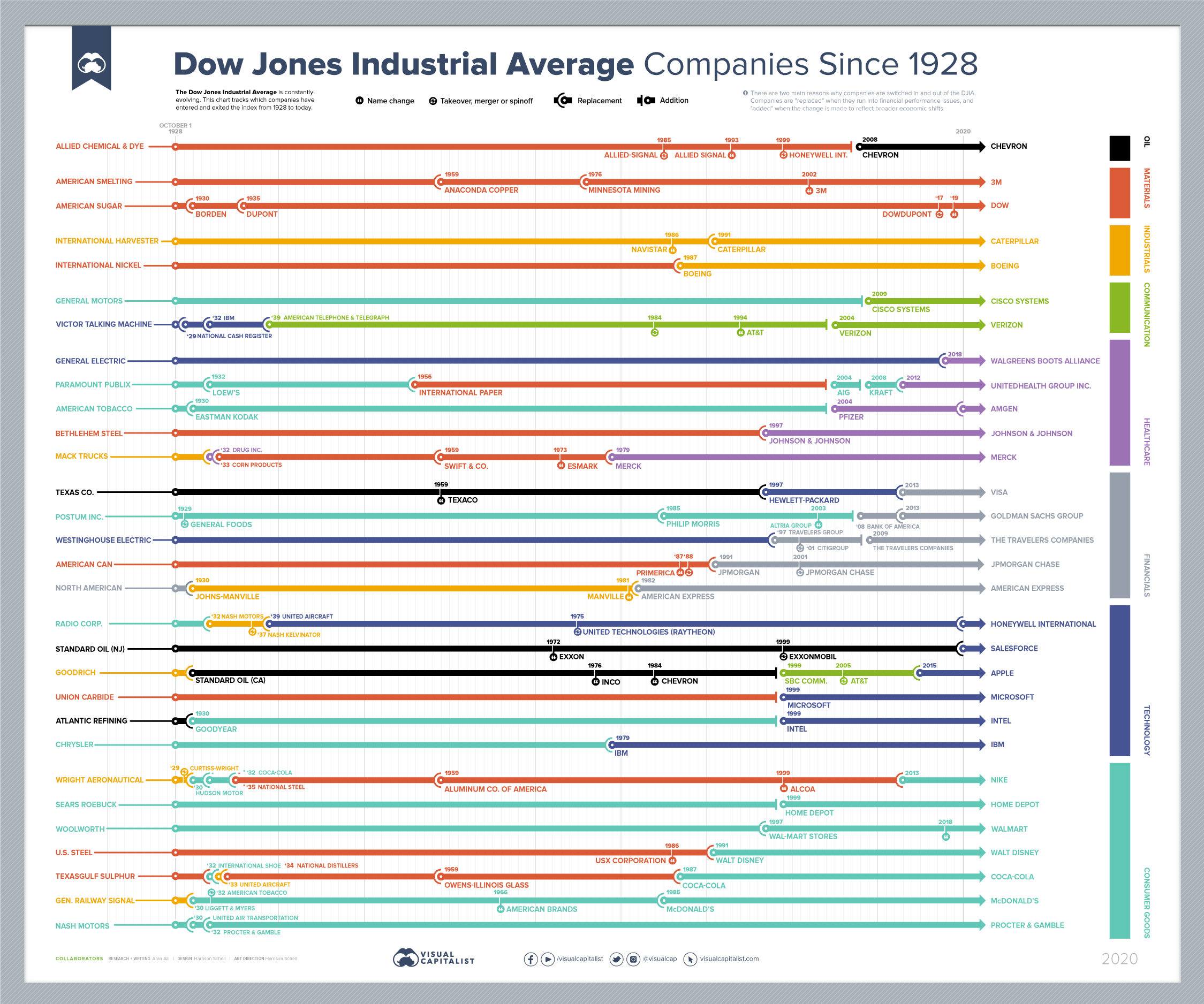
Throughout its history, the Dow has seen numerous changes to its lineup, each reflecting a specific era’s economic dynamics. For example, legacy industrial giants have given way to technology powerhouses. General Electric, an original component from 1896 and a continuous member since 1907, was removed in 2018, symbolizing the shift away from traditional manufacturing. Similarly, ExxonMobil, once a dominant energy player, was replaced by Salesforce in 2020, highlighting the growing importance of software and cloud computing. Other significant changes have seen companies like Apple and Amazon join the ranks, underscoring the ascendance of the tech sector. These changes, while sometimes surprising, are critical for maintaining the Dow’s representativeness and its ability to reflect the modern U.S. economy.
Impact and Limitations: Why the Dow Matters (and Why It Doesn’t Always)
Despite its prominence, the Dow is not without its critics, and understanding its unique calculation method is crucial for appreciating its strengths and weaknesses as a financial tool.
A Barometer for the U.S. Economy
For many, the Dow is the quintessential measure of market performance. Its daily movements are reported globally, and a rising Dow is often interpreted as a sign of economic optimism, while a falling Dow can signal caution or distress. Its blue-chip components are deeply intertwined with the broader economy, employing millions, driving innovation, and generating significant revenue. Therefore, their collective health is often seen as a good indicator of the overall economic climate. Investors and policymakers alike watch the Dow closely for cues on market sentiment, corporate profitability, and the general direction of the American financial landscape. It offers a quick, easily digestible snapshot of how the largest and most influential companies are performing.
Criticisms and Alternatives: Price-Weighting and Scope
One of the most significant criticisms of the Dow stems from its price-weighted methodology. Unlike market-capitalization-weighted indices (like the S&P 500), where companies with larger market values have a greater impact, the Dow gives more weight to stocks with higher share prices. This means a $1 change in a high-priced stock has a greater effect on the index than a $1 change in a low-priced stock, regardless of their actual company size. Critics argue this gives disproportionate influence to a few high-priced stocks and can misrepresent the overall market.
Furthermore, its limited scope of just 30 companies means it doesn’t offer as broad a representation of the entire U.S. stock market as the S&P 500 or the Russell 3000. It omits many small and mid-cap companies, as well as a significant portion of larger ones. For these reasons, many professional investors and financial analysts consider the S&P 500 a more accurate and comprehensive benchmark for the U.S. equity market.
For Investors: Using the Dow in Your Strategy
Despite its limitations, the Dow remains a valuable tool for investors, particularly for gaining a quick understanding of large-cap performance. Many exchange-traded funds (ETFs) and mutual funds track the Dow, offering investors an easy way to gain exposure to these influential companies. For those interested in a concentrated portfolio of established, financially robust companies, the Dow’s components represent a solid collection of businesses. However, a well-diversified investment strategy would typically look beyond just the Dow, incorporating a broader range of companies, market capitalizations, and potentially international exposure, to mitigate risk and capture wider market growth. Understanding the Dow’s specific characteristics, especially its price-weighting, is crucial for interpreting its movements and integrating it thoughtfully into a broader investment philosophy.
Evolution and Future: Keeping the Dow Relevant
The Dow has survived economic depressions, world wars, market crashes, and technological revolutions. Its ability to adapt is key to its longevity.
Adapting to Economic Shifts
The committee’s willingness to adjust the Dow’s components ensures its continued relevance. As the U.S. economy shifts from manufacturing to services, from brick-and-mortar retail to e-commerce, and from traditional energy to renewable sources, the Dow’s composition reflects these changes. This adaptability is vital for an index that aims to be a leading economic indicator. Without these periodic refreshes, the Dow would quickly become an anachronism, reflecting an outdated economic structure rather than the dynamic present. This ongoing evolution ensures that the 30 companies within the index truly represent the current drivers of American corporate success and innovation.
The Dow’s Enduring Legacy
The Dow Jones Industrial Average, with its consistent count of 30 companies, holds a unique place in financial history and continues to captivate the public imagination. While financial professionals often turn to broader, market-capitalization-weighted indices for nuanced analysis, the Dow’s simplicity, long history, and focus on America’s corporate titans ensure its enduring legacy. It remains a powerful symbol of economic progress and a readily understood benchmark for the health of the world’s largest economy. For anyone seeking to understand the pulse of the American stock market, knowing that it’s composed of exactly 30 carefully chosen, influential companies is a fundamental piece of financial literacy. Its journey from a dozen railway and industrial stocks to a diverse collection of modern giants reflects the relentless evolution of capitalism itself.
aViewFromTheCave is a participant in the Amazon Services LLC Associates Program, an affiliate advertising program designed to provide a means for sites to earn advertising fees by advertising and linking to Amazon.com. Amazon, the Amazon logo, AmazonSupply, and the AmazonSupply logo are trademarks of Amazon.com, Inc. or its affiliates. As an Amazon Associate we earn affiliate commissions from qualifying purchases.