
The American financial system is one of the most complex and fragmented in the world. Unlike many developed nations where a handful of massive institutions dominate the entire landscape, the United States has historically supported thousands of individual banking entities. However, if you look at the trajectory of the last four decades, that landscape is shifting rapidly. To understand how many banks are in the U.S. today, one must look beyond a simple headcount and examine the economic, regulatory, and technological forces that are thinning the ranks of traditional brick-and-mortar institutions.
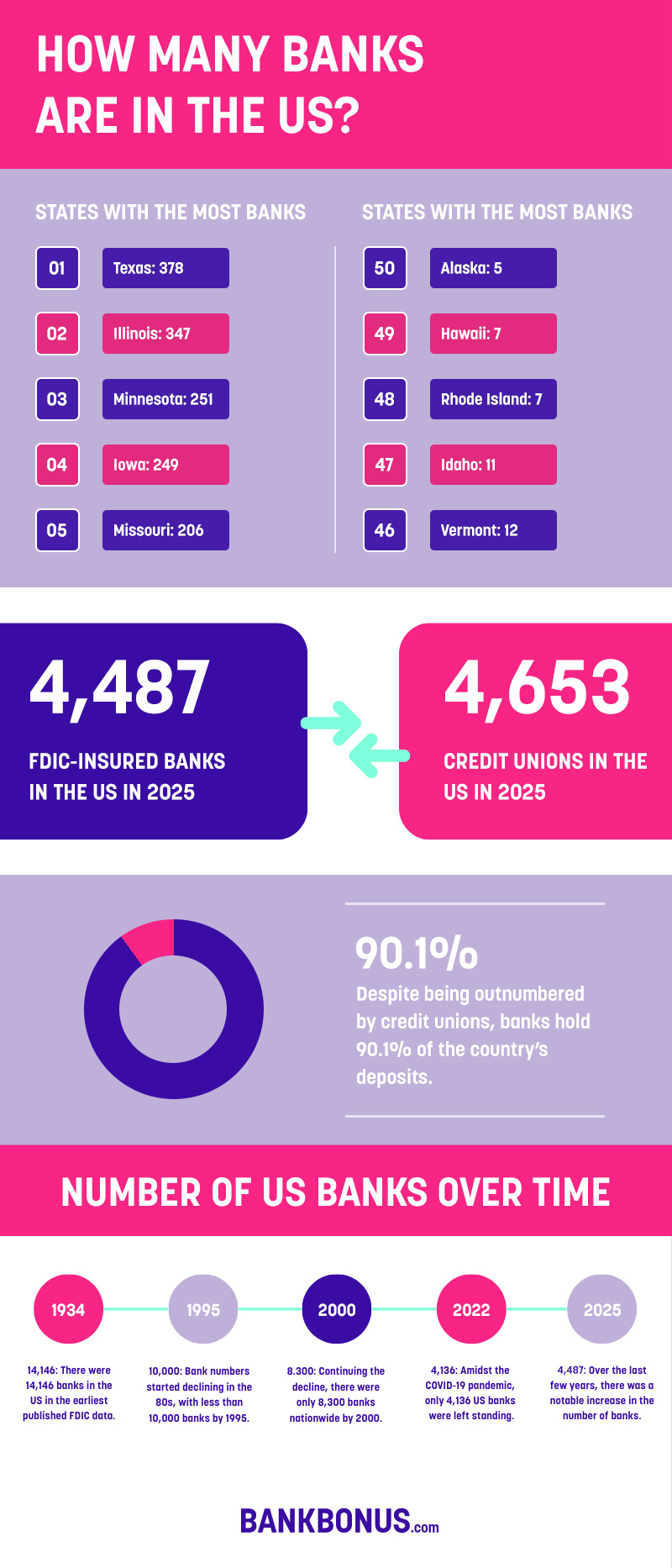
As of the most recent data from the Federal Deposit Insurance Corporation (FDIC), there are approximately 4,500 FDIC-insured commercial banks in the United States. When you include credit unions, which are insured by the National Credit Union Administration (NCUA), the number of depository institutions rises by another 4,600. While nearly 9,000 total institutions might seem like a vast number, it represents a significant decline from the mid-1980s, when the U.S. boasted more than 14,000 commercial banks alone.
The Current Statistics: Quantifying the U.S. Banking System
The raw number of banks in the U.S. is a moving target due to constant mergers, acquisitions, and the occasional bank failure. However, the downward trend is consistent. To understand where the industry stands today, we must categorize these institutions by their size, charter, and regulatory oversight.
FDIC-Insured Commercial Banks vs. Savings Institutions
The bulk of the U.S. banking system is composed of commercial banks. These range from small, locally owned “community banks” to international behemoths. As of 2024, the FDIC reports that the number of insured institutions continues to shrink at a rate of about 3% to 4% annually. This contraction isn’t necessarily a sign of a failing industry; rather, it is a sign of intense consolidation.
Savings institutions, often referred to as “thrifts” or savings and loan associations, represent a smaller segment of the market. These institutions traditionally focused on residential mortgage lending. While their numbers have also dwindled, they remain a vital part of the housing finance ecosystem in many regions.
The Role of Credit Unions
While they are not technically “banks” in the legal sense, credit unions perform nearly all the same functions for the average consumer. Credit unions are member-owned cooperatives. Because they are non-profit entities, they often provide higher interest rates on savings and lower rates on loans. There are currently about 4,600 federally insured credit unions in the U.S. serving over 135 million members. While the number of credit unions is also declining due to mergers, their total membership and asset base continue to grow, making them a formidable alternative to traditional commercial banking.
The Trend of Consolidation
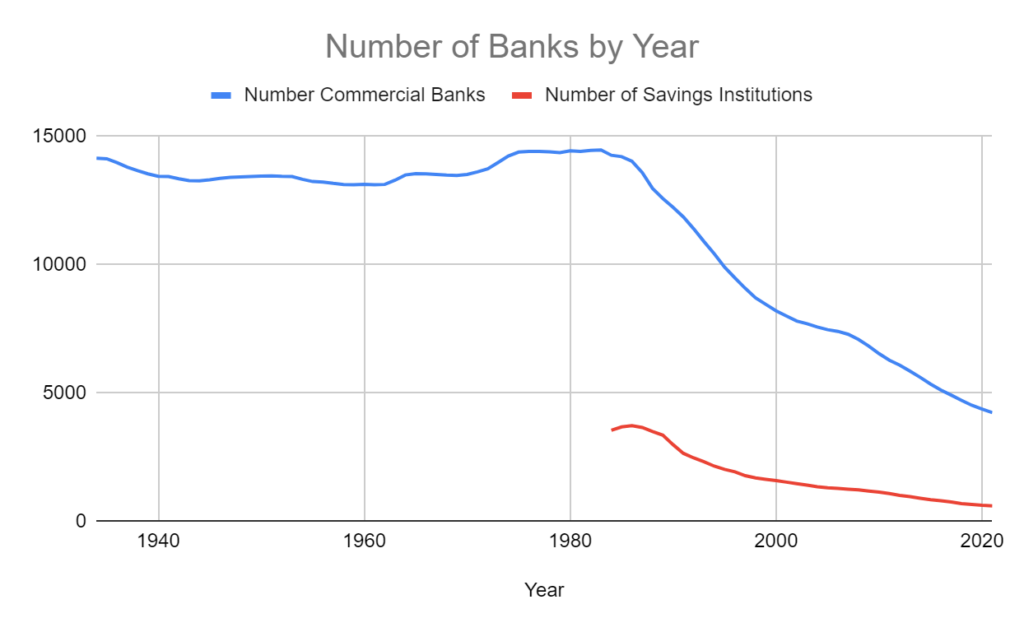
The most striking aspect of the U.S. banking count is its historical decline. In 1984, there were 14,496 banks. By 2004, that number had dropped to roughly 7,600. Today, we sit well below the 5,000 mark. This consolidation is driven by several factors: the repeal of interstate banking restrictions in the 1990s, the rising cost of regulatory compliance (particularly following the 2008 financial crisis and the Dodd-Frank Act), and the massive capital requirements needed to compete in the digital age.
Why the U.S. Has So Many Banks Compared to Other Nations
To an outside observer, the thousands of banks in the U.S. seem redundant. In Canada, the “Big Five” banks control the vast majority of the market. In the United Kingdom, a similarly small group of “High Street” banks dominates. The U.S. is an outlier, and the reasons are deeply rooted in American history and a cultural distrust of centralized financial power.
Historical Fragmentation and Unit Banking Laws
For much of the 19th and early 20th centuries, many states had “unit banking” laws. These regulations prevented banks from opening branches, often restricting a bank to a single physical location. The goal was to prevent large “money center” banks in New York or Chicago from draining capital out of rural communities. While these laws were eventually dismantled, they created a legacy of local, independent banks that became the backbone of small-town America.
Community Banking as a Pillar of Local Economies
Community banks—defined generally as institutions with less than $10 billion in assets—still make up the vast majority of the bank count in the U.S. Even though they hold a small fraction of the total assets in the system, they provide a disproportionate amount of credit to small businesses and the agricultural sector. Because these banks rely on “relationship banking” rather than standardized credit scores alone, they are often the only source of financing for entrepreneurs who don’t fit the rigid criteria of larger national banks.
The Dual Banking System
The U.S. operates under a “dual banking system,” meaning banks can be chartered at either the state or federal level. This creates a competitive environment among regulators and allows for a diversity of banking models. This dual structure has historically encouraged the entry of new banks into the market, though the “de novo” (new bank) rate has slowed significantly since 2008.
The Hierarchy of the American Financial System
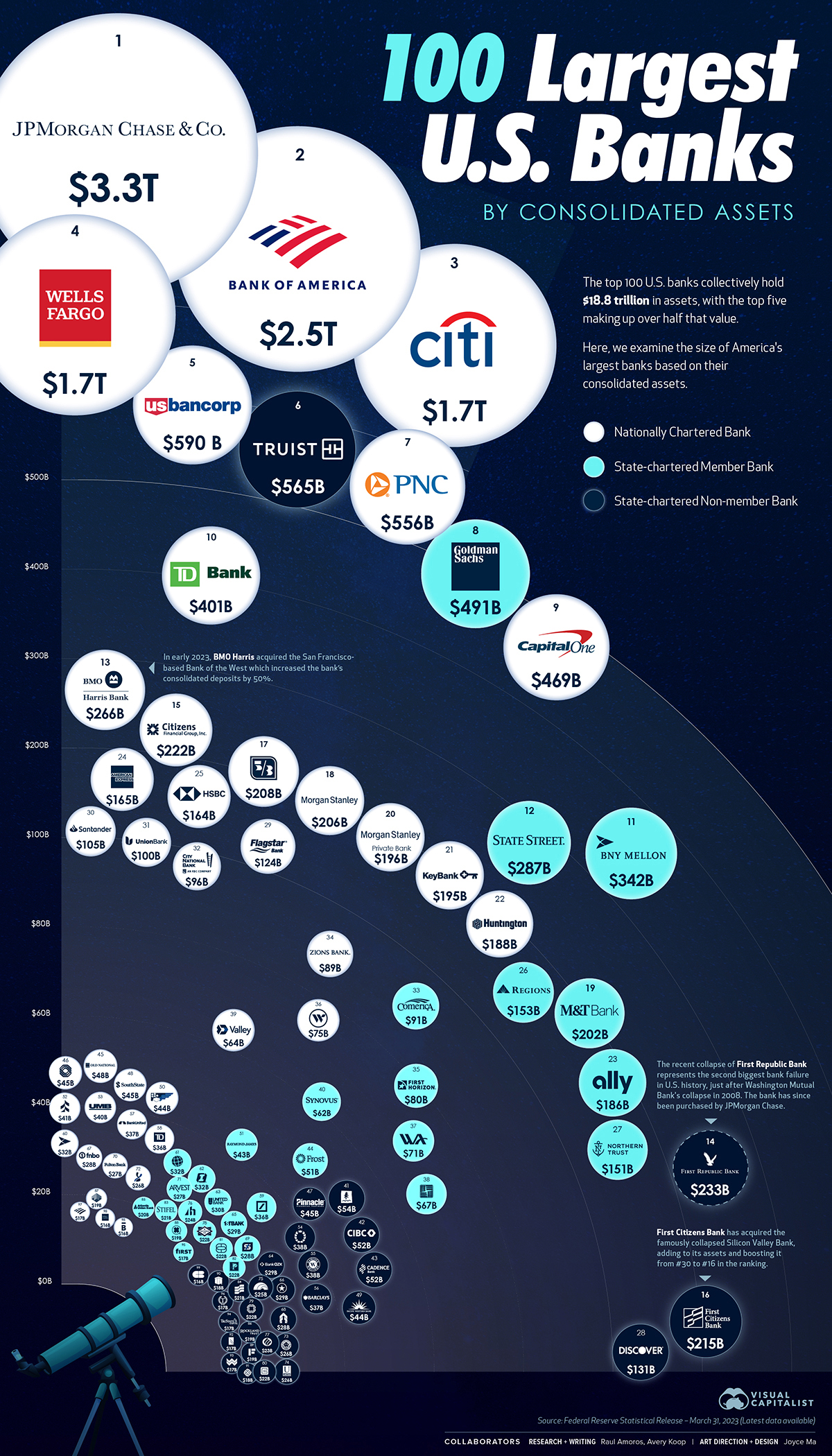
While there are thousands of banks, the distribution of wealth within the system is extremely top-heavy. The U.S. banking landscape is best described as a pyramid: a massive base of small banks supporting a tiny peak of gargantuan institutions.
The “Big Four” and SIFIs
At the top of the pyramid sit the “Big Four”: JPMorgan Chase, Bank of America, Citigroup, and Wells Fargo. These four institutions alone hold nearly 40% of all U.S. customer deposits. These are categorized as Systemically Important Financial Institutions (SIFIs), or more colloquially, “Too Big to Fail.” Their operations are global, and their health is considered essential to the stability of the global economy.
Regional Banks and Their Current Challenges
Below the giants are the regional banks, such as PNC, U.S. Bank, and Truist. These institutions serve multi-state areas and often have hundreds of billions in assets. However, this sector has faced significant scrutiny recently. The collapse of Silicon Valley Bank and Signature Bank in 2023 highlighted the unique risks regional banks face—specifically, the sensitivity of their deposit bases to rising interest rates and their heavy exposure to commercial real estate loans.
The Rise of Neobanks and Fintech Challengers
In the last decade, a new category has emerged: the Neobank. Entities like Chime, Current, and SoFi have gained millions of users by offering mobile-first experiences with no fees. It is important to note that many of these are “fintech companies” rather than chartered banks. They typically partner with a smaller, traditional bank (like Stride Bank or Celtic Bank) to hold the actual deposits. This “Banking-as-a-Service” (BaaS) model allows tech companies to offer financial services without the burden of a full banking charter, further complicating the answer to “how many banks” actually exist.
The Impact of Mergers and Acquisitions on the Number of Banks
The primary reason the number of U.S. banks decreases every year is not bank failure, but mergers and acquisitions (M&A). When two banks merge, the number of institutions drops by one, but the remaining entity often becomes more resilient.
Efficiency vs. Choice: The Trade-off for Consumers
Consolidation brings a mix of pros and cons for the average consumer. On the positive side, larger banks have the capital to invest in world-class mobile apps, robust cybersecurity, and extensive ATM networks. On the negative side, consolidation can lead to “banking deserts” in rural or low-income areas. When a local bank is bought by a national giant, the new owners may close less profitable branches, leaving residents without access to physical banking services.
Regulatory Hurdles and the “Too Big to Fail” Dilemma
Regulators are increasingly wary of further consolidation among the largest banks. The Department of Justice and the Federal Reserve have recently signaled a stricter approach to bank mergers, fearing that if the system becomes too concentrated, the failure of a single institution could trigger a systemic collapse. This regulatory environment creates a “middle-market squeeze,” where small banks are forced to merge to survive costs, but large banks are blocked from growing even larger.
Looking Ahead: The Future of the Number of Banks in the U.S.
The U.S. banking landscape is in the midst of its most significant transformation since the Great Depression. While the number of physical banks is likely to continue its downward trend, the way Americans interact with their money is becoming more diversified.
Digital Transformation and Branch Closures
The “number of banks” is often conflated with the “number of bank branches.” While the number of bank charters is falling, the number of physical branches is falling even faster. As consumers move toward digital-first banking, the need for a physical location on every corner has evaporated. We are entering an era where the “bank” is an icon on a smartphone rather than a marble building downtown.
Will the Downward Trend Continue?
Most industry analysts predict that the number of U.S. banks will eventually stabilize somewhere between 2,500 and 3,000. While this is a far cry from the 14,000 of the past, it would still leave the U.S. with one of the most diverse and decentralized banking systems in the world. The survival of the community bank model will depend on their ability to adopt new technologies while maintaining the personalized service that big banks cannot replicate.
In conclusion, while there are roughly 4,500 banks in the U.S. today, the “Money” sector is far from stagnant. The ongoing consolidation reflects a maturing industry adapting to the demands of a globalized, digital economy. For the consumer, the sheer number of banks matters less than the health, accessibility, and competitive nature of the institutions that remain. Whether you bank with a trillion-dollar giant or a ten-million-dollar local credit union, you are participating in a uniquely American financial ecosystem that continues to evolve at a rapid pace.
aViewFromTheCave is a participant in the Amazon Services LLC Associates Program, an affiliate advertising program designed to provide a means for sites to earn advertising fees by advertising and linking to Amazon.com. Amazon, the Amazon logo, AmazonSupply, and the AmazonSupply logo are trademarks of Amazon.com, Inc. or its affiliates. As an Amazon Associate we earn affiliate commissions from qualifying purchases.