
Navigating the ecosystem of premium credit cards can often feel like solving a complex mathematical equation. For many savvy consumers and business owners, the ultimate goal is to understand exactly how many American Express (Amex) points per dollar can be earned and how to optimize that earning potential. American Express Membership Rewards is widely considered one of the most valuable flexible currency programs in the world of personal finance, but the rate at which you accumulate these points varies wildly depending on the card in your wallet, the category of your spend, and your overall financial strategy.
Understanding the “points per dollar” metric is the first step in moving from a casual card user to a high-volume points earner. Whether you are aiming for a first-class international flight or looking to offset business expenses, mastering the earning structure of American Express is essential.
Understanding the Base Earning Structure of American Express
The foundation of the American Express Membership Rewards program is the “1x” baseline. On nearly every American Express card that participates in the rewards program, the default earning rate is 1 point for every $1 spent on eligible purchases. However, in the modern landscape of competitive financial products, earning only one point per dollar is often seen as the floor rather than the goal.
The Standard 1x Point Baseline and Non-Category Spend
For most “un-bonused” categories—think utility bills, medical expenses, or various professional services—you will typically earn 1 point per dollar. While this may seem low, these points add up over time. However, financial experts often suggest that if you are only earning 1x on a significant portion of your spend, you may be leaving money on the table. The goal of a sophisticated points strategy is to ensure that as little spending as possible falls into this 1x bucket.
Category Multipliers: Groceries, Dining, and Travel
The real power of American Express lies in its category multipliers. Amex has designed its card portfolio to reward specific lifestyle and business behaviors. Depending on the card you hold, you can earn anywhere from 2x to 5x points per dollar. These multipliers are usually applied to “high-velocity” spending categories—areas where the average consumer or business spends the most money. Common multipliers include:
-
Dining and Restaurants: Often rewarded at 4x points per dollar.
-
U.S. Supermarkets: Frequently capped at a certain annual limit but offering up to 4x points.
-
Airfare and Hotels: The hallmark of premium travel cards, often reaching 5x points.
-
Transit and Gas: Usually earning between 2x and 3x points.
By aligning your spending with these specific categories, you effectively quadruple or quintuple the return on your investment compared to a standard 1x card.
Analyzing the Top Amex Cards for Point Accumulation
To answer the question of “how many points per dollar” accurately, one must look at specific products. American Express does not have a “one size fits all” policy; instead, they offer a ladder of products tailored to different spending profiles.
The American Express Gold Card: The Foodie’s Choice
The American Express Gold Card is often cited as the “workhorse” of the Membership Rewards ecosystem. For the average American household, the largest monthly expenses outside of housing are typically food-related. The Gold Card addresses this by offering 4x points per dollar at U.S. supermarkets (on up to $25,000 in purchases per calendar year) and 4x points per dollar on dining at restaurants worldwide.
If a household spends $1,000 a month on groceries and $500 a month on dining, they are earning 6,000 points per month, or 72,000 points per year, just from food. At a conservative valuation of 2 cents per point, that represents $1,440 in value annually, far outweighing the card’s annual fee.
The Platinum Card: The Luxury Travel Powerhouse
While the Gold Card wins on daily spending, The Platinum Card® from American Express is the king of travel rewards. It offers a staggering 5x points per dollar on flights booked directly with airlines or via American Express Travel (on up to $500,000 on these purchases per calendar year). It also offers 5x points on prepaid hotels booked through the Amex Travel portal.
For frequent flyers or business consultants who spend $20,000 a year on airfare, the Platinum Card generates 100,000 Membership Rewards points. This “5x” rate is one of the highest consistent earning rates in the entire credit card industry, making it the premier choice for high-end travel spend.
The Blue Business Plus: The “Everything Else” Solution
In the quest to avoid the 1x “trap,” the Blue Business Plus® Credit Card from American Express is a vital tool. This card earns 2x points per dollar on all eligible business purchases up to $50,000 per year, with 1x thereafter. For a small business owner, this card ensures that even “boring” expenses like office supplies, insurance premiums, or legal fees earn double the standard rate. It serves as the perfect safety net for any spend that doesn’t fit into the Gold or Platinum’s 4x or 5x categories.
Business vs. Personal: Which Strategy Earns More?
The distinction between personal and business cards is crucial for maximizing points per dollar. American Express offers a robust suite of business cards that often have different spending caps and bonus categories than their personal counterparts.
Business Gold and Platinum Point Structures
The American Express® Business Gold Card utilizes a unique “flexible” multiplier system. It earns 4x points per dollar on the two categories where your business spends the most each billing cycle from a specific list (up to $150,000 in combined purchases annually). These categories include things like U.S. online advertising, U.S. shipping, and U.S. computer hardware/software providers.
This automated optimization is a significant advantage for businesses whose spending fluctuates. One month you might spend heavily on marketing, and the next on shipping; the card adjusts to ensure you are always earning the maximum 4x points per dollar on your top expenses.
Optimizing Business Spending for High-Volume Rewards
For businesses with high overhead, the strategy shifts from “where can I earn the most?” to “how can I stay within the bonus caps?” Since many Amex cards have annual limits on their 4x or 5x categories (like the $150,000 limit on the Business Gold), large enterprises often juggle multiple card accounts or “player two” strategies (utilizing a spouse’s or partner’s card) to ensure that every dollar spent continues to earn more than the 1x baseline.
Advanced Strategies to Boost Points Beyond the Standard Spend
If you only look at the “points per dollar” printed on the box, you are missing half the story. American Express provides several “hidden” ways to accelerate point accumulation that can push your effective earning rate well into the double digits.
Amex Offers and Merchant-Specific Bonuses
Within the American Express app or online portal, cardmembers have access to “Amex Offers.” These are targeted promotions that provide either statement credits or, more lucratively, bonus points for spending at specific retailers. For example, an offer might provide “5 extra points per dollar” at a specific technology retailer. If you use your Blue Business Plus card (which already earns 2x) for this offer, you are suddenly earning 7x points per dollar on that transaction.
The Power of Referral Bonuses and Welcome Offers
The fastest way to increase your “points per dollar” average is through sign-up bonuses (welcome offers) and referrals. If you spend $6,000 to earn a 100,000-point welcome offer, your effective earning rate for those $6,000 is over 16 points per dollar. Similarly, American Express has a very generous referral program. Referring a friend or colleague can often net you between 10,000 and 30,000 points. When these bonuses are factored into your annual totals, the math shifts dramatically in favor of the consumer.
Evaluating the Value: What Are Those Points Actually Worth?
The question of “how many points per dollar” is only relevant if you know what those points can buy. In the world of personal finance, not all points are created equal.
Transfer Partners and High-Value Redemptions
The true value of American Express points is unlocked through their transfer partners. Amex points can be transferred to over 20 airline and hotel partners, including Delta, British Airways, Air Canada (Aeroplan), and Hilton.
If you earn 5x points on a flight using your Platinum card and transfer those points to an airline partner for a business-class seat, you might achieve a redemption value of 3 or 4 cents per point. This means that for every dollar you spent on that original flight, you effectively received a 15% to 20% “return” in travel value. This is the “holy grail” of the points-per-dollar strategy.
Avoiding Low-Value “Pay with Points” Traps
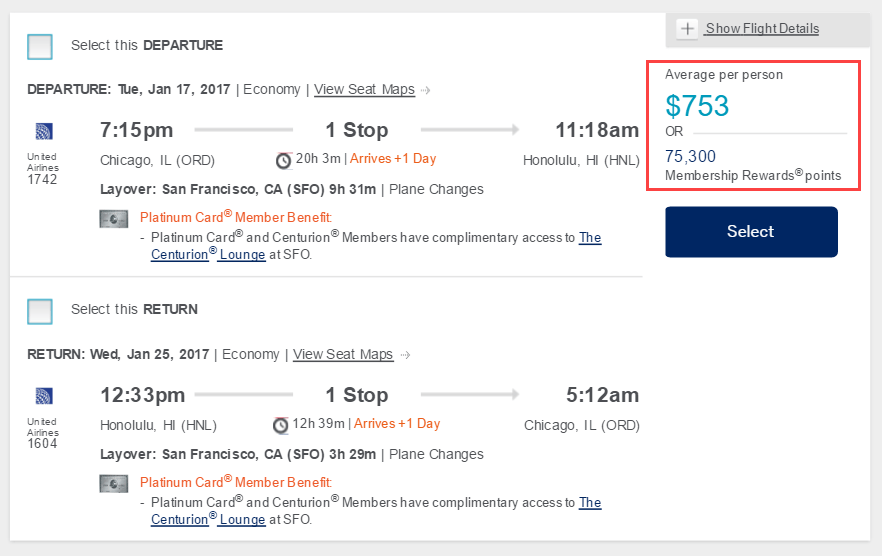
Conversely, using points for statement credits or “paying with points” at checkout (like on Amazon) typically yields a value of 0.6 to 0.7 cents per point. If you earn 1 point per dollar and redeem it at 0.6 cents, your return on spend is a dismal 0.6%. In this scenario, you would have been better off using a basic 1.5% or 2% cash-back card. To make the American Express ecosystem work for your finances, you must focus on high-value redemptions that justify the effort of tracking category multipliers.
By strategically choosing cards like the Gold, Platinum, and Blue Business Plus, and leveraging Amex Offers and transfer partners, you can transform a standard spending habit into a powerful financial engine. The goal isn’t just to earn “a point,” but to ensure every dollar spent is working as hard as possible toward your next financial or travel milestone.
aViewFromTheCave is a participant in the Amazon Services LLC Associates Program, an affiliate advertising program designed to provide a means for sites to earn advertising fees by advertising and linking to Amazon.com. Amazon, the Amazon logo, AmazonSupply, and the AmazonSupply logo are trademarks of Amazon.com, Inc. or its affiliates. As an Amazon Associate we earn affiliate commissions from qualifying purchases.