
To understand the scale of a global behemoth like Amazon (AMZN), one must look beyond its sprawling logistics network and dominant cloud computing division. For the individual investor or the institutional fund manager, the most granular way to evaluate the company is through its share count. The number of shares outstanding is not a static figure; it is a dynamic element of corporate finance that dictates everything from earnings per share (EPS) to the accessibility of the stock for retail traders.
As of the most recent fiscal filings, Amazon has approximately 10.41 billion shares outstanding. However, this number is the result of decades of strategic financial engineering, stock splits, and compensation structures. To truly grasp what this number means for your portfolio, it is necessary to dive into the mechanics of Amazon’s capital structure, its history of splits, and how ownership is distributed across the market.

The Current State of Amazon’s Outstanding Shares
The term “shares outstanding” refers to the total number of shares currently held by all shareholders, including restricted shares held by company insiders and institutional investors, as well as those held by the public. When you see a figure near 10.4 billion, you are looking at the total pie that has been sliced to represent ownership in Amazon.com, Inc.
Shares Outstanding vs. Public Float
While the total shares outstanding sit above 10 billion, an investor should also be aware of the “public float.” The float represents the portion of shares that are actually available for trading by the public. This excludes “locked-in” shares held by insiders or founders like Jeff Bezos.
For a company as massive as Amazon, the float is exceptionally large, ensuring high liquidity. High liquidity is a boon for investors because it means they can enter or exit a position—even a multi-million dollar one—without significantly moving the stock price. In Amazon’s case, the difference between total shares and the float is relatively narrow compared to younger tech companies, reflecting its maturity as a public entity.
The Role of Authorized Shares
Behind the shares outstanding is a much larger number: authorized shares. These are the maximum number of shares Amazon is legally allowed to issue according to its corporate charter. The company typically keeps a large buffer of authorized but unissued shares. This gives the board of directors the flexibility to raise capital, fund acquisitions, or issue employee stock options without needing immediate shareholder approval for a charter amendment. For Amazon, this flexibility has been crucial in its transition from an online bookseller to a diversified tech and logistics giant.
The 2022 20-for-1 Split: A Turning Point in Liquidity
For many years, Amazon’s share count was significantly lower—hovering around 500 million. However, the price per share had climbed to over $3,000, making it difficult for retail investors with limited capital to purchase a single full share. This changed dramatically in June 2022, when Amazon executed a 20-for-1 stock split.
How the Split Changed the Numbers
A stock split does not change the fundamental value of the company; it is akin to cutting a pizza into more slices. Before the 2022 split, if you owned one share worth $2,500, you suddenly owned 20 shares worth $125 each. Consequently, the total number of shares outstanding jumped from approximately 500 million to over 10 billion overnight.
The primary objective of this move was accessibility. By lowering the psychological and financial barrier to entry, Amazon invited a new wave of retail participation. It also made it easier for the company to manage its employee compensation packages, as stock-based compensation is a primary tool for attracting top-tier engineering talent in the tech sector.
Historical Context: The 1990s Splits
The 2022 split was not Amazon’s first. During the late 1990s dot-com boom, Amazon was frequent in its split activity to keep up with its rapidly ascending stock price:
-
June 1998: 2-for-1 split
-
January 1999: 3-for-1 split
-
September 1999: 2-for-1 split
Following the 1999 split, the company abstained from splits for over two decades. This period of “split-abstinence” allowed the share price to grow into the thousands, eventually necessitating the massive 20-for-1 correction to bring the share count to its current 10-billion-plus level.
Ownership Dynamics: Institutions, Insiders, and Retail
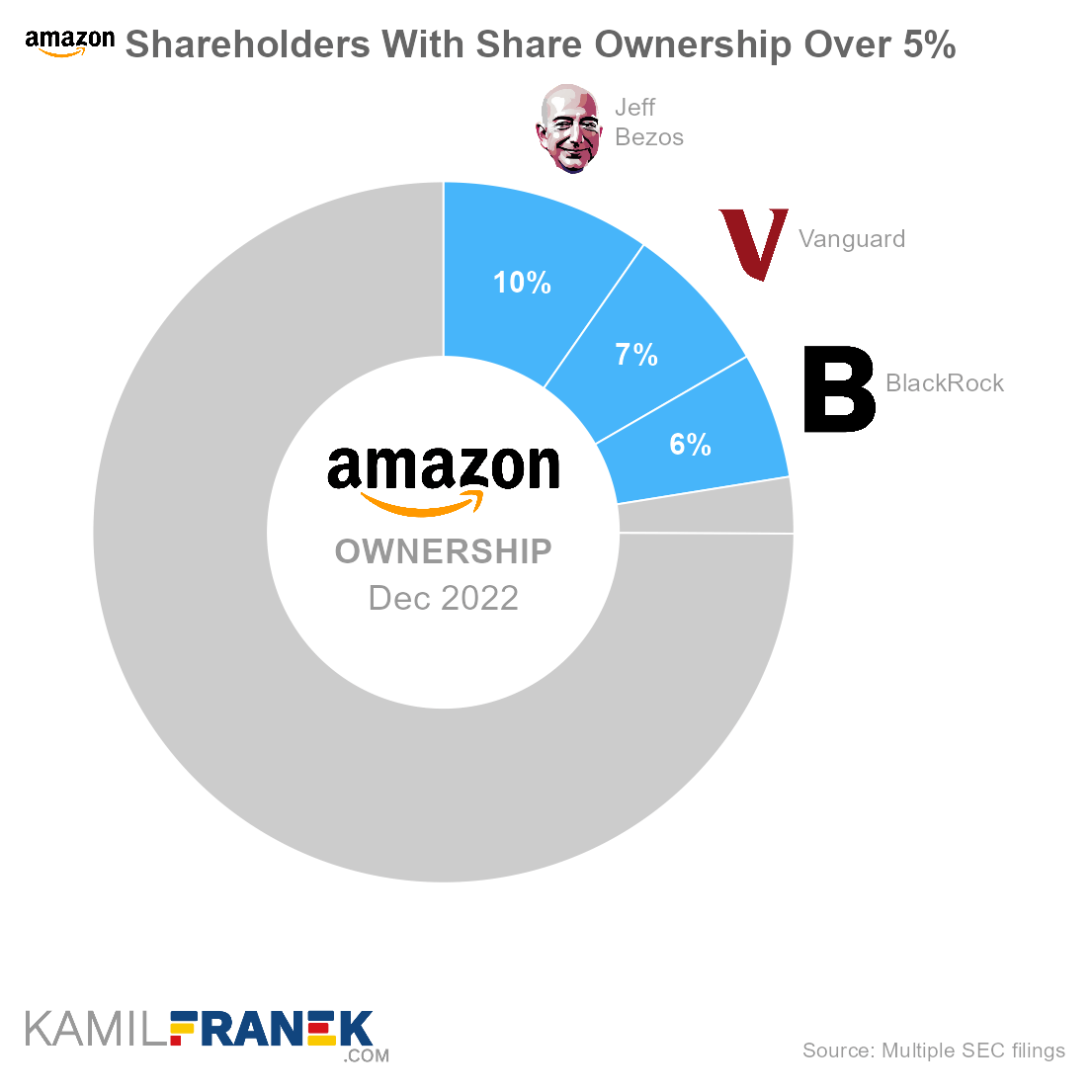
Knowing how many shares exist is only half the battle; the other half is knowing who holds them. The distribution of these 10.4 billion shares tells a story of institutional confidence and founder legacy.
The Role of Institutional Heavyweights
Amazon is one of the most widely held stocks in the world. Because it is a core component of the S&P 500 and the Nasdaq-100, almost every major mutual fund and ETF owns a piece of the company.
Institutional investors—such as Vanguard, BlackRock, and State Street—collectively own more than 60% of Amazon’s outstanding shares. This high level of institutional ownership provides a certain level of price stability. These large entities tend to have longer time horizons and do not trade based on daily emotional volatility. When you buy a share of a total market index fund, you are effectively joining these giants in holding a portion of the 10.4 billion AMZN shares.
Insider Ownership and Governance
Jeff Bezos, the founder and former CEO, remains one of the largest individual shareholders. Despite selling billions of dollars worth of stock over the years to fund ventures like Blue Origin or for philanthropic purposes, his remaining stake still represents a significant percentage of the total share count.
Insider ownership is a double-edged sword in financial analysis. On one hand, high insider ownership suggests that the leadership’s interests are aligned with those of the shareholders. On the other hand, a founder with a massive share count can exert significant control over the company’s direction. In Amazon’s case, the transition to Andy Jassy as CEO has been smooth, but the shadow of the share count held by insiders remains a key factor in the company’s governance profile.
Why Share Count is Critical for Valuation and EPS
For an investor, the total number of shares is the denominator in the most important equation in finance: Earnings Per Share (EPS).
The Mechanics of Dilution
When Amazon issues new shares to reward employees—a practice known as Stock-Based Compensation (SBC)—the total number of shares outstanding increases. This is known as dilution. If the company’s net income stays the same but the share count increases, each individual share is worth a smaller piece of the profit.
In the tech industry, SBC is a standard way to preserve cash while incentivizing staff. However, savvy investors monitor the 10.4 billion figure closely to see how fast it is growing. If the share count grows faster than the company’s revenue or net income, the value for existing shareholders may be eroded. Amazon has historically been aggressive with its growth, often prioritizing reinvestment over immediate share price defense, making the share count a vital metric for tracking long-term value.
Share Buyback Programs as a Value Driver
To counteract dilution, companies often engage in share buybacks. When Amazon uses its excess cash to buy its own shares off the open market, it “retires” those shares, effectively reducing the total shares outstanding.
A lower share count means that the remaining shareholders own a larger percentage of the company. While Amazon was not historically known for massive buybacks—preferring instead to build new warehouses or satellite arrays—the company has increasingly authorized buyback programs as it has matured and generated massive free cash flow. In 2022, alongside the stock split, the board authorized a $10 billion share repurchase program. While $10 billion sounds enormous, against a market cap in the trillions, it is a measured approach to managing the share count.

Navigating AMZN Shares as a Modern Investor
With over 10 billion shares in circulation, Amazon is a liquid, accessible, and heavily scrutinized security. For the personal finance enthusiast, the sheer number of shares means that even a modest investment of $100 or $500 now buys a meaningful “whole number” of shares, rather than a tiny fraction.
Understanding the share count is also essential for calculating the Market Capitalization. By multiplying the current stock price by the 10.41 billion shares outstanding, you arrive at the total market value of the company. This helps investors compare Amazon to other “Magnificent Seven” peers like Apple, Microsoft, or Alphabet, all of which have share counts in the billions.
As Amazon continues to evolve, its share count will likely continue to shift through employee grants and potential future buybacks. For those looking to build wealth through AMZN, staying informed about these shifts is not just about counting numbers—it is about understanding the underlying value of your slice of the world’s most dominant retail and cloud empire. Whether the count is 500 million or 10 billion, the focus remains on the company’s ability to generate value per share, ensuring that every piece of the pie continues to grow in worth.
aViewFromTheCave is a participant in the Amazon Services LLC Associates Program, an affiliate advertising program designed to provide a means for sites to earn advertising fees by advertising and linking to Amazon.com. Amazon, the Amazon logo, AmazonSupply, and the AmazonSupply logo are trademarks of Amazon.com, Inc. or its affiliates. As an Amazon Associate we earn affiliate commissions from qualifying purchases.