
Understanding how your Social Security benefits are calculated is a crucial piece of financial literacy for every American. Far from being a simple, flat payout, your monthly Social Security check is the culmination of decades of work, earnings, and carefully calibrated formulas designed to provide a safety net in retirement, disability, or for survivors. This intricate system, managed by the Social Security Administration (SSA), aims to replace a portion of pre-retirement income, but the exact amount an individual receives is subject to a complex interplay of factors, primarily your earnings history and the age at which you choose to claim benefits. Delving into the mechanics of this determination is not just an academic exercise; it’s an essential step in planning your financial future and maximizing the benefits you’ve earned.
The Foundational Principles of Social Security Benefits
Before dissecting the calculation itself, it’s vital to grasp the fundamental concepts underpinning the Social Security program. Established in 1935, its core mission has evolved but remains steadfast in its goal to provide economic security.
What is Social Security?
Social Security is a federal insurance program primarily funded through payroll taxes (FICA taxes). It provides benefits to retirees, disabled people, and survivors of deceased workers. It’s not a savings account in the traditional sense, but rather a pay-as-you-go system where today’s workers pay for today’s beneficiaries, with any surplus invested in special government bonds. The system is designed to provide a basic level of income replacement, especially for those with lower lifetime earnings, while still reflecting the contributions of higher earners.
The Program’s Core Objectives
The Social Security program operates on several key objectives. Firstly, it aims to provide income replacement, ensuring that individuals aren’t left without a financial safety net in their later years. Secondly, it incorporates a degree of progressivity, meaning it replaces a higher percentage of pre-retirement earnings for lower-income workers than for higher-income workers. This progressive structure is built into the benefit calculation formula itself. Thirdly, it serves as a form of social insurance, offering protection not just for retirees but also for families facing disability or the loss of a primary wage earner. Understanding these objectives helps illuminate why the determination process is structured the way it is.
Key Factors Influencing Your Social Security Benefit Amount
While the calculation can seem daunting, it boils down to a few critical pieces of information that the SSA uses to construct your benefit amount. Your financial life from your first job to your last contributes to this final figure.
Your Earnings Record: The Cornerstone
The most significant factor in determining your Social Security benefits is your lifetime earnings record. The SSA tracks all earnings on which you paid Social Security taxes throughout your working life. Each year, up to a certain maximum amount (the “taxable maximum”), your earnings are recorded. These earnings form the basis of what’s called your Primary Insurance Amount (PIA), which is your full retirement benefit. The more you earn and contribute to Social Security through FICA taxes, generally, the higher your eventual benefits will be, up to the maximum benefit level. It’s crucial to regularly check your Social Security statement (available online via your “my Social Security” account) to ensure your earnings record is accurate. Errors can lead to a reduced benefit, so addressing them promptly is vital.
The 35-Year Rule
When calculating your benefits, the SSA doesn’t just look at every year you worked. Instead, it focuses on your 35 highest-earning years. If you have worked for more than 35 years, your lowest-earning years will be dropped from the calculation. If you have worked fewer than 35 years, the SSA will fill in the missing years with zeros, which can significantly reduce your average earnings and, consequently, your benefit amount. This “35-year rule” strongly incentivizes longer careers and makes clear the financial impact of taking extended periods out of the workforce, even for high earners. For instance, a person who worked for 30 years at a high salary but has five years of zero earnings will have their average significantly pulled down compared to someone who worked 35 years at the same salary.
Indexed Earnings for Fairness
Simply taking your raw earnings from decades ago wouldn’t be fair due to inflation and changes in general wage levels. To account for this, the SSA indexes your past earnings. This process adjusts your earnings from previous years to reflect the change in average wages since the year the earnings were received. For example, earnings from 1980 will be converted to approximate what they would be worth in a more recent year (typically two years before you become eligible for benefits) by multiplying them by an “indexing factor.” This ensures that your past contributions are valued in terms of current dollar purchasing power, providing a more accurate and equitable representation of your lifetime contributions relative to today’s economic standards. Earnings after age 60 are generally not indexed because they are already relatively current.
Understanding the Calculation Formula
With your indexed earnings in hand, the SSA moves on to a more complex formula to determine your Primary Insurance Amount (PIA). This is the monthly benefit you would receive if you start collecting benefits exactly at your Full Retirement Age (FRA).
Average Indexed Monthly Earnings (AIME)
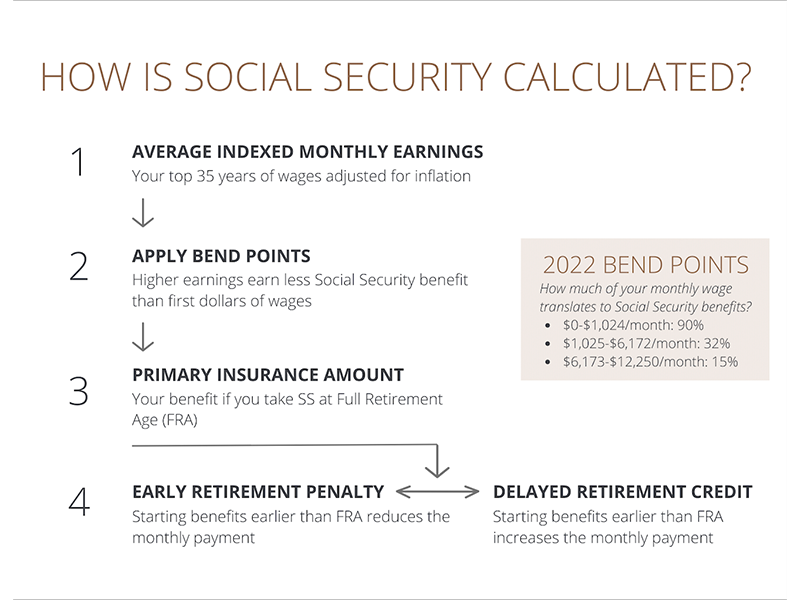
The first step in calculating your PIA is to determine your Average Indexed Monthly Earnings (AIME). This is derived from your 35 highest indexed earning years. The SSA totals your indexed earnings from these 35 years and then divides that total by the number of months in 35 years (420 months). The result is your AIME, which provides a normalized monthly average of your career earnings after inflation adjustments. The AIME is a crucial intermediate step, serving as the foundation upon which the progressive benefit formula is applied. It represents your average monthly “covered” earnings adjusted for the changing value of money over time.
Bend Points and Primary Insurance Amount (PIA)
Once your AIME is calculated, the SSA applies a progressive formula using “bend points” to determine your Primary Insurance Amount (PIA). Bend points are specific dollar amounts in the AIME formula that separate different tiers of benefit calculation. For benefits becoming payable in a given year, a certain percentage of your AIME up to the first bend point is included, then a smaller percentage of your AIME between the first and second bend points, and an even smaller percentage of your AIME above the second bend point.
For example, for someone becoming eligible for benefits in 2024:
- 90% of the first $1,174 of your AIME, plus
- 32% of your AIME over $1,174 up to $7,078, plus
- 15% of your AIME over $7,078.
This progressive structure ensures that lower-income workers receive a higher percentage of their average indexed earnings as benefits compared to higher-income workers, reflecting the program’s social adequacy goal. The sum of these three components is your PIA, which is the monthly benefit you are entitled to at your full retirement age. These bend points are adjusted annually based on the national average wage index.
An Illustrative Example
To clarify, imagine an individual whose AIME is $4,000 in 2024.
- They would get 90% of $1,174 = $1,056.60
- Then, for the amount between $1,174 and $7,078, which is ($4,000 – $1,174 = $2,826), they would get 32% of $2,826 = $904.32
- Since their AIME is not above $7,078, they get 0% of that tier.
- Their PIA would be $1,056.60 + $904.32 = $1,960.92 per month.
This example demonstrates how the progressive formula ensures that while higher earners receive more in absolute dollars, lower earners receive a larger proportion of their average indexed earnings back as benefits.
Impact of Claiming Age on Benefits
Your PIA is the benefit you receive at your Full Retirement Age (FRA). However, very few people claim their benefits precisely at their FRA. The age at which you choose to start receiving benefits has a profound and permanent impact on the monthly amount you receive.
Full Retirement Age (FRA) Defined
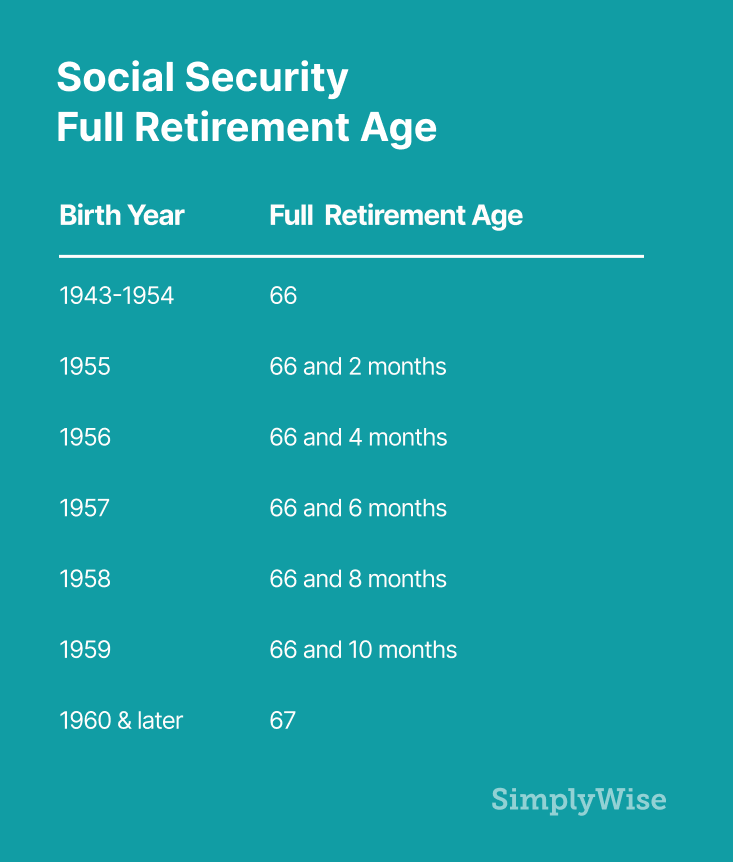
Your Full Retirement Age (FRA) is the age at which you are entitled to receive 100% of your Primary Insurance Amount (PIA). This age isn’t universal; it depends on your birth year. For those born between 1943 and 1954, FRA is 66. For those born in 1960 or later, FRA is 67. For birth years in between, it gradually increases from 66 to 67. Knowing your FRA is critical for retirement planning, as it serves as the benchmark for benefit adjustments. It’s the point where you get your “full” benefit, without reductions for early claiming or credits for delayed claiming.
Claiming Early: Reductions Explained
You can start receiving Social Security retirement benefits as early as age 62. However, if you claim benefits before your FRA, your monthly benefit will be permanently reduced. The reduction amount depends on how many months you are away from your FRA. The reduction is calculated in two tiers:
- For the first 36 months before your FRA, your benefit is reduced by 5/9 of 1% for each month.
- For any months beyond 36, the benefit is reduced by an additional 5/12 of 1% per month.
For someone with an FRA of 67, claiming at age 62 would result in a permanent reduction of approximately 30%. This significant reduction means that while you start receiving benefits sooner, your monthly income from Social Security will be considerably lower for the rest of your life. This trade-off is a critical decision point in retirement planning.
Delaying Benefits: The Power of Delayed Retirement Credits
Conversely, if you delay claiming your Social Security benefits past your FRA, you can earn Delayed Retirement Credits (DRCs). For each year you delay claiming benefits past your FRA, up to age 70, your monthly benefit increases by 8%. This means if your FRA is 67 and you delay claiming until age 70, you can increase your monthly benefit by 24% (3 years x 8% per year) compared to your PIA. These credits represent a powerful incentive for those who can afford to wait, offering a guaranteed, inflation-adjusted increase to your monthly income that can significantly enhance financial security in later retirement years. There is no further increase in benefits if you delay claiming past age 70.
Special Considerations and Other Benefit Types
While retirement benefits are the most commonly discussed, Social Security offers a broader range of protections. The determination principles extend, with modifications, to other critical benefit types.
Spousal and Survivor Benefits
Social Security isn’t just for primary workers; it also provides benefits for family members. A spouse can receive up to 50% of their working spouse’s PIA if they claim at their own FRA, provided their own earned benefit is less than that amount. If a spouse claims spousal benefits early, their benefit will also be reduced. Survivor benefits are paid to eligible widows, widowers, and children of a deceased worker. A surviving spouse can receive up to 100% of the deceased worker’s PIA, depending on their age and other factors. These benefits are also subject to claiming age rules and aim to prevent financial hardship for families after a worker’s death.
Disability Benefits (SSDI)
The Social Security Disability Insurance (SSDI) program provides benefits to workers who become disabled and are unable to engage in substantial gainful activity. To qualify, an individual must have worked long enough and recently enough under Social Security. The benefit amount for SSDI is generally equal to the worker’s full Primary Insurance Amount (PIA), essentially treating the onset of disability as if it were the full retirement age. The determination process for SSDI is rigorous, involving medical evaluations to confirm the severity and long-term nature of the disability.

Taxation of Social Security Benefits
Finally, it’s important to note that Social Security benefits can be subject to federal income tax, depending on your “provisional income.” Provisional income includes your adjusted gross income, tax-exempt interest, and one-half of your Social Security benefits.
- If your provisional income is between $25,000 and $34,000 for an individual (or $32,000 and $44,000 for a married couple filing jointly), up to 50% of your benefits may be taxable.
- If your provisional income exceeds $34,000 for an individual (or $44,000 for a married couple filing jointly), up to 85% of your benefits may be taxable.
Some states also tax Social Security benefits, adding another layer of complexity to the overall financial impact of these benefits.
In conclusion, the determination of Social Security benefits is a multifaceted process rooted in your earnings history, adjusted for inflation, and then progressively scaled based on income tiers. Your personal claiming strategy, specifically the age at which you begin receiving benefits, introduces the final and most significant variable that can either reduce or enhance your monthly payout. Understanding these mechanics empowers individuals to make informed decisions that can optimize their financial security for years to come.
aViewFromTheCave is a participant in the Amazon Services LLC Associates Program, an affiliate advertising program designed to provide a means for sites to earn advertising fees by advertising and linking to Amazon.com. Amazon, the Amazon logo, AmazonSupply, and the AmazonSupply logo are trademarks of Amazon.com, Inc. or its affiliates. As an Amazon Associate we earn affiliate commissions from qualifying purchases.