
Understanding how monthly interest is calculated is a cornerstone of sound personal finance, impacting everything from the cost of your mortgage to the growth of your savings. It’s a concept that, while seemingly straightforward, carries nuances that can significantly affect your financial trajectory. Whether you’re borrowing to buy a home, taking out a personal loan, or diligently saving for retirement, a clear grasp of interest mechanics empowers you to make informed decisions, minimize debt costs, and maximize investment returns. This comprehensive guide will demystify the process, breaking down the core principles, common scenarios, and practical implications of monthly interest calculations.
The Fundamentals of Interest Calculation
At its heart, interest is the cost of borrowing money or the return on an investment. It’s the rental fee you pay for using someone else’s capital, or the compensation you receive for lending your capital. While the core concept is simple, the methods by which it’s calculated can vary, leading to different outcomes.
Defining Interest: Simple vs. Compound
The first distinction to make is between simple and compound interest. This fundamental difference dictates how your money grows or how your debt accrues over time.
-
Simple Interest: Simple interest is calculated solely on the principal amount of a loan or deposit. It’s a fixed percentage of the original sum, and it doesn’t factor in any accumulated interest from previous periods. The formula for simple interest is:
-
Simple Interest = Principal (P) × Rate (R) × Time (T) -
Where P is the initial amount, R is the annual interest rate (as a decimal), and T is the time period in years. While simple to understand, simple interest is less common for long-term loans or savings accounts. It might be seen in some short-term loans or bonds. For monthly simple interest, you would divide the annual rate by 12 or use the time period in months as a fraction of a year (e.g., 1/12 for one month).
-
-
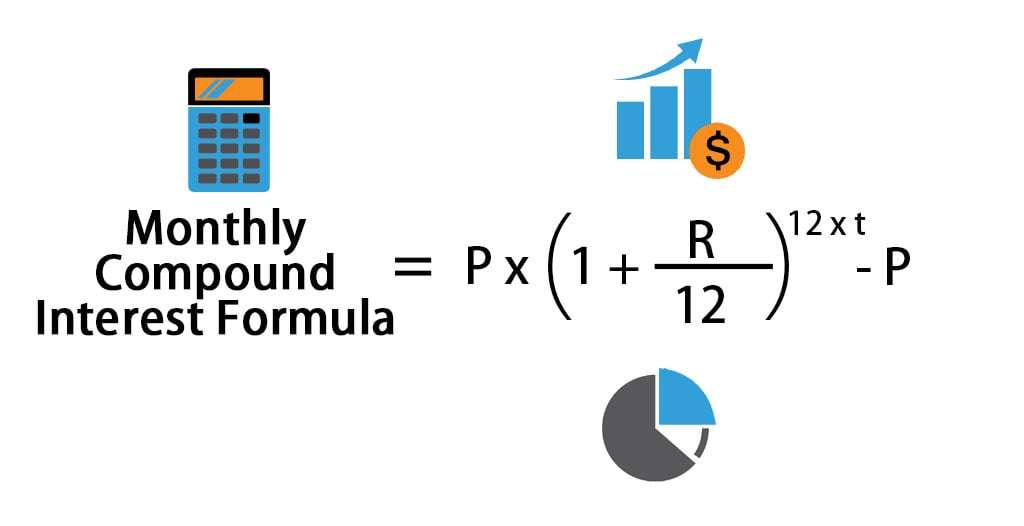
Compound Interest: Compound interest, often dubbed the “eighth wonder of the world” by Albert Einstein, is interest calculated on the initial principal and also on the accumulated interest from previous periods. This means your money earns interest on interest, leading to exponential growth for investments and a potentially faster increase in debt for loans. Most modern financial products, from savings accounts to mortgages and credit cards, utilize compound interest. The frequency of compounding (daily, monthly, quarterly, annually) plays a crucial role in the overall effect.
Key Variables in Interest Calculation
To calculate monthly interest accurately, several key variables must be considered. Understanding each of these components is vital for both borrowers and savers.
-
Principal Amount (P): This is the initial sum of money borrowed or invested. It’s the base upon which all interest calculations begin.
-
Interest Rate (R): This is the percentage charged or paid on the principal amount over a specific period, typically expressed annually.
-
Annual Percentage Rate (APR): This is the yearly cost of a loan, including any fees, expressed as a percentage. While it gives an annual rate, for monthly calculations, this rate will be divided by 12.
-
Effective Annual Rate (EAR) / Annual Percentage Yield (APY): For savings and investments, the APY (or EAR) accounts for the effect of compounding, showing the actual annual rate of return you’ll receive after all compounding is factored in. It’s often higher than the stated annual interest rate when compounding occurs more frequently than annually.
-
-
Time Period (T): This refers to the duration over which the interest is calculated. For monthly interest calculations, the annual rate is typically divided by 12 to arrive at a monthly rate, which is then applied each month.
-
Compounding Frequency: How often the accrued interest is added back to the principal. The more frequently interest is compounded (e.g., daily vs. monthly vs. annually), the greater its impact will be. For monthly interest, the interest is typically calculated and added to the principal each month.
Calculating Monthly Interest: Common Scenarios
While the underlying principles remain constant, the practical application of monthly interest calculations varies significantly depending on the financial product.
Loans and Mortgages (Amortization)
Mortgages and installment loans (like car loans or personal loans) are prime examples of financial products where monthly interest calculation is critical. These loans are typically amortized, meaning each monthly payment consists of both principal and interest, with the proportion changing over the life of the loan.
The general approach involves taking the annual interest rate (APR) and dividing it by 12 to get the monthly interest rate. This monthly rate is then applied to the outstanding principal balance for that month.
Let’s illustrate with a simple example:
Suppose you have a mortgage with an annual interest rate of 4.5% and an outstanding principal balance of $200,000.
-
Convert annual rate to monthly rate: 4.5% / 12 = 0.045 / 12 = 0.00375
-
Calculate monthly interest: $200,000 * 0.00375 = $750
So, for that particular month, $750 of your payment goes towards interest. The remainder of your monthly payment would then reduce your principal balance, which in turn means less interest accrues the following month. This is why early payments on a loan heavily favor interest, while later payments reduce principal more significantly.
Credit Cards and Revolving Debt
Credit card interest calculation is often more complex due to its revolving nature and the “average daily balance” method commonly used. Unlike a fixed-term loan, your principal balance on a credit card can fluctuate daily as you make purchases and payments.
Most credit card companies use the average daily balance (ADB) method to calculate interest. This involves:
-
Summing your daily balances for a billing cycle.
-
Dividing that sum by the number of days in the billing cycle to get the average daily balance.
-
Multiplying the average daily balance by your daily periodic rate (your APR divided by 365 or 360).
-
Multiplying that result by the number of days in the billing cycle to get the total interest for the month.
Example: If your credit card APR is 18%, your daily periodic rate is 0.18 / 365 = 0.000493. If your average daily balance for a 30-day billing cycle was $1,000, your interest for that month would be $1,000 * 0.000493 * 30 = $14.79.
Crucially, most credit cards offer a grace period, typically 21-25 days, during which no interest is charged on new purchases if you pay your entire statement balance by the due date. If you carry a balance from month to month, you lose this grace period, and interest starts accruing immediately on new purchases as well as the outstanding balance.
Savings Accounts and Investments
For savings accounts, certificates of deposit (CDs), and many investment vehicles, monthly interest calculation works in your favor. Banks usually pay compound interest, meaning your earned interest is added to your principal, and then the next month’s interest is calculated on the new, larger balance.
Example: You deposit $1,000 into a savings account with an annual interest rate of 2%, compounded monthly.
-
Monthly interest rate: 2% / 12 = 0.02 / 12 = 0.001667
-
Month 1 interest: $1,000 * 0.001667 = $1.67
-
New balance: $1,000 + $1.67 = $1,001.67
-
Month 2 interest: $1,001.67 * 0.001667 = $1.67 (slightly higher due to compounding)
This seemingly small difference quickly adds up over years, demonstrating the power of compound interest for long-term savings. The APY (Annual Percentage Yield) for a savings account shows the actual return after considering this monthly (or other frequency) compounding.
Practical Application: Step-by-Step Calculation Examples
Let’s walk through a few concrete examples to solidify your understanding.
Simple Monthly Interest Example
Imagine you take out a short-term personal loan of $5,000 at a 6% annual simple interest rate for 6 months.
-
Principal (P): $5,000
-
Annual Rate (R): 6% or 0.06
-
Time (T): 6 months or 0.5 years (6/12)

-
Calculate total simple interest for the loan term:
Interest = P * R * T = $5,000 * 0.06 * 0.5 = $150 -
Calculate monthly interest (if paid monthly):
Monthly Interest = Total Interest / Number of Months = $150 / 6 = $25
In this simple scenario, you would pay $25 in interest each month, in addition to a principal repayment portion.
Compound Monthly Interest Example (Savings Account)
You open a high-yield savings account with an initial deposit of $10,000 and an Annual Percentage Yield (APY) of 3%, compounded monthly. Let’s look at the first three months. Note: If given an APY, you need to convert it to a nominal annual rate compounded monthly for calculation, or simply apply the monthly equivalent factor. Often banks advertise an annual rate compounded monthly. Let’s assume a 3% annual rate compounded monthly.
-
Principal (P): $10,000
-
Annual Rate (R): 3% or 0.03
-
Monthly Rate: 0.03 / 12 = 0.0025
Month 1:
-
Interest = $10,000 * 0.0025 = $25.00 -
New Balance = $10,000 + $25.00 = $10,025.00
Month 2:
-
Interest = $10,025.00 * 0.0025 = $25.06 -
New Balance = $10,025.00 + $25.06 = $10,050.06
Month 3:
-
Interest = $10,050.06 * 0.0025 = $25.13 -
New Balance = $10,050.06 + $25.13 = $10,075.19
You can see how the principal grows, and consequently, the amount of interest earned each month also slightly increases.
Credit Card Interest Example
Let’s consider a credit card with an 20% APR. The billing cycle is 30 days. You start with a balance of $500. On day 10, you make a purchase of $200. On day 20, you make a payment of $100.
- Daily Periodic Rate: 0.20 / 365 = 0.0005479 (approx)
-
Calculate daily balances:
-
Days 1-9: Balance $500 (9 days)
-
Days 10-19: Balance $500 + $200 = $700 (10 days)
-
Days 20-30: Balance $700 – $100 = $600 (11 days)
-
-
Sum of daily balances:
($500 * 9) + ($700 * 10) + ($600 * 11) = $4,500 + $7,000 + $6,600 = $18,100
-
Average Daily Balance (ADB):
$18,100 / 30 days = $603.33
-
Monthly Interest Charge:
ADB * Daily Periodic Rate * Number of Days = $603.33 * 0.0005479 * 30 = $9.92(approx)
This example highlights why managing credit card balances is crucial. Even with relatively small balances, interest can quickly accumulate, especially without utilizing grace periods.
Factors Influencing Monthly Interest
Beyond the formulas, several external and internal factors dictate the monthly interest you pay or earn.
Market Rates and Economic Conditions
The broader economic environment significantly influences interest rates. Central banks, like the Federal Reserve in the U.S., set benchmark interest rates that influence what banks charge each other for overnight lending. These rates, in turn, filter down to consumer loan products and savings rates.
-
Inflation: When inflation is high, interest rates tend to rise as lenders demand higher compensation to offset the erosion of purchasing power.
-
Economic Growth: During periods of strong economic growth, demand for credit increases, which can also push rates higher. Conversely, during recessions, central banks often lower rates to stimulate borrowing and spending.
Lender Policies and Borrower Risk
Individual lenders have specific policies that determine the rates they offer. Furthermore, your personal financial profile plays a substantial role.
-
Credit Score: A higher credit score (indicating lower risk) typically qualifies you for lower interest rates on loans and credit cards. A lower score, conversely, often means higher rates to compensate the lender for the increased risk of default.
-
Loan Type: Secured loans (like mortgages or car loans, backed by collateral) generally have lower interest rates than unsecured loans (like personal loans or credit cards) because the collateral reduces the lender’s risk.
-
Down Payment: For large purchases like homes or cars, a larger down payment reduces the principal borrowed, which can lead to lower monthly interest payments over the life of the loan.
Compounding Frequency and Its Impact
The frequency at which interest is compounded is a critical factor, especially for long-term financial products.
-
Daily vs. Monthly vs. Annually: The more frequently interest is compounded, the faster your money grows (for savings) or your debt accumulates (for loans, though most loans quote an APR that includes fees, and effective interest is often calculated monthly on the outstanding balance).
- For example, an account with a 5% annual rate compounded daily will yield slightly more than an account with a 5% rate compounded monthly, which in turn yields more than one compounded annually. This is why APY (Annual Percentage Yield) for savings accounts is often slightly higher than the stated annual interest rate – it reflects the benefit of compounding.
Strategies for Managing Monthly Interest
Understanding how monthly interest is calculated is just the first step. The true power lies in using this knowledge to your financial advantage.
For Borrowers: Minimizing Interest Costs
If you’re taking on debt, strategize to minimize the amount of interest you pay over the life of the loan.
-
Pay More Than the Minimum: On amortized loans and credit cards, paying even a small amount extra each month can significantly reduce the total interest paid and shorten the loan term. This extra payment goes directly to reducing your principal, meaning less interest accrues in subsequent months.
-
Refinancing: If interest rates have dropped or your credit score has improved, refinancing a loan (especially a mortgage) to a lower rate can save you tens of thousands of dollars in interest over the long term.
-
Debt Consolidation: For high-interest debts like credit cards, consolidating them into a single loan with a lower interest rate can simplify payments and reduce overall interest costs. However, ensure the new loan doesn’t simply extend the repayment period, potentially costing more in the long run.
-
Improve Your Credit Score: A higher credit score translates to better interest rates. Regularly checking your credit report, paying bills on time, and keeping credit utilization low can improve your score.
For Savers & Investors: Maximizing Interest Earnings
For your hard-earned money, the goal is to leverage monthly interest calculations to your benefit.
-
Seek High-Yield Savings Accounts: While traditional savings accounts offer modest returns, online banks often provide higher interest rates (APRs/APYs) due to lower overhead costs.
-
Understand APY vs. APR: When comparing savings products, always look at the APY (Annual Percentage Yield) as it reflects the true annual return, taking compounding into account. For loans, APR (Annual Percentage Rate) gives you a better holistic view of the cost.
-
Leverage Long-Term Investing and Compounding Power: The longer your money is invested, the more time compounding has to work its magic. Even small, consistent contributions to retirement accounts or investment portfolios can grow substantially over decades thanks to the power of compounding. Starting early is one of the most effective strategies for wealth accumulation.

Conclusion
Monthly interest calculation is far from an abstract concept; it’s a dynamic force that directly impacts your financial health. By understanding the distinction between simple and compound interest, recognizing the key variables, and analyzing its application across different financial products, you equip yourself with the knowledge to navigate the complex world of personal finance. Whether you’re managing debt or growing your wealth, an insightful approach to monthly interest calculations is an essential tool for making informed decisions and building a secure financial future.
aViewFromTheCave is a participant in the Amazon Services LLC Associates Program, an affiliate advertising program designed to provide a means for sites to earn advertising fees by advertising and linking to Amazon.com. Amazon, the Amazon logo, AmazonSupply, and the AmazonSupply logo are trademarks of Amazon.com, Inc. or its affiliates. As an Amazon Associate we earn affiliate commissions from qualifying purchases.