
The advent of cryptocurrency has ushered in a transformative era in the global financial landscape, challenging conventional notions of currency, value, and investment. Far from being a mere digital novelty, cryptocurrencies represent a fundamental shift in how assets are created, distributed, and exchanged. At its core, understanding “how cryptocurrency is made” is not merely a technical inquiry but a crucial exploration into the economic mechanisms, incentive structures, and underlying principles that give these digital assets their value and shape their financial trajectories. This article delves into the various processes of cryptocurrency creation, examined through the lens of finance, investment, and market dynamics.

The Foundational Pillar: Proof-of-Work Mining
The most widely recognized method for creating new cryptocurrencies, particularly exemplified by Bitcoin, is Proof-of-Work (PoW) mining. This complex, energy-intensive process is more than just solving computational puzzles; it’s a carefully engineered system designed to establish digital scarcity, secure the network, and distribute new coins in a decentralized manner, mimicking the resource-intensive extraction of precious metals.
The Concept of Digital Scarcity and Value Creation
In the traditional financial world, central banks control the issuance of fiat currency, often leading to concerns about inflation and arbitrary supply increases. Cryptocurrencies, through PoW mining, introduce a novel approach to creating digital scarcity. The act of mining requires substantial computational effort and energy, making the creation of new units inherently costly. This cost, combined with pre-programmed supply limits (like Bitcoin’s 21 million coin cap), imbues newly minted cryptocurrencies with a perceived intrinsic value. It’s an economic design choice that contrasts sharply with the ease of creating infinite digital copies of other data, ensuring that each unit produced through mining represents a significant investment of resources, thereby contributing to its potential market worth and appeal as a store of value.
The Mechanics of Mining for Financial Reward
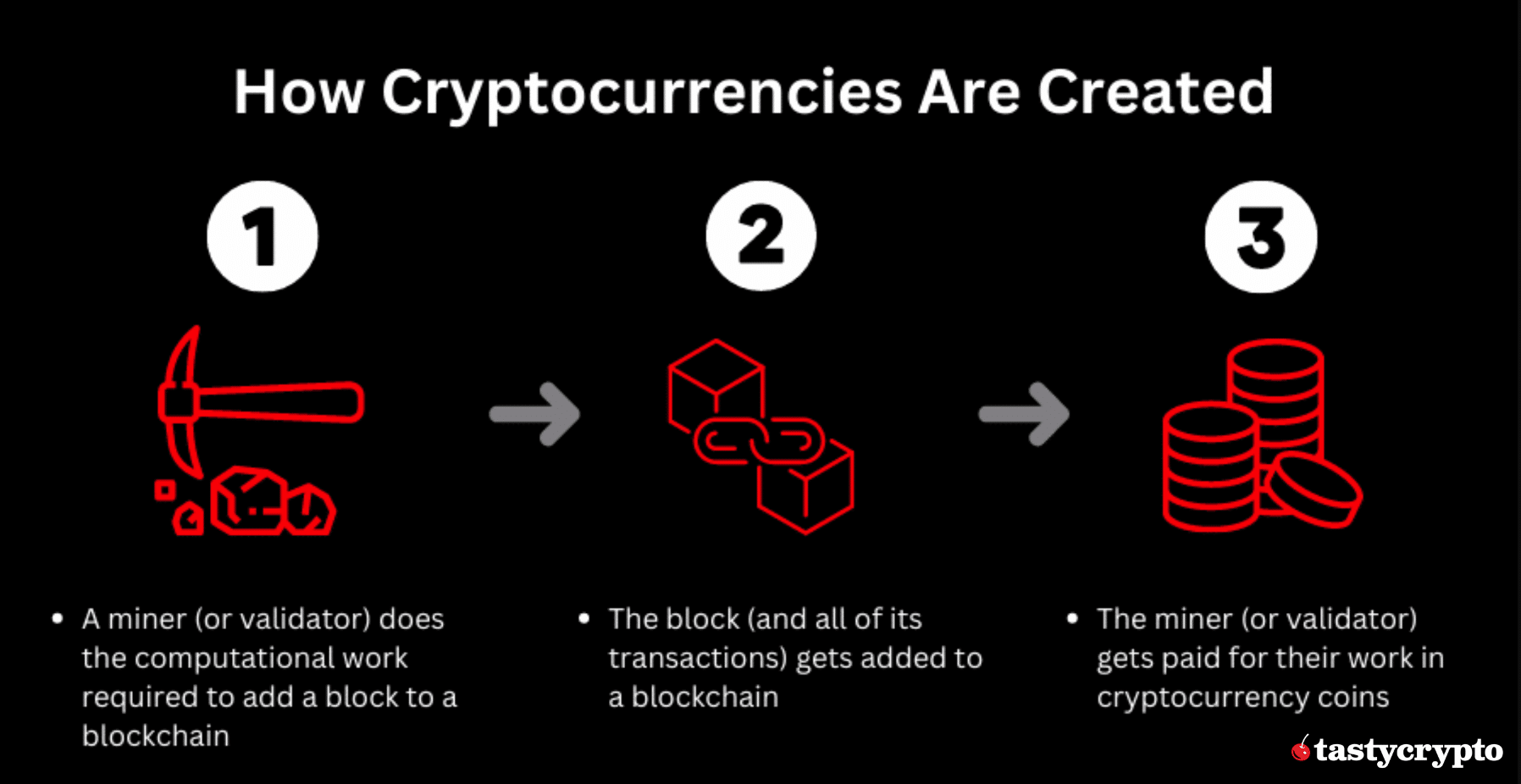
At a practical level, cryptocurrency mining involves powerful computers competing to solve a cryptographic puzzle. The first miner to find the solution gets the right to add the next block of verified transactions to the blockchain. As a reward for this effort, and for securing the network, the successful miner receives a predetermined amount of newly created cryptocurrency (the “block reward”) along with any transaction fees associated with the transactions in that block. This financial incentive is the lifeblood of the PoW system, motivating individuals and organizations to invest in expensive hardware and electricity. From an economic perspective, miners are essentially validating the integrity of the financial ledger and, in return, are compensated with newly minted assets, thus acting as the decentralized issuers of new currency. The profitability of mining is a constant calculation for participants, balancing hardware costs, electricity consumption, and the fluctuating market price of the cryptocurrency.
Economic Implications of Halving Events
A unique and crucial economic feature of many PoW cryptocurrencies, particularly Bitcoin, is the “halving” event. Approximately every four years (or after a certain number of blocks), the block reward for miners is automatically cut in half. This pre-programmed reduction in the rate of new coin issuance is a powerful deflationary mechanism. From an investment standpoint, halving events create predictable supply shocks that historically have preceded significant price increases, as the rate of new supply entering the market diminishes while demand potentially remains constant or grows. This controlled scarcity is a core design principle intended to ensure the long-term value and stability of the currency, making it an attractive asset for those concerned about the inflationary tendencies of fiat currencies. Understanding halving cycles is paramount for investors and financial analysts seeking to anticipate market movements and long-term investment strategies in the crypto space.
Alternative Creation Methods: Beyond Computational Power
While Proof-of-Work mining defined the initial era of cryptocurrency, innovation has led to the development of alternative methods for creating and distributing digital assets. These newer approaches often aim to address some of the perceived inefficiencies or environmental concerns associated with PoW, offering different economic models for network security and coin issuance.
Proof-of-Stake: Earning Through Capital Commitment
Proof-of-Stake (PoS) has emerged as a prominent alternative to PoW, most notably adopted by Ethereum 2.0. In a PoS system, new coins are not “mined” through computational effort but are “minted” or “forged” by individuals who “stake” (lock up) a certain amount of existing cryptocurrency as collateral. Instead of competing to solve puzzles, stakers are chosen to validate transactions and create new blocks based on the amount of currency they hold and are willing to commit. For their contribution to network security and consensus, they receive newly minted coins and transaction fees as a reward. From a financial perspective, staking can be viewed as an income-generating investment strategy, where holders earn passive income by participating in the network’s security. It shifts the economic model from energy consumption to capital commitment, offering a potentially more capital-efficient and environmentally friendly way to create and distribute new cryptocurrency units while rewarding long-term holders.
Initial Coin Offerings (ICOs) and Token Generation Events (TGEs): Fundraising and Distribution
Another significant method for creating and initially distributing new cryptocurrencies, particularly for new blockchain projects, is through Initial Coin Offerings (ICOs) or Token Generation Events (TGEs). In these events, a project issues its own proprietary digital tokens (often built on existing blockchains like Ethereum) and sells them to investors, typically in exchange for established cryptocurrencies (like Bitcoin or Ethereum) or even fiat currency. This process serves as a decentralized fundraising mechanism, allowing startups to raise capital directly from a global pool of investors without intermediaries like venture capitalists or investment banks. For investors, participating in an ICO/TGE is akin to early-stage venture capital investment, where they acquire newly created tokens with the expectation that their value will appreciate as the project develops and gains adoption. The tokens themselves are “created” by the project developers, often with a predefined total supply, and then distributed through the sale, marking their initial entry into the market and investor portfolios.
Airdrops and Faucets: Distribution for Awareness and Adoption

While not typically generating entirely new coins in the same vein as mining or ICOs, airdrops and faucets represent methods for distributing existing or newly created cryptocurrencies to a wider audience, often with the goal of fostering adoption, awareness, or community engagement. An airdrop involves a project automatically sending small amounts of its cryptocurrency to wallet addresses that meet certain criteria (e.g., holding a specific amount of another cryptocurrency, being an active user on a particular platform). Faucets, on the other hand, are websites or applications that dispense small amounts of cryptocurrency to users who complete simple tasks, like solving captchas. Financially, these methods are primarily marketing and distribution tools. For recipients, they represent a free acquisition of digital assets, which, if the project succeeds, could appreciate in value, offering a small-scale, no-cost entry point into crypto investment. For projects, it’s a way to quickly distribute tokens, build a user base, and potentially increase the decentralization of token ownership.
The Role of Blockchain Technology in Value Creation and Security
At the heart of every cryptocurrency creation method lies blockchain technology. The underlying architecture of a distributed, immutable ledger is not merely a technical detail; it is the fundamental guarantor of a cryptocurrency’s financial integrity, security, and unique value proposition.
Immutable Ledger: Securing Financial Transactions
The blockchain’s most defining characteristic, its immutability, is critical to the financial reliability of cryptocurrency. Once a transaction is recorded on a block and added to the chain, it cannot be altered or deleted. This permanent record-keeping prevents double-spending – the act of spending the same digital currency twice – which is a persistent challenge in digital finance. For newly created cryptocurrencies, this immutability ensures that every unit created, and every subsequent transfer, is verifiable and secure. From an economic perspective, this trustless environment eliminates the need for central authorities to reconcile transactions, reducing costs and delays. Investors can have confidence that their holdings and transactions are recorded accurately and permanently, forming the bedrock of cryptocurrency’s utility as a reliable store of value and medium of exchange.
Decentralization: A Paradigm Shift in Financial Control
The decentralized nature of blockchain profoundly impacts the financial system, moving control away from central institutions towards a distributed network of participants. In the context of cryptocurrency creation, decentralization means that no single entity dictates how and when new units are issued. Instead, predefined protocols (e.g., halving schedules in PoW, staking rules in PoS) govern the creation process, ensuring transparency and predictability. This democratic approach to money creation is a powerful draw for those seeking alternatives to traditional fiat systems, which are subject to governmental and banking policies. For investors, decentralization offers protection against censorship, seizure, and inflationary monetary policies, positioning cryptocurrencies as a form of “hard money” resistant to manipulation by central authorities. It reshapes the power dynamics of finance, empowering individuals with direct control over their digital assets.
Smart Contracts: Automating Financial Agreements
While not directly a method of creating the base layer cryptocurrency (like Bitcoin or Ethereum’s native coin), smart contracts, built on blockchain technology, play a crucial role in creating and managing derivative digital assets and complex financial instruments. Smart contracts are self-executing agreements with the terms directly written into code. They can automatically facilitate, verify, or enforce the negotiation or performance of a contract. For instance, they enable the creation of new tokens (e.g., ERC-20 tokens on Ethereum) with specific supply limits, distribution rules, and functions. They can automate lending, borrowing, insurance, and asset management in decentralized finance (DeFi), leading to the creation of new forms of digital capital and investment opportunities. By automating complex financial logic, smart contracts underpin the creation of new financial products and services, expanding the utility and economic possibilities of the underlying cryptocurrency ecosystem.
Economic Impact and Future Outlook of Crypto Creation
The diverse methods of cryptocurrency creation have profound economic implications, influencing market dynamics, investment strategies, and the evolving regulatory landscape. Understanding these effects is vital for anyone engaging with digital assets.
Supply Dynamics and Market Valuation
The various creation mechanisms directly dictate the supply dynamics of different cryptocurrencies, which in turn profoundly impacts their market valuation. Fixed supply models with predictable issuance reductions (like Bitcoin’s halving) aim to create deflationary assets, often driving long-term price appreciation as demand outstrips diminishing new supply. PoS systems introduce a different dynamic, where staking rewards encourage locking up coins, potentially reducing circulating supply and increasing scarcity. ICOs and TGEs introduce new tokens into the market, often with a pre-defined maximum supply, and their initial distribution and subsequent trading play a crucial role in their price discovery. For investors, understanding a cryptocurrency’s specific creation and supply schedule is fundamental to assessing its long-term investment potential, risk profile, and projected scarcity relative to demand. These economic parameters are key drivers behind the speculative and investment value of digital assets.
Regulatory Considerations and Financial Stability
The creation and distribution of cryptocurrencies have increasingly come under the scrutiny of financial regulators worldwide. Governments and central banks are grappling with how to classify and regulate assets born from decentralized processes, which don’t fit neatly into existing financial frameworks. Issues such as investor protection in ICOs, the environmental impact of PoW mining, and the financial stability implications of a rapidly growing, unregulated asset class are central concerns. Future developments in crypto creation, particularly new algorithmic stablecoins or novel token distribution models, will likely be shaped by evolving regulatory frameworks. For businesses and individual investors, staying abreast of these regulatory shifts is crucial, as they can significantly impact the legality, accessibility, and financial viability of engaging with different types of cryptocurrencies. The interplay between innovation in crypto creation and regulatory oversight will define the trajectory of the digital asset market’s integration into the broader global financial system.
The Evolution of Digital Finance
The evolution of cryptocurrency creation methods is not merely a technical narrative but a story of ongoing financial innovation. From Bitcoin’s pioneering Proof-of-Work to Ethereum’s transition to Proof-of-Stake, and the continuous emergence of new token standards and fundraising mechanisms, the ways digital assets are brought into existence are constantly expanding. This evolution signifies a move towards more efficient, sustainable, and versatile models of digital capital formation and distribution. These advancements are pushing the boundaries of what is possible in finance, enabling new forms of decentralized organizations, programmable money, and global liquidity. As the infrastructure for creating and managing these assets matures, cryptocurrencies are poised to play an increasingly integral role in the future of finance, offering both formidable opportunities and complex challenges for investors, businesses, and policymakers navigating this new digital frontier. The very act of creation in the crypto world is defining the future landscape of global economics.
aViewFromTheCave is a participant in the Amazon Services LLC Associates Program, an affiliate advertising program designed to provide a means for sites to earn advertising fees by advertising and linking to Amazon.com. Amazon, the Amazon logo, AmazonSupply, and the AmazonSupply logo are trademarks of Amazon.com, Inc. or its affiliates. As an Amazon Associate we earn affiliate commissions from qualifying purchases.