
The creation of cryptocurrency represents one of the most significant technological shifts in the history of digital systems. Unlike traditional fiat currencies, which are printed or digitally issued by central banks, cryptocurrencies are “made” through complex cryptographic processes, distributed computing, and consensus protocols. At its core, the production of a digital asset is a feat of engineering that blends mathematics, software development, and hardware optimization. To understand how these assets come into existence, one must look past the market charts and examine the underlying infrastructure of the blockchain.
The Architectural Foundation: Blockchain and Cryptography
Before a single unit of cryptocurrency can be generated, a robust architectural framework must exist. This framework is the blockchain—a decentralized, distributed ledger that records every transaction across a network of computers. The “making” of cryptocurrency is essentially the process of validating these transactions and adding them as new blocks to the chain.

The Role of Cryptographic Hashing
The fundamental “raw material” used to create cryptocurrency is data, secured by cryptographic hashing. A hash function, such as SHA-256 (used by Bitcoin), takes an input of any size and transforms it into a fixed-length string of characters. This process is one-way; it is computationally impossible to reverse the hash to find the original input. When a new block is created, it contains a hash of the previous block, creating a digital “seal.” If a single bit of data in an older block is altered, the hash changes, breaking the chain. This technological immutability is what allows digital assets to have value without a central authority.
Decentralized Node Networks
Cryptocurrency is not made on a single server. Instead, it is produced by a global network of “nodes”—computers running specific software that follows the rules of the protocol. These nodes communicate with each other to maintain a synchronized version of the ledger. The creation of new currency is the reward given to these nodes for performing the computational work necessary to maintain the network’s integrity and security.
Proof of Work: The Engineering of Mining
The most well-known method of making cryptocurrency is “mining,” technically referred to as Proof of Work (PoW). This process involves solving extremely complex mathematical puzzles to verify transactions and secure the network.
The Computational Race
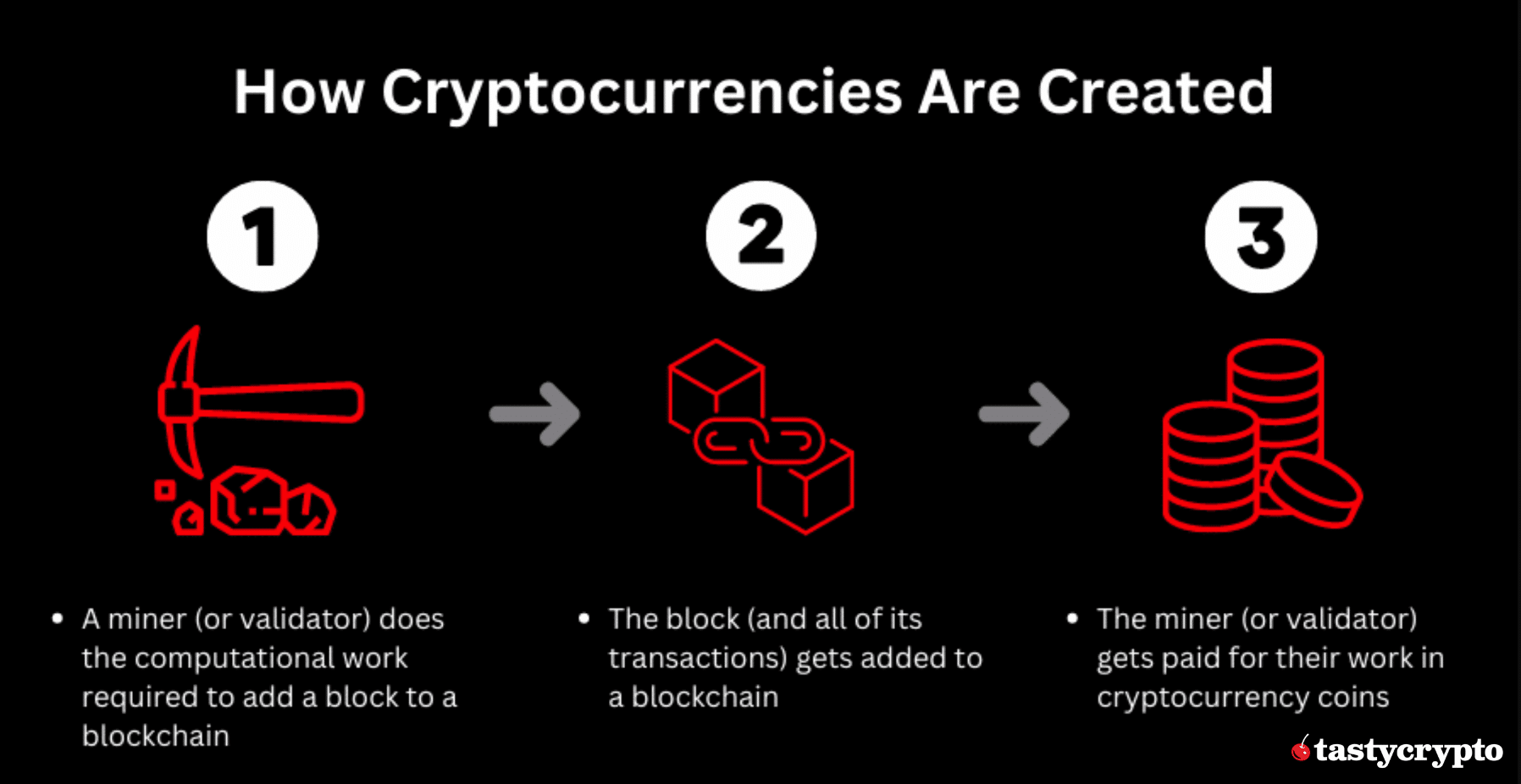
In a PoW system, miners compete to find a “nonce”—a random number that, when combined with the block data and run through a hashing algorithm, produces a result that meets a specific difficulty target. This is not a calculation that can be solved through logic; it requires “brute force,” where hardware generates trillions of guesses per second. The first miner to find the correct hash wins the right to add the block to the blockchain and is rewarded with newly “minted” cryptocurrency.
Hardware Evolution: From CPUs to ASICs
The technology used to make cryptocurrency has evolved rapidly. In the early days of Bitcoin, a standard desktop computer’s Central Processing Unit (CPU) was sufficient to mine coins. As the network’s “difficulty” (a self-adjusting software parameter) increased, the industry moved to Graphics Processing Units (GPUs), which are better at parallel processing.
Today, industrial-scale mining utilizes Application-Specific Integrated Circuits (ASICs). These are specialized pieces of hardware designed for the sole purpose of executing a specific hashing algorithm. An ASIC miner has no operating system or peripheral functions; its entire silicon architecture is optimized to perform SHA-256 or Scrypt calculations at maximum efficiency. This hardware arms race is a critical component of the “creation” process, as it dictates the security and decentralization of the network.
The Difficulty Adjustment Algorithm
A fascinating piece of software engineering in the creation of cryptocurrency is the difficulty adjustment. To ensure that new coins are made at a steady, predictable rate, the protocol automatically adjusts how hard the mathematical puzzles are. If more hardware joins the network, the puzzles become harder; if miners leave, they become easier. This ensures that even as technology advances, the production of the currency remains controlled and resistant to inflation.
Proof of Stake: Software-Based Minting
As the tech industry sought more energy-efficient ways to create digital assets, Proof of Stake (PoS) emerged as the primary alternative to mining. In PoS, cryptocurrency is not “mined” through hardware power but “minted” or “forged” through a software-driven consensus mechanism.

The Validator System
In a PoS network, such as Ethereum 2.0, the role of the miner is replaced by a “validator.” To participate in the creation of new coins, a user must “stake” a certain amount of the network’s native tokens. The protocol then uses a deterministic algorithm to select a validator to propose the next block. This selection is influenced by the amount of currency staked and the duration it has been held.
Algorithmic Security and Slashing
The security of PoS-made currency relies on game theory and code. If a validator attempts to verify fraudulent transactions or acts maliciously, the protocol “slashes” their staked assets, meaning a portion of their digital wealth is destroyed. This creates a technological incentive for honesty. Because this process does not require massive amounts of electricity or specialized hardware, it allows for the creation of cryptocurrency within a virtualized environment, making it highly scalable.
Minting and Distribution
In PoS systems, new units of currency are often distributed as “staking rewards.” The software automatically calculates the inflation rate and issues new tokens to validators in proportion to their contribution to the network’s security. This shift from physical hardware (ASICs) to financial collateral (Staking) represents a transition in the “how” of cryptocurrency production, moving from the realm of electrical engineering to pure software logic.
Tokenization and Smart Contract Deployment
Not all cryptocurrencies are created by building an entire blockchain from scratch. A significant portion of the digital asset ecosystem consists of “tokens” made using existing blockchain infrastructure through smart contracts.
Layer 2 and Protocol Standards
Platforms like Ethereum, Solana, and Binance Smart Chain provide a “base layer” upon which developers can issue new currencies. This is done by deploying a smart contract—a self-executing piece of code—that defines the token’s properties, such as its total supply, name, and transfer rules.
The most common technical standard for this is ERC-20. By following this specific set of programming rules, a developer can create a new cryptocurrency in a matter of minutes. The “making” of these tokens doesn’t involve mining or staking in the traditional sense; instead, it involves the programmatic issuance of digital units governed by the logic of the underlying smart contract.
The Role of the Virtual Machine
When a token is created on an existing blockchain, it lives within that network’s “Virtual Machine” (e.g., the Ethereum Virtual Machine or EVM). The EVM acts as a global, decentralized computer that executes the code of the smart contract. Every time a token is sent or created, the EVM updates the state of the ledger. This allows for the rapid proliferation of decentralized finance (DeFi) assets and utility tokens without the need for the creator to maintain their own hardware infrastructure.
Security Protocols and the Integrity of Creation
The process of making cryptocurrency is inseparable from the digital security measures that protect it. Without rigorous software audits and cryptographic safeguards, a created asset would be vulnerable to duplication or theft.
Preventing Double-Spending
One of the primary reasons for the complex “making” process is to solve the “double-spending” problem. In a digital environment, files can be easily copied. If a cryptocurrency were just a digital file, a user could spend it twice. The mining and staking processes prevent this by ensuring that every transaction is validated by the network and recorded in a linear, chronological order. The “work” performed by miners or the “stake” held by validators serves as a technological guarantee that the currency being created and moved is unique and authentic.
Multi-Signature and Cold Storage Infrastructure
Once a cryptocurrency is created, the technology used to secure it becomes paramount. This involves the use of public and private key cryptography. A public key acts as an address (where the currency is “made” or sent), while the private key acts as a digital signature that allows the owner to access it. Advanced digital security setups, such as multi-signature (MultiSig) protocols, require multiple private keys to authorize a transaction, ensuring that the created assets cannot be moved by a single point of failure.
The Future: Layer 2 and Beyond
As the technology continues to evolve, the way cryptocurrency is made is becoming even more layered. Layer 2 scaling solutions, such as Rollups and Lightning Networks, process transactions off-main-chain and then “settle” them on the primary blockchain. This effectively “makes” a new layer of digital economy that is faster and cheaper, while still relying on the security of the original “minting” process. The engineering of these systems represents the next frontier in digital asset production, focusing on throughput, interoperability, and sophisticated cryptographic proofs like Zero-Knowledge (ZK) SNARKs.
The creation of cryptocurrency is far more than a financial trend; it is a profound application of computer science and digital security. From the hum of ASIC miners in data centers to the silent execution of smart contracts on global virtual machines, the “making” of these assets is a testament to the power of decentralized technology. By leveraging cryptography, consensus algorithms, and distributed networks, humanity has engineered a new way to define and produce digital value.
aViewFromTheCave is a participant in the Amazon Services LLC Associates Program, an affiliate advertising program designed to provide a means for sites to earn advertising fees by advertising and linking to Amazon.com. Amazon, the Amazon logo, AmazonSupply, and the AmazonSupply logo are trademarks of Amazon.com, Inc. or its affiliates. As an Amazon Associate we earn affiliate commissions from qualifying purchases.