
The cryptocurrency market is a realm of unprecedented innovation and speculative fervor, where digital assets routinely challenge traditional notions of value and utility. Among the myriad of digital currencies, Ripple’s XRP has consistently captured attention, not just for its volatile price movements but for its ambitious mission: to revolutionize global payments. The question “how high can Ripple go?” is not merely a speculative query about price; it’s an inquiry into the fundamental value proposition of XRP, its technological advancements, regulatory hurdles, and its potential to disrupt established financial infrastructures. For investors and enthusiasts alike, understanding the multifaceted factors that could drive or hinder XRP’s growth is paramount to assessing its true long-term potential.

Understanding Ripple and XRP: Beyond the Hype
To accurately gauge XRP’s potential trajectory, one must first distinguish between Ripple Labs, the company, and XRP, the digital asset. Ripple Labs is a fintech company that develops global payment solutions, primarily for financial institutions. XRP is the native digital asset on the XRP Ledger (XRPL), an open-source, decentralized blockchain technology. While closely linked, their functions and ecosystems are distinct, yet mutually reinforcing.
The Core Value Proposition: Cross-Border Payments
Ripple’s primary objective is to make cross-border payments faster, cheaper, and more transparent than traditional banking systems. Legacy systems, often reliant on correspondent banking, are notorious for their slowness, high fees, and lack of transparency. Ripple’s solutions, particularly On-Demand Liquidity (ODL), leverage XRP as a bridge currency to facilitate instantaneous global transactions. This mechanism eliminates the need for pre-funded nostro/vostro accounts, freeing up capital for financial institutions and significantly reducing transaction costs and settlement times. The promise of near-instant global settlements, especially for remittances and international trade, represents a massive market opportunity that Ripple aims to capture.
Differentiating XRP from Bitcoin and Ethereum
XRP operates on a fundamentally different principle than its more famous counterparts, Bitcoin and Ethereum. Bitcoin was designed as a peer-to-peer electronic cash system and a store of value, secured by proof-of-work. Ethereum introduced smart contracts and a platform for decentralized applications. XRP, on the other hand, was built specifically for enterprise-level payments. Its consensus mechanism, the XRP Ledger Consensus Protocol, allows for transaction validation in 3-5 seconds, significantly faster and more energy-efficient than Bitcoin or Ethereum (which relies on Proof of Stake for Ethereum 2.0 but has historically been PoW). This speed and efficiency are critical for its target market – financial institutions requiring high throughput and low latency. Investors must appreciate these design differences, as they dictate XRP’s specific utility and competitive advantages within the broader crypto landscape.
The Role of RippleNet and ODL (On-Demand Liquidity)
RippleNet is Ripple’s global payment network that connects banks, payment providers, and digital asset exchanges. It offers various solutions, but ODL is arguably the most impactful for XRP’s utility. ODL allows financial institutions to instantly source liquidity for cross-border transactions using XRP. For example, a bank in Country A sending money to Country B can convert its local currency into XRP, send the XRP across the XRPL, and then convert XRP into Country B’s local currency. This process is nearly instant and eliminates the need for banks to hold large amounts of foreign currency, which is inefficient and costly. The more financial institutions adopt ODL, the greater the demand for XRP as a liquidity tool, which theoretically should positively impact its value. This direct correlation between utility and potential demand is a crucial aspect for any financial assessment of XRP.
Key Factors Driving XRP’s Price Potential
The trajectory of any financial asset, particularly in the volatile crypto market, is influenced by a confluence of factors. For XRP, these drivers are especially intricate, encompassing technological innovation, regulatory developments, market dynamics, and broader economic trends.
Institutional Adoption and Partnerships
The cornerstone of Ripple’s strategy is integrating its technology with established financial institutions. Each new partnership, whether with a bank, payment provider, or remittance company, expands the reach of RippleNet and increases the potential demand for XRP. When a major financial player commits to using ODL, it validates Ripple’s technology and demonstrates real-world utility for XRP. Announcements of significant partnerships or expanding use cases in new corridors are often met with positive market reactions, signaling growing confidence in XRP’s long-term viability. The network effect derived from increasing adoption could create a powerful virtuous cycle, driving up demand and, consequently, price.
Regulatory Clarity and the SEC Lawsuit Outcome
Perhaps the single most significant factor influencing XRP’s price potential has been the ongoing legal battle with the U.S. Securities and Exchange Commission (SEC). The SEC’s claim that XRP is an unregistered security has cast a long shadow over the asset, leading to its delisting from many U.S. exchanges and creating immense regulatory uncertainty. A favorable outcome for Ripple, particularly a ruling that XRP is not a security, would be a monumental catalyst. It would likely lead to relistings on U.S. exchanges, increased institutional interest, and a significant boost in market confidence. Conversely, an unfavorable outcome could have severe implications, restricting XRP’s utility and market access in the U.S. and potentially setting a precedent globally. Investors view this lawsuit as a critical binary event that will largely dictate XRP’s immediate and medium-term prospects.
Market Sentiment and Macroeconomic Trends
Like all cryptocurrencies, XRP is not immune to broader market sentiment and macroeconomic forces. During bull markets, investor enthusiasm often fuels speculative buying across the board, pushing up prices. Conversely, bear markets or periods of global economic uncertainty can lead to widespread sell-offs. Factors such as inflation, interest rate changes, geopolitical events, and the overall health of traditional financial markets can influence how investors perceive risk assets like cryptocurrencies. Furthermore, the overall sentiment towards the crypto industry, driven by narratives around decentralization, Web3, and digital finance, can create powerful tailwinds or headwinds for individual assets like XRP.
Technological Advancements and Use Cases (beyond payments)
While payments remain XRP’s primary focus, the underlying XRP Ledger (XRPL) is a versatile blockchain. Developers are exploring other use cases, including decentralized finance (DeFi), non-fungible tokens (NFTs), and central bank digital currencies (CBDCs). Projects like the XRPL Hooks, smart contract-like functionality on the ledger, could unlock new avenues for innovation and utility. Should these additional use cases gain traction, they could broaden XRP’s appeal beyond its core payment functionality, creating new demand vectors and diversifying its value proposition. A richer ecosystem built on the XRPL would inherently enhance XRP’s long-term utility and, by extension, its potential value.
Analyzing Price Predictions and Valuation Models
Predicting the future price of any asset, let alone a highly volatile cryptocurrency, is inherently challenging. While many enthusiastic proponents offer ambitious price targets, a more grounded financial analysis requires understanding the methodologies and limitations of valuation in this nascent asset class.
Technical Analysis vs. Fundamental Analysis for XRP
Investors often employ both technical and fundamental analysis. Technical analysis involves studying past price charts and trading volumes to predict future price movements. Patterns, indicators, and support/resistance levels are used to identify potential entry and exit points. While helpful for short-term trading, technical analysis alone does not account for the underlying value or utility of an asset.
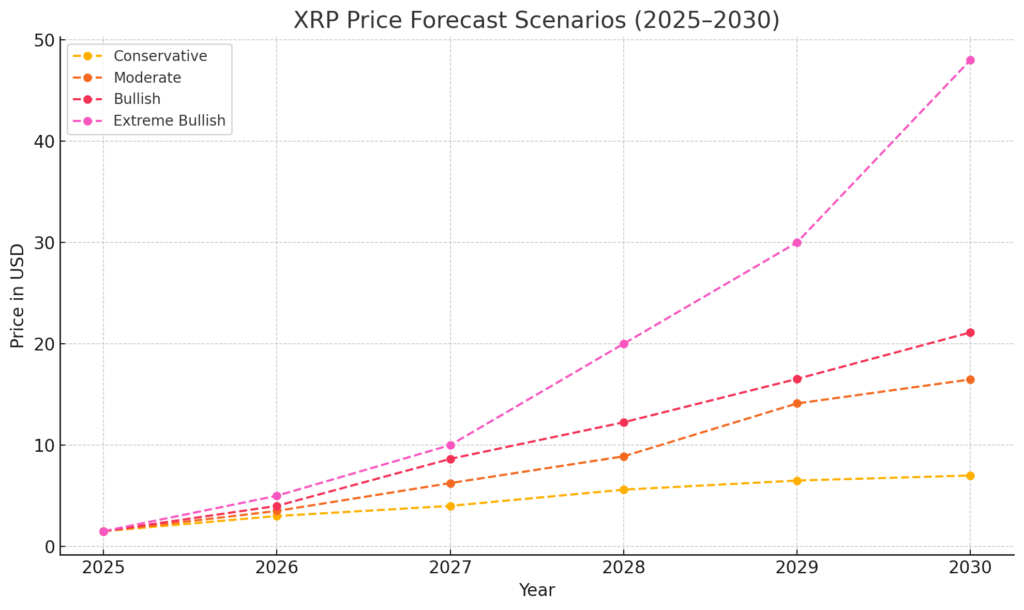
Fundamental analysis for XRP, on the other hand, focuses on its intrinsic value. This involves assessing factors like the adoption rate of ODL, the growth of RippleNet, regulatory developments, the strength of Ripple’s partnerships, competition, and the overall addressable market for cross-border payments. The challenge lies in quantifying these qualitative factors into a precise financial model. For instance, estimating the market share Ripple could capture in the multi-trillion-dollar cross-border payments market and translating that into demand for XRP requires significant assumptions.
Challenges in Valuing Cryptocurrency
Traditional valuation models, such as discounted cash flow (DCF), are difficult to apply to cryptocurrencies like XRP, which do not generate traditional revenue or profits in the same way a company does. Instead, their value is often derived from utility, network effects, scarcity, and speculative demand. Metrics often used include:
- Network Value to Transaction (NVT) Ratio: Compares market capitalization to transaction volume, aiming to show if the network value is justified by its use.
- Metcalfe’s Law: Suggests the value of a network is proportional to the square of the number of connected users, implying that increased adoption directly translates to increased value.
- Total Addressable Market (TAM): Estimating the size of the cross-border payments market and what percentage Ripple could realistically capture.
Each of these models has its limitations and requires significant assumptions, making precise price predictions highly speculative. A common challenge is that crypto prices often decouple from their underlying utility in short to medium terms, driven more by sentiment and speculation.
The “Moonshot” Scenario vs. Incremental Growth
Many “how high can it go” discussions revolve around a “moonshot” scenario, where XRP reaches exceptionally high valuations (e.g., $100, $500, or even $1000+ per coin). These predictions typically hinge on XRP becoming the dominant global standard for international payments, capturing a substantial portion of the multi-trillion-dollar market, and potentially benefiting from widespread DeFi or CBDC adoption. While not impossible in a highly transformative financial landscape, these scenarios represent extreme upside and rely on a perfect storm of positive developments and overcoming significant hurdles.
A more conservative approach considers incremental growth, where XRP steadily increases its market share, gains regulatory clarity, and sees gradual, sustained adoption. This perspective acknowledges the competitive landscape, regulatory complexities, and the inherent friction in disrupting established financial systems. For the discerning investor, balancing the allure of speculative “moonshots” with a realistic assessment of incremental progress is key to managing expectations and making informed decisions.
Risks and Roadblocks on Ripple’s Path
While the potential for XRP is considerable, a balanced financial assessment demands a thorough examination of the inherent risks and formidable roadblocks that could impede its progress or cap its growth ceiling. Ignoring these challenges would be a disservice to comprehensive financial planning.
Regulatory Uncertainty and Competitive Landscape
The ongoing SEC lawsuit is the most prominent regulatory hurdle, but it’s not the only one. The global regulatory environment for cryptocurrencies is still evolving, with different jurisdictions adopting varying approaches. Shifting regulations in key markets could impact Ripple’s ability to operate or expand. Beyond regulations, Ripple faces fierce competition. Traditional financial institutions are not standing still; they are developing their own faster, cheaper payment solutions, including real-time gross settlement systems and potentially even interbank digital currencies. Furthermore, other blockchain projects and stablecoin initiatives are vying for a share of the cross-border payments market. The ability of Ripple to maintain a competitive edge through innovation and superior execution will be crucial.
Centralization Concerns and Supply Dynamics
A common critique leveled against XRP is its perceived centralization. While the XRP Ledger itself is decentralized, Ripple Labs holds a significant portion of the total XRP supply in escrow. Although these escrows are released on a fixed schedule, the sheer volume of XRP held by Ripple and its historical sales practices have raised concerns among some proponents of true decentralization. This concentrated ownership could, in theory, exert undue influence over the market, though Ripple maintains its sales are managed responsibly. Understanding the supply dynamics, including the circulating supply and the escrow release schedule, is vital for investors as these factors can influence market liquidity and price pressure. Any unexpected large releases or changes in the supply strategy could impact market sentiment.
Market Volatility and Investor Behavior
Cryptocurrencies are inherently volatile assets, and XRP is no exception. Its price can swing wildly in response to news, speculation, or broader market movements. This volatility presents both opportunities and significant risks. Investors who are not prepared for sharp drawdowns could face substantial losses. Furthermore, the crypto market is often driven by emotional investor behavior, including fear of missing out (FOMO) during bull runs and panic selling during downturns. The influence of social media trends, influencer opinions, and speculative retail trading can amplify price movements, sometimes decoupling them from fundamental value. Investors must adopt a disciplined approach, resisting the urge to make impulsive decisions based on short-term market noise.
Strategic Considerations for Investors
For individuals contemplating an investment in XRP, a thoughtful and strategic approach is far more prudent than speculative gambling. The “how high can it go” question must be framed within a personal investment philosophy that prioritizes risk management and long-term vision.
Diversification and Risk Management
No single investment, particularly in a high-risk asset class like cryptocurrency, should constitute an outsized portion of one’s portfolio. Diversification is a fundamental principle of sound financial planning. Allocating only a small, acceptable percentage of capital to XRP, proportional to one’s risk tolerance, is critical. This approach protects the overall portfolio from the extreme volatility and potential downside risk inherent in the crypto market. Risk management also entails understanding that capital invested in XRP should be considered speculative, meaning investors should be prepared for the possibility of losing a significant portion, or even all, of their investment.
Long-Term Vision vs. Short-Term Speculation
Answering “how high can Ripple go” requires distinguishing between a long-term investment thesis and short-term speculative trading. For investors with a long-term vision, the focus should be on the fundamental adoption of ODL, the resolution of regulatory issues, and the expansion of the XRPL ecosystem. These are developments that unfold over years, not weeks or months. Short-term speculation, driven by technical analysis and market sentiment, is a different game altogether, requiring advanced trading skills, risk management, and a high tolerance for stress. For most individuals, a long-term perspective, based on a conviction in Ripple’s mission and technology, is more appropriate for navigating the crypto market’s inherent volatility.
Due Diligence and Continuous Learning
The cryptocurrency landscape is dynamic and complex. Any investment in XRP or other digital assets demands continuous due diligence. This includes staying abreast of regulatory developments, scrutinizing Ripple’s financial reports and partnership announcements, monitoring competitive threats, and understanding technological advancements on the XRPL. Relying solely on social media narratives or unverified information can lead to poor decision-making. Investors should actively seek out reputable financial news sources, independent analyses, and educational content to build a well-informed perspective. The commitment to ongoing learning is not just advisable; it is essential for anyone participating in this rapidly evolving financial frontier.
In conclusion, the question of “how high can Ripple go?” is complex, intertwined with technological innovation, regulatory clarity, market adoption, and macroeconomic forces. While XRP faces significant challenges, its unique value proposition in cross-border payments, coupled with its potential for broader utility on the XRPL, presents a compelling case for its long-term growth. However, financial prudence dictates a sober assessment of risks, a commitment to diversification, and a disciplined approach to investment, ensuring that any participation in the future of XRP aligns with an individual’s broader financial objectives and risk tolerance.
aViewFromTheCave is a participant in the Amazon Services LLC Associates Program, an affiliate advertising program designed to provide a means for sites to earn advertising fees by advertising and linking to Amazon.com. Amazon, the Amazon logo, AmazonSupply, and the AmazonSupply logo are trademarks of Amazon.com, Inc. or its affiliates. As an Amazon Associate we earn affiliate commissions from qualifying purchases.