
The world of cryptocurrency, once a niche interest, has rapidly evolved into a significant asset class and a multifaceted ecosystem offering numerous avenues for financial gain. Beyond the speculative trading that often dominates headlines, a diverse array of strategies allows participants to generate income, build wealth, and leverage their digital assets. Understanding these mechanisms is crucial for anyone looking to navigate this dynamic financial frontier responsibly. From passive income streams to active trading strategies and participation in decentralized economies, crypto presents unique opportunities for wealth creation.
Direct Investment and Active Trading Strategies
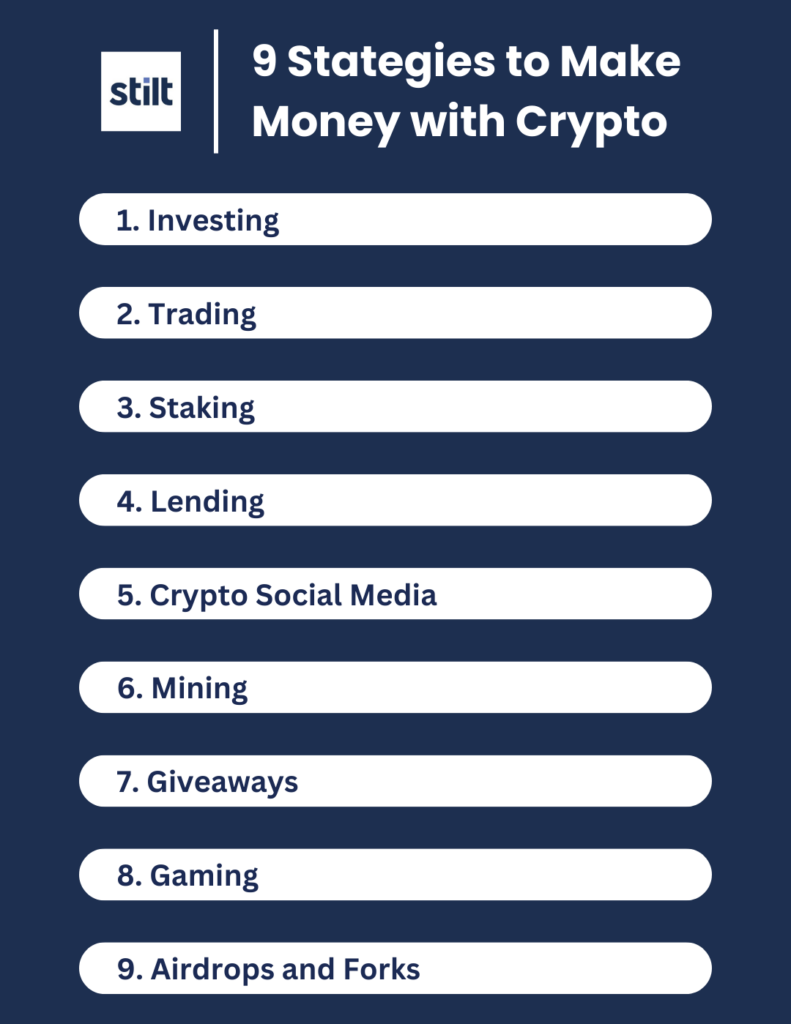
The most straightforward way to potentially make money with cryptocurrency involves buying digital assets with the expectation that their value will appreciate over time. This category encompasses various approaches, from long-term holding to rapid, high-frequency trading.

Buying and Holding (HODLing)
Often referred to by the crypto community as “HODLing” (a misspelling of “hold” that became an acronym for “Hold On for Dear Life”), this strategy involves purchasing cryptocurrencies like Bitcoin or Ethereum and retaining them for an extended period, typically months or years. The premise is based on the belief that the underlying technology and adoption of these assets will grow, driving their value upwards despite short-term market fluctuations. HODLers seek to capitalize on major market cycles, aiming to sell at significantly higher prices than their initial purchase. This strategy requires patience, a strong conviction in the asset’s long-term potential, and the ability to withstand substantial volatility. The profits are realized when the asset is eventually sold for more than its purchase price, minus any transaction fees.
Active Trading
Active trading involves frequently buying and selling cryptocurrencies to profit from short-term price movements. This can include day trading, where positions are opened and closed within the same day, or swing trading, which holds positions for a few days or weeks to capture larger price swings. Traders often rely on technical analysis (studying price charts and indicators) and fundamental analysis (evaluating project news, developments, and market sentiment) to make informed decisions. While active trading offers the potential for quick profits, it also carries significantly higher risk due to market volatility, the need for constant monitoring, and the psychological demands of making rapid decisions. Successful active traders typically possess deep market knowledge, disciplined risk management, and a robust trading strategy.
Arbitrage
Arbitrage is a less common but potentially lucrative trading strategy that exploits temporary price differences for the same cryptocurrency across different exchanges. Because crypto markets are decentralized and operate globally, slight price discrepancies can arise. An arbitrageur would simultaneously buy an asset on an exchange where its price is lower and sell it on another where it is higher, profiting from the spread. This strategy requires speed, access to multiple exchanges, and sophisticated trading tools, as price differences usually vanish quickly. While the profit margins on individual trades might be small, high-frequency arbitrage can accumulate substantial gains over time.
Earning Yield from Crypto Holdings
Beyond outright speculation or active trading, many opportunities exist to generate passive income from existing cryptocurrency holdings, much like earning interest in a traditional savings account or dividends from stocks.
Staking
Staking is a mechanism used in Proof-of-Stake (PoS) blockchain networks, where participants lock up a certain amount of their cryptocurrency to support the network’s operations and security. In return for staking their assets, participants become validators or delegate their stake to a validator, helping to verify transactions and create new blocks. For their contribution, stakers receive rewards in the form of newly minted cryptocurrency or transaction fees. Staking provides a way for holders to earn a yield on their assets while contributing to the decentralization and security of the network. The annual percentage yield (APY) can vary significantly depending on the specific cryptocurrency and network conditions, offering a compelling alternative to traditional interest rates.
Lending
Cryptocurrency lending platforms allow individuals to lend out their crypto assets to borrowers and earn interest in return. These platforms can be centralized (CeFi), operating similarly to traditional banks with custodianship, or decentralized (DeFi), where smart contracts automate the lending process without intermediaries. Borrowers typically use the funds for trading on margin or for other financial activities, often providing collateral in excess of the loan value. Lenders receive interest payments, which can be considerably higher than those offered by conventional financial institutions. However, risks include smart contract vulnerabilities in DeFi, counterparty risk in CeFi, and the potential for liquidation if collateral values drop rapidly.
Yield Farming and Liquidity Provision
Yield farming is a sophisticated DeFi strategy where participants seek to maximize returns on their crypto assets by providing liquidity to decentralized exchanges (DEXs) or other DeFi protocols. When users contribute tokens to a liquidity pool, they enable trading pairs on the DEX and earn a share of the transaction fees generated by that pair. Additionally, many protocols incentivize liquidity providers by issuing them governance tokens or other rewards, which can then be sold or staked for further profit. Yield farming strategies can be complex, often involving moving assets between different protocols to chase the highest returns, and they come with risks such as impermanent loss (when the value of deposited assets changes relative to each other), smart contract risks, and high gas fees.
Participating in New Projects and Ecosystems
The cryptocurrency space is constantly innovating, with new projects emerging regularly. Engaging with these nascent ecosystems can offer unique financial opportunities, often with higher risk but also higher potential rewards.
Initial Coin Offerings (ICOs), Initial Exchange Offerings (IEOs), and Launchpads
Similar to initial public offerings (IPOs) in traditional markets, ICOs and IEOs are fundraising methods used by new crypto projects to sell a portion of their tokens to early investors. ICOs were popularized in 2017-2018, allowing projects to raise capital directly from the public. IEOs are conducted via cryptocurrency exchanges, which often vet the projects, providing a layer of trust. Launchpads are platforms that host token sales for promising new projects, giving investors early access. Participating in these sales can offer significant returns if the project gains traction and its token’s value increases post-launch. However, they are highly speculative, and many projects fail, leading to total loss of investment. Due diligence is paramount before investing in any early-stage project.
Airdrops
Airdrops involve the free distribution of new cryptocurrency tokens to a wide audience, typically existing holders of a particular cryptocurrency (e.g., Bitcoin or Ethereum) or users of a specific blockchain protocol. Projects use airdrops for marketing, to decentralize token distribution, or to reward early adopters and active community members. While the value of individual airdropped tokens might be low initially, some have appreciated significantly, turning into substantial windfalls for recipients. To qualify, users might need to hold certain tokens, interact with a specific dApp, or fulfill other criteria set by the project.
Play-to-Earn (P2E) Gaming and NFTs
The emergence of play-to-earn gaming models and non-fungible tokens (NFTs) has created novel ways to earn money in crypto. P2E games integrate blockchain technology to allow players to earn cryptocurrency or NFTs through gameplay, such as completing quests, winning battles, or breeding in-game assets. These in-game assets are often NFTs, giving players true ownership that can be traded on open marketplaces for real-world value. Similarly, creating, buying, and selling NFTs – unique digital assets representing art, collectibles, music, or virtual land – has become a burgeoning market. Successful NFT artists or collectors can realize significant profits from resales as the market for digital collectibles continues to grow and mature.
Mining and Validation
For some cryptocurrencies, particularly those using Proof-of-Work (PoW) consensus mechanisms, direct participation in the network’s security infrastructure can be a source of income.
Proof-of-Work (PoW) Mining
PoW mining involves using specialized computer hardware to solve complex mathematical puzzles. The first miner to solve the puzzle gets to add the next block of transactions to the blockchain and is rewarded with newly minted cryptocurrency (block rewards) and transaction fees. Bitcoin is the most prominent example. While potentially profitable, PoW mining requires significant upfront investment in hardware, consumes substantial electricity, and demands technical expertise for setup and maintenance. Profitability depends on the asset’s price, mining difficulty, hardware efficiency, and electricity costs. As difficulty increases and block rewards decrease over time (halving events), smaller-scale mining becomes less accessible and often unprofitable.
Decentralized Autonomous Organizations (DAOs)
DAOs represent a new organizational structure where decisions are made by token holders through voting, rather than a centralized authority. Many DAOs require active participation to thrive. Individuals can earn cryptocurrency by contributing their skills (e.g., development, marketing, community management, content creation) to a DAO and being compensated for their work, often through proposals and voting mechanisms. This provides a decentralized employment model, allowing individuals to earn income by directly contributing to projects they believe in.
Understanding Risks and Due Diligence
While the opportunities to make money with crypto are diverse and appealing, it is critical to approach this space with a full understanding of the inherent risks. The cryptocurrency market is notoriously volatile, meaning prices can fluctuate wildly and unpredictably, leading to rapid gains or losses. Regulatory environments are still evolving globally, creating uncertainty regarding legality and taxation. Security risks, including platform hacks, scams, and the potential loss of private keys, pose significant threats to investors’ holdings.
Furthermore, the complexity of many crypto mechanisms, especially in DeFi, means a lack of understanding can lead to costly mistakes. Before committing capital, individuals must conduct thorough research (DYOR – Do Your Own Research), understand the underlying technology and project fundamentals, and assess their personal risk tolerance. Diversifying investments, investing only what one can afford to lose, and staying informed about market developments are crucial practices for responsible participation in the crypto economy.
aViewFromTheCave is a participant in the Amazon Services LLC Associates Program, an affiliate advertising program designed to provide a means for sites to earn advertising fees by advertising and linking to Amazon.com. Amazon, the Amazon logo, AmazonSupply, and the AmazonSupply logo are trademarks of Amazon.com, Inc. or its affiliates. As an Amazon Associate we earn affiliate commissions from qualifying purchases.