
In the rapidly evolving landscape of digital finance, terms like “cryptocurrency” and “blockchain” have become commonplace, yet the fundamental mechanisms that underpin these innovations often remain shrouded in mystery for many. At the heart of many cryptocurrencies, most notably Bitcoin, lies a process known as “mining.” Far removed from the pickaxes and tunnels of traditional resource extraction, digital mining is a sophisticated computational endeavor crucial for the creation of new currency units, the validation of transactions, and the overall security and integrity of the decentralized network. It is a complex interplay of cryptography, computing power, and economic incentives designed to maintain a robust and trustless digital ledger.

Understanding how bit mining works is not just an academic exercise; it’s essential for anyone seeking to grasp the true nature of decentralized digital economies. It reveals the ingenuity behind securing a global, immutable ledger without a central authority, showcasing the power of distributed consensus. This deep dive will unravel the technical intricacies of cryptocurrency mining, exploring the underlying principles, the step-by-step process, the specialized hardware and software involved, and its critical role in maintaining the security and functionality of digital assets.
The Foundational Principles of Cryptocurrency Mining
At its core, bit mining is a computational race to solve a complex mathematical problem, the successful completion of which grants the miner the right to add a new block of verified transactions to the blockchain. This process is integral to the security and operation of decentralized digital currencies.
What is “Mining” in the Digital World?
Unlike the physical act of digging for precious metals, digital “mining” refers to the process by which new cryptocurrency units are introduced into circulation and transactions are validated and added to the blockchain ledger. It’s a resource-intensive competition where participants use powerful computers to perform cryptographic computations. The goal is to be the first to find a solution to a specific mathematical puzzle, which proves that computational work has been expended. This mechanism is known as Proof-of-Work (PoW). Miners are not just creating new coins; they are the network’s auditors, ensuring that all transactions are legitimate and preventing issues like double-spending. Without mining, the network would cease to function securely and efficiently.
The Immutable Blockchain Ledger
Central to understanding mining is the concept of the blockchain itself. A blockchain is a distributed, immutable ledger that records all transactions across a network of computers. Each “block” in the chain contains a list of transactions, a timestamp, and a cryptographic hash of the previous block, linking them together in a secure, chronological order. This chained structure makes it incredibly difficult to alter past transactions without re-mining all subsequent blocks, an effort that would require immense computational power, thereby ensuring the ledger’s integrity. Miners are responsible for creating new blocks, filling them with pending transactions, and adding them to this ever-growing chain, making the blockchain a self-auditing and highly resilient system.
Proof-of-Work (PoW): The Consensus Mechanism
Proof-of-Work is the original and most widely used consensus algorithm in cryptocurrencies like Bitcoin. It dictates that miners must expend significant computational resources to solve a cryptographic puzzle. This “work” is easily verifiable by other network participants but difficult to produce, ensuring that miners have a vested interest in honest behavior. The specific puzzle involves finding a “nonce” (a number used only once) that, when combined with the block’s data and hashed, produces a result below a certain target value. This target value is dynamically adjusted by the network to ensure that a new block is found, on average, at regular intervals (e.g., every 10 minutes for Bitcoin), regardless of the total hashing power on the network. The miner who finds the correct nonce first broadcasts their solution to the network, and if validated by other nodes, their block is added to the blockchain, and they receive the block reward and transaction fees.
The Mining Process: A Technical Breakdown
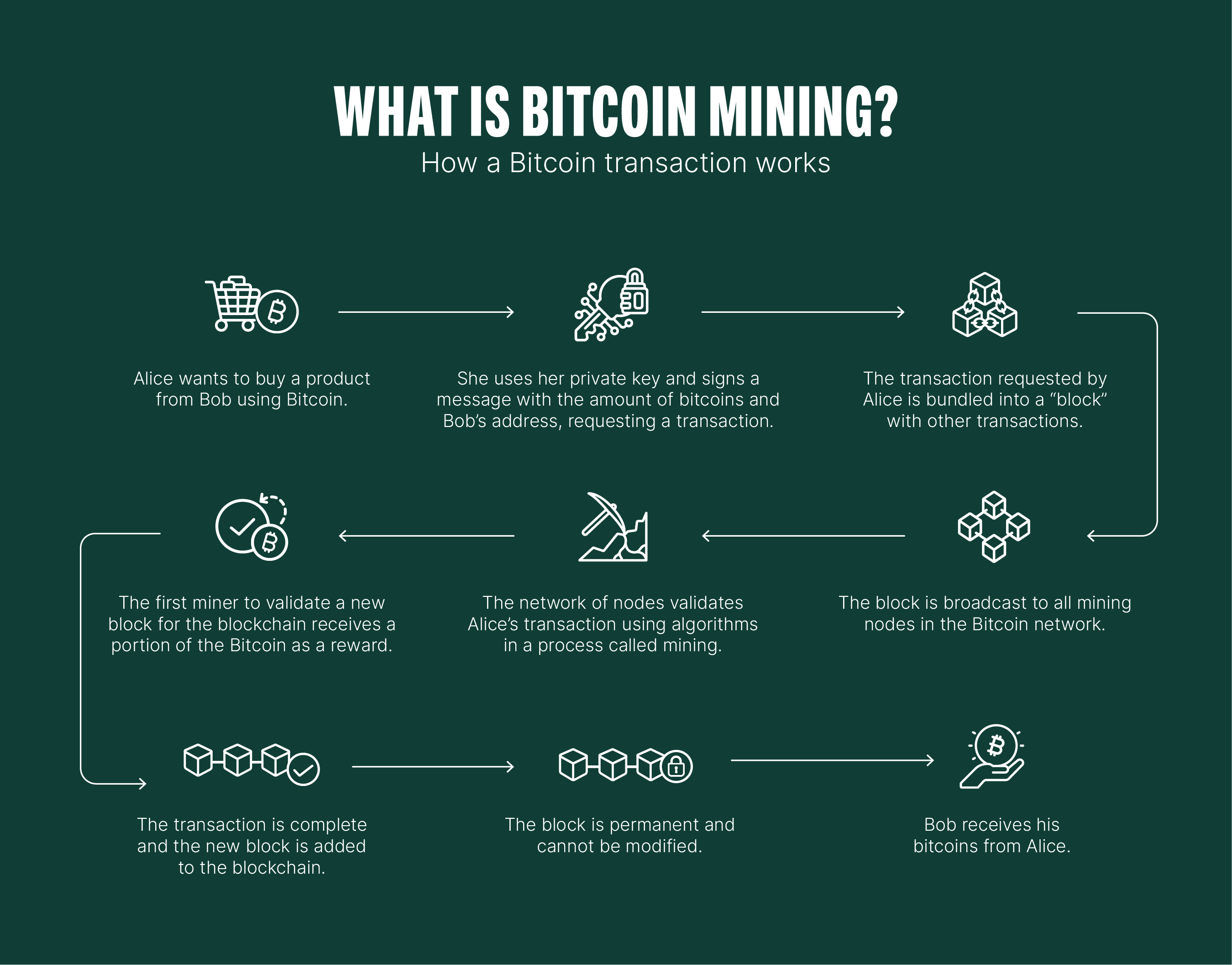
The journey from an unconfirmed transaction to a permanently recorded entry on the blockchain involves several intricate steps, all orchestrated by mining nodes.
Gathering Transactions and Building a Block
The mining process begins with a miner’s node listening for unconfirmed transactions broadcast across the network. These transactions are gathered into a temporary pool. The miner then selects a subset of these transactions, typically prioritizing those with higher transaction fees, and organizes them into a candidate block. This block also includes a reference to the previous block’s hash, a timestamp, and a “Merkle root,” which is a cryptographic hash of all the transactions within the current block. This Merkle root efficiently summarizes all transactions, allowing for quick verification without needing to process each one individually.
The Hashing Challenge: Finding the Golden Nonce
Once a candidate block is assembled, the miner faces the primary challenge: finding a “nonce” that, when combined with the block’s header data (including the previous block’s hash, Merkle root, and timestamp) and put through a cryptographic hashing function (like SHA-256 for Bitcoin), produces an output hash that is less than or equal to the current “target difficulty.” The target difficulty is an extremely small number set by the network. Because hashing functions are deterministic but practically impossible to reverse engineer (meaning you can’t predict the output from the input, or the input from the output, without trying many inputs), miners must repeatedly guess different nonces and re-hash the entire block header until they find one that meets the target. This trial-and-error process is computationally intensive and forms the core of the Proof-of-Work.
Verification, Propagation, and Consensus
The moment a miner discovers a nonce that yields a valid hash, they have “solved the block.” This successful block, now containing the valid nonce, is immediately broadcast to all other nodes on the network. Upon receiving this block, other nodes independently verify its validity: they check if the nonce, when hashed with the block data, indeed produces a hash below the current target difficulty. They also ensure all transactions within the block are valid and haven’t been double-spent. If the block is valid, these nodes accept it, add it to their copy of the blockchain, and begin mining on top of this newly accepted block. This collective verification and acceptance process is how network-wide consensus is achieved, ensuring that only valid blocks are added and that all participants maintain an identical, up-to-date ledger.
The Block Reward and Transaction Fees
The incentive for miners to expend vast amounts of electricity and computational power comes in two forms: the block reward and transaction fees. When a miner successfully mines a block, they are awarded a fixed amount of new cryptocurrency (e.g., 6.25 BTC as of 2024, subject to halving events) and collect all the transaction fees associated with the transactions included in that block. This dual incentive structure ensures that miners are compensated for their efforts in securing the network and that new coins are introduced into the system in a controlled, predictable manner. The block reward decreases over time through events called “halvings,” reducing the supply of new coins and ensuring scarcity.

Essential Components and Technologies for Mining
Mining is not a casual endeavor; it requires specialized hardware and software, often operating within a highly competitive ecosystem.
Evolution of Mining Hardware: From CPUs to ASICs
The journey of mining hardware reflects a relentless pursuit of efficiency and processing power:
- CPUs (Central Processing Units): In Bitcoin’s early days, mining could be done effectively with a standard computer’s CPU.
- GPUs (Graphics Processing Units): As difficulty increased, the parallel processing power of GPUs, originally designed for graphics rendering, proved far more efficient. Many altcoins (alternative cryptocurrencies) still leverage GPU mining.
- FPGAs (Field-Programmable Gate Arrays): A brief interlude saw FPGAs, customizable integrated circuits, offer a power efficiency improvement over GPUs for specific algorithms.
- ASICs (Application-Specific Integrated Circuits): Today, for major cryptocurrencies like Bitcoin, ASICs dominate. These are custom-built chips designed for the sole purpose of hashing a specific algorithm (e.g., SHA-256). ASICs offer orders of magnitude more hashing power and efficiency compared to any general-purpose hardware, making them essential for competitive mining.
Mining Software and Node Operation
Beyond the raw hardware, specialized software is crucial. Mining software (like CGMiner or Bfgminer) coordinates the hardware to perform the hashing operations and communicates with a mining pool or directly with the network. Crucially, every miner also runs a full node or connects to one. A full node is a computer that downloads and verifies every transaction and block, maintaining a complete copy of the blockchain. This allows miners to independently verify transactions, monitor network difficulty, and broadcast their newly found blocks.
Mining Pools: Collective Power
For individual miners, especially those without industrial-scale operations, directly competing against massive ASIC farms is often futile due to the immense network difficulty. Mining pools emerged as a solution. A mining pool is a group of miners who combine their computational resources (hashing power) to increase their chances of solving a block. When the pool successfully mines a block, the block reward and transaction fees are shared among the participants proportionally to the amount of hashing power each contributed. This reduces the variance of individual rewards, providing more predictable income streams for smaller miners.
Energy Consumption and Environmental Impact
The sheer computational power required for Proof-of-Work mining, particularly for networks like Bitcoin, translates into substantial electricity consumption. This is a significant concern, leading to debates about the environmental footprint of cryptocurrencies. Miners continuously seek cheap electricity sources, often leading to operations in regions with abundant renewable energy or otherwise underutilized power grids. The pursuit of efficiency in hardware design and the exploration of alternative consensus mechanisms (like Proof-of-Stake) are ongoing efforts to address these energy concerns.
Security and Integrity Through Mining
Beyond creating new currency, mining is the backbone of the security model for Proof-of-Work cryptocurrencies.
Preventing Double-Spending
One of the fundamental challenges of digital currency is preventing “double-spending” – the act of spending the same unit of currency more than once. Mining, through the Proof-of-Work mechanism and the blockchain’s chronological integrity, effectively solves this. When a transaction is included in a block and that block is added to the blockchain, it gains increasing finality with each subsequent block that is mined on top of it. This “chaining” makes it incredibly difficult to reverse or alter previous transactions, as it would require re-mining the target block and all subsequent blocks faster than the rest of the network, which is computationally infeasible for all but the largest adversaries.
The 51% Attack: A Theoretical Vulnerability
A theoretical risk to Proof-of-Work networks is the “51% attack.” This scenario occurs if a single entity or coordinated group gains control of more than 50% of the network’s total hashing power. With such dominance, the attacker could potentially:
- Prevent new transactions from getting confirmations.
- Reverse transactions they sent while they were in control, enabling double-spending.
- Prevent other miners from mining valid blocks.
However, even with 51% control, an attacker cannot create new coins out of thin air, send coins they don’t own, or alter historical blocks that have been deeply buried under many subsequent blocks. For large, established networks like Bitcoin, launching a 51% attack would require an astronomical amount of computing hardware and electricity, making it economically prohibitive and practically very difficult to sustain without being detected. The sheer cost would likely far outweigh any potential illicit gains, and the attempt itself would likely devalue the very currency the attacker is trying to exploit.
Network Decentralization and Resilience
Mining contributes significantly to the decentralized nature of cryptocurrencies. Because thousands of independent miners worldwide compete to add blocks, no single entity controls the network. This distributed participation makes the network highly resistant to censorship, single points of failure, and government control. Each miner’s independent verification of transactions and blocks reinforces the network’s integrity, creating a robust, self-regulating ecosystem where trust is placed not in a central authority, but in cryptographic proof and distributed consensus.
Conclusion
Bit mining, far from being a mere abstract concept, is the intricate, energy-intensive process that underpins the security, integrity, and operational functionality of many leading cryptocurrencies. It is a testament to the power of distributed systems and cryptographic engineering. From the initial gathering of transactions to the intense computational race for a valid nonce, and the subsequent verification and propagation across a global network, every step in the mining process is meticulously designed to create a trustless, immutable ledger.
The evolution of specialized hardware, the rise of mining pools, and the ongoing debates surrounding energy consumption highlight the dynamic nature of this critical industry. Ultimately, understanding how bit mining works provides a profound insight into the innovative technological solutions that enable truly decentralized digital economies, safeguarding value and fostering a new era of financial autonomy.
aViewFromTheCave is a participant in the Amazon Services LLC Associates Program, an affiliate advertising program designed to provide a means for sites to earn advertising fees by advertising and linking to Amazon.com. Amazon, the Amazon logo, AmazonSupply, and the AmazonSupply logo are trademarks of Amazon.com, Inc. or its affiliates. As an Amazon Associate we earn affiliate commissions from qualifying purchases.