
In an increasingly digital world, few innovations have captured public imagination and sparked as much debate as Bitcoin. Launched in 2009 by an anonymous entity known as Satoshi Nakamoto, Bitcoin introduced a radical concept: a decentralized digital currency that operates without the need for traditional financial intermediaries like banks or governments. Its rise from an obscure academic curiosity to a global phenomenon has been nothing short of extraordinary. Yet, despite its widespread recognition, the fundamental question “How does Bitcoin work?” often remains shrouded in mystery for many.
At its core, Bitcoin is not merely a digital asset; it is a meticulously engineered technological system. It represents a paradigm shift in how we perceive and interact with value, built upon a sophisticated interplay of cryptography, network protocols, and a novel data structure known as the blockchain. Understanding Bitcoin isn’t just about grasping its economic implications; it’s about appreciating the ingenious architectural design that allows it to function as a secure, transparent, and censorship-resistant digital currency. This article delves into the technical bedrock of Bitcoin, explaining the core components and processes that enable this revolutionary technology to operate.

The Genesis of a Digital Revolution: Understanding Bitcoin’s Core Concept
Bitcoin emerged from a long-standing desire within the cypherpunk movement for a form of digital cash that was resistant to censorship and government control. The 2008 financial crisis further highlighted the vulnerabilities and central points of failure inherent in traditional financial systems, providing a fertile ground for the birth of a decentralized alternative.
Beyond Traditional Currencies: What Makes Bitcoin Unique?
Traditional fiat currencies, like the US dollar or Euro, are issued and controlled by central banks and governments. Their value is backed by faith in the issuing authority, and transactions are processed and recorded by intermediaries. Bitcoin, however, breaks this mold in several critical ways:
- Digital Scarcity: Unlike previous attempts at digital cash, which struggled with the “double-spending problem” (the ability to spend the same digital token multiple times), Bitcoin solved this through its innovative use of a public, immutable ledger and cryptographic verification. It ensures that each Bitcoin can only be spent once, creating true digital scarcity comparable to physical commodities like gold.
- Peer-to-Peer Network: Bitcoin transactions occur directly between users (peer-to-peer) without the need for a central authority to facilitate or verify them. This architecture eliminates single points of failure and reduces transaction costs.
- Fixed Supply: Bitcoin has a predetermined maximum supply of 21 million coins. This hard-coded scarcity is designed to be deflationary over time, contrasting with fiat currencies which can be printed indefinitely, often leading to inflation.
The Promise of Decentralization: No Central Authority
Perhaps Bitcoin’s most defining characteristic is its decentralization. There is no central server, no CEO, no single company or government agency that controls Bitcoin. Instead, the network is maintained by a global community of participants running Bitcoin software on their computers. These participants collectively secure and validate the network, making it incredibly resilient to attack or manipulation. This distributed control is a cornerstone of its security and censorship resistance, fostering a level of trust not based on intermediaries, but on mathematical proof and open-source code.
The Blockchain: Bitcoin’s Immutable Ledger
At the heart of Bitcoin’s technological prowess lies the blockchain – a distributed, public ledger that records all Bitcoin transactions in a secure and chronological order. It’s the foundational technology that enables the system to maintain integrity without a central authority.
Blocks, Chains, and Cryptographic Links
The blockchain, as its name suggests, is a chain of “blocks.” Each block contains a list of verified transactions, along with a timestamp and a unique identifier called a cryptographic hash. Crucially, each new block also contains the hash of the previous block, creating a chronological and unalterable link in the chain. This cryptographic linkage ensures that if someone were to tamper with a transaction in an older block, the hash of that block would change, rendering all subsequent blocks invalid and immediately detectable by the network. This interdependence makes the blockchain incredibly robust against tampering.
Distributed Consensus: The Power of Peer-to-Peer Networks
Every participant running a full Bitcoin node holds a complete copy of the blockchain. When new transactions occur, they are broadcast to the network. Miners then collect these transactions into new blocks. For a new block to be added to the chain, it must be validated by the majority of the network’s nodes, adhering to a strict set of rules. This process of collective agreement is known as “distributed consensus.” Because no single entity controls the ledger, it is virtually impossible for any one party to unilaterally alter transactions or create fraudulent ones without the rest of the network noticing and rejecting them. This distributed nature is a fundamental security feature.
Immutability and Transparency: Trust Through Technology
Once a transaction is confirmed and added to a block, and that block is added to the blockchain, it is practically irreversible. The cryptographic links and the distributed nature of the ledger ensure that tampering with past records would require an impossible amount of computational power to rewrite the entire history of the blockchain and convince the majority of the network to accept the fraudulent chain. This immutability provides a high degree of security and finality for transactions.
Furthermore, the Bitcoin blockchain is entirely public and transparent. While user identities are pseudonymous (represented by public addresses), every single transaction ever made is recorded and accessible for anyone to view. This transparency eliminates the need for trust in a central party, as anyone can independently verify the network’s integrity.
Cryptography: The Invisible Shield of Bitcoin
Cryptography is not just an essential component of Bitcoin; it is its very foundation. It provides the mathematical proof and security mechanisms that underpin every aspect of the network, from transaction signing to wallet security.
Public and Private Keys: Your Digital Identity
At the core of Bitcoin’s security model are cryptographic key pairs: a public key and a private key.
- Private Key: This is a randomly generated, secret number that functions as your digital signature. It provides access to your bitcoins and is used to authorize transactions. It must be kept absolutely secure, as anyone who possesses your private key can control your funds.
- Public Key: Derived mathematically from your private key, the public key is used to generate your Bitcoin address. This is the address you share with others to receive bitcoins. Crucially, it is computationally infeasible to reverse-engineer a private key from a public key.
Together, these keys enable a system where you can prove ownership of your funds (with your private key) without revealing the private key itself, thereby ensuring security and privacy.
Digital Signatures: Proving Ownership and Authenticity
When you send bitcoins, you create a transaction and “sign” it using your private key. This digital signature is a mathematical proof that the transaction originated from the owner of the private key and that it hasn’t been altered since it was signed. The network uses your public key to verify this signature without ever seeing your private key. This ensures the authenticity and integrity of every transaction on the blockchain. Without a valid digital signature from the owner, no bitcoins can be moved.
Hashing Algorithms: Securing Data Integrity
Hashing is a process that takes an input (data of any size) and produces a fixed-size string of characters, called a hash or digest. Bitcoin heavily utilizes hashing algorithms, specifically SHA-256 (Secure Hash Algorithm 256-bit). Key applications of hashing in Bitcoin include:
- Block Identification: Each block in the blockchain has a unique hash, which incorporates the hash of the previous block, linking them together.
- Proof-of-Work: Miners compete to find a specific hash for a new block, a computationally intensive process known as Proof-of-Work.
- Transaction IDs: Each transaction is uniquely identified by its hash.
- Data Integrity: Any tiny change to the input data results in a completely different hash, making it easy to detect tampering. This ensures the integrity of the data stored within blocks.
Mining and Transaction Verification: Powering the Network
Bitcoin’s operation relies on a unique process called “mining,” which is both the engine that powers the network and the mechanism for creating new bitcoins.
Proof-of-Work: The Engine of Consensus
Mining is essentially a competition among “miners” (powerful computers) to solve a complex computational puzzle called the “Proof-of-Work” problem. This puzzle involves finding a nonce (a number used once) that, when combined with the block’s data, produces a hash that meets a specific difficulty target (e.g., starts with a certain number of zeros).
The process is:
- Miners gather unconfirmed transactions into a block.
- They repeatedly guess nonces, recalculating the block’s hash each time, until they find one that satisfies the network’s difficulty requirement.
- The first miner to find a valid hash broadcasts their “solved” block to the network.
- Other nodes verify the block’s validity (checking the hash and all transactions within it).
- If valid, the block is added to their copy of the blockchain, and the cycle repeats.
This Proof-of-Work mechanism is resource-intensive, requiring significant computational power and electricity. This makes it incredibly difficult and costly for malicious actors to rewrite the blockchain, as they would need to out-compute the rest of the network. This difficulty is precisely what secures the network.
How Transactions are Processed and Confirmed
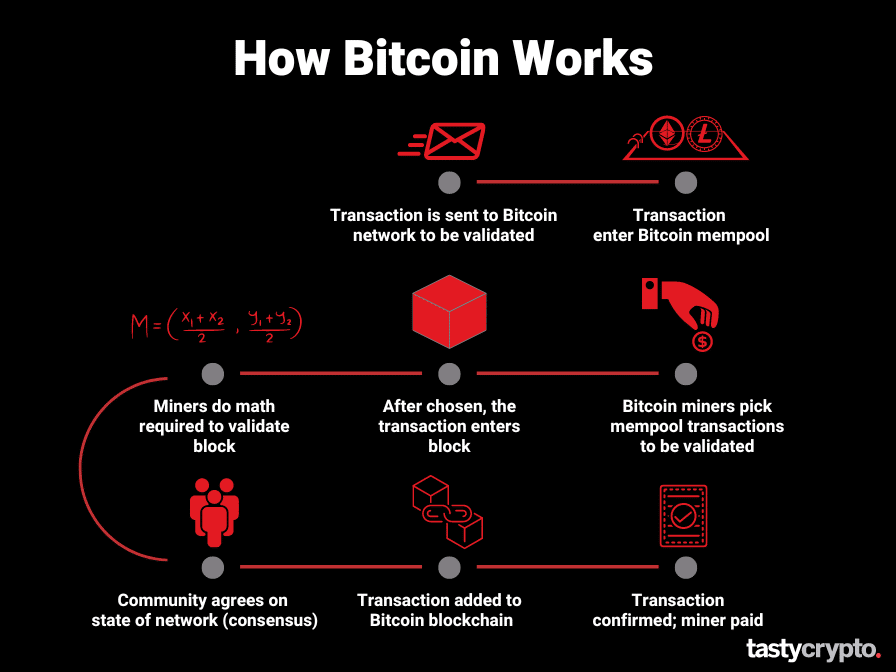
When you send bitcoins, your wallet creates a transaction request containing the recipient’s address, the amount, and your digital signature. This request is then broadcast to the Bitcoin network.
- Propagation: The transaction propagates across the peer-to-peer network, reaching various nodes and miners.
- Validation: Nodes independently verify the transaction against Bitcoin’s rules (e.g., does the sender have enough funds? Is the signature valid?).
- Inclusion in a Block: Miners collect valid, unconfirmed transactions and include them in a new block they are trying to mine.
- Confirmation: Once a miner successfully solves the Proof-of-Work puzzle and their block is added to the blockchain, the transaction is considered “confirmed.” Each subsequent block added on top of it further increases the transaction’s confirmation count, making it exponentially more secure against reversal. Typically, 6 confirmations are considered highly secure.
The Role of Miners: Securing and Extending the Blockchain
Miners play a dual role in the Bitcoin ecosystem:
- Security: By expending computational effort to solve the Proof-of-Work puzzle, they secure the network against fraudulent transactions and ensure the integrity of the blockchain.
- Block Creation and Rewards: For successfully mining a block, miners are rewarded with newly minted bitcoins (the “block reward,” which halves approximately every four years) and the transaction fees from all transactions included in that block. This incentive mechanism ensures that there is always a strong economic motivation for miners to maintain and secure the network.
Wallets and Nodes: Interacting with the Bitcoin Network
While the underlying blockchain and cryptography do the heavy lifting, users interact with the Bitcoin network through various software interfaces.
Bitcoin Wallets: Your Gateway to Digital Assets
A Bitcoin wallet is not a physical location where bitcoins are stored. Instead, it’s a software application or a hardware device that manages your public and private keys, allowing you to send, receive, and monitor your Bitcoin balance. Different types of wallets exist, each with varying levels of security and convenience:
- Software Wallets: These are applications installed on your computer or smartphone (e.g., desktop wallets, mobile wallets).
- Web Wallets: Accessed through a web browser, often provided by exchanges or online services. These generally offer less control as they typically manage your private keys for you.
- Hardware Wallets: Physical devices designed specifically to store private keys offline, offering the highest level of security against online threats.
- Paper Wallets: Private keys printed on paper, also an offline storage method.
Regardless of the type, the wallet’s primary function is to securely store your private keys and interface with the Bitcoin network to facilitate transactions.

Full Nodes: Guardians of the Network’s Integrity
A “full node” is a computer running the Bitcoin software that downloads and validates every single transaction and block on the blockchain. By doing so, a full node independently verifies the rules of the Bitcoin network.
- Validation: Full nodes verify that all transactions are valid, signatures are correct, and blocks follow the consensus rules.
- Broadcasting: They relay transactions and blocks to other nodes, helping to propagate information across the network.
- Security & Decentralization: By running a full node, users contribute directly to the network’s security and decentralization. They don’t have to trust anyone else’s version of the blockchain, maintaining a truly independent and verifiable record.
While not all users need to run a full node, the existence of many independently verifying nodes is crucial for Bitcoin’s robustness, censorship resistance, and the integrity of the entire system.
The intricate dance between cryptography, distributed consensus, and economic incentives is what allows Bitcoin to function as a self-sustaining, secure, and decentralized digital currency. It’s a testament to the power of open-source technology and cryptographic innovation, setting a precedent for a new era of digital finance and peer-to-peer value transfer. As the technology continues to evolve, understanding these foundational principles remains key to grasping its profound impact on our digital future.
aViewFromTheCave is a participant in the Amazon Services LLC Associates Program, an affiliate advertising program designed to provide a means for sites to earn advertising fees by advertising and linking to Amazon.com. Amazon, the Amazon logo, AmazonSupply, and the AmazonSupply logo are trademarks of Amazon.com, Inc. or its affiliates. As an Amazon Associate we earn affiliate commissions from qualifying purchases.